You walk into the room, and there it is. That sharp, unmistakable smell. Your cat peed on the carpet again. If you’ve ever scrubbed a spot, felt good about it, then caught the smell two days later, you’re not doing anything wrong. You’re just fighting the wrong way. Cat urine is built to stick around, and regular cleaners barely touch it. The good news is that with the right steps you really can clean cat pee from carpet for good, padding and all.
- Enzyme cleaners are the only products that fully break down the uric acid crystals in cat urine, which is what causes the lingering smell.
- Cat pee soaks through carpet into the padding and subfloor, so you must saturate those layers, not just the surface, to remove the odor.
- Never steam clean cat urine, because heat bonds the urine proteins to the fibers and locks the smell in for good.
- Vinegar and ammonia do not remove cat urine odor and can actually draw your cat back to the same spot.
- A UV black light shines on dried cat urine and makes old stains glow, so you can find and treat spots you missed.
How do you clean cat pee from carpet step by step?
To clean cat pee from carpet, blot up the urine, saturate the spot and the padding with an enzyme cleaner, let it air-dry fully, then deodorize with baking soda. Follow these seven steps in order, and don’t rush the drying. Here’s the full method.
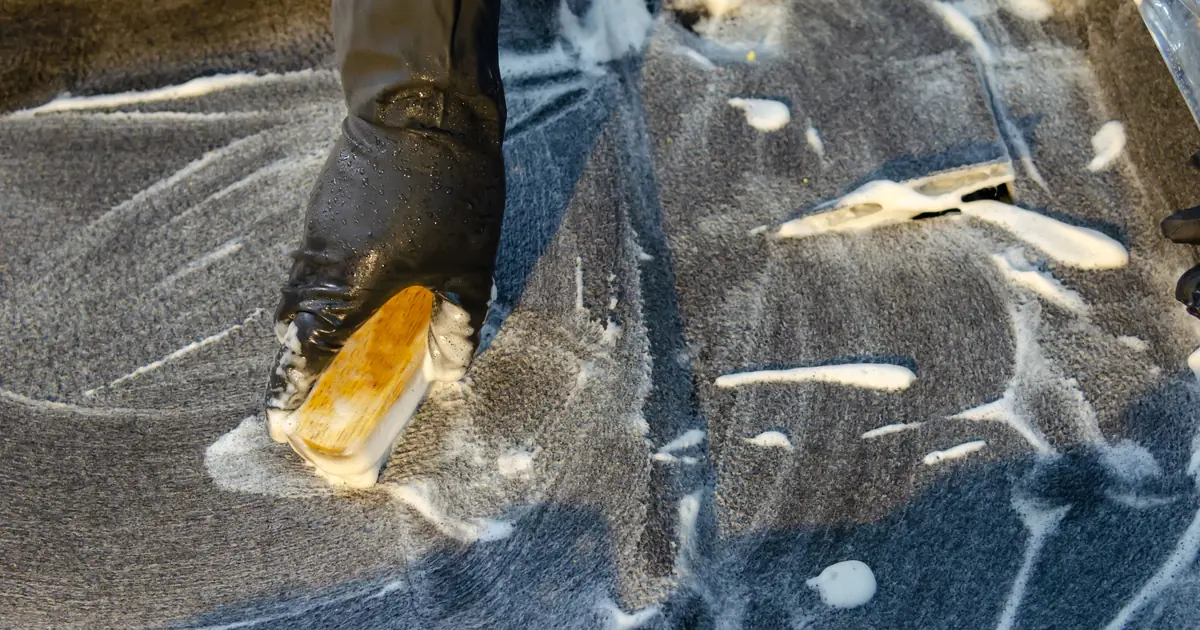
- Blot up every bit of urine you can. Press clean paper towels or an old towel straight down on the spot. Don’t scrub, since scrubbing pushes urine deeper and spreads it. Keep swapping in dry towels until they come up almost dry. For a fresh puddle, stand on the towels to pull moisture out of the padding.
- Rinse lightly with cool water and blot again. Pour a little cool water on the area, then blot it back up. Cool water dilutes the fresh urine and pulls more of it out. Never use hot water, since heat starts setting the odor right away.
- Saturate the spot with an enzyme cleaner, including the padding. An enzyme cleaner is a product that uses natural enzymes to digest the uric acid and proteins in cat urine. Spray or pour it on generously so it soaks past the carpet fibers and into the padding beneath, since that’s where the urine traveled. Treat an area a few inches wider than the visible stain.
- Let the enzyme cleaner dwell, then air-dry for 24 to 48 hours. Enzymes only work while the area stays wet, so resist the urge to blot it dry or blast it with a fan. Cover the wet spot with an upside-down laundry basket or some foil so your cat stays off it. Let it dry on its own, which usually takes a day or two.
- Sprinkle baking soda once the spot is dry. Baking soda is a gentle deodorizer that absorbs leftover odor molecules. Cover the dried area, let it sit for a few hours or overnight, then vacuum it up. This step polishes off any faint smell the enzymes left behind.
- Check your work with a UV black light. A UV black light makes dried cat urine glow yellow-green in a dark room. Turn off the lights, close the curtains, and scan the carpet. If the spot still glows, the urine isn’t fully gone, so repeat the enzyme treatment on that area.
- Repeat on any spot that still smells or glows. Deep or old stains often need a second round. Re-soak with enzyme cleaner, dry fully, and recheck. Patience here is what separates a spot that’s truly clean from one that smells again next week.
If you’ve found that the smell has spread well beyond one carpet, a whole-home approach helps too.
Why doesn’t regular cleaning get rid of the cat pee smell?
Regular cleaning fails on cat pee because cat urine contains uric acid, which forms crystals that ordinary soaps and water cannot dissolve. You can wash away the wet, smelly part of fresh urine, but the uric acid crystals stay bonded to the carpet, padding, and subfloor. Then humidity reactivates them, and the smell comes right back.
Cat urine is a mix of water, urea, uric acid, urochrome (the yellow pigment), creatinine, and salts. According to the McGill University Office for Science and Society, the urea gets broken down by bacteria into ammonia, and later into foul sulfur compounds called mercaptans, the same family of chemicals that gives skunk spray its punch. That two-stage breakdown is why an old cat pee spot smells worse over time, not better. The bacteria keep feeding and keep producing odor until something actually destroys the uric acid. That something is enzymes.
What’s the best cleaner for cat urine on carpet?
The best cleaner for cat urine on carpet is an enzyme-based (enzymatic) cleaner, because enzymes break uric acid crystals down into carbon dioxide and water that simply evaporate. Other cleaners only mask the smell or remove the surface stain, leaving the odor source behind. For a soaked-in cat pee stain, enzymes are the one product category that gets to the root.
Here’s how the common options stack up, and why most of the home remedies you’ve heard about fall short on cat urine.
| Product | Does it remove cat urine odor? |
|---|---|
| Enzyme cleaner | Yes. Digests uric acid crystals, urea, and bacteria at the source. The right choice for carpet. |
| Vinegar | Partly and temporarily. It can cut fresh ammonia smell but does not break down uric acid crystals, so the odor returns. |
| Baking soda | Helpful as a finishing deodorizer only. It absorbs odor but cannot remove the urine itself. |
| Ammonia cleaners | No, and they backfire. Ammonia smells like urine to a cat and can lure your cat back to the spot. |
| Bleach | No. Bleach mixed with the ammonia in urine can create dangerous fumes, so avoid it entirely. |
| Dish soap and water | Removes some fresh urine but leaves uric acid crystals behind, so the smell comes back. |
When you shop for an enzyme cleaner, look for one labeled specifically for pet urine and safe for carpet. One that works well on carpet is also exactly what you’d reach for on a soaked mattress.
Rocco & Roxie Professional Strength Stain & Odor Eliminator
This is a popular enzyme-based cleaner made for tough pet urine, and it’s a solid pick for carpet because you can soak it deep into the fibers and padding. It’s a good fit for cat parents dealing with a stubborn spot that keeps smelling after regular cleaning. Saturate generously and let it air-dry for the enzymes to finish the job.
Why shouldn’t you steam clean cat pee from carpet?
You should never steam clean cat pee from carpet because the heat sets the stain and bonds the urine proteins permanently into the fibers. Once heat locks the odor in, even professional enzyme treatments struggle to remove it. A steam cleaner can turn a fixable spot into a permanent one.
The same rule applies to hot water, hair dryers, and drying the area with heat. Cat urine and heat are a bad combination at every step. Stick with cool or room-temperature water, treat with enzymes, and let the spot dry on its own time. If you’ve already steam cleaned a cat pee spot, don’t panic. Soak it heavily with an enzyme cleaner and give it repeated treatments. It may take a few rounds, but you can often still pull the odor out.
How do you get cat pee out of the carpet padding underneath?
To get cat pee out of carpet padding, you have to saturate the padding with enough enzyme cleaner that it reaches the same depth the urine did, not just the carpet surface. Cat urine soaks straight through carpet into the padding and often the subfloor, so surface cleaning leaves most of the odor untouched. The padding is where the smell hides.
Pour the enzyme cleaner on slowly and generously so gravity carries it down through the carpet into the pad. Use roughly the same volume of cleaner as the amount of urine you think soaked in, then a little more. For a small fresh spot, a thorough spray may be enough. For a large or repeated spot, you may need to pour.
If the smell still won’t budge after two or three full enzyme treatments, the padding may be too saturated to save. In that case, the lasting fix is to pull back that section of carpet, replace the foam padding underneath, seal the subfloor with a stain-blocking primer, and treat the back of the carpet with enzyme cleaner before laying it back down. The Ohio State University Indoor Pet Initiative notes that replacing the padding and cleaning under the carpet is the go-to step when odor or repeat accidents persist.
How do you find old, dried cat pee stains in carpet?
To find old cat pee stains in carpet, scan the floor with a UV black light in a fully dark room, and dried urine will glow a dull yellow-green or cloudy color. A UV black light is a flashlight that emits ultraviolet light, which makes the phosphorus and proteins in dried urine fluoresce. Old spots you can smell but can’t see often light up clearly under UV.
Here’s how to do a proper sweep:
- Wait until the spot is dry. Wet urine will not glow, so let any fresh or just-cleaned areas dry first.
- Make the room as dark as possible. Turn off lights, close curtains, and work at night for the clearest glow.
- Hold the light close and low. Keep the UV black light a few inches above the carpet and move slowly across the floor.
- Mark every spot that glows. Use painter’s tape or sticky notes so you can find each spot again with the lights on.
- Treat each marked spot with enzyme cleaner. Then dry it fully and rescan to confirm the glow is gone.
One heads-up: a faint glow can remain after a spot is genuinely clean, because some residue can still fluoresce even with no odor left. Trust your nose alongside the light. If a treated spot has no smell, you’re in good shape.
How do you stop your cat from peeing on the carpet again?
To stop your cat from peeing on the carpet again, you need to fully remove the old odor with enzymes and figure out why your cat is avoiding the litter box in the first place. Cats return to spots that still smell like urine, so any leftover odor is an open invitation. Cleaning is only half the fix. The other half is the cause.
Common reasons a cat pees outside the box include a dirty or covered litter box, too few boxes, a box in a high-traffic spot, a sudden change at home, or a medical issue like a urinary tract infection or bladder inflammation. The vet-backed rule of thumb is one litter box per cat plus one extra, scooped daily. If your cat suddenly starts peeing on carpet, beds, or laundry, that change is worth a closer look.
A quick health note: This article is educational and isn’t a substitute for veterinary advice. Sudden or repeated peeing outside the litter box can signal a medical problem, and straining to urinate, blood in the urine, crying in the box, or producing little to no urine is a veterinary emergency, especially in male cats. See a vet right away if you notice any of those signs.
Frequently Asked Questions
Q: Does vinegar get cat pee smell out of carpet?
Vinegar does not fully remove cat pee smell from carpet. Vinegar is an acid that can briefly cut the ammonia odor in fresh urine, but it cannot break down the uric acid crystals that cause the lasting smell. Only an enzyme cleaner removes cat urine odor at the source.
Q: Will baking soda alone remove cat urine from carpet?
Baking soda alone will not remove cat urine from carpet. Baking soda is a deodorizer that absorbs some odor, but it cannot break down the uric acid crystals or reach the urine soaked into the padding. Use baking soda only as a finishing step after an enzyme cleaner has done the real work.
Q: How long do you leave enzyme cleaner on carpet?
Leave enzyme cleaner on carpet until it air-dries on its own, which usually takes 24 to 48 hours. Enzymes only break down cat urine while the area stays wet, so do not blot it dry, rinse it early, or speed it up with a fan or heat. Slow, full drying is what kills the odor.
Q: Can old, dried cat pee be removed from carpet?
Yes, old dried cat pee can usually be removed from carpet, though it often takes more than one enzyme treatment. Find the dried spots with a UV black light, soak each one thoroughly with enzyme cleaner, let it air-dry fully, and repeat as needed. Deep or repeated stains may also require replacing the padding underneath.
Q: Why does my carpet still smell like cat pee after cleaning?
Your carpet still smells like cat pee after cleaning because the urine soaked into the padding and the uric acid crystals were never broken down. Surface cleaning, vinegar, and steam cleaning leave those crystals behind, and humidity reactivates the smell. Re-treat the spot and the padding with an enzyme cleaner and let it dry completely.
Q: Is dried cat urine harmful to humans?
Dried cat urine is generally not dangerous to healthy adults in small amounts, but the ammonia it releases can irritate the eyes, nose, and lungs, especially in poorly ventilated rooms or for people with asthma. Clean it promptly with an enzyme cleaner and keep the area ventilated. Never mix urine cleanup with bleach, since that can create harmful fumes.
Q: Can a professional carpet cleaner get cat pee out?
A professional carpet cleaner can often get cat pee out, but only if they use an enzyme treatment and reach the padding, not just a hot-water surface clean. Ask whether they treat the padding and subfloor and whether they avoid heat, since heat sets the odor. For severe or repeat stains, replacing the padding may still be the most reliable fix.
Q: Why is ammonia-based cleaner bad for cat pee spots?
Ammonia-based cleaner is bad for cat pee spots because cat urine itself gives off ammonia as it breaks down, so the cleaner smells like urine to your cat. That scent can draw your cat back to the same spot to pee again. Use an enzyme cleaner instead, which removes the odor rather than mimicking it.
Cleaning cat pee from carpet comes down to three things: act fast, go deep into the padding, and use enzymes instead of the old vinegar-and-scrub routine. Skip the steam cleaner, give the spot time to air-dry, and double-check your work with a UV light. Do that, and you’ll clear the smell for good while keeping your cat happy and your home fresh.

Hello and welcome to The Ideal Cat!
We are some passionate cat owners from different professions. We love our cats and have a lot of experience in how to care for our pets. We are incredibly excited to share our knowledge, experience, and research with you. So you can take good care of your loving cat. We will answer most of the common questions about owning cats, taking care of them, etc. If you have any question contact with us. Thanks for visiting! Enjoy the content.
