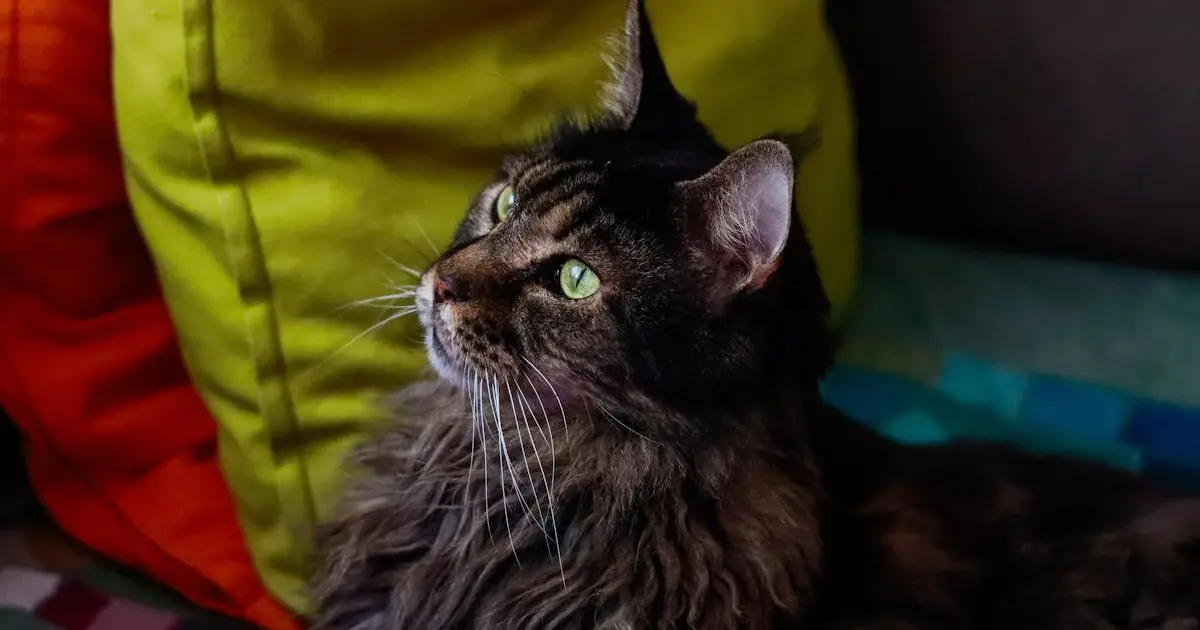
The first thing nobody warns you about is the thud. You’re working at your desk, your big fluffy roommate launches himself off the bookshelf, misjudges the landing by about four inches, and the entire apartment shakes. Then he stands up, blinks once, and walks away like nothing happened.
Welcome to life with a Maine Coon.
These cats are the closest thing the feline world has to a golden retriever in a fur coat. They’re enormous, they’re loud (in a chatty way, not an annoying way), and they have absolutely no idea how big they are. If you’re thinking about bringing one home, this guide will tell you what every other breed post leaves out: what it’s actually like, what it’ll really cost you, and how to make sure you’re getting the real thing.
| Origin | United States (Maine), 1850s |
| Weight (Male) | 13 to 18 lbs (some reach 20+) |
| Weight (Female) | 9 to 13 lbs |
| Lifespan | 10 to 15 years |
| Coat | Long, shaggy, water-resistant double coat |
| Colors | About 75 colors and patterns (no pointed) |
| Energy Level | Moderate to High |
| Grooming Needs | Moderate (2 to 3 brushings a week) |
| Good With Kids | Yes, one of the best breeds for families |
| Good With Other Pets | Yes, with calm introductions |
| Average Price | $1,500 to $4,000 (pet-quality from ethical breeders) |
Where the Maine Coon Came From
The truth is, nobody knows for sure. The romantic story says Viking sailors dropped longhaired ship cats on the New England coast, where they bred with the local farm cats and produced a hardy, mountain-of-a-cat that could survive Maine winters. There’s actually a small kernel of genetic truth there, since Maine Coons share DNA with Norwegian Forest Cats.
The wilder story says they descend from raccoons. They don’t. That’s genetically impossible. But you can see why people invented the tale, because the bushy ringed tail does look suspiciously raccoon-adjacent.
What we actually know: by the 1850s, large longhaired cats were a fixture on Maine farms, prized as world-class mousers. In 1895, a female Maine Coon named Cosey won Best in Show at America’s very first national cat show in Madison Square Garden. The breed almost vanished in the early 1900s when Persians stole the spotlight, then quietly clawed its way back during the 1950s and 60s. Maine made it the official state cat in 1985, which feels like the right move.
What a Maine Coon Actually Looks Like
Photos lie. Maine Coons look big on Instagram, but seeing one in person is a different experience entirely. Picture a small bobcat that decided to move indoors and learn how to use a litter box.
Adult males commonly hit 13 to 18 pounds, with some pushing past 20. Females stay daintier at 9 to 13 pounds, though “dainty” is relative when we’re still talking about a cat the size of a small dog. The world record holder, a Maine Coon named Stewie, measured 48.5 inches nose to tail. That’s longer than most coffee tables.
The Coat
A Maine Coon’s fur is a piece of engineering. It’s long and shaggy on the belly, ruff, and “britches” (the longer fur on the back legs), but shorter and smoother on the back and shoulders. The outer coat sheds water, the undercoat traps heat, and the whole system was built for sub-zero New England winters. You’re getting a cat with its own built-in parka.
Colors? Pretty much anything goes. The breed comes in around 75 different colors and patterns, from solid black to red tabby to silver to tortoiseshell. The only thing you won’t see is pointed coloring (the dark face, ears, and paws look found in Siamese cats), because that pattern isn’t recognized in the breed standard.
The Famous Features
Three things make a Maine Coon look like a Maine Coon at first glance:
- Lynx tips: The little tufts of fur that stick up from the ear tips. Some breeders call them “ear furnishings.” They’re impossibly cute.
- The mane: A thick ruff of fur around the neck, more pronounced in winter. Lion energy, fully intentional.
- The tail: Long, bushy, and constantly in motion. It’s not unusual for the tail alone to be 14 inches.
The Kitten-to-Adult Timeline
Here’s something most breed sites bury: Maine Coons mature slowly. Like, really slowly. While your friend’s tabby will be a full-grown adult by 12 months, your Maine Coon will keep growing, stretching, and filling out until they’re 3 to 5 years old.
This matters more than it sounds. It means you’re feeding a “growing kitten” for several years. It means their behavior stays kitten-like (read: chaotic) for longer. And it means the cat you bring home at 12 weeks will look like a completely different animal at age four.
The Maine Coon Personality, Without the Hype
Every breed site calls Maine Coons “dog-like.” It’s true, but it’s also lazy. Here’s what that actually means in your living room.
A Maine Coon will follow you from room to room. Not in a needy, in-your-face way, but in a “I just want to know what you’re doing” way. You’ll go to the kitchen, they’ll show up. You’ll go to the bathroom, they’ll show up (sorry, no privacy here). You’ll work from home, and they’ll claim the chair next to you.
They’re chatty, but not in the loud demanding way some breeds are. The Maine Coon vocabulary is mostly chirps, trills, and conversational little “brrt?” sounds. You’ll find yourself answering them. It’s weirdly charming.
Most of them love water. Yours might splash in their bowl, sit in the shower after you, or try to climb into the bathtub. This is genetic, not weird. Their water-resistant coat means they don’t mind getting wet, and their high intelligence means they get curious about anything that moves.
And the dog-like stuff? Real. Many Maine Coons play fetch. They learn their names quickly. Some learn to come when called, sit on cue, and even walk on a harness. They’re smart enough to figure out doorknobs (a warning, not a brag).
The “Gentle” Part Is Real
For all their size, Maine Coons are remarkably soft. They almost never go from zero to scratch. Most of them give a slow blink, a warning chirp, or a paw-tap before they ever consider biting. This is why they’re so good with kids who haven’t quite learned cat etiquette yet.
That said, they’re not pushover lap cats. They like being near you more than on you. If you want a cat that drapes itself across your chest for hours, you might be happier with a Ragdoll.
Is a Maine Coon Right for You? A 6-Point Reality Check
Honest answer: not everyone should get a Maine Coon. Here’s the framework most breed sites won’t give you.
- Space. They don’t need a mansion, but they need vertical space and a clear path to run. A cat tree built for large breeds is worth the money here, since standard towers wobble under a 20-pound cat. If your studio is already cramped, this isn’t your breed.
- Budget. Bigger cat, bigger food bill, bigger vet bills, bigger everything. Plan on $1,500 to $2,500 per year in basic costs after the initial purchase.
- Time. Maine Coons need real interaction. Not constant attention, but at least 30 to 45 minutes of engaged play and contact per day. Two hours alone? Fine. Twelve hours alone five days a week? Cruel.
- Tolerance for fur. Black pants, black couch, black anything, get ready. You will eat their fur. You will breathe it. You will find it in your coffee. This is non-negotiable.
- Patience for slow maturity. You’re signing up for a 3-to-5-year “kitten” who can knock things off the highest shelf in the house.
- Commitment to vet care. The two big inherited conditions (HCM and hip dysplasia) need yearly screening. If you skip vet visits, this is the wrong breed.
Honestly? If you’re a busy single professional who travels constantly, look at a different breed. If you’re a family, a remote worker, or someone with another social pet at home, you’re in the right place.
Maine Coon Health Issues to Know About
Here’s the part where most guides go vague. They list scary acronyms (HCM, SMA, PKD) and tell you to “ask a reputable breeder.” Helpful, right? Let’s go deeper.
Hypertrophic Cardiomyopathy (HCM)
This is the big one. HCM is a heart condition where the walls of the heart muscle thicken, making it harder for blood to pump properly. Maine Coons carry a specific mutation (MYBPC3) that raises their risk. Some cats live their whole lives without symptoms. Others develop heart failure or sudden blood clots.
What to ask the breeder: “Have both parents been DNA tested for the MYBPC3 mutation, and when was each parent’s last cardiac ultrasound?” An ethical breeder will pull up the test results without flinching. If they get defensive or vague, walk away.
Spinal Muscular Atrophy (SMA)
SMA is a recessive genetic condition that causes muscle wasting in the hind legs. Kittens with two copies of the gene start showing symptoms around 3 to 4 months: a swaying walk, weak hindquarters, an awkward landing when they jump. SMA isn’t painful or fatal, and cats with it can live full, happy lives indoors. But it’s preventable through DNA testing of breeding parents, so any responsible breeder should screen for it.
Hip Dysplasia
About 1 in 5 Maine Coons develops some degree of hip dysplasia, where the hip joint doesn’t sit properly in its socket. Big males are most at risk. There’s no DNA test for it (yet), so screening relies on X-ray evaluations of breeding cats through programs like PawPeds. Signs to watch for in your own cat: stiffness after sleeping, reluctance to jump, a bunny-hop gait when running.
Polycystic Kidney Disease (PKD)
Less common in Maine Coons than in Persians, but it does show up. Cysts form on the kidneys and eventually impair function. Ultrasound screening as early as 10 months can catch it.
Obesity
This isn’t genetic, it’s lifestyle. Maine Coons are big eaters who can balloon if you free-feed them. Extra weight makes every other health issue worse, especially hip dysplasia and heart disease. Measure their food.
Grooming a Coat That Drops Like Tumbleweeds
Good news first: a Maine Coon coat is easier to maintain than it looks. The fur is silky rather than woolly, which means it doesn’t mat as easily as a Persian‘s. Two or three brushings a week with a steel comb will keep things under control.
Bad news: there will be fur. Everywhere. Maine Coons shed year-round with two heavier “blows” in spring and fall when they swap out their seasonal coat. During those weeks, you may need to brush daily and accept that your roomba is now a part-time employee.
Tools that actually help:
- A wide-tooth steel comb for the body
- A slicker brush for the belly and “pants”
- A pair of blunt-nose scissors to clip mats behind the ears if they form
- Nail clippers (their nails grow fast, plan on a trim every 3 weeks)
Bathing? Optional. Most Maine Coons keep themselves clean, and the water-resistant coat actually makes baths a hassle (water rolls right off, so they take forever to fully soak). One or two baths a year is plenty for most cats.
Feeding a 20-Pound Cat
Maine Coons eat more than the average cat. Shocking, I know. A 16-pound adult typically needs around 300 to 350 calories a day, depending on activity level. Compare that to a 9-pound housecat at around 200 calories.
What matters most:
- High animal protein. Look for foods where the first ingredient is a named meat (chicken, turkey, salmon), not “meat by-products” or grains.
- Moderate fat. They need fuel, but free-fed high-fat food becomes obesity fast.
- Joint support. Foods with added glucosamine and omega-3s are a good idea for any large cat breed.
- Plenty of water. Many Maine Coons love a fountain. Use that to your advantage and get one.
Wet food, dry food, or both? Honestly, both is ideal. Wet food keeps them hydrated and supports kidney health. Dry food helps with dental cleaning (a little) and is easier to portion. A mix of the two through the day is what most vets recommend.
One thing to watch: Maine Coons can be slow eaters. Their big paws and broad face mean they sometimes scoop food with their paws rather than eat from a bowl. A wide, shallow dish works better than a deep narrow one.
Exercise, Enrichment, and Why Bigger Furniture Matters
A bored Maine Coon is a destructive Maine Coon. Their brains need work as much as their bodies do.
What works:
- Daily play sessions. Two 15-minute sessions with a wand toy will tire most of them out beautifully.
- Tall cat trees. Standard cat trees are sized for 8-pound cats. You need one rated for at least 20 pounds with platforms big enough for a Maine Coon to actually sit on. The 36-inch tower from the pet store? Useless. Look for 60 inches or taller, with extra-wide perches.
- Puzzle feeders. Their intelligence is wasted on a flat bowl. Slow feeders, snuffle mats, and food puzzles all earn their keep.
- Fetch toys. Try crinkle balls or small soft toys. Many Maine Coons will retrieve them like a Labrador.
- Harness walks. Yes, really. Plenty of Maine Coons love going outside on a harness, especially if you start training as a kitten.
A practical heads-up: the standard litter box at the pet store is too small for a full-grown Maine Coon. They need a box at least 24 inches long, ideally bigger. Many owners end up using under-bed storage boxes as litter boxes because nothing else fits.
Living With Kids, Dogs, and Other Cats
This is where Maine Coons shine. Most other “good family” cat breeds are tolerant. Maine Coons are actively engaged.
With kids: They’re patient with handling, sturdy enough that small hands won’t hurt them, and gentle enough that they almost never lash out. They often pick a child in the family as a favorite play partner. Teach the kids basic cat manners (no tail-pulling, respect the warning chirp) and you’ve got a magical combo.
With dogs: Maine Coons usually do great with calm, cat-friendly dogs. They’ll often play with the dog, share napping spots, and treat the dog like another oversized cat. The catch: introduce them slowly, supervise early interactions, and never assume a high-prey-drive dog will see them as anything other than prey.
With other cats: They get along with most cats once introductions are done properly. Two Maine Coons together can be magic, since they match each other’s energy and size. Pairing them with a more delicate breed needs some thought, since a friendly Maine Coon “boop” can knock a 6-pound cat off the couch.
Maine Coon Lifespan and Aging
The average Maine Coon lives 10 to 15 years, with 12.5 being a typical figure. Some live longer with good care, particularly if their breeder did proper health screening on the parents.
What helps them live their longest:
- Annual cardiac ultrasounds starting at age 3 (twice as often if there’s any family history of HCM)
- Weight management throughout life
- Dental care, including yearly cleanings (gum disease is common in the breed)
- Indoor living (an outdoor Maine Coon faces all the same threats as any cat, plus they’re highly recognizable to pet thieves)
- Senior food and joint supplements once they hit age 8 or 9
By the time a Maine Coon reaches 10, expect them to slow down a little. They’ll still want to play, but the sessions get shorter and the naps get longer. Watch for stiffness, changes in appetite, and any new behavior, since older cats hide pain expertly.
How Much Does a Maine Coon Really Cost?
Get ready, because this is where most guides stop short.
The Kitten Price
From an ethical breeder in 2026, expect to pay between $1,500 and $4,000 for a pet-quality Maine Coon kitten. Show-quality or rare-color kittens (gold, shaded silver, shell) can run $5,000 to $8,500 or more. From a shelter or breed rescue, adoption fees usually fall between $125 and $550.
Yes, you can find “Maine Coons” on Craigslist for $400. They’re almost certainly either scams, kittens from unhealthy parents, or domestic longhairs being passed off as the breed. Save the heartbreak. The cheap option costs more in the end.
The First-Year Setup
Plan for around $800 to $1,500 in setup costs:
- Oversized cat tree: $150 to $300
- Large litter box (or two): $50 to $100
- Carrier rated for 25+ pounds: $60 to $120
- Water fountain: $40 to $80
- Initial vet visits, neuter/spay, vaccinations: $400 to $700
- Microchip and registration: $50
- Toys, brushes, bowls, scratching posts: $100 to $200
The Yearly Cost
After the first year, budget $1,500 to $2,500 annually:
- Premium food: $600 to $900
- Litter (and lots of it): $200 to $300
- Routine vet care: $300 to $500
- Cardiac ultrasound: $250 to $500 (every 1 to 2 years)
- Pet insurance: $300 to $600 (highly recommended for this breed)
- Grooming tools, dental treats, replacement toys: $150 to $300
Over a 12-year lifespan, you’re looking at roughly $20,000 to $35,000 in total cost. Not to scare you, but to be real with you. A Maine Coon is a long-term financial commitment, not just a one-time purchase.
Where to Find a Maine Coon Ethically
The Maine Coon market has a scam problem. A serious one. Demand has exploded, supply is limited, and bad actors fill the gap. Here’s how not to get burned.
Green Flags (Sign of a Good Breeder)
- Registered with TICA, CFA, or another recognized registry
- Won’t let kittens leave before 12 to 16 weeks (some hold them until 14 weeks minimum)
- Provides documentation of HCM, SMA, and PKD testing for both parents
- Wants to interview YOU as much as you interview them
- Has a waiting list (good breeders don’t have constant availability)
- Raises kittens in their home, not in cages or a barn
- Offers a written health guarantee, usually 1 to 7 years
- Will take the cat back at any age if you can’t keep them
Red Flags (Run)
- “Ready to ship” kittens at suspiciously low prices ($300 to $800)
- Refuses to do a video call or show you the parents
- No registration paperwork or vague claims of “purebred”
- Kittens “ready to go home” at 6 to 8 weeks
- Multiple breeds available from the same breeder
- Payment requested only by wire transfer, Zelle, or gift cards
- Generic stock-photo-looking kitten pictures on their website
- Vague answers about health testing or breeding history
And rescue is real. Sites like Petfinder, MCBFA (Maine Coon Breeders and Fanciers Association) rescue, and breed-specific Facebook groups occasionally have purebred or near-purebred Maine Coons available. Don’t dismiss the option just because rescue cats are less Instagram-perfect.
Similar Breeds to Consider
If you love what Maine Coons offer but want to compare options, here are five worth a look:
- Norwegian Forest Cat: Same Viking-cat vibe, similar size, equally water-tolerant coat. Slightly more reserved personality.
- Siberian: Big, fluffy, friendly, and often better tolerated by people with cat allergies (they produce less Fel d 1 protein).
- Ragdoll: Bigger lap-cat energy. Floppy, affectionate, less dog-like. Indoor-only by temperament.
- Ragamuffin: Cousin of the Ragdoll with similar size and personality, but available in more colors.
- Turkish Van: Half the size of a Maine Coon, but shares the water obsession and playful intelligence.
Maine Coon Myths That Need to Die
You’ll hear all of these. Don’t believe them.
Myth: They’re part raccoon. Impossible. Different species, can’t interbreed. The tail just happens to look similar.
Myth: They’re hypoallergenic. They aren’t. No cat is fully hypoallergenic. Maine Coons might bother allergic people slightly less than some breeds, but the fur and dander are still very much there.
Myth: Bigger is always better. Some breeders push for extreme size, which raises the risk of hip dysplasia and joint issues. A healthy 15-pound Maine Coon is better than an unhealthy 22-pound one.
Myth: They’re outdoor cats because they’re rugged. Their ancestors were. Yours shouldn’t be. Indoor Maine Coons live longer, healthier lives.
Myth: They don’t need much grooming because the coat is “easy.” Easier than a Persian, sure. Still long, still sheds, still mats if neglected.
Myth: Polydactyl (extra-toed) Maine Coons aren’t real Maine Coons. Actually, polydactyly was common in early Maine Coons. Many registries don’t recognize it anymore, but the trait is part of the breed’s history.
Maine Coon FAQ
Q: Are Maine Coons good for first-time cat owners?
Yes, with a caveat. Their easygoing personality makes them forgiving of new-owner mistakes. But the cost and health-screening responsibilities are higher than average. First-timers should be ready for the financial commitment.
Q: Do Maine Coons need a friend?
Not strictly, but they thrive with company. If you’re away from home more than 8 hours most days, a second cat (another Maine Coon or a friendly breed) makes a big difference.
Q: How big do Maine Coons actually get?
Most males reach 13 to 18 pounds and 30 to 40 inches in length nose to tail. Females hit 9 to 13 pounds. The record holder reached 48.5 inches, but that’s exceptional, not typical.
Q: Are Maine Coons good apartment cats?
They can be, as long as the space has vertical room (tall cat trees, shelves to climb) and you commit to daily play. A small studio is tight; a one-bedroom apartment works fine for most.
Q: Do Maine Coons get along with dogs?
Usually yes, especially calm dogs introduced slowly. Maine Coons often act more like dogs themselves, which makes the relationship work. Avoid pairing with high-prey-drive breeds.
Q: How much do Maine Coons shed?
A lot. Year-round shedding with heavier seasonal coat blows in spring and fall. Plan on regular brushing, a powerful vacuum, and lint rollers as part of your life.
Q: Why are Maine Coons so expensive?
Ethical breeding involves yearly health testing, smaller litter sizes, longer rearing time (kittens stay until 12 to 16 weeks), and DNA screening that can cost $300 to $500 per breeding cat per year. Cheap kittens skip all of this.
Q: Can Maine Coons live outside?
Technically yes (their coat handles cold well), but they shouldn’t. Outdoor cats face predators, cars, disease, and theft, and Maine Coons are recognizable enough to be targeted by thieves. Indoor with supervised outdoor time on a harness is ideal.
Final Verdict: Should You Get a Maine Coon?
If you’ve made it this far, you’re either seriously considering one or you’ve already named the cat you haven’t bought yet (be honest). Here’s the bottom line.
Maine Coons are one of the best companion cats out there. They’re gentle, social, playful, beautiful, and weirdly easy to live with for a cat their size. They suit families, couples, retirees, and remote workers. They suit homes with other pets. They suit people who want a cat that’s a real part of the household, not just a fluffy houseguest.
They don’t suit people on tight budgets, people who travel constantly, or people who can’t tolerate fur on every surface. They don’t suit anyone who’ll skip vet care to save money, because the breed’s health risks are real and screening is the only way to manage them.
If you can afford one, find an ethical breeder, and commit to the next 12-plus years, you’ll end up with one of the most rewarding cats you’ll ever share a couch with. They’ll greet you at the door, chirp at your video calls, and yes, occasionally fall off the bookshelf with great dignity.
That’s the deal. And honestly? It’s a pretty good one.

Hello and welcome to The Ideal Cat!
We are some passionate cat owners from different professions. We love our cats and have a lot of experience in how to care for our pets. We are incredibly excited to share our knowledge, experience, and research with you. So you can take good care of your loving cat. We will answer most of the common questions about owning cats, taking care of them, etc. If you have any question contact with us. Thanks for visiting! Enjoy the content.
