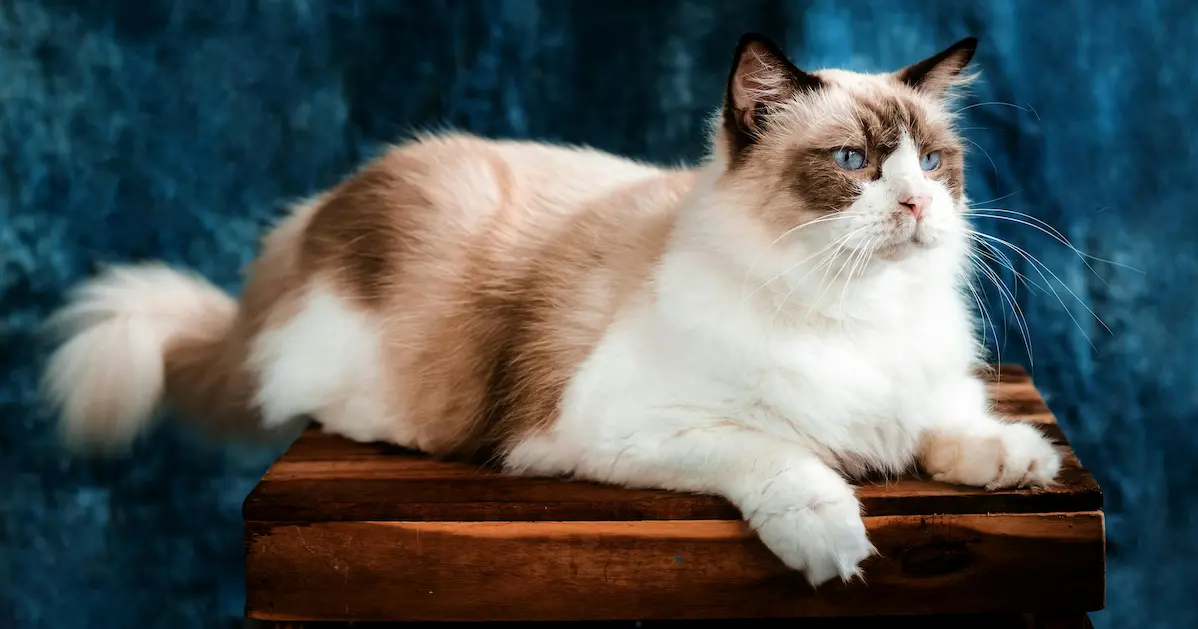
You walk in the door after a long day, and your cat is already at your feet. You bend down to scoop her up, and her whole body goes soft, like she just melted into your arms.
That’s a Ragdoll for you.
Of all the cat breeds out there, Ragdolls have a reputation that’s almost too good to be true: oversized, blue-eyed, dog-loyal, and so chill they earned their name from going limp like a child’s rag doll when picked up. The internet is full of swooning posts about them. What most of those posts won’t tell you is the other side of the story: the heart condition that runs in the breed, the four-year wait to see your kitten’s adult body, and the genuine ache they feel when you leave the house for too long.
This guide is going to give you both sides. The good news? If you’re the right home, a Ragdoll will be the easiest cat you’ve ever loved.
| Origin | United States (Riverside, California), 1960s |
| Weight (Male) | 15 to 20 lbs |
| Weight (Female) | 10 to 15 lbs |
| Lifespan | 12 to 17 years |
| Coat | Semi-long, silky, no thick undercoat |
| Colors | Seal, blue, chocolate, lilac, red (flame), cream |
| Energy Level | Low to Moderate |
| Grooming Needs | Moderate (twice-weekly brushing) |
| Good With Kids | Yes, with gentle handling |
| Good With Other Pets | Yes, with slow introductions |
| Average Price | $1,500 to $3,500 (pet quality, from ethical breeders) |
Where the Ragdoll Came From
The Ragdoll’s story starts in 1960s Riverside, California, with a woman named Ann Baker and a white longhaired stray cat called Josephine. Josephine lived next door, had a few litters that were unusually mellow, and somehow caught Ann’s eye as the foundation of a brand-new breed.
The accepted history goes like this: Ann bred Josephine to a couple of local toms, including a seal-pointed male called Daddy Warbucks, and ended up with kittens so calm and floppy that she named the breed for the way they’d go slack in your arms. By December 1966, four cats were officially registered as Ragdolls with the NCFA, making them the first of their kind.
Now, the messy part. Ann Baker was, by every account, a difficult person. She made claims about her cats being part alien, products of secret government experiments, and immune to pain. She tried to franchise the breed and demand royalties on every kitten sold, which sent breeders like Denny and Laura Dayton in the opposite direction. The Daytons quietly built their own line, called Blossom-Time, and worked with mainstream registries to get the Ragdoll recognized without Ann’s involvement.
The result? TICA accepted the Ragdoll for championship status in 1979, the CFA followed with full recognition in 2000, and the breed quietly grew into one of the most popular cats in the United States.
The wild origin stories make for great trivia. The cat in your lap, though, owes its calm temperament to decades of careful breeding by people who came after Ann.
What a Ragdoll Actually Looks Like
Ragdolls are big. Not Maine Coon big, but bigger than your average house cat by a clear margin. Males commonly hit 15 to 20 pounds, females settle around 10 to 15. From nose to tail tip, a fully grown adult can stretch close to three feet long.
Here’s the thing most guides skip: a Ragdoll kitten you bring home at twelve weeks is nowhere near done growing. The breed matures slowly, taking three to four years to reach full adult size and weight. Your nine-month-old “kitten” will still look slightly leggy and unfinished. That’s normal.
The coat is silky, semi-long, and (this part matters) lacks the dense undercoat you’d find in a Persian or Maine Coon. That’s why Ragdolls mat less, shed less in clumps, and feel more like rabbit fur than a fluffy comforter. They still shed, just more evenly throughout the year.
Their eyes are always blue. Always. The color comes from the same pointed gene found in Siamese cats, which also explains why Ragdoll kittens are born pure white. Their color and pattern only start showing after about a week, getting deeper and richer over the first three to four years.
Recognized Colors and Patterns
Ragdolls come in six point colors: seal (dark brown), blue (cool gray), chocolate (warm brown), lilac (pale silver-lavender), red (called flame), and cream. Each color can show up in three core patterns:
- Colorpoint: dark points on the face, ears, legs, and tail, with no white anywhere.
- Mitted: same as colorpoint, but with white “mittens” on the front paws, white “boots” on the back legs, and a white chin and belly stripe.
- Bicolor: an inverted white “V” across the face, white legs, and a white belly.
Then there are overlays. A lynx pattern adds tabby-style stripes. Tortie patterns appear in females and mix patches of red or cream into the points. Combine the two and you get a “torbie.” Mink and sepia Ragdolls (born with color instead of white) exist too, though some registries don’t accept them in the show ring.
If you ever hear a breeder say a Ragdoll has anything other than blue eyes, you’re not looking at a purebred.
Living With a Ragdoll: The Real Personality
Most breed guides will tell you Ragdolls are friendly. That’s like saying the ocean is wet. It undersells the whole point.
A Ragdoll wants to be wherever you are. Cooking dinner? She’s threading through your ankles. Working from home? He’s parked on your keyboard. Going to the bathroom? Yep, that door’s getting nudged open. The breed picked up the nickname “puppy cat” for good reason, and you’ll see it within days of bringing one home.
The signature trait, going boneless when picked up, is real but not universal. Some Ragdolls truly do flop like a beanbag, surrendering completely. Others stay relaxed but don’t fully limp. Personality varies cat to cat, and the floppiness tends to soften as they mature out of kittenhood.
They’re chatty too, but not in the way a Siamese is chatty. A Ragdoll’s voice is soft, almost questioning, more “hm?” than “MEOW.” You’ll have actual back-and-forth conversations with one if you’re the type to talk to your cat (and let’s be honest, you are).
A few things that surprise new owners:
- They follow you everywhere. The Velcro tendency is real and pretty intense.
- They’re quiet players. No frantic 3 a.m. zoomies for most Ragdolls. Their play looks more like “lazy bat at a feather” than parkour.
- They get genuinely sad when left alone. More on this in a minute.
- Many like water. Not all, but enough that “Ragdoll in the bathtub” is a common video genre.
Here’s the downside nobody talks about enough: Ragdolls can develop real separation anxiety. If you work twelve-hour shifts and live alone, this breed will struggle. They thrive in homes where someone’s around most of the day, or where they have another pet for company.
Is a Ragdoll Right for You?
Let’s get honest. Not every cat lover should get a Ragdoll. Here’s a quick way to figure out if you’re a good match.
A Ragdoll is probably right for you if:
- You’re home most days, or you work from home
- You want a cat that acts a bit like a dog
- You have time for two short brushing sessions a week
- You can budget $1,500 to $3,500+ for the kitten alone
- You’re committed to keeping the cat indoors
- You’re okay with a “Velcro cat” who follows you into the shower
A Ragdoll is probably wrong for you if:
- You travel often or work very long days
- You want an aloof, independent cat
- Your home is loud, chaotic, or constantly changing
- You hate grooming, even a little
- You want an outdoor cat (please, just don’t)
- You’re allergic to cats (Ragdolls are not hypoallergenic, despite what you’ll read elsewhere)
If you fall in the middle, consider getting two Ragdolls together, or pairing one with another cat or a calm dog. They genuinely do better with a buddy.
The HCM Conversation Every Buyer Needs to Have
If you read nothing else in this guide, read this section.
Hypertrophic cardiomyopathy, called HCM for short, is the most common heart disease in cats. In Ragdolls, it’s tied to a specific genetic mutation called R820W in the MYBPC3 gene. Cats with two copies of this mutation often develop serious heart disease as early as twelve to twenty-four months of age. Cats with one copy can live normal lives, though they pass the gene to their kittens.
Here’s the part that should worry you: studies from Langford Vets and UC Davis suggest around 13% of the Ragdoll population carries the mutation. A DNA test costs a breeder roughly $40 to $60 per cat. Every ethical Ragdoll breeder in the world tests their breeding stock for this mutation. Period.
If a breeder can’t show you HCM test results for both parents of your kitten, walk away. Doesn’t matter how cute the photos are. Doesn’t matter how “rare” they say the litter is. Walk away.
What to ask a breeder, in plain English:
- “Can I see HCM (MYBPC3) DNA test results for both parents?”
- “Do you have echocardiogram results from a veterinary cardiologist?”
- “Are the parents also tested for PKD?”
- “Will you replace or refund if my kitten develops HCM in the first two years?”
A real breeder will answer these without hesitation and produce documentation. A backyard breeder will get defensive, change the subject, or quote a “great deal” that suddenly sounds urgent. That’s your cue to leave.
Other Health Issues Ragdoll Owners Should Watch For
HCM is the headliner, but a few other conditions show up in the breed often enough to deserve a heads-up:
Polycystic Kidney Disease (PKD): Cysts form in the kidneys and slowly impair function. Less common in Ragdolls than in Persians, but it does appear. A DNA test is available and good breeders run it.
Bladder Stones and FLUTD: Ragdolls are prone to urinary tract issues, partly because they’re indoor cats who don’t always drink enough. Watch for litter box straining, blood in urine, or peeing outside the box. Wet food and a pet fountain help a lot here.
Obesity: A laid-back cat who’d rather nap than chase a toy can pack on weight fast. Ragdolls are heavy-boned to start with, so excess weight strains their joints. Stick to measured meals, not free-feeding.
Joint and bone issues: Because they grow so large so slowly, Ragdolls can have soft developing skeletons. Don’t let kittens jump from very high places, and feed a quality kitten food for the full first year (some breeders say up to eighteen months) to support growth.
Hairballs: Their long coat means they swallow loose hair when grooming themselves. Regular brushing cuts this down a lot. If you see them coughing up hairballs more than once a month, brush more often.
The good news is that with regular vet checkups and the right diet, most Ragdolls stay healthy well into their teens.
Grooming Your Ragdoll Without Losing Your Mind
Here’s a happy surprise: Ragdolls are easier to groom than they look. The lack of a thick undercoat means less matting, less hair tumbleweed, and less hair-on-your-black-pants drama than you’d get with a Persian or Maine Coon.
Your basic grooming routine:
- Brush twice a week with a stainless steel comb or a quality slicker brush
- Daily brushing during heavy shed seasons (usually spring and fall)
- Bath every four to six months, or only when actually dirty
- Trim claws every two to three weeks
- Brush teeth two or three times a week if your cat tolerates it
Ragdolls who start grooming as kittens usually love it as adults. Start early, keep sessions short and rewarding, and you’ll have a cat who flops on his back for belly brushing.
A small warning: senior Ragdolls (10+) often slow down on self-grooming because of arthritis or just plain laziness. You may need to step up the brushing frequency in their golden years to keep mats from forming around the armpits and tail base.
Feeding a Slow-Growing Giant
Because Ragdolls take three to four years to fully mature, their feeding needs are a little different from a typical cat’s.
Kitten stage (under 12 months)
- High-protein, high-fat kitten food
- Free-feed or three to four small meals a day
- Plenty of water access (a pet fountain helps)
Young adult (1 to 4 years)
- Transition to a quality adult food rich in animal protein
- Watch the calories: they’re still growing but slowing down
- Two measured meals a day works well
Adulthood (4+ years)
- Maintain a healthy weight: you should be able to feel ribs easily
- Mix wet and dry food for hydration and dental health
- Avoid foods with cheap fillers like corn or wheat as top ingredients
Exercise, Play, and Why They Stay Indoors
Ragdolls aren’t athletes. They’re more like the friend who’ll happily go for a walk but won’t sign up for a marathon. You won’t see Maine Coon-level acrobatics or Bengal-level chaos. Most days, your Ragdoll will be content with two or three short play sessions, a high perch by the window, and a long nap in a sunbeam.
What they actually need:
- Interactive play time, 15 to 20 minutes twice a day
- Feather wands, kicker toys, and puzzle feeders
- A sturdy cat tree (they’re heavy, so don’t cheap out here)
- A scratching post tall enough for a full-body stretch
About the indoor thing: please keep your Ragdoll indoors. I know that’s a strong recommendation. Here’s why.
Ragdolls were selectively bred for docility, which is great in your living room and terrible in the wild. They don’t run away from threats. They walk up to strangers expecting friendliness. They don’t read territorial cues from other cats well. They’re also worth a lot of money to thieves.
In 2024 in the UK, a rescue center in Whitehaven found seven abandoned Ragdolls within a mile of each other, all in rough shape, all clearly bewildered by being outside. The rescue’s lead specifically warned that Ragdolls “are in real danger in the outside world” because they lack survival instincts.
If you want your Ragdoll to enjoy fresh air, build a catio or train them to walk on a harness. Both are reasonable. Letting them roam isn’t.
Ragdolls With Kids, Dogs, and Other Cats
This is where the breed really shines.
With kids: Ragdolls are famously tolerant. They put up with rough handling that would send most cats running. That said, they’re still cats, and very young children should always be supervised. Teach kids how to support the cat’s weight when picking him up (these guys are too big to dangle by the armpits).
With dogs: Excellent, especially when introductions happen slowly and the dog is calm. Many Ragdolls genuinely befriend dogs. Golden Retrievers, Labradors, and Cavalier King Charles Spaniels are common pairings.
With other cats: Generally great, especially if both cats are introduced young. Ragdolls do well with other Ragdolls, Birmans, British Shorthairs, or any cat with similar laid-back energy. They can be bullied by high-energy breeds like Bengals or Abyssinians, so think carefully before mixing.
With small pets (birds, hamsters, fish): Ragdolls have a lower prey drive than most cats, but low doesn’t mean zero. Keep cages secure and assume your cat will eventually try.
Lifespan and What Aging Looks Like
A well-cared-for Ragdoll typically lives 12 to 17 years, with many making it to their late teens. Most breed authorities cite an average lifespan around 14 to 15 years.
The Aging Timeline
Kitten stage (0 to 12 months): Rapid growth, full of energy, building social bonds.
Young adult (1 to 4 years): Still filling out. Most active years. Full color and personality emerge around the four-year mark.
Adult (4 to 10 years): Settled, predictable, prime cuddle years. Pay attention to dental health and weight.
Senior (10+ years): Slower, more nap-focused. Watch for arthritis, kidney changes, and dental disease. Vet visits should go from yearly to every six months.
A senior Ragdoll wellness checklist worth saving:
- Annual bloodwork starting at age 7
- Annual or twice-yearly dental cleanings as needed
- Heated cat beds for joint comfort
- Lower-sided litter boxes for easier access
- Ramps or steps to favorite perches
How Much a Ragdoll Really Costs (2026 Numbers)
Ragdoll prices have climbed steadily over the past five years. Part of that is breed popularity, part of it is rising health-testing costs, and part of it (no joke) is Taylor Swift. Her seal point Ragdoll, Olivia Benson, became one of the most photographed cats in the world, and breeder waitlists across the US grew measurably longer after she went viral. Industry watchers estimate Ragdoll prices rose 15 to 20% between 2020 and 2026, partly because of the celebrity halo effect.
Here’s the realistic 2026 breakdown from reputable breeders:
- Pet quality Ragdoll kitten: $1,500 to $3,500
- Show quality Ragdoll kitten: $3,500 to $7,500+
- Rare colors (chocolate, lilac, mink): often a $500 to $1,500 premium
- Adult Ragdoll from a retiring breeder: $400 to $1,200
- Shelter or rescue Ragdoll: $100 to $400
Ongoing monthly costs:
- Food: $40 to $80
- Litter: $20 to $40
- Pet insurance: $30 to $60
- Vet care (averaged): $40 to $80
- Toys, treats, surprises: $20 to $50
First-year setup (one-time): $400 to $800 for carrier, cat tree, litter box, fountain, brush, beds, and starter supplies.
The honest math: budget $2,500 to $4,500 for your first year of Ragdoll ownership, then $1,500 to $2,500 a year ongoing. A healthy Ragdoll who lives to 15 is roughly a $25,000+ commitment. Not to scare you off, just to be straight.
Red flag prices: If you see a “purebred Ragdoll kitten” listed for $400 to $800, something’s off. Either it’s not actually a Ragdoll, the breeder skipped health testing, or it’s a scam. Picture this: you buy a $490 “Ragdoll” off Facebook Marketplace, save thousands compared to a real breeder, and then eight months in your cat is diagnosed with HCM. Suddenly you’re paying $120 a month for cardiac medication for the next 10 years. That kind of story is depressingly common. A cheap kitten almost always costs more in the long run.
Finding a Ragdoll Ethically
Two main paths: breeder or rescue. Both are valid. Let’s break down each.
Going Through a Breeder
Green flags:
- TICA or CFA registered cattery
- HCM and PKD DNA testing on both parents (with paperwork)
- Echocardiograms from a veterinary cardiologist
- Kittens stay with mom until at least 12 weeks
- Health guarantee in writing
- Willing to do a video call or in-person visit
- Asks YOU questions about your home and lifestyle
- Limited litters per year (quality over volume)
Red flags:
- “We don’t need to test, our line is healthy”
- Multiple breeds offered at once (Ragdolls, Maine Coons, Persians, all from one place)
- Kittens ready at 6 to 8 weeks
- No paperwork
- Cash only, urgent sale pressure
- Too many cats, vague answers, dirty conditions
Going Through Rescue
Yes, purebred Ragdolls do end up in rescue. Try these starting points:
- Ragdoll Rescue USA
- Petfinder.com (search “Ragdoll” by zip code)
- Local breed-specific rescues
- Retiring breeders (many rehome adult breeding cats at low cost)
Rescue Ragdolls are usually adults, which has perks: their personality is already formed, they’re past the chaotic kitten stage, and you’ll know exactly what you’re getting. The trade-off is you may not get a full health history.
Similar Breeds Worth Considering
If you love what you’ve read about Ragdolls but want to explore your options, here are five close cousins to compare:
- Birman: Smaller (8 to 12 lbs), similar pointed coloring, white “gloves” on paws, equally docile. Often called the “Sacred Cat of Burma.”
- Ragamuffin: Descended from the same Ann Baker lineage as Ragdolls, but with more color and pattern variety and a slightly stockier build.
- Maine Coon: If you want bigger and goofier. More active, slightly more independent, similar size to Ragdolls but with a thicker double coat.
- Siberian: Easier on allergies (lower Fel d 1 protein), similar fluffy look, more athletic than a Ragdoll.
- British Shorthair: For when you want a chill teddy bear vibe without the long hair. Less needy than a Ragdoll, more independent.
Ragdoll Myths That Need to Die
Let’s clear up some persistent nonsense.
Myth: All Ragdolls go completely limp when picked up.
Reality: Many do, some don’t. It’s a temperament spectrum, not a defining feature of every individual cat.
Myth: Ragdolls don’t shed.
Reality: They shed less than Persians or Maine Coons because they lack an undercoat, but they absolutely shed. You’ll find hair on your couch.
Myth: Ragdolls are hypoallergenic.
Reality: No cat is truly hypoallergenic. Ragdolls produce the same Fel d 1 protein every cat does.
Myth: Ragdolls feel no pain.
Reality: This was an Ann Baker fairy tale. Ragdolls feel pain like every other cat. Watch them for signs of discomfort the same way you would any pet.
Myth: A Ragdoll under $1,000 is just a bargain.
Reality: Almost always means skipped health testing, no pedigree papers, or outright scam.
Myth: Ragdolls are okay being outdoor cats because they’re big.
Reality: Their docile temperament makes them especially vulnerable outdoors. Indoor only.
Myth: They’re all seal point.
Reality: Six colors, three main patterns, dozens of combinations. The internet just shows you seal points because they’re photogenic.
Frequently Asked Questions
Q: Do Ragdoll cats get along with dogs?
Yes, usually very well. Ragdolls have a low prey drive and a high tolerance for friendly chaos, so calm dog breeds like Golden Retrievers and Cavaliers tend to pair beautifully with them. Always introduce slowly.
Q: How long do Ragdoll cats live?
The average Ragdoll lives 12 to 17 years, with 14 to 15 years being typical. Indoor lifestyle, regular vet care, and HCM testing of the parents all stack the odds in your favor.
Q: Are Ragdolls good for first-time cat owners?
They’re one of the best breeds for first-time owners. They’re affectionate, easygoing, tolerant, and not particularly skittish. Just make sure you’ve budgeted for a healthy kitten and committed to indoor living.
Q: Do Ragdolls really go limp when held?
Many do, but not all. The trait is real and tied to their bred-in docility, though personality varies. Don’t be surprised if your specific Ragdoll stays relaxed without fully flopping.
Q: How much does a Ragdoll kitten cost in 2026?
Pet-quality kittens from ethical breeders run $1,500 to $3,500. Show-quality kittens with champion bloodlines can go $3,500 to $7,500 or more. Anything under $1,000 is a red flag.
Q: Can Ragdoll cats be left alone?
Not for long periods. They form strong bonds and can develop separation anxiety. If you work full days, get a second pet for company, or seriously consider whether this breed suits your lifestyle.
Q: What’s the difference between a Ragdoll and a Ragamuffin?
They share an ancestor (Ann Baker’s foundation cats), but Ragamuffins come in any color or pattern and tend to be stockier. Ragdolls are restricted to pointed colors and always have blue eyes.
Q: Are Ragdolls hypoallergenic?
No. Ragdolls produce Fel d 1, the allergen most cat-allergic people react to. If you have severe cat allergies, no breed is truly safe, though Siberians and Balinese have lower Fel d 1 levels.
Final Verdict: Should You Get a Ragdoll?
A Ragdoll is a cat for someone who wants a companion, not just a pet. They’ll follow you around, talk to you, sleep on your chest, and act genuinely thrilled when you walk in the door. If you’ve ever wished your cat acted more like a dog, this is the breed that delivers.
But they come with real costs: financial (you’re looking at $2,500+ to get one home ethically), emotional (separation anxiety is genuine), and medical (HCM is the boogeyman, and the only defense is testing). They need a home where someone’s around most days, a commitment to indoor living, and a buyer willing to slow down and find an ethical breeder.
If that sounds like you, you’re about to have one of the easiest, sweetest, most floppy-cuddly cats your friends have ever met. Take your time finding the right kitten. Ask the hard questions. Read the test results. The right Ragdoll cat is worth every penny and every month on the waitlist.
Go meet a few. Then you’ll understand the fuss.

Hello and welcome to The Ideal Cat!
We are some passionate cat owners from different professions. We love our cats and have a lot of experience in how to care for our pets. We are incredibly excited to share our knowledge, experience, and research with you. So you can take good care of your loving cat. We will answer most of the common questions about owning cats, taking care of them, etc. If you have any question contact with us. Thanks for visiting! Enjoy the content.
