Your cat won’t stop scratching. Maybe there are little scabs along the neck, a bald patch on the belly, or that constant grooming that sounds like a tiny sandpaper machine at 2am. Or maybe it’s the other end: soft stools, the occasional surprise on the rug, a tummy that never seems settled. You’ve cleaned everything, checked for fleas, and you’re starting to wonder if the food itself is the problem.
Sometimes it is. Food allergies are one reason cats itch, over-groom, and have chronic digestive trouble. The tricky part is that the fix isn’t a fancy label or a grain-free bag. It’s about simplifying what goes in the bowl down to ingredients your cat’s immune system won’t pick a fight with. Below we break down what actually causes food allergies, how to spot them, and the seven best over-the-counter foods worth trying, plus when it’s time to loop in your vet. If your cat’s trouble is more stomach than skin, our guide to the best grain-free cat food and best wet cat food pair well with this one.
- True food allergies in cats are almost always a reaction to an animal protein the cat has eaten before, most commonly beef, fish, chicken, dairy, and egg, not to grains.
- Grain-free is not the same as hypoallergenic, since most cat food allergies are triggered by the meat, not the grain.
- The two over-the-counter strategies that help are limited-ingredient diets (LID) and novel-protein diets built around a meat your cat has never eaten, like rabbit or duck.
- The gold-standard way to diagnose a food allergy is an 8 to 12 week elimination diet run under a vet’s guidance, feeding one novel or hydrolyzed protein and nothing else.
- Being allergic to your cat is different from your cat being allergic to its food; human cat allergies come from the Fel d1 protein in cat saliva and dander, which foods like Purina Pro Plan LiveClear help reduce.
Our Top Picks
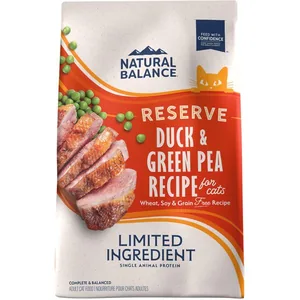
Natural Balance L.I.D. Grain-Free Duck & Green Pea Dry Cat Food
Best overall (limited-ingredient)
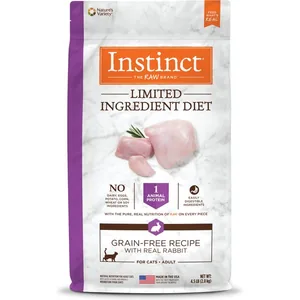
Instinct Limited Ingredient Diet Real Rabbit Grain-Free Dry Cat Food
Best novel protein
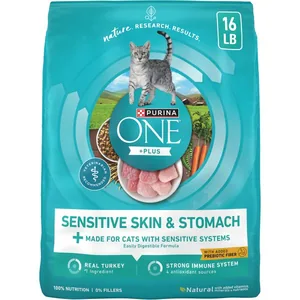
Purina ONE +Plus Sensitive Skin & Stomach Dry Cat Food
Best budget
The 7 Best Cat Foods for Allergies at a Glance
| Food | Best for | Main protein | Type | Price |
|---|---|---|---|---|
| Natural Balance L.I.D. Grain-Free Duck & Green Pea Dry Cat Food | Best overall (limited-ingredient) | Duck | Dry | ~$43 |
| Instinct Limited Ingredient Diet Real Rabbit Grain-Free Dry Cat Food | Best novel protein | Rabbit | Dry | ~$37 |
| Hill’s Science Diet Adult Sensitive Stomach & Skin Chicken & Rice Dry Cat Food | Best for itchy skin | Chicken | Dry | ~$40 |
| Purina ONE +Plus Sensitive Skin & Stomach Dry Cat Food | Best budget | Turkey | Dry | ~$34 |
| Blue Buffalo Basics Turkey & Potato Grain-Free Dry Cat Food | Best grain-free limited-ingredient | Turkey | Dry | ~$30 |
| Purina Pro Plan LiveClear Probiotic Chicken & Rice Dry Cat Food | Best if you’re allergic to your cat | Chicken | Dry | ~$23 |
| Natural Balance L.I.D. Reserve Duck & Green Pea Wet Cat Food | Best wet food | Duck | Wet | ~$48/case |
1. Natural Balance L.I.D. Grain-Free Duck & Green Pea Dry Cat Food – Best overall (limited-ingredient)
This is a limited-ingredient diet built around a single animal protein: duck. The ingredient list is short on purpose, which makes it easier to see whether your cat reacts to what’s in the bowl. Duck is a protein many cats have never eaten, so it works as a novel protein for a lot of allergy-prone cats.
We put this at the top because it hits the sweet spot: one meat, few extras, easy to find, and reasonably priced at around $43. It’s a solid starting point if you suspect a food allergy but haven’t nailed down the culprit yet, and it’s a good long-term option if duck agrees with your cat.
Pros:
- Single novel animal protein (duck) keeps the reaction risk low
- Short, limited ingredient list makes it easy to test tolerance
- Grain-free and pea-based for cats sensitive to common fillers
- Widely available and mid-range in price at about $43
Cons:
- Duck isn’t truly novel if your cat has eaten it before
- Dry-only, so it adds little moisture to the diet
2. Instinct Limited Ingredient Diet Real Rabbit Grain-Free Dry Cat Food – Best novel protein
Rabbit is about as novel as proteins get for house cats, which is exactly why this food shines for allergy trials. Instinct’s limited-ingredient formula uses one animal protein, rabbit, with a pared-down ingredient list and no grains. Because most cats have never eaten rabbit, their immune system usually has no reason to react to it.
Reach for this one when your cat has already been on chicken, fish, beef, or turkey diets and still itches or has stomach trouble. At around $37, it’s a genuinely novel option without a prescription. It’s best for cats whose more common proteins have already been ruled out.
Pros:
- Rabbit is truly novel for most cats, ideal for allergy trials
- One animal protein and a limited ingredient list
- Grain-free with no common fillers
- Affordable for a novel-protein food at roughly $37
Cons:
- Some picky cats need time to warm up to rabbit
- Dry-only formula, so no added moisture
3. Hill’s Science Diet Adult Sensitive Stomach & Skin Chicken & Rice Dry Cat Food – Best for itchy skin
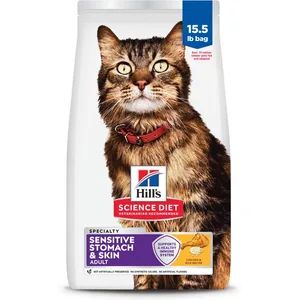
This food is formulated to support skin and coat, with added vitamin E and omega-6 fatty acids that help calm irritation and keep the coat soft. It’s a good pick for cats with sensitive skin and mild tummy sensitivities that aren’t tied to a specific protein allergy.
Here’s the honest catch: this formula contains chicken. Chicken is one of the most common feline food allergens, so this is not the food for a cat with a confirmed chicken allergy. Think of it as skin and coat support for a generally sensitive cat, not a hypoallergenic elimination diet. If your cat itches and you’ve ruled chicken out, the skin-nourishing nutrients here can genuinely help.
Pros:
- Added vitamin E and omega-6 fatty acids support skin and coat
- Gentle on sensitive stomachs
- Vet-recommended brand with consistent quality
- Easy to find in stores and online
Cons:
- Contains chicken, so it’s wrong for a confirmed chicken allergy
- Not a limited-ingredient or novel-protein diet, so it won’t work as an elimination trial
4. Purina ONE +Plus Sensitive Skin & Stomach Dry Cat Food – Best budget
If money is tight and you still want to help a sensitive cat, this is a smart place to start. Real turkey is the first ingredient, and the formula is designed to be gentle on skin and digestion. It’s easy to find at most grocery and pet stores, which matters when you’re feeding the same bag month after month.
At around $34, it won’t break the bank. It’s best for cats with mild sensitivities or as a first, low-cost experiment before you commit to a pricier novel-protein diet. Just know it isn’t a true limited-ingredient food, so it’s support, not a diagnostic trial.
Pros:
- Real turkey as the first ingredient
- Budget-friendly at about $34
- Easy to find almost anywhere
- Formulated for sensitive skin and stomach
Cons:
- Not a limited-ingredient or novel-protein formula
- Turkey may not be novel if your cat has eaten it before
5. Blue Buffalo Basics Turkey & Potato Grain-Free Dry Cat Food – Best grain-free limited-ingredient
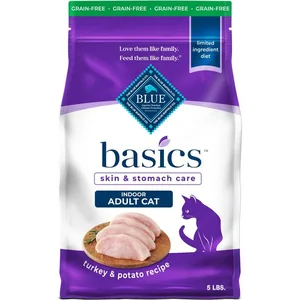
Blue Buffalo Basics keeps things simple with a limited-ingredient, grain-free recipe built around a single main protein: turkey, paired with potato for carbs. The shorter ingredient list means fewer things that could trigger a reaction, which is the whole point of an allergy-friendly food.
This is a good middle-ground choice if you want grain-free plus limited-ingredient without spending a fortune, at around $30. It’s best for cats who do fine on turkey but need the extras stripped away. If your cat has already reacted to turkey, pick a different protein instead.
Pros:
- Limited-ingredient recipe with a single main protein (turkey)
- Grain-free with potato as the carb source
- Wallet-friendly at roughly $30
- No common fillers like corn, wheat, or soy
Cons:
- Turkey isn’t novel for cats that have eaten it
- Won’t help if turkey is your cat’s trigger
6. Purina Pro Plan LiveClear Probiotic Chicken & Rice Dry Cat Food – Best if you’re allergic to your cat
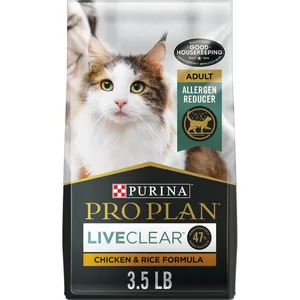
This one solves a different problem, so read carefully. LiveClear is not for a cat with a food allergy. It’s for people who are allergic to their cat. Human cat allergies are triggered by Fel d1, a protein in cat saliva and dander that ends up on the coat during grooming and then on your furniture, clothes, and nose.
LiveClear contains an egg-derived ingredient that binds to Fel d1 in the cat’s saliva, lowering the amount of active allergen your cat spreads around your home. Purina’s research found it reduces the allergen on cat hair and dander, often starting around the third week. At around $23, it’s an easy option if your eyes water and you sneeze around your own cat. It does contain chicken, so it is not suitable as an allergy food for the cat itself.
Pros:
- Reduces the Fel d1 allergen that triggers human cat allergies
- Backed by Purina research showing lower allergen levels
- Includes probiotics and complete daily nutrition
- Affordable at about $23
Cons:
- Does nothing for a cat’s own food allergy and contains chicken
- Reduces, but does not eliminate, human allergy symptoms
7. Natural Balance L.I.D. Reserve Duck & Green Pea Wet Cat Food – Best wet food
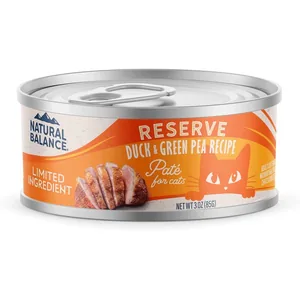
This is the wet-food version of our top pick, and it’s a great choice for cats who need both allergy-friendly ingredients and more moisture. It’s a limited-ingredient diet built around duck, a novel protein for many cats, with a short ingredient list and no grains.
Wet food adds hydration, which is a quiet win for cats prone to urinary or kidney trouble and for cats who just don’t drink enough water. At around $48 for a case, it costs more per feeding than dry, but the moisture and the clean protein make it worth it. It’s best for allergy-prone cats who need extra water in their diet or simply prefer wet food.
Pros:
- Limited-ingredient wet food with duck as a novel protein
- Added moisture supports hydration and urinary health
- Grain-free with a short ingredient list
- Good for cats who won’t eat dry allergy diets
Cons:
- Pricier per serving than dry food at about $48 a case
- Duck isn’t novel if your cat has already eaten it
How do you know if your cat has a food allergy or an environmental allergy?
A food allergy means your cat’s immune system reacts to an ingredient in the food, almost always an animal protein. Environmental allergies, called atopy, are reactions to things in the world around your cat: pollen, dust mites, mold, or grass. Both can make a cat itchy, which is why they’re so easy to mix up. Cornell’s Feline Health Center notes food allergies can appear at any age, even to a food your cat has eaten for years.
The biggest clue is timing. Environmental allergies often flare with the seasons, worse in spring or summer, then calm down. Food allergies don’t care about the calendar. They stick around year-round because your cat eats the trigger every single day. Food allergies are also more likely to come with digestive signs, like vomiting or loose stools, alongside the itching.
Cats with food allergies tend to itch most around the head, face, neck, and ears. The only way to know for sure is an elimination diet, since there’s no reliable blood or skin test for feline food allergies. If the itching stops on a strict novel-protein diet and comes back when the old food returns, you’ve found your answer.
- Itching that stays constant all year points more to food than to seasonal environmental allergies.
- Food allergies often cause both skin signs and digestive upset like vomiting or diarrhea.
- Head, face, neck, and ear scratching is a classic pattern for feline food allergies.
- Environmental allergies (atopy) usually flare in specific seasons and ease off in others.
- There’s no reliable blood or skin test for cat food allergies, so an elimination diet is the real diagnostic tool.
- Recurring ear infections and over-grooming to the point of bald patches can show up with food allergies.
How to choose the right allergy food for your cat
Start with the protein, not the marketing. A good allergy food is built around one animal protein your cat has never eaten, or as few ingredients as possible so there’s less to react to. Look for the words limited-ingredient diet (LID) or a single novel protein like rabbit, duck, or venison on the label.
Read the ingredient list like a detective. Even a food that advertises one protein can sneak in others, so check for hidden chicken fat, fish oil, or egg. For a true elimination trial, your cat can eat only that one food, with no treats, no table scraps, and no flavored medications or supplements. One cheat bite can ruin weeks of testing. For more, natural ways to ease cat allergies and cat food that helps with allergies go deeper.
When you switch foods, go slow. Transition over 7 to 10 days by mixing a little more of the new food into the old each day, so you don’t trade an allergy problem for a diarrhea problem. Then give it time. A real elimination trial runs 8 to 12 weeks before you’ll know if it’s working, so patience is part of the plan.
- Choose a single novel protein your cat has never eaten, or a limited-ingredient diet with the fewest components.
- Ignore grain-free as a shortcut, since most food allergies come from the meat, not the grain.
- Read the full label for hidden proteins like chicken fat, fish oil, or egg.
- During an elimination trial, feed only the test food: no treats, scraps, or flavored medications.
- Transition to the new food gradually over 7 to 10 days to protect your cat’s stomach.
- Give the diet a full 8 to 12 weeks before deciding whether it worked.
What about prescription hypoallergenic diets?
Sometimes over-the-counter foods aren’t enough, and that’s where prescription hydrolyzed protein diets come in. Hydrolyzed means the protein has been broken down into pieces so tiny that your cat’s immune system can’t recognize them as a threat. No recognition means no allergic reaction. Common ones your vet might prescribe include Hill’s Prescription Diet z/d, Royal Canin Hydrolyzed Protein HP, and Purina Pro Plan Veterinary Diets HA. International Cat Care explains more about food allergy in cats.
A vet usually reaches for these when a food allergy is strongly suspected but over-the-counter novel proteins haven’t given clean results, or when a cat has already eaten so many proteins that finding a truly novel one is tough. These diets are also popular for elimination trials because they remove the guesswork about which protein is safe.
We’re not selling these, and we can’t, since they require a veterinary prescription. We’re mentioning them so you know they exist and what your vet may suggest if the OTC route falls short. If you and your vet decide a hydrolyzed diet is the next step, you’ll get it through your vet or an approved pharmacy, with their guidance on how to run the trial.
This article is educational and isn’t a substitute for veterinary care. See your vet if your cat is scratching to the point of wounds or hair loss, has chronic vomiting or diarrhea, develops facial swelling, or keeps getting ear infections, since these can signal an allergy or another condition that needs treatment. If you think you may be allergic to your cat rather than the reverse, see our note on hypoallergenic cat breeds.
Frequently Asked Questions About Cat Food for Allergies
Q: What is the best food for cats with allergies?
The best food for a cat with allergies is a limited-ingredient or novel-protein diet, like a duck or rabbit formula, that reduces the food down to one animal protein the cat rarely eats. For confirmed allergies, a vet-guided elimination diet, sometimes using a prescription hydrolyzed formula, works best. There’s no single winner for every cat, since it depends on which protein your cat reacts to.
Q: Is grain-free food good for cat allergies?
Grain-free isn’t a reliable fix for cat allergies, because true food allergies in cats are almost always caused by an animal protein like beef, fish, chicken, or dairy, not by grains. Grain-free only helps the rare cat that reacts to a grain. What matters far more is choosing a limited-ingredient or novel-protein diet.
Q: How long does it take for allergy cat food to work?
An allergy food usually needs 8 to 12 weeks to show clear results, which is why an elimination diet runs that long. Some cats improve sooner, but skin allergies in particular take weeks to calm down. During that window your cat must eat only the test food, with no treats or scraps, or the results won’t be reliable.
Q: Can cat allergies go away with food?
Food allergy symptoms can clear up completely once you remove the trigger protein from your cat’s diet, but the underlying allergy doesn’t disappear. If your cat eats that protein again, the itching or stomach trouble usually returns. Managing a food allergy means avoiding the offending ingredient for life, not curing it.
Q: What are the most common cat food allergies?
The most common feline food allergens are beef, fish, chicken, and dairy, with egg also showing up often. These are the proteins cats eat most, and allergies develop after repeated exposure over time. Grains are a far less common trigger than most people assume.
Q: Should I feed wet or dry food to an allergic cat?
Both wet and dry foods can work for an allergic cat, as long as the recipe is limited-ingredient or built on a novel protein. Wet food adds valuable moisture, which supports hydration and urinary health, so it’s a good choice if your cat doesn’t drink much. The right protein matters more than the format.
Q: Do I need a prescription for hypoallergenic cat food?
You don’t need a prescription for over-the-counter limited-ingredient or novel-protein diets, which you can buy freely. You do need a veterinary prescription for hydrolyzed protein diets like Hill’s z/d, Royal Canin Hydrolyzed Protein HP, or Purina HA. Vets prescribe those when OTC options don’t resolve the allergy or for a strict elimination trial.

Hello and welcome to The Ideal Cat!
We are some passionate cat owners from different professions. We love our cats and have a lot of experience in how to care for our pets. We are incredibly excited to share our knowledge, experience, and research with you. So you can take good care of your loving cat. We will answer most of the common questions about owning cats, taking care of them, etc. If you have any question contact with us. Thanks for visiting! Enjoy the content.
)