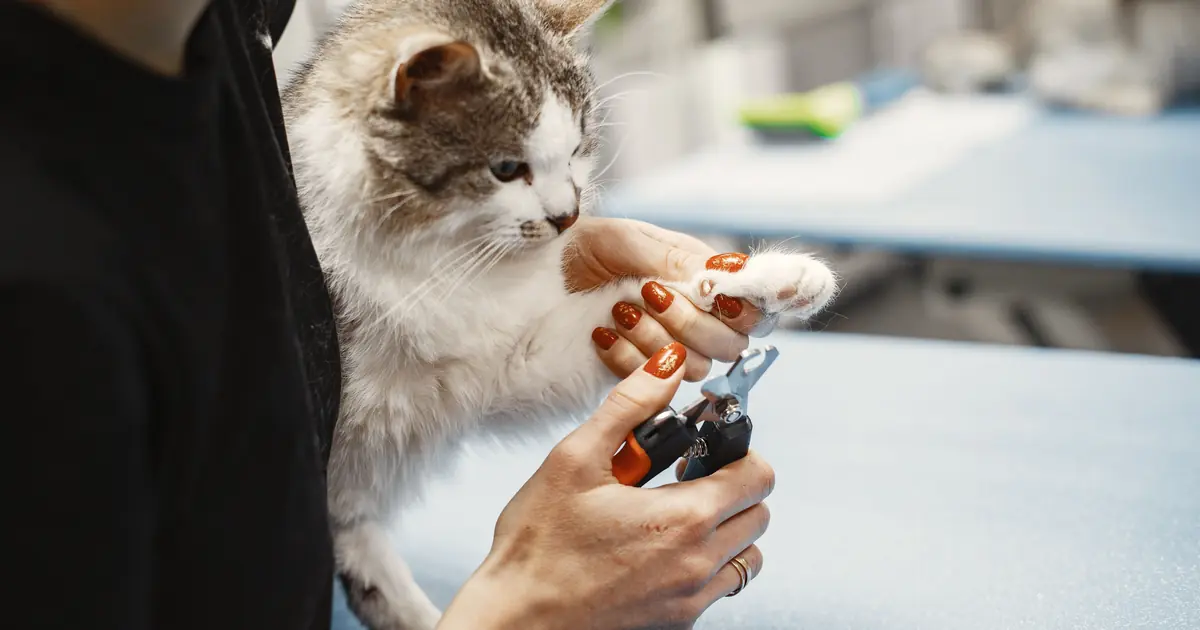
If you’ve ever chased your cat around the house holding a tiny pair of clippers, you’re not alone. Learning how to cut cat nails feels intimidating the first time. The worry is real: what if you hurt them, what if they hate you forever, what if there’s blood? Take a breath. Cutting cat nails is a quick, safe skill once you know where to snip and how to keep your cat calm. Let’s walk through it together.
- Press gently on the top and bottom of your cat’s toe to push the claw out, then clip only the sharp hooked tip.
- The “quick” is the pink area inside a cat’s nail that contains blood vessels and nerves, and cutting into it hurts and bleeds.
- Most indoor cats need a nail trim every 2 to 4 weeks, while kittens may need one weekly.
- If you nick the quick, press styptic powder onto the nail tip to stop the bleeding within seconds.
- Nail trimming is not declawing; declawing is the surgical amputation of bone and is opposed by the AVMA, while trimming is painless when done right.
What Do You Need to Cut Cat Nails?
To cut cat nails you need three things: a pair of cat nail clippers, styptic powder to stop accidental bleeding, and a few treats. Cat nail clippers come in two main styles, and both work well when sharp. Having the right tool makes a clean cut instead of a crushed, splintered one.
Here’s a quick look at the clipper options so you can pick what feels comfortable in your hand.
| Clipper Type | How It Works | Best For |
|---|---|---|
| Scissor-style clippers | Two small curved blades close like scissors around the claw | Beginners and most adult cats |
| Guillotine-style clippers | The nail slides through a hole and a blade rises to cut it | Owners who like a single clean snip |
| Human nail clippers | Flat blades made for human nails | Kittens only, in a pinch, if very sharp |
Keep your styptic powder within arm’s reach before you start. Styptic powder is a clotting agent that stops nail bleeding fast if you accidentally cut too far.
Miracle Care Kwik-Stop Styptic Powder
This is a clotting powder that stops nail bleeding within seconds if you nick the quick during a trim. A tiny pinch pressed onto the nail tip does the job, and one small jar lasts for years. It’s a smart thing to have on the shelf before your very first at-home trim, especially with a wiggly cat.
How Do You Cut Cat Nails Step by Step?
To cut cat nails, settle your cat in your lap, press a toe to extend the claw, and clip only the clear curved tip while avoiding the pink quick. The whole routine takes a couple of minutes once you both relax. Here are the 7 steps from start to finish.
- Pick a calm moment. Choose a time when your cat is sleepy or relaxed, like after a meal. A drowsy cat squirms far less than a playful one.
- Settle into position. Sit with your cat in your lap facing away from you, or tuck them gently into the crook of your arm. Many cats stay calmer when they can’t watch the clippers.
- Take a paw and press the toe. Hold one paw in your non-dominant hand. Press gently on the top and bottom of a single toe, just behind the claw, to push the nail out so it sticks forward.
- Find the quick. Look for the pink area inside the nail near the base. That pink part is the quick, and you’ll trim well in front of it. (More on this in the next section.)
- Clip only the sharp tip. Position the clippers about 2mm in front of the quick and snip off the clear, hooked tip in one smooth cut. Aim for a 45-degree angle so the nail still rests flat when your cat walks.
- Reward and move on. Give a treat after each paw, or even each nail. Stop if your cat gets antsy; you can finish the rest later.
- Don’t forget the dewclaw. Check the inner side of each front leg for the dewclaw, a thumb-like claw higher up that never touches the ground. The dewclaw doesn’t wear down naturally, so it can curl into the skin if you skip it.
That’s the full process. Cutting cat nails gets faster every time as your cat learns it’s no big deal.
How Do You Find and Avoid the Quick?
You avoid the quick by trimming only the thin, clear, curved tip of the nail and stopping about 2mm before the pink part begins. The quick is the living core of a cat’s nail that contains blood vessels and nerves, so cutting into it causes pain and bleeding. Staying in the clear, hollow tip keeps every trim painless.
On pale or clear claws, the quick is easy to spot as a pink shadow inside the nail. The clear, slightly hollow section past the pink is the safe zone to cut. Hold the paw up to a bright light if the pink is faint.
How Do You Cut Dark or Black Cat Nails?
To cut dark cat nails where the quick is hidden, trim in tiny slivers and stop the moment you see a small dark dot or a grayish, slightly moist center on the cut surface. That dot signals you’re getting close to the quick, so don’t cut further. Taking off a little at a time is far safer than one deep snip when you can’t see the pink.
What Do You Do If You Cut the Quick?
If you cut the quick, stay calm and press a pinch of styptic powder firmly onto the bleeding nail tip for a few seconds to stop the bleeding. A nicked quick looks scary because cats have busy little blood vessels in there, but it’s rarely serious and usually stops fast. Your cat may pull away and lick the spot, which is normal.
No styptic powder on hand? You have backups. Here’s how the common fixes compare.
| Remedy | How to Use It | How Fast It Works |
|---|---|---|
| Styptic powder | Press a pinch onto the nail tip | Seconds (best option) |
| Cornstarch or flour | Dip the nail tip into a small pile | 1 to 2 minutes |
| Bar of soap | Drag the nail tip across a soft bar | 1 to 2 minutes |
| Clean cloth pressure | Hold gentle pressure on the tip | A few minutes |
This article is educational and not a substitute for veterinary advice. Call your vet if the bleeding won’t stop after 10 to 15 minutes of pressure, if the toe swells, or if you notice pus, a bad smell, or your cat limping a day later. Those signs can point to infection and deserve a quick checkup.
How Do You Get a Cat Used to Nail Trims?
You get a cat used to nail trims by handling their paws often and pairing it with treats long before clippers come out. Cats accept nail trims much faster when paw-touching already feels normal and rewarding. This gentle conditioning, called desensitization, turns a wrestling match into a quiet two-minute routine.
Work through these stages over a week or two, moving to the next only when your cat stays relaxed.
- Days 1 to 3: Gently massage your cat’s paws during cuddle time. Reward with a treat. Press a toe softly to pop a claw out, then let go.
- Days 4 to 6: Let your cat see and sniff the clippers. Touch the clippers to a nail without cutting. Treat again.
- Days 7 and on: Clip just one nail, then stop and reward. Add a nail or two each session until you can do all of them.
Go at your cat’s pace. A few nails today and a few tomorrow beats one stressful battle that makes the clippers the enemy.
How Often Should You Cut Cat Nails?
Most indoor cats need their nails cut every 2 to 4 weeks, while fast-growing kitten nails may need a trim about once a week. The right schedule depends on your cat’s age, activity, and how much they use a scratching post. A simple test: if you hear loud clicking on hard floors or feel sharp hooks during cuddles, it’s trim time.
| Cat Type | Typical Trim Frequency |
|---|---|
| Kittens | About every week (nails grow fast) |
| Active adult cats | Every 3 to 4 weeks |
| Senior or less active cats | Every 1 to 2 weeks (they wear nails down less) |
| Outdoor-access cats | Check every 2 to 3 weeks; many wear front claws naturally |
Front claws usually need attention more often than back claws. Older cats often need trims more frequently because they scratch less and their nails can thicken with age.
Is Cutting Cat Nails the Same as Declawing?
No, cutting cat nails is not the same as declawing, and the two could not be more different. Nail trimming removes only the dead tip of the claw and is painless when done correctly. Declawing, known medically as onychectomy, is the surgical amputation of the last bone of each toe, removing the entire claw and nail bed.
The American Veterinary Medical Association (AVMA) discourages declawing for non-medical reasons, describing it as an amputation that can cause chronic pain and behavior problems. Several U.S. states, including New York, Maryland, and California, have banned the procedure for non-medical reasons. Regular nail trimming, scratching posts, and soft nail caps are the kinder alternatives that let your cat keep their claws and still spare your furniture.
Frequently Asked Questions About Cutting Cat Nails
Q: Can you cut cat nails with human nail clippers?
You can use human nail clippers on a cat’s nails in a pinch, but only if the blades are very sharp. Cat claws are rounded and thicker than human nails, so dull human clippers can crush or splinter them, which hurts. Cat-specific clippers give a cleaner cut and more control, so they’re the safer choice for adult cats.
Q: What happens if you don’t cut your cat’s nails?
If you don’t cut your cat’s nails, they can overgrow and curl into the paw pad, causing pain, infection, and trouble walking. Overgrown claws also snag on carpet and fabric, risking a torn nail. Indoor cats are most at risk because they wear their nails down less than outdoor cats.
Q: Does cutting a cat’s nails hurt them?
Cutting a cat’s nails does not hurt when you trim only the clear tip and avoid the pink quick. The tip of the claw is dead tissue with no nerves, like the white part of your own fingernail. Pain only happens if you cut into the quick, which holds blood vessels and nerves.
Q: How do you cut the nails of a cat that won’t let you?
To trim a cat that won’t let you, work in tiny sessions of one or two nails, choose sleepy moments, and reward with treats every time. Wrapping your cat snugly in a towel with one paw out, sometimes called the “purrito,” helps many wiggly cats. If your cat stays panicked, a vet or groomer can do it quickly and safely.
Q: How many nails does a cat have?
Most cats have 18 nails total: five on each front paw, including the dewclaw, and four on each back paw. The dewclaw sits higher on the inner front leg and never touches the ground, so it doesn’t wear down on its own. Always check dewclaws during a trim since they can curl into the skin.
Q: At what age can you start trimming a kitten’s nails?
You can start trimming a kitten’s nails as early as 4 to 6 weeks of age, and starting young helps them accept it for life. Begin with gentle paw handling, then trim just the sharp tips. Kitten nails grow quickly, so expect to trim about once a week.
Q: Should you cut a cat’s back nails too?
Yes, you can cut a cat’s back nails, though they usually grow slower and need trimming less often than front nails. Back claws are often duller because cats use them less for scratching. Trim the back nails every few weeks or whenever the tips feel sharp.
Q: How short should you cut cat nails?
Cut cat nails by removing only the clear, sharp hook at the very tip, stopping about 2mm before the pink quick. Never try to cut a nail flush with the toe. Taking off just the curved point keeps the claw blunt and safe without risking the quick.
Learning how to cut cat nails is one of those small grooming wins that makes life easier for both of you. Go slow, trim only the tip, keep treats and styptic powder handy, and remember that a few nails at a time is perfectly fine. Before long, cutting your cat’s nails will feel as routine as filling the food bowl.
This article is for educational purposes and is not a substitute for professional veterinary care. If your cat has injured or infected nails, or trimming causes ongoing distress, please consult your veterinarian.

Hello and welcome to The Ideal Cat!
We are some passionate cat owners from different professions. We love our cats and have a lot of experience in how to care for our pets. We are incredibly excited to share our knowledge, experience, and research with you. So you can take good care of your loving cat. We will answer most of the common questions about owning cats, taking care of them, etc. If you have any question contact with us. Thanks for visiting! Enjoy the content.
