
If you’ve ever watched your cat flop over for a belly rub one minute and bolt from a cucumber the next, you already know something is going on behind those eyes. That’s not just reflex. It’s a real inner life, and it’s why so many people go on to ask whether cats have souls.
Cat parents have known this for centuries, but science and law are finally catching up. Here’s what “sentient” actually means, what researchers have found, and why it matters for how you treat the cat curled up on your couch right now.
- Cats are sentient, meaning they can feel physical sensations like pain and pleasure, and experience basic emotions like fear and contentment.
- The UK’s Animal Welfare (Sentience) Act 2022 legally recognizes cats and other vertebrates as sentient beings.
- Sentience is different from self-awareness. Cats generally fail the classic mirror self-recognition test, so scientists are cautious about calling them self-aware in the human sense.
- Cats show clear primary emotions like fear, anger, and contentment, but whether they feel complex emotions like guilt or jealousy the way humans do is still debated among researchers.
- Recognizing cats as sentient shapes real-world welfare standards, including the Five Domains model vets and animal welfare groups use to judge a cat’s quality of life.
Are Cats Sentient?
Yes, cats are sentient. Sentience is the ability to have subjective experiences, to feel things like pain, pleasure, fear, and comfort, rather than just reacting like a machine. A sentient animal doesn’t just respond to stimuli. It actually experiences what’s happening to it.
Cats meet this bar easily. They have a complex nervous system, a brain structure similar in key ways to other mammals, and behavior that consistently lines up with internal emotional states. A cat hiding under the bed during a thunderstorm isn’t just running a program. She’s scared. A cat kneading a blanket with half-closed eyes isn’t performing a routine. He’s content.
Organizations like International Cat Care treat feline sentience as settled fact, not a debate, and build their welfare guidance around it.
What Does the Science Say About Cat Sentience?
The science says cats experience genuine emotions and physical sensations, not just automatic behaviors. Researchers studying feline cognition and behavior have documented fear responses, contentment signals, frustration, and pain reactions that mirror what we see in other sentient mammals.
Cats have a nervous system built to register pain, and veterinary medicine now treats feline pain management as standard care, not an afterthought. The American Veterinary Medical Association notes that pain recognition and treatment in animals has become a core part of ethical veterinary practice precisely because animals like cats genuinely suffer, not just display suffering-like behavior.
Behavioral studies also show cats form attachment bonds with their people, similar in structure to how human infants bond with caregivers. That kind of attachment only makes sense in a creature that actually feels something toward the people it’s attached to.
Is There a Difference Between Sentience, Intelligence, and Self-Awareness?
Yes, sentience, intelligence, and self-awareness are three separate things, and cats clearly have the first, show real signs of the second, and probably don’t have the third in the way humans do. It’s easy to lump these together, but they measure different capabilities entirely.
- Sentience is the capacity to feel things: pain, fear, pleasure, stress. Cats have this.
- Intelligence is the ability to learn, solve problems, and adapt behavior. Cats show this constantly, from figuring out how to open cabinet doors to learning the sound of a treat bag from across the house.
- Self-awareness is knowing you exist as a distinct individual, separate from your environment. This one is harder to prove.
The classic test for self-awareness is the mirror test, where researchers mark an animal with a scent-free dot and see if it investigates the mark on its own body when it sees its reflection. Most cats fail this test. They tend to treat a mirror reflection as another cat, or ignore it entirely once it doesn’t move, smell, or respond like a real animal. That doesn’t mean cats have no sense of self at all. It just means the tools scientists use to measure self-awareness in animals like great apes and dolphins don’t translate cleanly to cats, whose world is built more around scent and sound than sight.
Do Cats Have Emotions?
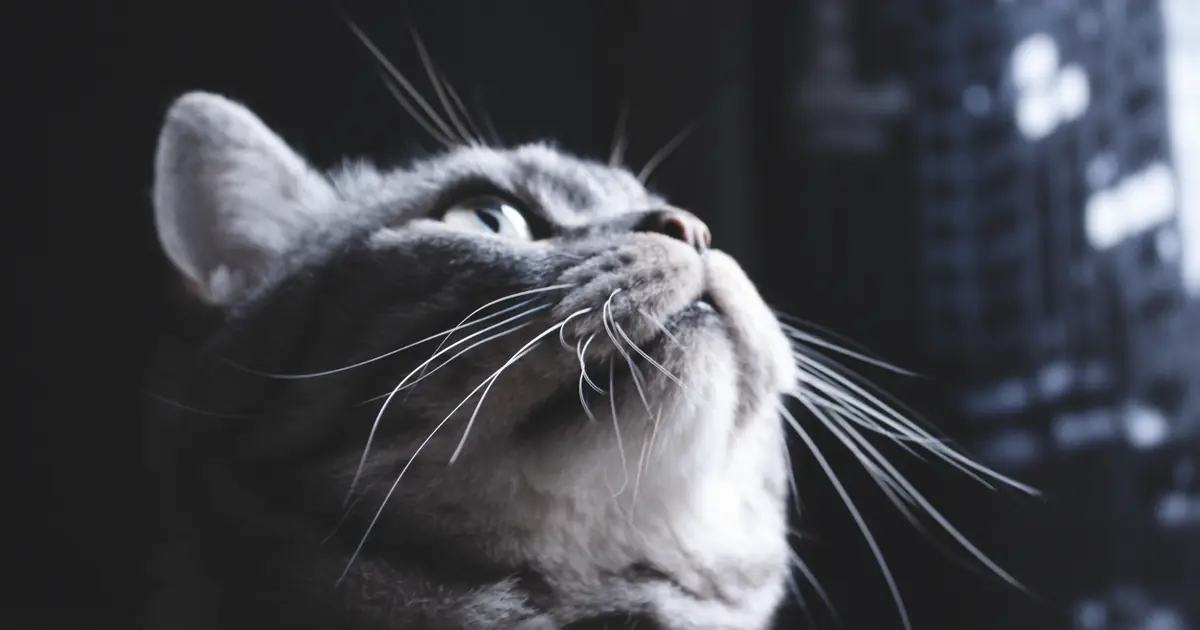
Yes, cats have emotions, at least the primary kind: fear, anger, contentment, and something close to joy or excitement. What’s less certain is whether cats experience complex, self-conscious emotions the way humans do, like genuine guilt, shame, or jealousy.
When your cat’s ears flatten and their tail puffs up, that’s fear or anger, not a random muscle spasm. When they slow-blink at you across the room, most behaviorists read that as a relaxed, trusting state, close to contentment. These are called primary emotions, and they don’t require complex self-reflection, just a functioning nervous system and an emotional response to a trigger.
Complex emotions are trickier. If you’ve ever come home to a shredded couch and sworn your cat “looks guilty,” what you’re probably seeing is your cat reacting to your tone and body language, not an actual sense of moral wrongdoing. Wondering whether your cat forms deeper attachments at all? A lot of parents ask does my cat love me, and the honest answer leans yes on attachment, murkier on complex emotion. The same goes for jealousy: it’s worth reading into whether cats get jealous before assuming your cat is plotting against the new kitten out of spite.
Which Countries Legally Recognize Cats as Sentient?
The UK is the clearest example: the Animal Welfare (Sentience) Act 2022 legally recognizes cats and other vertebrate animals as sentient beings capable of feeling pain and emotion. This law requires the UK government to consider animal welfare when making policy decisions.
The UK isn’t alone. The European Union recognized animals as “sentient beings” in the Treaty of Lisbon back in 2009, and countries like New Zealand and France have also written animal sentience into law over the past decade. You can read the actual UK legislation on gov.uk’s sentience factsheet.
These laws don’t change biology. Cats were sentient long before any government said so. What the laws do is force policymakers to factor real animal suffering and welfare into decisions, which is a meaningful shift from treating animals as pure property.
What Does Sentience Mean for How We Treat Cats?
Recognizing cats as sentient means their physical and emotional welfare matters, not just their physical health. This shows up most clearly in the Five Domains model, a framework vets and welfare scientists use to judge an animal’s overall quality of life.
| Domain | What It Covers |
|---|---|
| Nutrition | Access to food and water, and freedom from hunger or thirst |
| Environment | A comfortable, safe space with appropriate temperature and shelter |
| Health | Freedom from pain, injury, and disease |
| Behavior | Opportunities to express normal cat behaviors, like scratching, climbing, and play |
| Mental State | The animal’s overall emotional experience, shaped by the other four domains |
That last domain, mental state, only makes sense if you accept that cats actually feel something. Groups like the RSPCA use frameworks like this to set real welfare standards, from minimum enclosure sizes to enrichment requirements. If your cat has been acting off lately, it’s worth learning the common signs of stress in cats, since stress is a direct welfare issue, not just a behavior quirk.
Do Cats Feel Love, or Just Attachment?
Cats form real attachment bonds with their people, and most behaviorists agree that counts as a genuine emotional connection, even if it isn’t identical to human romantic or familial love. Cats show clear preference behaviors: seeking out specific people, relaxing more around them, and showing distress when separated from a trusted person for extended periods.
Whether you call that “love” is partly a language question. It’s not the same complex, narrative love humans describe, but it’s not nothing either. It’s a real bond, built on trust, routine, and comfort. Curious whether that bond runs both ways emotionally? Some cat parents also wonder if their cat can hold a grudge after a vet visit gone wrong, and it’s worth checking into whether cats hold grudges to separate myth from behavior science. Others want to know if their cat actually follows what they’re saying, which ties into whether cats understand words. And if you’ve noticed your cat acting strange after losing a companion animal, research into whether cats grieve suggests the answer is more yes than no.
Comparing Sentience Capacities in Cats
| Capacity | Do Cats Have It? |
|---|---|
| Feeling pain | Yes, clearly established and standard in veterinary care |
| Basic emotions (fear, contentment, anger) | Yes, well documented in behavior research |
| Problem-solving | Yes, cats learn, adapt, and solve novel problems |
| Self-recognition (mirror test) | Generally no, most cats fail or ignore the classic mirror test |
Frequently Asked Questions
Q: Are cats sentient beings?
Yes, cats are sentient beings. They have the capacity to feel physical sensations like pain and pleasure, and experience basic emotions like fear and contentment, which is what sentience means.
Q: Is there scientific proof cats are sentient?
There’s strong scientific consensus, built on decades of behavior research and neuroscience, that cats have the physical structures and behavioral responses that indicate genuine sentience. It’s treated as established fact by veterinary and animal welfare organizations, not an open debate.
Q: Do cats feel pain the way humans do?
Cats have a nervous system built to detect and respond to pain, and veterinary medicine treats feline pain management as standard practice. The exact subjective experience can’t be measured directly, but the physical and behavioral evidence for real pain is strong.
Q: Which country first legally recognized cats as sentient?
The European Union recognized animals as sentient beings in the Treaty of Lisbon in 2009. More recently, the UK’s Animal Welfare (Sentience) Act 2022 specifically legally recognized cats and other vertebrates as sentient.
Q: Are cats self-aware?
Most cats fail the classic mirror self-recognition test, so scientists are cautious about calling cats self-aware in the same sense as humans or great apes. Cats clearly have sentience, but self-awareness in that specific tested sense hasn’t been demonstrated.
Q: Do cats understand when they’re being loved or cared for?
Cats recognize and respond to consistent, gentle care from trusted people, showing relaxed body language, purring, and seeking out that person’s company. That’s a real emotional response to care, even if cats don’t process it in the same reflective way humans do.
Q: Can cats feel complex emotions like guilt or jealousy?
This is genuinely debated. Cats clearly show primary emotions like fear and contentment, but whether they experience complex, self-conscious emotions like guilt or jealousy the way humans do is not settled science.
Q: Why does it matter if cats are legally recognized as sentient?
Legal recognition of sentience forces policymakers to factor real animal welfare into decisions, from housing standards to how animals are treated in commerce and research. It shifts cats from being viewed purely as property to beings whose suffering and wellbeing count.

Hello and welcome to The Ideal Cat!
We are some passionate cat owners from different professions. We love our cats and have a lot of experience in how to care for our pets. We are incredibly excited to share our knowledge, experience, and research with you. So you can take good care of your loving cat. We will answer most of the common questions about owning cats, taking care of them, etc. If you have any question contact with us. Thanks for visiting! Enjoy the content.
