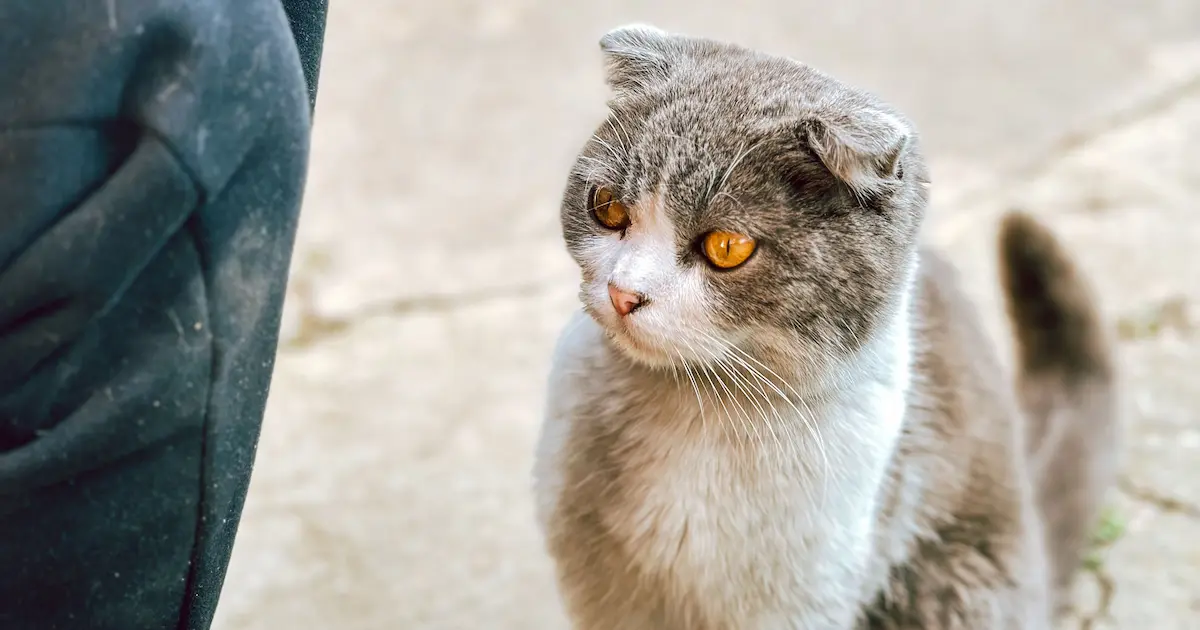
Picture this. You’re scrolling your phone late at night and a video stops you cold: a round little cat with ears folded flat to its head, sitting upright like a tiny owl, blinking up at the camera. Your heart does the thing. You want one immediately.
Here’s the thing though. That folded ear is the single most misunderstood feature in the entire cat world. It’s adorable, yes. It’s also the visible tip of a health condition that affects every single folded-ear Scottish Fold ever born.
That’s not a reason to slam the door on this breed. It’s a reason to walk in with your eyes open. So let’s talk about what living with a Scottish Fold actually looks like, the good and the genuinely hard, and a kinder option a lot of people don’t know exists.
| Origin | Scotland, 20th century (1961) |
| Weight (Male) | 9 to 13 lbs |
| Weight (Female) | 6 to 9 lbs |
| Lifespan | 11 to 15 years |
| Coat | Short or long (Highland Fold), dense and plush |
| Colors | Almost all colors and patterns: solid, tabby, tortoiseshell, bicolor, colorpoint, silver |
| Energy Level | Low to Moderate |
| Grooming Needs | Low (Highland Fold: Moderate) |
| Good With Kids | Yes, with gentle handling |
| Good With Other Pets | Yes, with a slow intro |
| Average Price | $1,000 to $3,000 from breeders |
The Truth About Those Folded Ears (Read This First)
I’m putting this at the top instead of burying it, because you deserve to know before you fall any deeper in love.
A normal cat’s ear stands up because the cartilage inside holds it there. A Scottish Fold’s ear folds because that cartilage didn’t form properly. And cartilage isn’t only in the ears. It’s in every joint, every bone end, the tail, the spine. The same gene that gives this breed its sweet owl face affects cartilage all over the body.
The condition has a name: Scottish Fold osteochondrodysplasia, or SFOCD. Vets sometimes just call it Scottish Fold disease. In the early 1990s, Australian researchers confirmed something the breed’s fans didn’t want to hear: every cat with folded ears develops it to some degree. Not most. Not the unlucky ones. All of them.
What does that mean day to day? It means progressive arthritis. Stiff, swollen, painful joints. A thickened, less flexible tail. Sometimes short, stiff legs and trouble jumping. In the worst cases, the pain starts shockingly young, before six months old, and some cats are put to sleep on welfare grounds because nothing stops it. There is no cure. You can manage the pain, you can slow it, but you can’t fix the cartilage.
Here’s the part that matters most. The severity varies a lot. A cat with two copies of the fold gene (from two folded parents) gets hit hard and early. A cat with one copy, bred from one folded and one straight-eared parent, often has milder, slower disease and can live a comfortable life with good care. But “milder” is not “none.” Reputable studies haven’t found a folded cat without joint changes on X-ray.
So when you look at those ears, it helps to remember what you’re really looking at. I’ll come back to the kinder path later, because there genuinely is one.
Where the Scottish Fold Came From
The whole breed traces back to one cat. Her name was Susie.
In 1961, on a farm near Coupar Angus in the Tayside region of Scotland, a white barn cat turned up with ears that folded down and forward. A local shepherd named William Ross noticed her right away, partly because he and his wife loved cats and partly because she looked, well, like a little owl. When Susie had kittens, a couple of them shared her folded ears. The Rosses took one home and started breeding.
Early on they crossed these cats with British Shorthairs and ordinary domestic cats. The breed was first called the “lop-eared” cat, then renamed the Scottish Fold in 1966 to honor where it began. By 1971 the cats had crossed the Atlantic, and Americans fell hard for them. To this day, every legitimate Scottish Fold can trace its family tree back to Susie.
There’s a twist in the story worth knowing. In 1977, a British geneticist reported that a large share of kittens from fold-to-fold pairings developed skeletal problems. Britain’s main cat registry, the Governing Council of the Cat Fancy, stopped recognizing the breed, and breeding there largely came to a halt. The cat that started in Scotland is no longer really bred in Scotland. That tells you something.
What a Scottish Fold Looks Like
Round is the word that does the heavy lifting here. Round head, round cheeks, big round eyes, even a roundish body. The folded ears make the head look rounder still, which is exactly why people melt.
They’re medium-sized cats with a sturdy, slightly chunky build. Males usually land between 9 and 13 pounds, females a bit lighter at 6 to 9. The eyes are large and expressive, often a warm copper or gold, though you’ll see green, blue, and odd-eyed Folds too.
The coat comes in two lengths. The short-haired version is dense and plush like a soft toy. The long-haired version, called the Highland Fold in some registries, has a flowing coat that needs more brushing. Color-wise, almost anything goes: solids, tabbies, tortoiseshells, bicolors, silvers, and pointed patterns.
One quirk you’ll fall for: the “Buddha sit.” Folds love to plop down on their bottoms with their back legs stretched out front, paws resting on their belly, like a tiny person watching TV. Nobody fully knows why they do it more than other cats, but it’s pure charm.
A note on kittens. Every Scottish Fold is born with straight ears. The fold (if it’s coming) shows up around three to four weeks old. So a fold-eared “kitten” you see at eight weeks already carries the gene.
Living With a Scottish Fold: Personality and Temperament
If you want a cat that adores you quietly, this is your dream.
Scottish Folds are gentle shadows. They follow you from room to room, settle near you while you work, and would rather be in your company than off doing their own thing. They’re affectionate without being needy, which is a lovely balance. You won’t get a cat that screams for attention, but you will get one that’s always nearby.
They’re famously soft-spoken. Instead of loud meows, you get little chirps and trills, almost like they’re murmuring to themselves. Honestly, it’s one of the sweetest things about them.
Energy-wise, they sit on the calm end. They enjoy a feather wand or a puzzle feeder, then they’re happy to nap. That makes them brilliant for apartments and for people who want a companion rather than a tornado. They tend to bond with the whole household instead of fixating on one person, and they handle changes in routine better than a lot of high-strung breeds.
Trust me on this part though: their calm, stoic nature has a hidden cost. A cat that doesn’t complain is a cat that hides pain well. With this breed, that quiet toughness can mask the joint disease until it’s advanced. More on spotting that soon.
Is a Scottish Fold Right for You?
Let’s be real with each other for a minute. This breed isn’t a simple yes or no.
A Scottish Fold might be a great fit if you:
- Want a calm, cuddly, low-drama companion who’s always close by
- Live in an apartment or quieter home
- Can afford not just the kitten but years of possible joint care and vet visits
- Are willing to choose a responsible breeder who pairs a folded cat only with a straight-eared one, never fold to fold
- Have the patience to watch closely for subtle signs of pain
You should probably look elsewhere if you:
- Want a guaranteed-healthy cat with no breed-specific worries
- Are on a tight budget that can’t stretch to chronic care
- Feel uneasy about supporting the breeding of a cat with a built-in painful condition (a completely fair feeling)
- Won’t have time to monitor a stoic cat for quiet suffering
If that second list hit home, don’t feel guilty. A lot of thoughtful cat lovers land there. And there’s a way to get nearly everything you love about this breed without the heartache, which I’ll get to.
Scottish Fold Health Issues You Have to Understand
We covered the headline already, but you deserve the full picture so nothing blindsides you.
Osteochondrodysplasia (SFOCD)
This is the big one, and it’s not optional or occasional. The faulty cartilage causes arthritis and bony growths around the joints, most often in the tail, ankles, knees, and spine. Signs include a stiff or thick tail, reluctance to jump, a stiff or hopping walk, swollen joints, and a cat who’d rather not be picked up. It can show on X-rays as early as seven weeks of age.
There’s no cure, but you can help your cat feel better. Vets often use anti-inflammatory pain meds, gabapentin, and a newer monthly injection called Solensia that targets pain signals. Joint supplements like glucosamine and chondroitin, weight control, and a low-stress home all help. Some severe cases need stronger intervention. The goal is comfort and dignity for as long as possible.
Hypertrophic Cardiomyopathy (HCM)
This is a thickening of the heart muscle seen across many breeds, including the British Shorthair lines behind the Fold. It can be silent until it’s serious, so periodic heart screening with your vet is a smart habit.
Polycystic Kidney Disease (PKD)
Cysts in the kidneys that can develop over time, again inherited from outcross lines. A good breeder tests their breeding cats for it, and you can ask to see those results.
One quick, kind word here. If you already share your life with a Fold, please don’t read this and panic. Plenty of these cats live full, loving lives. Knowing what to watch for is how you give yours the best shot at comfort.
How to Spot Early Pain in a Cat That Hides It
Cats are masters at hiding pain, and Folds are quieter than most. Most breed guides skip this, and I think that’s a real miss. Here’s what to actually watch for.
- The tail tells the truth. Gently feel it now and then. A tail that’s stiffening, thickening, or losing its flexibility is one of the earliest warning signs. Never force or yank it.
- Jumping habits change. If your cat used to leap onto the counter and now takes the long way, or hesitates, take note.
- A stiff or slightly bouncy walk, especially in the back legs or first thing after a nap.
- Less grooming in hard-to-reach spots, because twisting hurts.
- Grumpiness when handled, or pulling away when you touch the legs or lower back.
- Hiding more, playing less. A cat in pain often just quietly withdraws.
Picture this: you notice your Fold has started skipping the tall cat tree she used to love. That’s not laziness. That’s information. A vet visit and possibly some X-rays will tell you what’s going on, and early pain relief makes a world of difference.
Grooming and Everyday Care
The good news: grooming a Scottish Fold is easy.
A short-haired Fold needs a brush about once a week to keep shedding down and the coat glossy. A long-haired Highland Fold needs it two or three times a week, since that plush coat can mat behind the ears and under the legs.
Those folded ears need a little extra attention. The fold can trap wax and debris, so check them weekly and wipe gently with a vet-approved ear cleaner if needed. Never poke anything deep inside. If you see redness, dark gunk, or smell something off, call your vet.
Round out the routine with nail trims every couple of weeks and regular tooth brushing. And because joint comfort matters so much here, keep their main spots easy to reach. Low-sided litter boxes, soft bedding, and a step or ramp up to their favorite perch can save a stiff cat a lot of strain.
Feeding and Diet
There’s no magic Scottish Fold diet, but a few choices make a real difference for this breed.
Feed a high-quality food built around real animal protein, since cats are meat-eaters through and through. The single most important thing you can do for a Fold’s joints is keep them at a healthy weight. Every extra pound presses on already-struggling joints, so portion control isn’t optional, it’s kindness.
Many owners add a vet-recommended joint supplement with glucosamine, chondroitin, or omega-3s to support cartilage and ease inflammation. Wet food helps with hydration, which is good for kidney health given the PKD risk. Always check with your vet before adding supplements, especially for a kitten.
Exercise and Enrichment (Joint-Friendly Style)
Folds aren’t athletes, and that’s fine. They want gentle, regular play rather than wild zoomies.
Think feather wands at floor level, slow-rolling balls, and puzzle feeders that work their clever little brains. Short sessions a couple of times a day keep them fit and happy without stressing sore joints.
Skip the encouragement to make big leaps. Instead of a towering cat tree with huge gaps, choose one with closely spaced platforms, or add pet steps and ramps so your cat can climb without jumping. A warm, padded resting spot is a small thing that means a lot to an achy cat. Keep them indoors, both for safety and because a controlled space is easier on their bodies.
Living With Kids, Dogs, and Other Cats
This is one of the breed’s real strengths. Scottish Folds are easygoing and tolerant, which makes them lovely family cats.
With kids, they’re patient and gentle. The catch is teaching children to handle them softly, and to absolutely never pull or grab the tail, both because it’s rude and because that tail can be sore. Show little ones how to pet calmly and let the cat come to them.
With dogs and other cats, Folds usually do well, especially with a slow, patient introduction. They’re not territorial divas. They actually tend to prefer having company, since they hate being left alone for long stretches. If you work long hours, a second gentle pet can keep your Fold from getting lonely.
Lifespan and Aging Tips
A Scottish Fold typically lives 11 to 15 years, and a well-cared-for cat can hit the upper end of that.
The arc of their life is shaped by their joints. As a kitten and young adult, focus on building good habits: ideal weight, gentle exercise, and a baseline vet check that may include X-rays so you know where things stand. In the middle years, watch closely for the pain signs we covered and start treatment the moment something seems off. In the senior years, comfort is everything: warm beds, easy access to food and litter, ramps, and a pain-management plan you build with your vet.
The kindest thing you can do across all those stages is stay observant. A Fold won’t tell you it hurts. Your attention is its voice.
How Much Does a Scottish Fold Cost?
Let’s talk real numbers, because this breed isn’t a budget pet.
From a breeder, expect to pay somewhere between $1,000 and $3,000 for a kitten, with show-quality or rare-colored kittens running higher, sometimes past $4,000. Straight-eared kittens from the same litter usually cost less than folded ones. If you’re lucky enough to find a Fold through a rescue, adoption fees are far lower, often under $200.
But the sticker price is only the beginning. Plan for the ongoing costs every cat needs (food, litter, routine vet care, insurance) plus the very real possibility of joint care: pain medication, supplements, periodic X-rays, and senior support. Over a lifetime, that can add up to thousands more. Be honest with yourself about whether that fits your life before you commit.
One red flag on price: a folded kitten going cheap is not a deal. It often means fold-to-fold breeding, no health testing, and a kitten likely to suffer early.
Where the Scottish Fold Is Banned (and Why It Matters)
This breed sits at the center of a growing global debate, and the laws are shifting fast.
As of January 1, 2026, the Netherlands made it illegal to keep, breed, or sell Scottish Folds, with a transition period that protects current owners who registered their cats. Austria bans the breeding outright under its animal welfare law. Several Australian states restrict breeding cats with hereditary conditions like SFOCD. In June 2025, the European Parliament voted in favor of new rules targeting so-called “torture breeding,” which covers traits like the fold.
On top of that, two major registries, the Governing Council of the Cat Fancy in the UK and the international FIFe, refuse to recognize the breed at all on welfare grounds. Even Scotland, the breed’s birthplace, no longer really breeds them.
Why share all this? Not to lecture you. It’s because these decisions were made by vets and welfare experts looking at the same evidence we covered earlier. Knowing the breed is genuinely controversial helps you make a choice you can feel good about, whichever way you go.
The Kinder Choice: Meet the Scottish Straight
Here’s the part I really wanted you to reach.
Remember how every Scottish Fold is born with straight ears, and only some develop the fold? The kittens whose ears stay upright are called Scottish Straights. And this is the lovely bit: a Scottish Straight that didn’t inherit the fold gene doesn’t get the cartilage disease.
They have the same round face (just with normal ears), the same sweet eyes, the same calm and cuddly personality, the same soft chirps, the same Buddha sit. You get the whole Scottish Fold experience, the temperament and the charm, without signing your cat up for a lifetime of joint pain.
If you love everything about this breed but the health reality sits heavy on you, the Scottish Straight is your answer. Responsible breeders actually rely on them, because the only ethical way to breed Folds is to pair a folded cat with a straight-eared one. Ask your breeder about their Straights. A good one will be glad you did.
Where to Find a Scottish Fold Ethically
If you’ve weighed everything and still want a Fold, how you get one matters enormously.
Look for a breeder who:
- Only pairs a folded cat with a straight-eared cat, never fold to fold
- Health-tests their breeding cats for HCM and PKD and shows you results
- Lets you visit, meet the parents, and see how the cats live
- Gives a written health guarantee and won’t let kittens leave before about 12 weeks
- Asks you plenty of questions too, because they care where their kittens go
Walk away if you see:
- Folded kittens at suspiciously low prices
- A “breeder” who won’t let you visit or meet the parent cats
- No health records and vague answers about the parents’ ears
- Multiple breeds churned out in volume
And don’t overlook rescue. Scottish Folds do end up in shelters and breed-specific rescues. Adopting one means giving a deserving cat a home, often at a fraction of the cost.
Similar Breeds to Consider
Drawn to the Fold’s looks or personality but want to explore your options? A few breeds scratch the same itch.
- Scottish Straight: The obvious one. Same cat, same sweetness, upright ears, none of the cartilage disease.
- British Shorthair: Round-faced, plush, calm, and dignified. One of the breeds behind the Fold, and a hardy choice.
- Ragdoll: If you want a big, floppy, follow-you-everywhere love sponge, this gentle giant delivers.
- Exotic Shorthair: The teddy-bear face and mellow vibe, in a sturdy short-haired package.
- Burmese: Sweet, people-focused, and playful, for someone who wants devotion with a bit more spark.
Common Myths and Misconceptions
This breed comes wrapped in confusion, so let’s clear a few things up.
Myth: The folded ears just affect their hearing. Nope. Their hearing is fine. The fold is a sign of body-wide cartilage problems, not an ear issue.
Myth: Only some Folds have health problems. Every folded-ear Fold develops the joint condition to some degree. Severity varies, the presence of it doesn’t.
Myth: You can breed two Folds for “more folded” kittens. Fold-to-fold breeding produces the most severely affected, often suffering kittens. Ethical breeders never do it.
Myth: A Scottish Straight is a different, lesser breed. It’s the same breed, same litters, just without the fold. If anything, it’s the healthier sibling.
Myth: They’re high-maintenance grooming divas. Short-haired Folds are genuinely easy. A weekly brush and you’re set.
Frequently Asked Questions
Q: Are Scottish Fold cats always in pain?
All folded-ear Folds develop the cartilage condition, but pain levels vary. Cats with one copy of the gene may have mild, slow-developing arthritis and live comfortably with good care, while those from fold-to-fold breeding suffer more, and earlier. None are entirely free of joint changes.
Q: How long do Scottish Folds live?
Most Scottish Folds live 11 to 15 years. With ideal weight, attentive care, and prompt pain management when needed, many reach the upper end of that range.
Q: Why are Scottish Folds banned in some countries?
Countries like the Netherlands and Austria, plus parts of Australia, have banned or restricted breeding because the fold gene causes a painful, incurable joint disease in every affected cat. The EU Parliament voted for broader restrictions in 2025.
Q: What’s the difference between a Scottish Fold and a Scottish Straight?
They come from the same litters and share the same temperament and round look. Folds have folded ears and the cartilage disease that comes with them. Straights have normal upright ears and, if they lack the fold gene, none of that joint disease.
Q: Are Scottish Folds good for first-time owners?
Their calm, gentle, low-drama nature suits beginners beautifully. The complicating factor is the health commitment, so a first-timer should be ready to monitor for pain and budget for possible joint care, or consider a Scottish Straight.
Q: How much does a Scottish Fold cost?
Breeder prices typically run $1,000 to $3,000, with rare colors and show kittens costing more. Adoption through a rescue is far cheaper, often under $200. Factor in lifelong care costs beyond the purchase price.
Q: Do Scottish Folds get along with other pets?
Generally yes. They’re sociable and tolerant, and they often prefer company to being alone all day. A slow, patient introduction helps them settle in with dogs and other cats.
Q: Why does my Scottish Fold sit up like a person?
That upright “Buddha sit,” with the back legs stretched out and paws on the belly, is a famous breed quirk. It’s adorable and usually harmless, though if your cat seems to sit oddly to avoid joint pain, mention it to your vet.
Final Verdict: Should You Get a Scottish Fold?
So where does this leave you? Honestly, it depends on the kind of cat parent you want to be.
The Scottish Fold is one of the sweetest, gentlest, most loving cats you’ll ever meet. If you bring one home, you’re in for years of quiet companionship, soft chirps, lap snuggles, and that ridiculous owl face greeting you every morning. There’s a reason people adore them.
But that famous fold isn’t free. It comes with a lifelong health reality you can’t wish away, only manage with love, attention, and a real budget. If you’re ready for that, and you choose an ethical breeder who never pairs fold to fold, you can give a Fold a wonderful life.
And if the health side sits uneasy with you, please know you’re not giving up the dream. The Scottish Straight offers the same heart, the same charm, the same cuddles, with a body that isn’t fighting itself. For a lot of cat lovers, that’s the happiest ending of all.
Whatever you choose, you’re already doing the most important thing: deciding with open eyes and a soft heart. Your future cat is lucky to have you.

Hello and welcome to The Ideal Cat!
We are some passionate cat owners from different professions. We love our cats and have a lot of experience in how to care for our pets. We are incredibly excited to share our knowledge, experience, and research with you. So you can take good care of your loving cat. We will answer most of the common questions about owning cats, taking care of them, etc. If you have any question contact with us. Thanks for visiting! Enjoy the content.
)