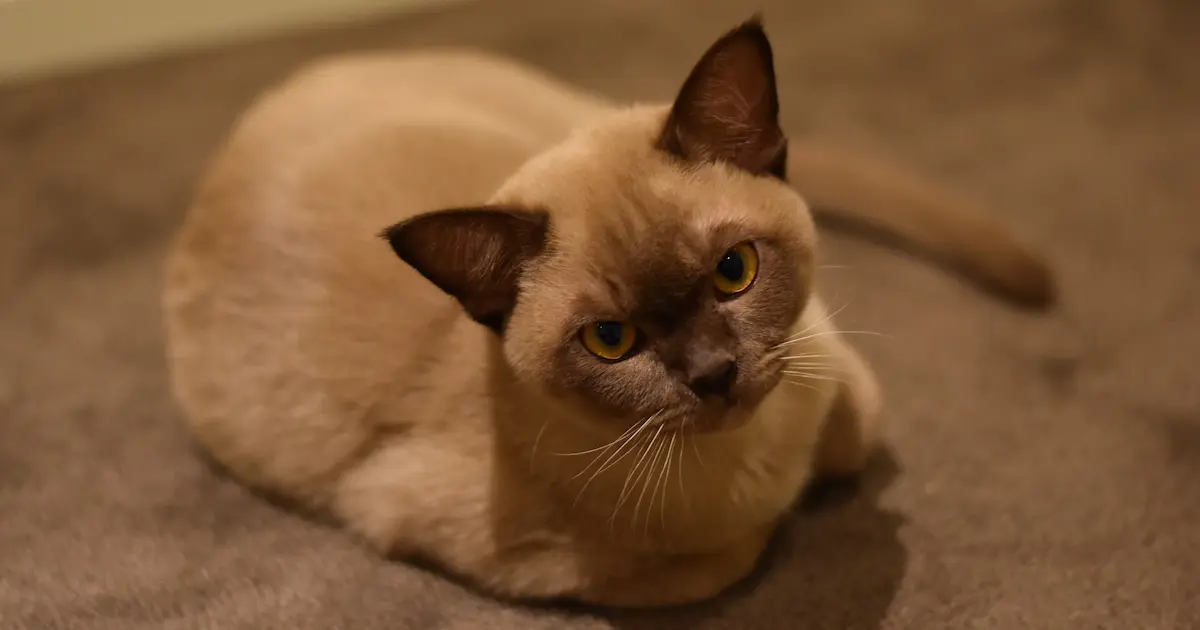
You set your coffee down for ten seconds. When you turn back, there’s a small, muscular cat sitting in your chair like it owns the lease. That’s a Burmese. They don’t just live in your house. They co-manage it.
Here’s the thing about this breed. They picked you. From the moment a Burmese decides you’re their person, you’ve got a velvet shadow following you from room to room, supervising your every move and offering soft commentary along the way.
If that sounds delightful, keep reading. If it sounds like a lot, also keep reading, because honesty about the downsides is the whole point of this guide.
| Origin | Burma / Myanmar (developed in the US, 20th century) |
| Weight (Male) | 8 to 12 lbs |
| Weight (Female) | 6 to 8 lbs |
| Lifespan | 12 to 16 years (some reach 18) |
| Coat | Short, fine, glossy, satin-like |
| Colors | Sable, champagne, blue, platinum (more in Europe) |
| Energy Level | High |
| Grooming Needs | Low |
| Good With Kids | Yes |
| Good With Other Pets | Yes, with a slow intro |
| Average Price | $600 to $2,500 from breeders |
Where the Burmese Cat Came From
Almost every Burmese alive today traces back to a single cat. Her name was Wong Mau, a small walnut-brown female brought from Burma to San Francisco in 1930.
A doctor named Joseph Thompson took an interest in her unusual solid coloring and bred her to a Siamese. The litters that followed were a genetic grab bag. Some kittens looked Siamese, some looked like their mother, and some came out a deep, even chocolate brown. Those solid brown cats bred true, and a new breed was born.
The Cat Fanciers’ Association began registering Burmese in 1936, though the breed didn’t earn full championship status until 1959. Back in their homeland these cats were prized for their rich coats and were sometimes called “copper cats.” They even show up in old Thai manuscripts of cat poetry, so people have admired this look for a very long time.
One fun side note: when you cross a Burmese back with a Siamese, you get a Tonkinese. So the Burmese isn’t just an old breed, it’s also a building block for newer ones.
What a Burmese Cat Actually Looks Like
Pick one up and you’ll get the first surprise. Burmese feel way heavier than they look. People call them “bricks wrapped in silk,” and you’ll understand why the second one lands in your arms. Under that sleek coat is a dense, muscular little body.
The coat itself is short, fine, and so glossy it almost looks wet in good light. There’s barely any undercoat, which is part of why they shed so little. Their eyes are the other showstopper: big, round, and usually a warm gold or yellow that seems to glow.
Now for the part that confuses a lot of buyers. There are two distinct Burmese types.
American vs European Burmese
The American Burmese (sometimes called Contemporary Burmese) is rounder everywhere. Round head, round eyes, round cheeks, cobby body. Think of a cat designed entirely out of soft curves.
The British or European Burmese is more slender and elegant. Longer body, a gentle wedge-shaped head, larger pointed ears, and a slightly more almond eye. Both are the same breed at heart, but they look noticeably different side by side, and European lines sometimes carry a slightly more active streak.
Neither is “better.” It just helps to know which look you’re drawn to before you contact breeders, because a breeder usually specializes in one type.
Burmese Colors Decoded (US vs UK Names)
Burmese colors come with a built-in headache: the US and the UK use totally different names for the same cat. So a “sable” in America is a “brown” in Britain. Here’s the cheat sheet.
| USA name | UK / Australia name | Look |
| Sable | Brown (or Seal in NZ) | Rich, warm dark brown. The original and most common. |
| Champagne | Chocolate | Soft honey-to-warm-beige with darker face and paws. |
| Blue | Blue | Medium gray with subtle fawn undertones. |
| Platinum | Lilac | The palest, a silvery dove gray. |
The Cat Fanciers’ Association recognizes those four in the US. European registries go further, adding reds, creams, and tortoiseshell patterns, which is why a European Burmese can show up in colors you’ll never see on an American show bench.
Good to know if you’re buying a kitten: Burmese babies often look lighter than they’ll end up. That sable kitten will deepen into a darker, richer brown as it matures, so don’t be thrown by a pale-looking little one.
Living With a Burmese: The Real Personality
If you’ve heard a Burmese described as “dog-like,” believe it. These cats fetch. They greet you at the door. They want to be in the room you’re in, every single time, and they’re genuinely a little wounded if you close a door on them.
They’re talkers too, but here’s an important distinction. A Siamese has that loud, piercing yowl that can rattle your nerves. A Burmese voice is softer, raspier, almost a sweet little rusty-hinge sound. They’ll hold actual conversations with you, but it’s pleasant background chatter, not an air-raid siren.
The other thing nobody quite prepares you for is the energy. Most cats mellow into couch potatoes by age two. Burmese stay kitten-like for years, launching into zoomies, stealing hair ties, and inventing games out of bottle caps long after you’d expect them to settle down. They’re clever, they’re nosy, and that curiosity gets them into open drawers, cabinets, and the occasional grocery bag.
Picture this: you’re trying to wrap a birthday gift on the floor. Within ninety seconds you’ll have a Burmese sitting directly on the wrapping paper, batting the ribbon, and looking deeply offended that you started without them. That’s daily life with this breed, and most owners wouldn’t trade it.
Is a Burmese Cat Right for You?
This is the most honest part of the guide, so let me not sugarcoat it. The Burmese’s biggest strength and its biggest challenge are the same thing: they need you around.
This breed bonds hard and does not do well with long stretches of solitude. A Burmese left alone all day, every day, can spiral into separation anxiety, and that shows up as excessive crying, litter box accidents, destructive chewing, or even a kind of low-grade depression. They aren’t being dramatic. They’re built for companionship and they suffer without it.
A Burmese is probably right for you if:
- You work from home, work part-time, or have a busy household with people in and out
- You want a cat that’s affectionate and interactive, not aloof
- You’re open to getting two so they keep each other company
- You enjoy daily play and don’t mind a chatty supervisor
A Burmese is probably the wrong fit if:
- You’re out of the house ten-plus hours a day with no other pets or people
- You want a quiet, independent cat that entertains itself
- You travel constantly and can’t bring backup care in
- You prefer a low-interaction pet
The good news is there’s a middle path. If you work full-time but want this breed, the answer is often two Burmese kittens raised together, plus puzzle feeders and rotating toys. A bonded pair handles your absence far better than a single cat ever will.
Health Issues to Know About
Burmese are generally robust, hardy cats. But this breed does carry a handful of inherited conditions, and a responsible buyer should know each one by name before handing over a deposit. None of this is meant to scare you. It’s meant to make you a sharper, kinder buyer.
Hypokalemia (the big one)
This is a hereditary condition where blood potassium drops too low, which messes with nerve and muscle function. In Burmese it often shows up as episodic muscle weakness, and the classic sign is a cat that can’t hold its head up properly, bobbing or drooping its neck, or walking with a stiff, crouched gait. It usually appears between two and six months of age.
Here’s the reassuring part. It’s caused by a recessive mutation in a gene called WNK4, and there’s a reliable DNA test for it (UC Davis Veterinary Genetics Laboratory offers one). A kitten only develops the disease if it inherits two copies of the gene. So if a breeder tests their cats and avoids pairing two carriers, the condition is almost entirely preventable. Even affected cats can often live well with potassium supplements and vet guidance.
Burmese Head Defect
This is a serious craniofacial deformity tied mostly to certain American lines. Kittens with two copies of the gene are born with severe skull malformations and don’t survive. It’s heartbreaking, but again, genetic testing of breeding pairs prevents it. This is exactly why you ask about health testing.
Diabetes
Burmese sit at a higher risk for diabetes than the average cat, and it’s made worse by obesity. Keeping your cat lean is your single best defense. More on that in the feeding section.
Other conditions to keep on your radar
- Gangliosidosis: a fatal neurological disorder appearing in very young kittens, also screenable by DNA test
- Flat-chested kitten syndrome: a chest deformity in newborns, often outgrown in mild cases
- Cherry eye: a prolapsed third-eyelid gland that needs minor surgery
- Feline orofacial pain syndrome: a painful mouth condition seen more in this breed
- Dental disease: Burmese are prone to gingivitis, so home brushing and cleanings matter
Trust me, a breeder who happily talks you through their DNA testing is a breeder worth your money. One who gets defensive is a red flag.
Grooming and Care
This is where Burmese owners get an easy win. That short, almost undercoat-free satin coat needs barely anything. A quick once-over with a soft brush or even a damp hand once a week keeps it glossy and removes the little hair they do shed.
Bathing is rarely needed. Where you should actually focus your effort is the mouth. Given the breed’s tendency toward dental disease, getting your cat used to tooth brushing as a kitten pays off hugely down the road. Add regular nail trims and the occasional ear check and you’re done.
If you want one practical tool, a rubber grooming mitt works beautifully on this coat and most Burmese treat it like a free massage.
Feeding Your Burmese
Burmese are little athletes, so they do best on a protein-rich, high-quality diet built around real animal protein. A mix of wet and dry food is a smart move: wet food helps with hydration, and the variety keeps a curious cat interested.
Here’s the catch. This breed loves to eat and has zero internal portion control. Combine that hearty appetite with their diabetes risk and you get the one rule that matters most: measure their food. Free-feeding a Burmese is asking for a chunky cat, and an overweight Burmese is a cat headed for health trouble.
Split meals into two or three servings a day, keep fresh water available, and check with your vet on amounts based on your cat’s age and activity. Keeping your Burmese lean is the kindest long-term thing you can do for them.
Exercise and Enrichment
Remember that “stays a kitten forever” energy? You need to channel it. A bored Burmese is a destructive Burmese, and that brain of theirs needs a job.
Daily interactive play is non-negotiable: wand toys, fetch (yes, really, many will bring it back), and puzzle feeders that make them work for a snack. They’re also avid climbers, so a tall cat tree or some wall shelves give them vertical territory to patrol.
Because they’re so smart, many Burmese take to clicker training and learn little tricks happily. It tires them out mentally, which is often more effective than physical play alone. Rotate their toys every week so “old” toys feel new again.
Burmese With Kids, Dogs, and Other Cats
This is genuinely one of the most family-friendly breeds out there. Burmese are sturdy enough to handle respectful kids and social enough to enjoy the chaos of a busy home. They tend to gravitate toward the action rather than hide from it.
They also get along famously with dogs, often bonding with a friendly pup as a playmate and partner in crime. With other cats, a calm, gradual introduction usually leads to a solid friendship, and honestly, a second cat is one of the best gifts you can give a Burmese.
One small caution: their friendliness means they assume everyone loves them. A Burmese may walk straight up to a grumpier resident cat with zero diplomacy, so supervise early meetings until everyone’s settled.
Lifespan and Aging Tips
Most Burmese live a good long life, commonly 12 to 16 years, and plenty push toward 18 with attentive care. To get there, the priorities are simple: keep them lean, stay on top of dental care, and don’t skip annual vet visits (twice yearly once they’re seniors).
As they age, some Burmese mellow and shift from “play with me” to “watch me from your lap,” though many keep their playful spark surprisingly late. Watch older cats for increased thirst, weight changes, or appetite shifts, since aging Burmese can be prone to kidney issues and diabetes. Catching those early makes a real difference.
How Much Does a Burmese Cat Cost?
For a pet-quality kitten from a reputable breeder, expect to pay roughly $600 to $1,000. Show-quality cats, rarer colors, or European lines can run $1,500 to $2,500 and up. You’ll see the breed quoted anywhere from $450 to $3,000 depending on lineage and location.
Then there’s the part the price tag hides. Budget for ongoing costs: quality food, litter, annual vet care, pet insurance, and the toys this enrichment-hungry breed burns through. A rough yearly estimate of $600 to $1,200 is realistic, more in years with health issues.
Ethical sourcing red flags to walk away from:
- No health or DNA testing offered (no hypokalemia or gangliosidosis screening)
- Kittens available to leave before 12 weeks
- Multiple breeds churned out, or “always have kittens ready”
- Won’t let you see where the cats live
- Prices that seem too good to be true (they usually are)
Where to Find a Burmese Ethically
Start with breed registries. The Cat Fanciers’ Association and TICA both list registered breeders, and breed clubs often keep referral lists. A good breeder will interview you as much as you interview them, raise kittens underfoot in the home, and show you health testing without being asked.
Don’t overlook rescue. Purebred Burmese rarely land in general shelters, but breed-specific rescues exist, and adult cats needing a second home can be a wonderful (and cheaper) option. Just know that many “Burmese” cats in shelters are actually look-alike mixes, which can be just as lovable but won’t carry guaranteed breed traits.
Wherever you go, meet the kitten’s parents if you can, ask for written health records, and never feel pressured to decide on the spot.
Similar Breeds to Consider
If the Burmese personality appeals but you’re weighing options, look at these:
- Tonkinese: a Burmese-Siamese blend with a slightly mellower middle-ground temperament
- Siamese: just as people-focused, but louder and more demanding
- Bombay: the “mini panther,” closely related and similarly affectionate
- Burmilla: a Burmese-Persian cross that’s a touch calmer and softer-coated
- Devon Rex: another playful, people-obsessed clown if you want goofy energy
Common Myths and Misconceptions
Myth: Burmese are hypoallergenic. Nope. No cat truly is. They shed less than long-haired breeds, but they still produce the allergens that set people off.
Myth: They’re just brown Siamese. Different breed, different build, different voice. The Burmese is rounder, denser, and far softer-spoken.
Myth: A short coat means low maintenance overall. The coat is, sure. But the emotional maintenance is high. This is not a “set it and forget it” cat.
Myth: They’re lap cats that nap all day. Some seniors get there. Young and middle-aged Burmese want action far more than they want stillness.
Frequently Asked Questions
Q: Are Burmese cats good for first-time owners?
Yes, as long as you’ll be home a lot. Their easy grooming and friendly nature make them beginner-friendly, but their need for companionship means they’re a poor fit for someone gone all day.
Q: Do Burmese cats get along with dogs?
Usually very well. Burmese are confident and social, and many form genuine friendships with dogs. A calm, gradual introduction helps things go smoothly.
Q: How vocal are Burmese cats?
Fairly chatty, but in a soft, sweet, raspy way. They like to “talk” with you, and the sound is much gentler than a Siamese’s sharp yowl.
Q: Can Burmese cats be left alone?
Not for long stretches. This breed is prone to separation anxiety and does best with company. If you work full-time, a second cat is strongly recommended.
Q: What colors do Burmese cats come in?
The four standard US colors are sable, champagne, blue, and platinum. UK and European registries add more, including reds, creams, and tortoiseshell patterns.
Q: How long do Burmese cats live?
Most live 12 to 16 years, and many reach 18 with good care. Keeping them lean and on top of dental and vet care helps them thrive into their senior years.
Q: Are Burmese cats high maintenance?
Low maintenance on grooming, high on attention. The coat is a breeze, but their emotional and play needs are demanding compared to more independent breeds.
Q: How much does a Burmese kitten cost?
Pet-quality kittens usually run $600 to $1,000 from reputable breeders, while show-quality or European lines can reach $2,500 or more. Always factor in lifelong care costs too.
Final Verdict: Should You Get a Burmese?
If you want a cat that treats you like the center of its universe, the Burmese delivers in a way few breeds can match. They’re warm, funny, endlessly curious, and they’ll be right there with you for everything from morning coffee to bedtime.
But that devotion is a two-way contract. A Burmese gives you its whole heart and expects your time in return. Give them your presence, a playmate, and a measured diet, and you’ll have one of the most rewarding companions in the cat world.
So the real question isn’t whether the Burmese cat is a great pet. It’s whether your life has room for a small shadow who never wants to leave your side. If the answer is yes, you’re going to adore this breed.

Hello and welcome to The Ideal Cat!
We are some passionate cat owners from different professions. We love our cats and have a lot of experience in how to care for our pets. We are incredibly excited to share our knowledge, experience, and research with you. So you can take good care of your loving cat. We will answer most of the common questions about owning cats, taking care of them, etc. If you have any question contact with us. Thanks for visiting! Enjoy the content.
