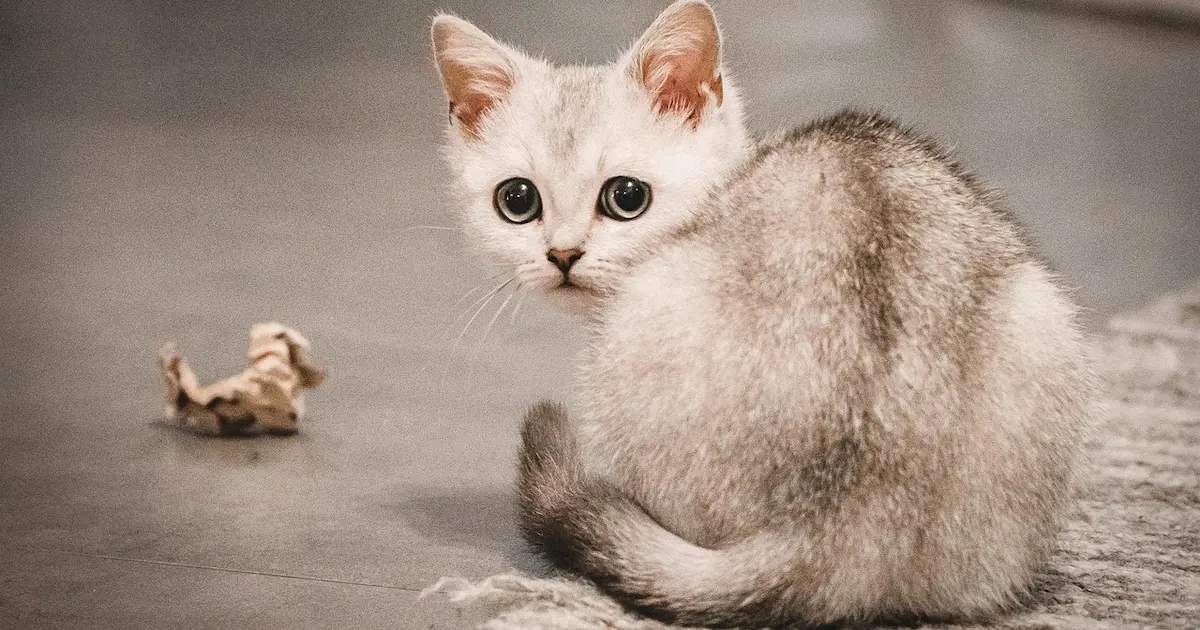
Picture this: a cat the color of moonlight on water pads across your living room. For a second you can’t tell if its coat is silver, smoke, or something in between. Then it turns to look at you, and you notice the eyes. Big, green, and rimmed in what looks like carefully applied eyeliner.
That’s a Burmilla. People call them “silver shadows,” and once you’ve watched one shimmer under a lamp, the nickname makes complete sense.
Here’s the fun part: nobody planned this cat. The Burmilla exists because of one unlocked door and two cats who had their own ideas. We’ll get to that story. First, the quick version for anyone in a hurry.
| Origin | United Kingdom, 1981 (20th century) |
| Weight (Male) | 9 to 13 lbs |
| Weight (Female) | 6 to 10 lbs |
| Lifespan | 12 to 16 years (records are thin, see below) |
| Coat | Soft and silky; shorthair or semi-longhair |
| Colors | Silver shaded or tipped (most common); black, blue, brown, chocolate, lilac, cream, red tipping; golden in some registries |
| Energy Level | Moderate |
| Grooming Needs | Low |
| Good With Kids | Yes, with gentle kids |
| Good With Other Pets | Yes, with a slow intro |
| Average Price | $800 to $2,000 from breeders (sometimes up to $3,000) |
The Accidental Cat: Where the Burmilla Came From
The Burmilla is young as cat breeds go. Its whole story starts in London in 1981, in the home of a breeder named Baroness Miranda von Kirchberg.
She owned a lilac Burmese female and had recently brought home a silver Chinchilla Persian male. The plan was to breed each of them carefully, to other cats. Then a door got left open at the wrong moment, the two found each other, and nature took its course.
The result was four silver kittens with short, shimmery coats and unusually sweet temperaments. They were so striking that breeders decided to develop the look on purpose. That was the start of the breed.
The Burmilla earned championship status through the 1990s and is grouped with the Asian breeds by the UK’s Governing Council of the Cat Fancy. It’s also recognized by TICA, FIFe, and the Cat Fanciers’ Association, making it one of the newer pedigreed cats on the books. Getting a kitten that truly matches the breed standard can take four to five generations of careful breeding, which is a big reason these cats stay rare and a little pricey.
What a Burmilla Looks Like
The first thing you notice is the shimmer. A Burmilla’s coat is either “tipped,” where only the very ends of the hairs carry color, or “shaded,” where the color reaches a bit further down. Underneath, the hair is pale, almost white. That contrast is what gives the coat its glittery, lit-from-within look.
Then there’s the makeup. The breed has dark pencil-thin rims around the eyes, lips, and nose, like someone gave the cat a careful beauty routine. Pair that with large, expressive green eyes, and you get a face that’s hard to forget.
A small heads-up on those eyes: kittens and young Burmillas often show a yellow or gold tinge that deepens into green as they grow up. In a few warm colors, like red and cream, an amber eye is normal and stays that way. So if you meet a young Burmilla with goldish eyes, that’s usually nothing to worry about.
Body-wise, these are medium cats with a muscular, surprisingly heavy build. Males run larger than females. They look elegant and slim, but pick one up and you’ll feel the weight, which matters later when we talk about food.
One detail trips up a lot of buyers: the Burmilla comes in two coat lengths. The shorthair is the version most people picture. The semi-longhair has a silkier coat with feathering on the belly, chest, and tail, and in the UK it’s often registered under its own name, the Tiffanie. Same breed family, just a longer coat.
Is That Even a Burmilla? Telling It Apart From Lookalikes
Because Burmillas are rare and silver cats are everywhere, “Is my cat a Burmilla?” is one of the most common questions out there. Here’s the honest answer: without pedigree papers, you usually can’t be sure. But you can rule things in and out.
A silver tabby domestic cat has stripes, swirls, or spots. A Burmilla does not. Its color sits in soft, even shading or fine tipping with no tabby pattern on the body.
A Chinchilla Persian shares the silver shimmer and the eye makeup, but it has the flat Persian face and a much fuller, longer coat. A Burmilla has a gentler wedge-shaped face and a sleeker coat, even in the longhair version.
People also mix Burmillas up with solid grey breeds like the Russian Blue or Korat. Those cats are a single steady blue-grey from root to tip, with no pale undercoat and no glitter. The Burmilla’s whole trick is that pale base showing through. If your cat looks like it’s wearing a thin silver veil over a white coat, with dark eyeliner and green eyes, you might be looking at a Burmilla. If you want certainty, only registered breeder paperwork or a DNA breed test can give it to you.
Living With a Burmilla: The Real Personality
If the Burmese is the extrovert of the cat world and the Persian is the couch philosopher, the Burmilla landed right in the sweet spot between them.
These cats stay playful and kitten-like well into adulthood. Yours will probably trail you from room to room, supervise your cooking, and decide your laptop is the best seat in the house. They love being near their people.
The good news for light sleepers: they’re not loud. A Burmilla talks in soft chirps and gentle little meows, nothing like the operatic yelling of a Siamese. They ask for attention with their presence more than their voice.
They’re smart, too. Many learn to fetch, open cupboards they shouldn’t, and figure out puzzle toys faster than you’d like. There’s an independent streak in there, so a Burmilla is happy to nap solo for a while. What it can’t handle is being truly alone all day, every day. More on that next.
Is the Burmilla Right for You?
No breed fits everyone, and pretending otherwise just leads to unhappy cats. So let’s be straight.
A Burmilla is a great match if you’re home a lot, want an affectionate cat without the constant noise, and like the idea of a gentle companion that still loves to play. They suit families with calm kids, multi-pet homes, and first-time owners who do their homework. They adapt well to apartments.
You should probably skip this breed if you’re out of the house ten-plus hours a day with no other pet for company. A lonely Burmilla gets stressed and sad. Pass too if you want a quiet, aloof cat that ignores you, or if a rare, harder-to-find, higher-priced kitten doesn’t fit your timeline or budget. Wanting one is easy. Finding one near you can take patience.
Burmilla Health: The PKD Question, Explained Simply
If you read three Burmilla articles, you’ll see three different takes on kidney disease. Some say the breed is riddled with it. Others never mention it. Both are wrong, and the truth is actually reassuring once you understand it.
The condition in question is polycystic kidney disease, or PKD. It causes fluid-filled cysts to form in the kidneys, which slowly crowd out healthy tissue and can lead to kidney failure later in life. It’s tied to a single gene called PKD1.
Here’s the part nobody explains well. PKD1 is “autosomal dominant,” which is a fancy way of saying a kitten only needs to inherit one copy of the faulty gene to be affected. It doesn’t need a bad copy from both parents. Just one is enough.
So why does this matter for Burmillas? Because they descend from the Chinchilla Persian, and Persians are the breed where this gene is most common. That shared ancestry is why labs like the UC Davis Veterinary Genetics Laboratory list the Burmilla as a breed worth testing for PKD1.
Now the reassuring part. Actual cases in Burmillas are not common. UK testing labs such as Langford Vets rank the breed as low risk in practice. That low number isn’t luck. It’s the payoff from years of responsible breeders running a simple cheek-swab DNA test, removing carriers from their programs, and only breeding cats that come back clear.
What this means for you as a buyer is simple and powerful. Ask the breeder for proof that both parents tested “negative” or “N/N” for PKD1. A good breeder will hand it over without hesitation. If they get cagey, dodge the question, or say “the vet checked and they’re fine,” walk away. That one question protects you from the breed’s biggest health risk.
A few other things to keep on your radar. Burmillas are heavy-boned and gain weight easily, and extra pounds quietly drive most feline health problems. Dental disease is common in cats generally, so home brushing and vet checkups pay off. Some Burmillas have sensitive stomachs or skin allergies. And because there’s Burmese in the mix, ask your breeder whether their lines have any history of the head and skull issues seen in a few older Burmese bloodlines. A reputable breeder won’t flinch at that question either.
Grooming and Coat Care
Good news if you hate fur on your clothes: the Burmilla is about as low-maintenance as pedigreed cats get.
A weekly brush is plenty for the shorthair. It clears out loose hair, cuts down on hairballs, and keeps that silver coat glossy. The semi-longhair version needs maybe two brushings a week to stay tangle-free, since the longer hair around the belly and tail can mat if you ignore it.
Shedding is light to moderate. You’ll notice some, especially with seasonal coat changes, but you won’t be vacuuming daily. While you’re at it, peek in the ears once a week and wipe gently with a cat-safe cleaner if they look grubby. Trim the nails every couple of weeks and brush those teeth as often as your cat will tolerate.
One myth to bust early: no, the Burmilla is not hypoallergenic. No cat truly is. We’ll come back to that in the myths section.
Feeding Your Burmilla
Burmillas are little bricks. They carry more weight than their slim shape suggests, and they’ll happily eat past the point of “enough” if you let them. That combination makes portion control the single most useful feeding habit you can build.
Feed a quality, protein-rich food with real meat as the first ingredient, since cats are built to run on animal protein. Measure meals instead of free-feeding, and count treats as part of the daily total, keeping them under about 10 percent of calories. Fresh water should always be available, and a wet-food component helps with hydration.
If your Burmilla has a touchy stomach, introduce any new food slowly over a week or so rather than switching overnight. And once your cat hits the senior years, talk to your vet about whether a kidney-supportive diet makes sense, given the Persian background.
Exercise and Enrichment
The Burmilla’s energy is moderate, not manic. It’ll have a wild ten minutes chasing a toy, then collapse into a sunbeam for an hour. Your job is mostly to make sure those wild ten minutes actually happen.
They love to climb and perch, so a tall, sturdy cat tree near a window is a genuine quality-of-life upgrade. Rotate a few interactive toys, throw in a puzzle feeder to keep that clever brain busy, and set aside a couple of short play sessions a day. As Burmillas age they get lazier, so it falls to you to keep them moving and at a healthy weight.
Burmillas With Kids, Dogs, and Other Cats
This is one of the breed’s best features. Burmillas are genuinely social and rarely pick fights.
With kids, they do well as long as the children are gentle and old enough to respect a cat’s space. With dogs, a cat-friendly dog and a calm introduction usually leads to fast friends. With other cats, a slow, scent-first introduction over a few days works far better than tossing them in a room together.
The one caveat: Burmillas are sensitive to chaos and loud, unpredictable households. They thrive on warmth and routine, so a calm home brings out the best in them.
Lifespan and Aging
Here’s where I’ll be honest in a way most guides aren’t. You’ll see Burmilla lifespans quoted as anywhere from 7 years to 18-plus, and the spread is that wide for a simple reason: the breed is new and rare, so there just isn’t much long-term data yet.
A realistic expectation is around 12 to 16 years, with plenty of well-cared-for cats living longer. What moves the needle is the stuff in your control: keeping your cat at a healthy weight, staying on top of dental care, monitoring kidney health as they age, and keeping them indoors and low-stress.
As your Burmilla enters its senior years, schedule more frequent vet visits and ask about routine kidney bloodwork. Catching changes early is the closest thing to a longevity hack that exists.
How Much Does a Burmilla Cost?
Burmillas aren’t cheap, and the price reflects how hard they are to produce. A kitten from a reputable breeder usually runs between $800 and $2,000, and show-quality or rare-color kittens can climb toward $3,000. In the United States especially, they’re scarce, so you may end up on a waitlist or buying from out of state.
The sticker price is only the start. Budget for first-year costs like vaccinations, neutering, microchipping, food, litter, and gear, which often add several hundred dollars on top. After that, a healthy indoor cat typically costs somewhere in the ballpark of $1,000 to $1,800 a year once you factor in food, litter, vet care, and a little pet insurance cushion.
One thing worth saying plainly: a “bargain” Burmilla should make you nervous. With a breed this hard to produce, a suspiciously cheap kitten usually means corners were cut, often the health testing.
Where to Find a Burmilla Ethically
Because the breed takes four to five generations to breed true, good Burmilla breeders are serious, careful people who often outcross to Burmese and other Asian-group cats to keep the lines healthy. That’s exactly who you want.
When you talk to a breeder, ask to see PKD1 test results for both parents, ask about a health guarantee, and ask to meet the kitten and at least the mother in person. A trustworthy breeder asks you plenty of questions too, about your home and your plans, because they care where their kittens land.
Walk away from anyone who has kittens “always available,” won’t share paperwork, pushes you to pay fast, or offers to ship a kitten sight unseen with no questions asked. Those are the classic warning signs.
Rescue is a long shot for such a rare breed, but it’s worth a try. Check breed-specific rescues and use a site like Petfinder, where you can search for confirmed Burmillas or lookalikes who need homes. Shelters sometimes mislabel mixed cats, so you might find a silver sweetheart that captures the same charm for a fraction of the cost.
Similar Breeds to Consider
If the Burmilla has your heart but you can’t find one, these cousins share some of its best traits:
- Burmese: One of the parent breeds. More talkative and intensely people-focused, with a sleek single-color coat.
- Tiffanie: Essentially the semi-longhair side of the same Asian-group family, if you love the silky coat.
- Bombay: Another Asian-group relative, jet-black and glossy, with a warm, dog-like personality.
- Chinchilla Persian: The other parent. Same silver shimmer and eyeliner, but with the flat face and high-maintenance coat.
- Russian Blue: A gentle, reserved silvery-grey cat if you prefer a quieter, more independent companion.
Common Myths and Misconceptions
The Burmilla collects more than its share of bad information. Let’s clear up the big ones.
Myth: Burmillas are riddled with kidney disease. Not true. They’re genetically eligible to carry the Persian PKD gene, but real-world cases are uncommon because responsible breeders test and screen it out.
Myth: Any silver cat is a Burmilla. Nope. Most silver cats are tabbies, Chinchilla Persians, or shaded domestics. The Burmilla is a specific, rare pedigreed breed.
Myth: They’re hypoallergenic. No cat is. Burmillas still produce the Fel d 1 protein that triggers allergies, though their light shedding may mean less of it floating around.
Myth: They’re high-maintenance like Persians. The opposite, really. Their coat is easy, and a weekly brush keeps it in great shape.
Myth: They’re as loud as Siamese. Far from it. Burmillas are soft-spoken and chirpy, not the kind of cat that narrates your whole evening.
Burmilla FAQ
Q: Are Burmilla cats rare?
Yes. The breed only began in 1981 and takes four to five generations to breed true, so good breeders are few. They’re especially scarce in the United States, where waitlists are common.
Q: Are Burmilla cats hypoallergenic?
No. There’s no truly hypoallergenic cat. Burmillas still carry the Fel d 1 allergy protein, though their light shedding may spread a bit less of it around your home.
Q: Do Burmilla cats shed a lot?
Not much. Shedding is light to moderate, with a small seasonal uptick. A weekly brush for the shorthair, or twice weekly for the semi-longhair, keeps it well under control.
Q: Are Burmilla cats vocal or loud?
They’re quiet talkers. Burmillas use soft chirps and gentle meows rather than the loud yowling Siamese cats are known for, so they suit apartments and light sleepers.
Q: How much does a Burmilla cost?
Expect $800 to $2,000 from a reputable breeder, with rare colors or show lines reaching around $3,000. A very cheap “Burmilla” usually means missing health testing.
Q: How long do Burmilla cats live?
Around 12 to 16 years is a realistic range, and many live longer. Long-term data is limited because the breed is so new, but good weight, dental, and kidney care all help.
Q: Are Burmillas good for first-time owners?
Yes, as long as you’re home often. They’re easygoing, low-grooming, and friendly, but they dislike being left alone all day, so a busy empty-home schedule isn’t ideal for them.
Q: What’s the difference between a Burmilla and a Tiffanie?
They’re closely related. The Tiffanie is essentially the semi-longhaired member of the same UK Asian breed group, with a silkier coat. The Burmilla most people picture is the shorthair.
Final Verdict: Should You Get a Burmilla?
If you want a cat that’s affectionate without being clingy, playful without being wild, and beautiful without being a grooming chore, the Burmilla is hard to beat. It brings the warmth of a Burmese and the calm of a Persian in one shimmery silver package.
The honest catch is availability and lifestyle. These cats are rare, so you’ll need patience and a healthy budget, and you’ll need to be home enough to give them the company they crave. Ask every breeder for PKD1 results, walk away from anyone who dodges the question, and you’ll sidestep the breed’s main health worry before it ever becomes one.
Do that, and you’ll end up with a gentle silver shadow who follows you from room to room for the next decade and change. For the right home, the Burmilla is just about perfect.

Hello and welcome to The Ideal Cat!
We are some passionate cat owners from different professions. We love our cats and have a lot of experience in how to care for our pets. We are incredibly excited to share our knowledge, experience, and research with you. So you can take good care of your loving cat. We will answer most of the common questions about owning cats, taking care of them, etc. If you have any question contact with us. Thanks for visiting! Enjoy the content.
