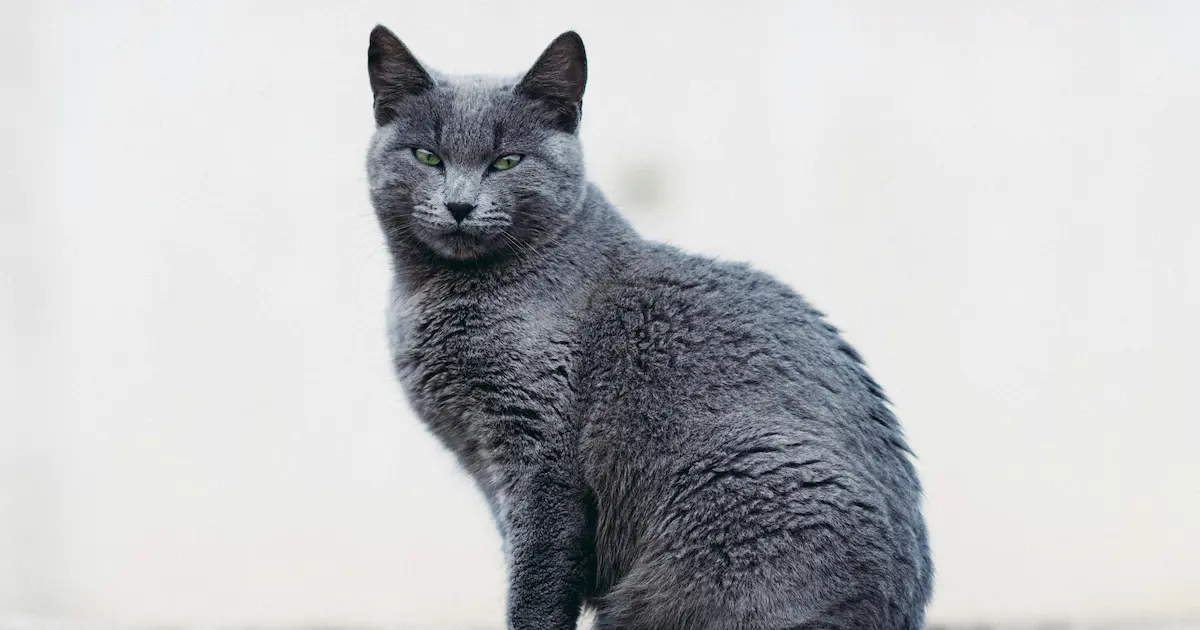
Picture this. You’re working at the kitchen table, and a silver-gray cat appears at your feet without a sound. She doesn’t yowl for attention. She just settles nearby, watching you with eyes the color of sea glass. Then the doorbell rings, and she vanishes like smoke under the couch.
That’s the Russian Blue in a nutshell. Velcro-close with her people, gone the second a stranger walks in.
If you’re drawn to that quiet, elegant, slightly mysterious vibe, you’re in good company. But there’s a lot of fluff written about this breed online, and some of it is flat-out wrong. So let’s do this properly and honestly.
Russian Blue at a Glance
| Origin | Russia (Arkhangelsk), 1860s |
| Weight (Male) | 10 to 12 lbs |
| Weight (Female) | 7 to 10 lbs |
| Lifespan | 15 to 20 years |
| Coat | Short, dense, plush double coat |
| Colors | Solid blue-gray with silver-tipped fur |
| Energy Level | Moderate |
| Grooming Needs | Low |
| Good With Kids | Yes, with gentle handling |
| Good With Other Pets | Yes, with slow introductions |
| Average Price | $500 to $3,000 from breeders |
Where the Russian Blue Came From
Here’s the thing about this breed’s history: a lot of it is charming guesswork. The most repeated story traces the Russian Blue back to the port city of Arkhangelsk in far northern Russia, near the White Sea and not far from the Arctic Circle.
The old nickname “Archangel Cat” comes from that port. The romantic version of the tale says sailors fell for these silvery cats and carried a few aboard ships bound for Britain and northern Europe in the 1860s. The first written mention of an “Archangel Cat” in Britain pops up around 1862.
One detail matters more than the legend, though. The Russian Blue is what’s called a naturally occurring breed. Nobody designed her by crossing other cats to chase a look. She showed up in nature, and breeders later refined her. That natural origin is a big reason she tends to be such a sturdy, healthy cat, which we’ll get to.
The breed nearly disappeared after World War II, when so many cat populations crashed. Dedicated breeders rebuilt the line, sometimes outcrossing to Siamese to keep it going. That’s likely where some of the breed’s more talkative, people-focused traits crept in.
What a Russian Blue Actually Looks Like
The first thing you notice is the color. It’s not just gray. It’s a soft blue-gray with a silvery shimmer that seems to shift when the light moves.
That shimmer isn’t a trick. Each hair is tipped in silver, so the coat almost glows. It’s the single most reliable thing to look for if you’re trying to identify the breed.
The coat itself is short but surprisingly thick. It’s a double coat, meaning the soft undercoat is about the same length as the outer guard hairs. The result is a dense, plush texture that stands slightly off the body. Run your hand over it once and you’ll understand why people get a little obsessed.
Under all that fluff is a lean, fine-boned, athletic cat. She looks bigger than she weighs. Take the coat away and you’ve got a long, elegant frame built for jumping.
Those Eyes (and the Famous “Smile”)
Adult Russian Blues have vivid green eyes, often a deep emerald. But kittens don’t start that way. Their eyes begin yellowish, then develop a green ring, and finally turn full bright green as they mature. If a kitten’s eyes haven’t gone green yet, that’s completely normal.
There’s also the smile. The shape of the muzzle gives many Russian Blues a slightly upturned mouth, so they look like they’re wearing a soft, knowing little grin. People compare it to the Mona Lisa, and once you see it, you can’t unsee it.
Is Your Gray Cat Even a Russian Blue?
Time for the question almost no breed guide answers honestly. You adopted a gorgeous gray cat from a shelter, the listing said “Russian Blue mix,” and now you’re wondering if it’s true.
The honest answer? Probably not, at least not a purebred one. Russian Blues are genuinely rare and almost never end up in shelters. Most gray shelter cats are domestic shorthairs, which are wonderful cats but not the breed. Shelters mislabel them all the time, with the best intentions.
Here’s how to actually tell. A true Russian Blue has that silver-tipped sheen, a dense double coat, vivid green eyes (in adults), and a refined, slightly wedge-shaped head. A regular gray domestic shorthair usually has a single flatter coat, eyes that can be any color, and no silver shimmer.
And then there are the look-alike breeds that fool everyone.
The Other “Blue” Cats People Mix Up
- Korat: From Thailand, with a single coat and a more heart-shaped face. Their green eyes can take up to four years to fully develop, and their ears sit higher with rounder tips.
- Chartreux: A French breed with copper or gold eyes (not green) and a woolly, water-resistant coat. Rounder face, sturdier build.
- British Shorthair (blue): Much chunkier and rounder, with copper-orange eyes and a single coat that lacks the silver tips.
- Nebelung: Basically the Russian Blue’s long-haired cousin. Same silvery color and green eyes, just with flowing fur.
If your cat’s eyes are orange or gold, it’s not a Russian Blue. That’s the quickest tell of all.
What It’s Really Like to Live With a Russian Blue
This is the part that matters most, so let’s be real about it. The Russian Blue is a wonderful cat for the right person and a frustrating one for the wrong person.
She is loving, but on her own terms. She’ll follow you from room to room, supervise your every move, and curl up beside you for hours. What she usually won’t do is leap into a stranger’s lap or demand to be held the moment you pick her up. Affection with this breed is something you earn, and once you have it, it runs deep.
Most Russian Blues pick a favorite person. You might be the chosen one, the human she shadows everywhere. Other family members get politeness and the occasional snuggle, but you get her whole heart. It’s flattering and a little funny.
So Are They Loud or Quiet?
You’ll find sources swearing Russian Blues are chatty like Siamese, and others swearing they’re nearly silent. Both are sort of right, which is why people get confused.
Here’s the truth as owners actually describe it. The Russian Blue is conversational, not loud. She’ll answer when you talk to her, chirp a greeting, or politely remind you it’s dinner time. But she rarely belts it out the way a Siamese will. Think gentle running commentary, not opera.
The Downside Nobody Mentions: They Hate Change
This breed loves routine with a passion that can border on dramatic. New furniture, a rearranged living room, a guest staying over, or dinner served 40 minutes late can genuinely throw her off. Some will sulk. Some will hide. Some will let you know about it for days.
It’s not a dealbreaker, but it’s worth knowing. If your life is chaos and constant company, a more easygoing breed might be happier than this sensitive soul.
Is a Russian Blue Right for You?
Let’s make this simple. The Russian Blue is a great fit if you:
- Want a deeply loyal cat that bonds hard with its people
- Live a fairly calm, predictable life
- Are okay with a cat that’s shy around guests
- Prefer a quiet, low-shedding, low-grooming companion
- Work away from home sometimes (she handles alone time well)
She’s probably the wrong cat for you if you:
- Want a social butterfly that loves every visitor
- Have a loud, high-traffic, ever-changing household
- Expect an instant cuddly lap cat from day one
- Have very young kids who grab and chase (she’ll just disappear)
The good news is that Russian Blues do beautifully in apartments and tolerate being left alone for a normal workday far better than clingier breeds. They’re surprisingly easygoing about solitude, as long as the rest of life stays predictable.
The Truth About Russian Blues and Allergies
You’ve probably read that Russian Blues are hypoallergenic. Let’s clear this up, because the internet has made a mess of it.
No cat is hypoallergenic. Not one. Every cat, including the Russian Blue, produces a protein called Fel d 1, the main thing that triggers cat allergies. It lives in saliva and skin oils, spreads onto the fur during grooming, and floats around your home.
So where does the Russian Blue reputation come from? Two real factors and one shaky claim.
The real factors: she sheds very little, and her dense double coat tends to trap dander close to the body instead of flinging it around your house. Less airborne dander can mean fewer sniffles for some allergy sufferers.
The shaky claim: that she produces dramatically less Fel d 1 than other cats. Some breed fans repeat this as fact, but the science isn’t settled, and a few breed authorities openly push back on it. Fel d 1 levels vary enormously from one individual cat to the next, even within the same breed.
Honest takeaway? If you have mild allergies, a Russian Blue might bother you less than the average cat. If you have serious allergies, do not rely on the breed alone. Spend real time with an adult Russian Blue before committing, and talk to your doctor. Neutering, regular brushing, and a good HEPA air purifier help far more than the breed label does.
Health Issues to Know About
Good news first. Because the Russian Blue is a naturally occurring breed, she’s one of the healthier purebred cats out there. There’s no single devastating genetic disease that defines the breed, the way some conditions plague other purebreds. Many live happily into their late teens.
That said, here’s what to actually watch for.
Obesity (the Real #1 Risk)
This is the big one, and it’s the one most guides bury. Russian Blues love food and will absolutely con you with big, tragic eyes at the food bowl. Worse, their thick coat hides weight gain, so you often don’t notice until your vet does.
Measured meals beat free-feeding for this breed. Skip the constant treats. A puzzle feeder slows her down and gives her brain a workout at the same time.
Progressive Retinal Atrophy (PRA)
A few Russian Blues can develop PRA, a slow deterioration of the cells in the retina that can lead to vision loss over time. It’s not common in the breed, but reputable breeders test for eye health, so ask.
Urinary and Bladder Issues
Some Russian Blues are prone to urinary tract problems and bladder stones. Good hydration helps a lot here, which is one reason wet food earns its place in their diet.
Dental Disease
Like most cats, they can build up plaque and develop gum issues with age. Regular dental care and vet checkups keep small problems small.
One quiet concern with this breed is its smallish gene pool. Responsible breeders manage it carefully, which is exactly why where you get your kitten matters so much.
Grooming and Care
The good news is that this is one of the easiest coats to maintain. That dense plush fur looks high-maintenance, but it really isn’t.
A quick brush once or twice a week is plenty. It removes loose hair, keeps the coat glossy, and gives you a moment to check her over for any lumps or changes. Many owners say their Russian Blue genuinely enjoys the attention.
During seasonal shedding, you might bump up to a few times a week. Otherwise, a soft slicker brush and a few minutes is all you need. Keep nails trimmed, peek at the ears now and then, and you’re basically done.
Feeding and Diet
Russian Blues are carnivores, so prioritize a quality food built around real animal protein. Look for a named meat (chicken, turkey, fish) as the first ingredient rather than vague “meat by-products.”
A mix of wet and dry food works well for most. Wet food supports hydration, which is a real bonus given those urinary tendencies. Dry food adds a little crunch and some dental benefit, and it’s handy for puzzle feeders.
The golden rule with this breed is portion control. Talk to your vet about how much she actually needs, then stick to set mealtimes. Your Russian Blue will lobby for more. Stay strong. Future-you and her waistline will be grateful.
Exercise and Enrichment
Don’t let the calm reputation fool you. Under that serene face is an athlete who can launch onto the top of your fridge from a standstill.
Russian Blues are smart, and a bored Russian Blue gets into mischief. Give her vertical space to climb, a tall cat tree, and a window perch for bird-watching. Daily interactive play matters more than people expect.
She’ll happily chase a wand toy, stalk a feather, and play fetch (yes, really, plenty of them retrieve like little dogs). Puzzle toys that hide treats keep that clever brain busy. Ten or fifteen focused minutes, twice a day, makes a noticeably happier cat.
Living With Kids, Dogs, and Other Cats
The Russian Blue can absolutely be a family cat, with the right expectations.
With kids, she does best around gentle, calm children who understand that this cat needs space and won’t tolerate being grabbed. Toddlers who chase and squeeze usually just send her into hiding. Older kids who respect her boundaries often become her quiet favorites.
With other pets, slow introductions are everything. Rushed introductions stress this sensitive breed badly. Done patiently, she usually coexists fine with mellow dogs and other cats. She tends to prefer calm housemates over rowdy ones, which tracks with her whole personality.
Lifespan and Aging Tips
Russian Blues are wonderfully long-lived, commonly reaching 15 to 20 years, and some sail well past that. You’re signing up for a long, rewarding friendship.
As she ages, keep an eye on weight (still the top concern), and watch for stiffness, changes in appetite, or shifts in litter box habits. Senior cats benefit from more frequent vet visits, softer sleeping spots, and a little patience as they slow down.
Keep that beloved routine steady into her senior years. A predictable life keeps an older Russian Blue calm and content.
How Much Does a Russian Blue Cost?
Let’s talk money, because this breed isn’t cheap. From a reputable breeder, you’re generally looking at $500 to $3,000, with show-quality kittens from champion bloodlines climbing higher still.
Why the range? Pedigree, the breeder’s reputation, your location, and simple availability all play a part. Russian Blues are rare in North America, so good breeders often have waiting lists.
Then there’s the rest of the cost. Food, litter, vet care, insurance, and supplies add up over a 15-to-20-year life. The kitten price is honestly the small part. Budget for the long haul, not just the cute beginning.
One red flag: if you see a “Russian Blue” advertised dirt cheap or free, be skeptical. Those are almost always gray domestic shorthairs (still lovely cats!) or kittens from unscreened parents with no health testing.
Where to Find a Russian Blue Ethically
If you want a purebred, a registered, responsible breeder is the way to go. A good breeder will happily show you health test results, let you meet the kitten’s parents, keep kittens until at least 12 weeks, and ask you plenty of questions in return. Honestly, a breeder who interrogates you is a green flag.
Walk away from anyone who dodges health questions, won’t show you where the cats live, has kittens available year-round with no waitlist, or pressures you to buy fast. Those are the hallmarks of a kitten mill.
Adoption is a beautiful option too. Purebred Russian Blues rarely land in shelters, but breed-specific rescues exist, and shelters are full of gorgeous gray cats with that same gentle vibe. You may not get papers, but you’ll get a best friend and save a life.
Similar Breeds to Consider
- Nebelung: The long-haired version of the same look. Same silvery coat and green eyes, more floof.
- Korat: Another silver-blue beauty, a bit more outgoing and people-demanding.
- Chartreux: Plush blue coat with copper eyes and a famously easygoing temperament.
- British Shorthair (blue): Rounder, sturdier, calmer, and more tolerant of a busy home.
- Siberian: Worth a look if allergies are your main concern and you want a friendlier, more robust cat.
Common Myths and Misconceptions
Myth: Russian Blues are hypoallergenic. Nope. No cat is. They may shed less and stir up less dander, but they still make Fel d 1.
Myth: Every gray cat is a Russian Blue. Most gray cats are domestic shorthairs. The silver sheen, double coat, and green eyes set the real breed apart.
Myth: They’re cold and aloof. They’re reserved with strangers, sure. With their chosen people, they’re some of the most devoted cats you’ll ever meet.
Myth: That thick coat means tons of grooming. Actually one of the lowest-maintenance coats around. Once or twice a week does it.
Myth: They’re as loud as Siamese. They chat, but softly. Gentle commentary, not a marching band.
Russian Blue FAQ
Q: Are Russian Blue cats hypoallergenic?
No cat is truly hypoallergenic, including the Russian Blue. They shed little and their dense coat traps dander, which may help mild allergy sufferers, but they still produce the Fel d 1 allergen. Spend time with one before committing.
Q: Are Russian Blue cats rare?
Yes, they’re fairly rare, especially in North America. Reputable breeders often keep waiting lists, and you’ll seldom find a purebred one in a shelter.
Q: Are Russian Blue cats friendly and good pets?
They make excellent pets for the right home. They’re loyal, gentle, and deeply bonded to their people, though shy around strangers and happiest in calm, predictable households.
Q: Do Russian Blue cats meow a lot?
They’re conversational rather than loud. A Russian Blue will chirp and answer when you talk to her, but she rarely yowls at full volume the way a Siamese might.
Q: How long do Russian Blue cats live?
Russian Blues are long-lived, commonly reaching 15 to 20 years. With good diet, weight control, and regular vet care, some live even longer.
Q: How much does a Russian Blue cat cost?
Expect roughly $500 to $3,000 from a reputable breeder, with champion-bloodline kittens costing more. Suspiciously cheap or free “Russian Blues” are usually gray domestic shorthairs.
Q: Are Russian Blues good for first-time owners?
Yes, as long as you can offer a calm, steady home. Their low grooming needs and easygoing attitude toward alone time make them manageable, but they don’t love chaos or constant change.
Q: Can Russian Blue cats be left alone during the day?
They handle a normal workday alone better than many clingier breeds, with low separation anxiety. Just leave food, water, toys, and a window perch, and keep their daily routine consistent.
Final Verdict: Should You Get a Russian Blue?
If you want a cat that loves loudly and obviously, this isn’t your breed. If you want a quiet, elegant, fiercely loyal companion who chooses you and means it, the Russian Blue is hard to beat.
She asks for a calm home, a steady routine, portion control, and a little patience while she decides you’re worthy. In return, you get fifteen-plus years of a devoted shadow with sea-glass eyes and a secret little smile.
For the right person, a Russian Blue isn’t just a pretty gray cat. She’s the quiet best friend you didn’t know you were missing.

Hello and welcome to The Ideal Cat!
We are some passionate cat owners from different professions. We love our cats and have a lot of experience in how to care for our pets. We are incredibly excited to share our knowledge, experience, and research with you. So you can take good care of your loving cat. We will answer most of the common questions about owning cats, taking care of them, etc. If you have any question contact with us. Thanks for visiting! Enjoy the content.
