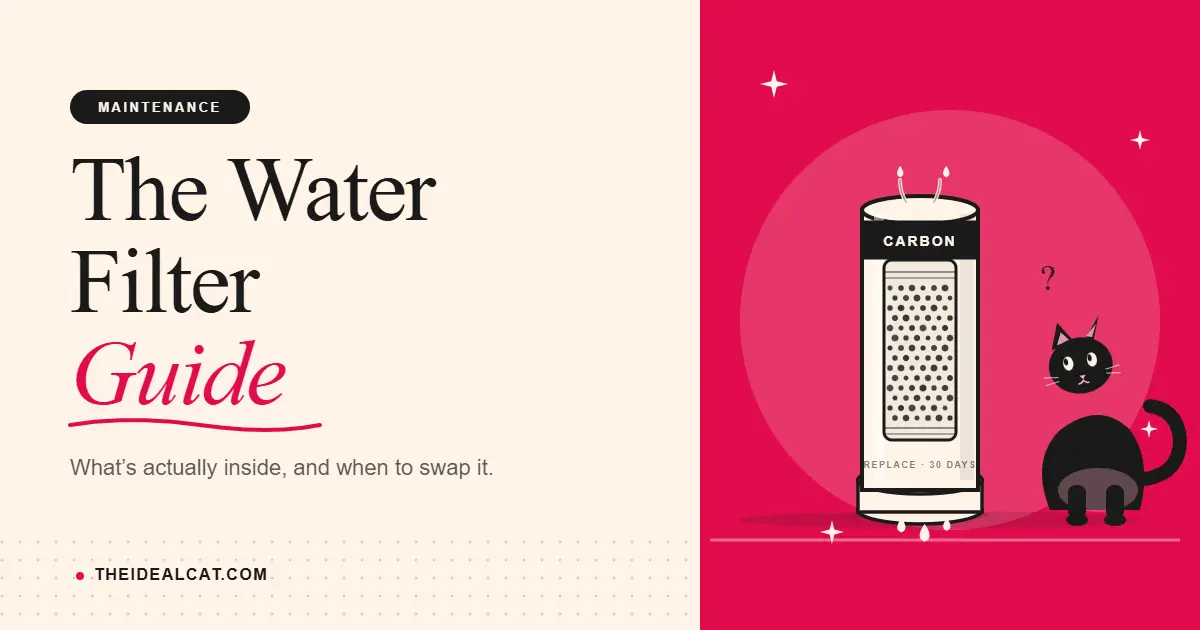
If you’ve ever pulled apart your cat’s fountain and wondered, “wait, am I supposed to be replacing this little black thing?”, you’re not alone. The cat water filter is the most overlooked piece of feline gear in most homes. And honestly, that little cartridge does way more heavy lifting than people realize.
Whether your kitty drinks from a Drinkwell, a Catit Flower, a PetLibro, or anything in between, the filter is the part keeping that water actually drinkable. Skip it for too long and you’re basically asking your cat to drink from a swamp. Not great.
Here’s everything you actually need to know about cat water filters, plus the 7 best replacements you can grab on Chewy right now.
Why Your Cat Actually Needs a Water Filter
Cats are famously bad at drinking water. Their thirst drive is low (a leftover from their desert-dwelling ancestors who got most of their hydration from prey), and they’re notoriously picky about what’s in their bowl. If the water tastes off, smells weird, or sits too long, they’ll just walk away thirsty.
That’s a problem, because dehydration is linked to some of the most common feline health issues:
- Urinary tract infections (UTIs) and bladder crystals
- Chronic kidney disease, which affects roughly 1 in 3 senior cats
- Constipation and digestive trouble
- Concentrated urine that’s harder on the bladder
A clean filter helps with all of this by making water more appealing. It strips out the chlorine taste of tap water, traps fur and food bits, and keeps the fountain from turning into a bacterial petri dish. Cats are more likely to drink water that’s fresh, flowing, and odor-free. The filter is what makes that possible.
The 3 Types of Cat Water Filters (And What Each One Does)
Most cat fountains use a combination of two or three filter types. Knowing what each one is actually doing helps you understand why your filter needs changing and which kind matters most for your home.
1. Activated Carbon Filter
This is the main filter in almost every cat fountain. It’s usually a black, granular cartridge made from coconut shell charcoal. Its job is to absorb chlorine, bad tastes, and odors from your tap water. It’s what makes water taste “clean” to your cat.
Carbon filters typically last 2 to 4 weeks before they’re saturated and stop working.
2. Foam Pre-Filter
The foam (or sponge) filter sits in front of the pump. Its only job is to catch the chunky stuff: cat hair, food bits, dust, lint from rugs. It protects the pump motor from getting clogged and keeps gunk out of the carbon filter.
You can usually rinse a foam pre-filter and reuse it for 1 to 2 months before tossing it.
3. Ion-Exchange Resin
This one’s less common but really useful if you have hard water. The resin (often tiny clear beads) pulls magnesium and calcium out of the water. Those minerals can build up in your cat’s urinary tract and contribute to crystals or stones. Catit’s “Triple Action” filters are well known for including this layer.
Quick Comparison
| Filter Type | What It Removes | Lifespan |
|---|---|---|
| Activated Carbon | Chlorine, odors, bad taste, organic impurities | 2 to 4 weeks |
| Foam Pre-Filter | Hair, food debris, dust, large particles | 1 to 2 months |
| Ion-Exchange Resin | Calcium and magnesium (hard water) | 2 to 4 weeks |
What Happens If You Skip Changing the Filter?
Here’s the part nobody tells you. A neglected filter doesn’t just stop helping, it actively starts hurting.
Once the carbon is saturated (usually around the 4-week mark), it stops absorbing impurities and instead becomes a surface for biofilm and bacteria to grow on. That gunky, slimy feeling on the inside of an old fountain? That’s biofilm. It often contains coliform bacteria, and your cat is drinking right through it.
You’ll also notice:
- The flow gets weak or sputtery because the pump is choking on debris
- The water starts smelling musty, like a damp basement
- Your cat suddenly avoids the fountain and starts begging for sink water
- Pump motor wear increases, shortening your fountain’s life
If your cat has stopped using the fountain for no obvious reason, the filter is the first thing to check. Cats notice these things long before we do.
How to Pick the Right Filter for Your Cat’s Fountain
This is where most people get tripped up. There are dozens of “compatible” filters online, and the wrong size or shape will leak, dislodge, or not seat properly. Here’s a quick way to figure out what you actually need.
Step 1: Find your fountain’s brand and model number. Check the bottom of the fountain or the original box. PetSafe fountains have a PAC-something code. PetLibro uses PLWF codes (PLWF003, PLWF105, etc.).
Step 2: Match the filter to that exact model. Don’t go by brand alone. PetLibro has at least four different filter shapes across their lineup, and they’re not interchangeable. The Dockstream filter won’t fit a Capsule fountain.
Step 3: When in doubt, buy the manufacturer’s filter. Third-party filters are cheaper, but cat parents on Chewy report constant fit issues with them. Until you know your fountain plays nice with generics, stick with the official brand.
Here’s a cheat sheet for the most popular fountains:
| Your Fountain | Filter You Need |
|---|---|
| PetSafe Drinkwell 360 (Plastic or Stainless) | Drinkwell 360 Carbon Filters |
| PetSafe Drinkwell Avalon, Pagoda, Lotus, Sedona, ½/1/2 Gallon | Drinkwell Carbon Filters (standard or Premium) |
| Catit Flower Fountain (any version) | Catit Triple Action Filter |
| PetLibro Stainless Steel (PLWF003) | PetLibro PLWF003 Replacement Filters |
| Cat Mate Pet Fountain | Cat Mate Replacement Filter Cartridges |
The 7 Best Cat Water Filters on Chewy in 2026
These are the replacement filters that consistently come up as the most reliable options across the four biggest cat fountain brands. Find your fountain in the list below and grab the matching pack.
1. PetSafe Drinkwell 360 Fountain Carbon Replacement Filters
Best for: PetSafe Drinkwell 360 (Stainless and Plastic) owners
If you have the iconic Drinkwell 360, this is your filter. Each cartridge has a duo-density polyester pad that catches hair and debris on top, plus activated carbon underneath that strips out the funky tap water taste. The 12-count box is a year’s worth of filtration if you change every 2 weeks. Drop-in install, no tools needed.
2. PetSafe Drinkwell Premium Replacement Carbon Filters
Best for: Multi-cat homes or heavier daily use
These are the upgraded version of the standard Drinkwell filter. The activated carbon is split between six pockets instead of two, which prevents settling and gives more even filtration through the cartridge’s full life. If your tap water is heavy on chlorine or your cats drink a lot, the Premium version handles the load better. Fits most Drinkwell models including Avalon, Pagoda, Lotus, Sedona, and the ½, 1, and 2-gallon fountains.
3. PetSafe Drinkwell Replacement Carbon Filters (Standard)
Best for: Single-cat homes with a standard Drinkwell
The standard version of PetSafe’s carbon filter, designed to fit a wide range of Drinkwell models. It contains 50% more carbon than most generic alternatives, which means longer-lasting filtration before you need to swap it out. A solid no-frills pick if you don’t need the Premium version’s extra structure.
4. PetSafe Drinkwell Foam Replacement Filters
Best for: Anyone with a long-haired cat
This is the foam pre-filter that pairs with the carbon filters above. If you have a Maine Coon, Persian, Ragdoll, or any shedder, you absolutely want one of these in the pump chamber. It catches loose fur before it reaches the motor and pretty much doubles the working life of your fountain. Compatible with Avalon, Butterfly, Creekside, Pagoda, Seascape, Seaside, Sedona, Stainless Multi-Pet, and the ½, 1, and 2-gallon Drinkwell fountains.
5. Catit Triple Action Pet Fountain Filter
Best for: Catit Flower Fountain owners and homes with hard water
This is the standout filter from Catit’s lineup, and it’s the only filter on this list with an ion-exchange resin layer. That means it actually softens hard water by pulling out calcium and magnesium, which is huge if you live somewhere with mineral-heavy tap water. The three layers (polyester for hair, carbon for taste, resin for hardness) work together to make fountain water genuinely cleaner. Fits all Catit Flower Fountain versions and the Catit Stainless Steel fountains.
6. PetLibro Stainless Steel Cat Water Fountain Replacement Filters
Best for: PetLibro PLWF003 owners
PetLibro’s stainless steel fountain is one of the most popular newer designs, and this 8-pack includes both the carbon filters and the matching foam pre-filter sponges. Together they form a triple filtration system that pulls hair, heavy metals, and bad tastes out of the water. Each filter lasts 2 to 4 weeks, so an 8-pack is roughly 4 to 8 months of use depending on how many cats you have. Soak in water for 5 minutes before installing.
7. Cat Mate Replacement Filter Cartridges
Best for: Cat Mate Pet Fountain owners (and cats who like a low-profile fountain)
Cat Mate fountains have a quieter, lower-profile design that suits skittish cats, and these cartridges are made specifically for them. Each carbon filter lasts up to 4 weeks, and the 6-pack gets you about 6 months of fresh water. The cartridge style makes swaps quick: just pop the old one out, drop a new one in, no rinsing required.
How Often Should You Actually Change the Filter?
The label says 2 to 4 weeks, but real life isn’t that simple. Here’s a more honest schedule based on your specific situation:
- One short-haired cat, soft water: Every 4 weeks works fine
- One long-haired cat or hard water: Every 2 to 3 weeks
- Two or more cats: Every 2 weeks, no excuses
- Hot, humid climate: Every 2 weeks (mold grows faster)
- Cat with a known UTI history or kidney issues: Every 2 weeks, paired with weekly fountain cleaning
Signs your filter needs changing earlier than scheduled: a musty smell, slimy buildup inside the fountain, weak water flow, visible dark spots on the filter, or your cat suddenly drinking less.
What Filter Maintenance Actually Costs Per Year
Cat parents are often surprised by how the filter bill stacks up. Here’s roughly what you’re looking at annually for the main brands:
| Fountain Brand | Estimated Annual Filter Cost |
|---|---|
| PetSafe Drinkwell 360 (12-pack) | $45 to $60 |
| Catit Flower Fountain | $50 to $80 |
| PetLibro | $60 to $90 |
| Cat Mate | $30 to $50 |
Two ways to keep that cost down: buy the bulk packs (12-count is almost always cheaper per filter) and set up Chewy’s Autoship for an automatic 5 to 35% discount on recurring orders. Most filter replacements are eligible.
How to Install a New Cat Water Filter (Properly)
This is the part Chewy reviews complain about most: people skip the rinse step, then their water turns black with charcoal dust and they think the filter is defective. It’s not. Here’s how to do it right:
- Unplug the fountain and remove the old filter
- Rinse the new filter under cool tap water for at least 30 seconds, until the water runs clear (this removes loose charcoal dust)
- For PetLibro filters, soak for 5 minutes before installing (the activated carbon needs to fully hydrate)
- Check the orientation: most filters have a “this side up” marking. The polyester or foam side typically faces the dirty water side
- Drop the filter into its housing and make sure it sits flat with no gaps around the edges
- Refill the fountain with fresh water and plug it back in
- Run the fountain for 5 minutes before letting your cat drink (helps flush any last bits of dust)
If you see a small amount of charcoal dust in the water during the first day, that’s normal and harmless. It usually settles within 24 hours.
Troubleshooting Common Filter Problems
If something seems off with your filter, here’s what’s probably going on.
The water has a weird smell, even with a fresh filter. The fountain itself needs a deep clean. Filters only handle the water, not the biofilm on the plastic. Disassemble everything, scrub with warm soapy water and a small brush, and let it air dry before reinstalling the filter.
Water flow is weak or sputtering. The pump is clogged. Pull it out and rinse the impeller under running water. Replace the foam pre-filter too if you’ve been skipping that one.
Filter won’t sit flat. Sometimes the foam pre-filter swells when wet. Try squeezing it gently, then reinstalling. If it still won’t fit, you probably have a model mismatch.
Black charcoal residue keeps appearing. Either you skipped the rinse step on install, or the filter quality is poor. Brand-name filters from Catit, PetSafe, and PetLibro are much less prone to this than generic ones.
Your cat refuses to drink from the fountain after a filter change. Cats can detect tiny changes in water taste. Let the new filter run for an hour or two before serving, and refresh the actual water once more before they try it.
Should You Use Tap, Filtered, or Distilled Water in the Fountain?
Even with a great filter, the water you start with matters. Here’s how the three options compare:
- Tap water: Perfectly fine in most U.S. cities. The fountain filter handles the chlorine and minor impurities. Don’t use it if your area has known lead pipe issues or if your water has a strong taste even to you.
- Filtered tap water (Brita, fridge filter): The best option for most homes. You’re giving the fountain filter less work to do, so it lasts longer.
- Distilled water: Don’t use this regularly. It lacks the trace minerals cats need and can throw off their electrolyte balance over time.
- Bottled spring water: Fine occasionally, but expensive and not really necessary.
FAQ: Cat Water Filter Questions Answered
Q: Do cat water fountains really need a filter?
Yes, almost always. The filter is what keeps the circulating water clean and palatable. Running a fountain without one turns it into a slow, dirty fish tank within days, and most cats will refuse to drink from it.
Q: How long does a cat water filter actually last?
Most carbon filters last 2 to 4 weeks. Foam pre-filters last 1 to 2 months with weekly rinsing. Hard water, multiple cats, and humid climates shorten these lifespans.
Q: Can I wash and reuse my cat water filter?
You can rinse a foam pre-filter several times and reuse it. Carbon filters cannot be washed and reused. Once the carbon is saturated with impurities, washing doesn’t reactivate it, and reusing one risks releasing trapped contaminants back into the water.
Q: Are generic third-party cat water filters okay?
Some are fine, but compatibility issues are common. Cheaper generics often don’t fit properly, dislodge during use, or use lower-quality carbon. If you go generic, check recent reviews on Chewy or Amazon for your exact fountain model first.
Q: My cat won’t drink from the fountain after a filter change. Why?
The new filter is probably releasing minor amounts of charcoal dust or changing the water taste slightly. Rinse the new filter thoroughly before installing, then run the fountain for an hour or two before letting your cat drink. The taste should normalize quickly.
Q: What’s the difference between a carbon filter and a foam filter?
Carbon filters use activated charcoal to remove chemical impurities like chlorine and bad tastes. Foam filters are mechanical pre-filters that just catch physical debris like hair and food bits. Most fountains use both together.
Q: Can a dirty filter make my cat sick?
Yes. A neglected filter becomes a breeding ground for bacteria like coliform, which can cause GI upset in cats. Cats with weakened immune systems, kittens, and seniors are especially at risk. Regular filter changes prevent this.
Q: Do I need a filter if I refill the fountain with bottled water?
Yes, you still need one. The filter doesn’t just clean the starting water, it removes hair, food particles, and saliva that build up as your cat drinks. Even pristine bottled water gets contaminated within hours of being in an open fountain.
Final Thoughts on Cat Water Filters
The cat water filter is one of those quiet pieces of pet gear that does its job until you forget about it. Then it stops doing its job, and suddenly your cat is dehydrated, your fountain smells like a swamp, and you’re scrolling Chewy at 11pm trying to figure out which replacement to buy.
The good news: now you know what to look for. Match the filter to your specific fountain model, change it every 2 to 4 weeks, rinse it before installing, and pair it with a foam pre-filter if you have a shedder. Do that, and your cat gets clean, appealing water every single day, which is one of the simplest things you can do for their long-term kidney and urinary health.
If you want to make it really easy on yourself, set up Autoship on Chewy for your cat water filter of choice and forget about it. Your future self (and your cat) will thank you.

Hello and welcome to The Ideal Cat!
We are some passionate cat owners from different professions. We love our cats and have a lot of experience in how to care for our pets. We are incredibly excited to share our knowledge, experience, and research with you. So you can take good care of your loving cat. We will answer most of the common questions about owning cats, taking care of them, etc. If you have any question contact with us. Thanks for visiting! Enjoy the content.
)