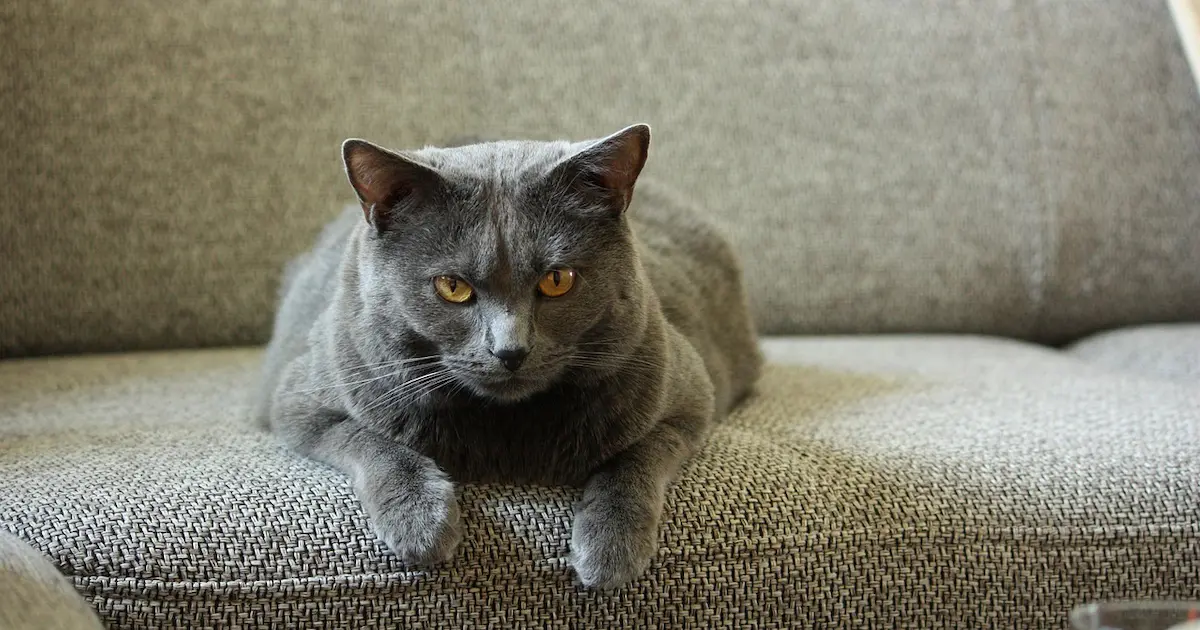
Picture this. You’re reading on the couch and you get that prickly feeling of being watched. You look up, and there’s a stocky blue-gray cat sitting three feet away, copper eyes locked on you, completely silent. No meow. No demand. Just a patient little statue waiting for you to notice.
That’s the Chartreux. It won’t yell across the house for dinner like a Siamese. It’ll walk up, tap your arm with one paw, and stare at the cupboard until you get the hint.
This French cat has been charming people for centuries, and once you understand how it actually communicates, it’s hard to go back to a chattier breed. Here’s the honest, full picture before you decide to bring one home.
Chartreux Cat Stats at a Glance
| Origin | France, documented to the 18th century (legends go back further) |
| Weight (Male) | 10 to 16 lbs |
| Weight (Female) | 6 to 9 lbs |
| Lifespan | 11 to 15 years (some reach their late teens) |
| Coat | Short-to-medium, dense, woolly, water-repellent double coat |
| Colors | Blue-gray only (ash to slate) |
| Energy Level | Moderate |
| Grooming Needs | Low to Moderate (spikes twice a year) |
| Good With Kids | Yes, with gentle handling |
| Good With Other Pets | Yes, with a slow intro |
| Average Price | $750 to $2,500 from breeders |
Where the Chartreux Came From
The Chartreux is one of those breeds where the truth and the legend got tangled up a long time ago. The romantic story says these blue cats lived alongside Carthusian monks in France, quietly keeping the monasteries free of mice (and, the tale goes, prized for not breaking the monks’ vows of silence). Another version has their ancestors arriving with Crusaders returning from the East.
Here’s the thing: there’s no monastery record to back any of it up. What we do have is solid. The French naturalist Buffon described the breed in the 18th century, and the name “Chartreux” for blue cats shows up in a 1723 commerce dictionary. A Chartreux even appears in a 1747 French portrait, lounging in its owner’s arms.
For centuries these cats lived as working ratters in Paris and the French countryside. Both World Wars nearly wiped them out. In the early 20th century, two sisters (the Léger sisters) found a colony of woolly blue cats living on an island off Brittany and started breeding them carefully. That effort, plus later work by European cat fanciers, is why the breed still exists. Today the Chartreux is often called the national cat of France, and it’s recognized by the CFA, TICA, FIFe, and the GCCF, which granted it championship status in 2023.
What a Chartreux Actually Looks Like
The body is the giveaway. A Chartreux is built like a little tank: broad chest, heavy shoulders, thick neck, and a surprisingly dense, muscular frame hiding under soft fur. Then it stands on these relatively fine, slim legs. French breeders have a perfect nickname for the look: “a potato on toothpicks.” Once you’ve heard it, you can’t unsee it.
The coat only ever comes in one color: blue-gray, anywhere from pale ash to deep slate. It’s a double coat with a woolly, slightly resistant texture, almost like a sheepskin, and it’s water-repellent. (Try to bathe one and you’ll see how stubbornly the water beads off.) The fur often shows soft “breaks” rather than lying perfectly flat.
Then there are the eyes: round and a warm copper-to-gold, which pop beautifully against all that gray. And the face does this thing where the full cheeks and tapered muzzle create a permanent, gentle little grin. People aren’t imagining it. The “smiling cat of France” earns the name.
One detail new owners love: Chartreux kittens are often born with faint tabby ghost markings and slightly off eye color. As they grow, the stripes fade into solid blue and the eyes deepen to that copper glow. They’re also slow to mature physically, taking three to four years to fully fill out, so your “kitten” stays a work in progress for a while.
Is It Really a Chartreux? (How to Tell It From the Look-Alikes)
This is where a lot of people get burned. There are four solid blue-gray breeds that get mixed up constantly: the Chartreux, the Russian Blue, the British Shorthair (in its blue version), and the Korat. Plenty of “Chartreux” listings online are actually one of the others, or just a gray domestic shorthair. So before you fall for a photo, learn the tells.
Eye color is your fastest filter. The Chartreux and the blue British Shorthair both have copper-to-gold eyes. The Russian Blue and the Korat have green eyes (the Korat’s green can take a few years to fully come in). So if you’re looking at a green-eyed “Chartreux,” it isn’t one.
Coat texture splits the gold-eyed pair. The British Shorthair has a plush, crisp single-toned coat that never feels woolly. The Chartreux coat has that distinctive sheepskin texture and breaks. Run your hand through it and you’ll feel the difference.
Body and head shape seal it. The British Shorthair is chunkier overall with a rounder face and ears set wide and low. The Chartreux has a narrower muzzle, ears set a bit higher, and those famously slim legs under a heavy body. The Russian Blue is the slender, fine-boned, elegant one with a wedge-shaped head, nothing like the Chartreux’s robust build.
Quick cheat sheet:
- Copper eyes + woolly coat + slim legs + narrow muzzle = Chartreux
- Copper eyes + plush single coat + round face + chunky = British Shorthair
- Green eyes + slender, fine-boned + wedge head = Russian Blue
- Green eyes + heart-shaped face + single coat = Korat
If a seller can’t tell you which of these their cat is, or hands you a vague answer, treat that as a red flag.
Living With a Chartreux: The Quiet One-Person Cat
If you’ve only ever had loud cats, the Chartreux will reset your expectations. Many barely vocalize at all. Some are essentially mute. When they do “speak,” it’s usually a soft chirp or trill rather than a real meow. The CFA flat-out describes some Chartreux as silent communicators.
So how does a near-silent cat tell you what it wants? With everything else. A Chartreux uses its eyes, its body, and gentle touches. You’ll learn its language fast: a steady stare at the food bin, a paw on your forearm, a toy carried over and dropped at your feet. Honestly, it makes you a more attentive owner, because you can’t tune out a cat that doesn’t make noise.
The other defining trait is loyalty. Chartreux tend to pick one person as their human and shadow them from room to room. They’re not clingy in a needy, anxious way. They just like to be near you, observing, ready to join in. The rest of the household still gets affection, but the bond with their chosen person runs deepest.
They’re also smarter than they let on. Chartreux are quiet observers who figure things out. Owners report cats that learn to open door latches, flick light switches, fetch toys, and respond to their names. Some even take to leash walks. There’s a real dog-like streak here: devoted, trainable, and game to play if you start the game.
Temperament-wise, they’re famously level-headed. A Chartreux would rather walk away from a conflict than fight. That mellow, adaptable nature makes them good travelers and easy roommates. The flip side of all that calm and quiet? They’re so undemanding that a busy owner can accidentally under-engage them. A bored Chartreux won’t scream about it. It’ll just quietly get a little chunky and a little dull. You have to remember to play.
Is the Chartreux Right for You?
Let’s be honest about fit, because no breed suits everyone.
A Chartreux is a great match if you:
- Want a calm, affectionate cat without the constant noise
- Are home enough to be someone’s chosen person, but also need a cat that’s fine solo during work hours
- Like the idea of a trainable, dog-ish cat that plays fetch
- Have a fairly stable, predictable home (they love routine)
- Are a first-time owner who wants something gentle and forgiving
Think twice if you:
- Want a lap cat that’s surgically attached to you 24/7 (they’re loving but independent)
- Crave a chatty, interactive talker (you’ll be disappointed)
- Can’t commit to a possible months-long breeder waitlist
- Have a chaotic, high-traffic household with no quiet retreat for the cat
- Are hoping for a hypoallergenic cat (no such thing, and the dense double coat sheds)
Chartreux Health Issues to Know About
The good news: thanks to careful breeding and a hardy working-cat heritage, the Chartreux is generally a robust, healthy breed. But “generally healthy” isn’t “risk-free,” so here’s what responsible owners watch for.
Patellar luxation. This is the one most associated with the breed. The kneecap slips out of its groove, which can cause a limp or a little “bunny hop” when your cat moves. Mild cases often just need monitoring and joint support; severe cases sometimes need surgery. Keeping your cat lean takes pressure off those joints.
Hypertrophic cardiomyopathy (HCM). This thickening of the heart muscle shows up across many cat breeds. It can be silent early on, which is why regular vet checks and listening for heart murmurs matter.
Urinary and kidney issues. Some Chartreux are prone to urinary tract problems, including struvite crystals. Plenty of fresh water and a good diet help a lot here.
Dental crowding. Their strong jaw structure can lead to misaligned or crowded teeth, so dental care isn’t optional. Brush a few times a week if your cat tolerates it, and keep up with vet dental checks.
Obesity. This is the sneaky one. Chartreux aren’t hyperactive, and that calm streak plus a healthy appetite adds up fast. Extra weight feeds nearly every other problem on this list. Measure meals, go easy on treats, and play daily.
A rare genetic disorder called mucopolysaccharidosis (MPS VI) exists in the breed too, which is exactly why buying from a breeder who does genetic health testing is worth the wait and the money.
Grooming and Coat Care
Most guides call the Chartreux “low grooming,” and that’s mostly true. The woolly double coat doesn’t mat easily, so a weekly brush usually keeps it in good shape and cuts down on the hair you find on your clothes.
But here’s the part those guides skip: twice a year, that undercoat blows out. In spring and fall, a Chartreux can shed seriously, and “weekly” becomes “two or three times a week” if you don’t want fur tumbleweeds. A good de-shedding tool during those weeks saves your furniture and your vacuum.
A useful tip for that woolly texture: combing works better than brushing for getting down into the dense undercoat. Round out the routine with monthly nail trims, regular ear checks, and the dental care mentioned above. Baths are rarely needed, and honestly they’re a fight, because that water-repellent coat does not want to get wet.
Feeding and Diet
There’s nothing exotic about feeding a Chartreux. Like every cat, it’s an obligate carnivore, so the goal is a high-quality, protein-first diet built around real animal protein. Look for named meats (chicken, turkey, fish) high on the ingredient list.
Because this breed leans toward weight gain, portion control matters more than the brand. Measure meals instead of free-feeding, and keep treats to about 10% of daily calories. A mix of wet and dry food works well: the moisture in wet food supports urinary and kidney health, which is handy given the breed’s tendencies, while some dry food can help with crunch.
Always keep fresh water available, and consider a pet fountain, since plenty of cats drink more from running water. That extra hydration is genuinely helpful for a breed that can be prone to urinary issues.
Exercise, Play, and Enrichment
A Chartreux has moderate energy with a strong “off” switch. It’ll happily nap in a sunbeam for hours, then turn on a dime into a lightning-fast hunter the second a toy moves. Those reflexes are a leftover from its ratter past, and they’re impressive.
The trick is making sure the play actually happens. Because these cats don’t pester you for it, the burden is on you to initiate. Two short, energetic play sessions a day keep them fit and their clever brains busy. Wand toys, puzzle feeders, and fetch (yes, real fetch) are big hits.
They’re indoor cats at heart and adapt fine to apartments, as long as they get vertical space and stimulation. A tall cat tree or a window perch where they can survey their kingdom goes a long way. Some Chartreux even enjoy harness walks if you introduce them slowly.
Chartreux With Kids, Dogs, and Other Cats
This is one of the breed’s quiet superpowers. The Chartreux is patient, tolerant, and non-confrontational, which makes it a solid pick for busy households.
With kids: Generally great, especially with children old enough to be gentle. A Chartreux would rather slip away than swat, so it usually handles a noisy home well. Just give it a quiet retreat to escape to when it’s had enough.
With dogs: Often a real friendship, particularly with calm dogs who respect the cat’s space. That dog-like Chartreux temperament helps the two species find common ground.
With other cats: Usually fine with a proper, slow introduction. Separate feeding stations and vertical space reduce friction. If you’re out at work a lot, a second pet can actually be a nice companion for your Chartreux during the day.
What to Expect as Your Chartreux Grows and Ages
One thing that surprises new owners: this breed grows up slowly. Plan for a long, drawn-out kittenhood.
Year 1: Your kitten reaches close to full height but still looks lanky and leggy. Expect goofy energy, ghost tabby markings fading to solid blue, and eye color deepening toward copper.
Years 2 to 4: The “potato” fills in. Males especially keep adding muscle and those signature cheeks until around their fourth birthday. Females settle a bit sooner, around three. They stay playful through all of this.
Adulthood: A settled, dignified, deeply bonded companion. Routines matter to them now, so they’ll have favorite spots and little daily rituals.
Senior years (10+): Move to twice-yearly vet visits, watch for weight changes, and keep joints comfortable (those knees again). Add soft bedding, easier-access litter boxes, and gentle play to keep an aging Chartreux engaged. With good care, plenty of them stay sprightly well into their teens.
How Much Does a Chartreux Cost?
Chartreux aren’t cheap, mostly because they’re rare. From a reputable breeder, expect to pay roughly $750 to $2,500, with well-established show-quality catteries sometimes going higher. Pet-quality kittens sit at the lower end; cats from champion lines with full health testing cost more.
Adoption is technically cheaper at around $50 to $150, but here’s the catch: Chartreux almost never end up in shelters. They’re too rare, and most breeders include a clause requiring the cat be returned to them if an owner can’t keep it. So while adoption is the dream, it’s rarely realistic for this specific breed.
Don’t forget the ongoing costs. Budget for quality food, litter, annual (then twice-yearly) vet care, dental cleanings, and pet insurance. The good news is that a Chartreux doesn’t cost more to maintain than any other healthy cat once it’s home.
One red flag worth repeating: if a “breeder” is selling a Chartreux suspiciously cheap with no paperwork, no health testing, and no questions for you, walk away. Cheap usually means a backyard operation, a misidentified gray cat, or worse.
Where to Find a Chartreux Ethically
Because the breed is so uncommon, your realistic path is a reputable breeder, and you’ll likely wait. Many good catteries have waitlists running months long. Patience here protects you from scams and from health problems down the road.
A neat detail that doubles as a verification tool: in France, purebred cats are registered with a letter assigned to each birth year, so kittens born in the same year often have names starting with the same letter. It’s a clever system that encodes a cat’s birth year right into its registered name, and it’s a sign you’re dealing with a serious, paperwork-keeping breeder.
What a good breeder looks like:
- Registered with CFA, TICA, or a recognized club, and happy to prove it
- Does genetic and health screening (ask specifically about HCM and patellar issues)
- Lets you see where the kittens are raised, or shares plenty of video
- Asks you lots of questions; they care where their kittens go
- Provides a health guarantee and a return clause
What to avoid:
- Sellers who can’t confirm the cat is actually a Chartreux and not a look-alike
- No health records, no contract, cash-only, ship-anywhere-today vibes
- Always having kittens “ready now” (a rare breed shouldn’t have endless instant stock)
- Prices that seem too good to be true
Similar Breeds to Consider
If you love the Chartreux but want to weigh your options, these come closest:
- Russian Blue: Same blue coat, but slimmer, more reserved, with green eyes. Great for a quieter, more delicate-looking cat.
- British Shorthair: Chunkier and rounder with a plush single coat. More easygoing and a touch more independent.
- Korat: A rarer blue breed with a heart-shaped face and green eyes. More vocal and high-energy than the Chartreux.
- Nebelung: Essentially a long-haired Russian Blue type, shimmery and gentle, if you want that gray look with more floof.
- Domestic Shorthair (gray): Often available in shelters right now, for a fraction of the cost and just as lovable, if breed pedigree isn’t your priority.
Common Myths and Misconceptions About the Chartreux
Myth: Chartreux were bred by monks to be silent. It’s a lovely story with zero documentation behind it. They’re naturally quiet, but no monastery records confirm the legend.
Myth: A Chartreux is just a gray cat or a Russian Blue. Nope. It’s a distinct breed with a specific woolly coat, copper eyes, and stocky build. The look-alikes have telltale differences (see the ID section above).
Myth: They’re low-maintenance because they barely shed. They’re easy most of the year, but that undercoat blows out hard twice a year. Budget extra grooming time in spring and fall.
Myth: Quiet means antisocial. Not even close. A Chartreux is intensely people-bonded. It just expresses love through presence and eye contact instead of noise.
Myth: They’re hypoallergenic. No cat truly is, and a dense double coat doesn’t help. If allergies are severe, this isn’t your shortcut.
Frequently Asked Questions About Chartreux Cats
Q: Do Chartreux cats meow?
Rarely. Many Chartreux are nearly silent, and some are essentially mute. When they do vocalize, it’s usually a soft chirp or trill rather than a full meow, and they communicate mostly through eye contact and body language.
Q: Are Chartreux cats good for first-time owners?
Yes. Their calm, gentle, low-drama temperament makes them forgiving and easy to live with. Just be ready to initiate playtime yourself, since they won’t demand it.
Q: How much does a Chartreux cost?
Expect around $750 to $2,500 from a reputable breeder, sometimes more for show-quality lines. Adoption is cheaper but very rare, since these cats almost never appear in shelters.
Q: What’s the difference between a Chartreux and a Russian Blue?
Eye color is the quickest tell: Chartreux have copper-gold eyes, Russian Blues have green. The Chartreux is also stockier with a woolly coat, while the Russian Blue is slim and fine-boned with a plush, even coat.
Q: Do Chartreux cats shed a lot?
Moderately most of the year, with heavy shedding twice a year when they blow out their undercoat. Weekly combing keeps it manageable, increasing to a few times a week during spring and fall.
Q: How long do Chartreux cats live?
Usually 11 to 15 years, and some reach their late teens with good care. Keeping them lean and staying on top of vet checks helps them live to the high end of that range.
Q: Are Chartreux cats friendly with kids and dogs?
Generally very. They’re patient and non-confrontational with gentle children, and they often befriend calm dogs. A slow introduction and a quiet retreat space help things go smoothly.
Q: Why are Chartreux cats so rare?
The breed nearly went extinct after both World Wars and was rebuilt from a small number of cats. There are relatively few breeders today, so kittens are limited and waitlists are common.
Final Verdict: Should You Get a Chartreux?
If you want a cat that constantly performs for attention, this isn’t the one. But if you want a steady, loyal companion who picks you, watches over you, and “talks” with a single paw on your arm, the Chartreux is something special.
It’s a gentle, low-noise, surprisingly clever cat that fits beautifully into calm homes and busy ones alike. The trade-offs are real: you’ll wait to find one, you’ll pay for the privilege, and you’ll need to remember to initiate play and brush hard come shedding season. But ask anyone who’s lived with a Chartreux, and they’ll tell you the quiet devotion of this smiling French cat is worth every bit of it.
Take your time, find an ethical breeder, and get ready to learn a whole new silent language. Your Chartreux will teach it to you, one patient stare at a time.

Hello and welcome to The Ideal Cat!
We are some passionate cat owners from different professions. We love our cats and have a lot of experience in how to care for our pets. We are incredibly excited to share our knowledge, experience, and research with you. So you can take good care of your loving cat. We will answer most of the common questions about owning cats, taking care of them, etc. If you have any question contact with us. Thanks for visiting! Enjoy the content.
