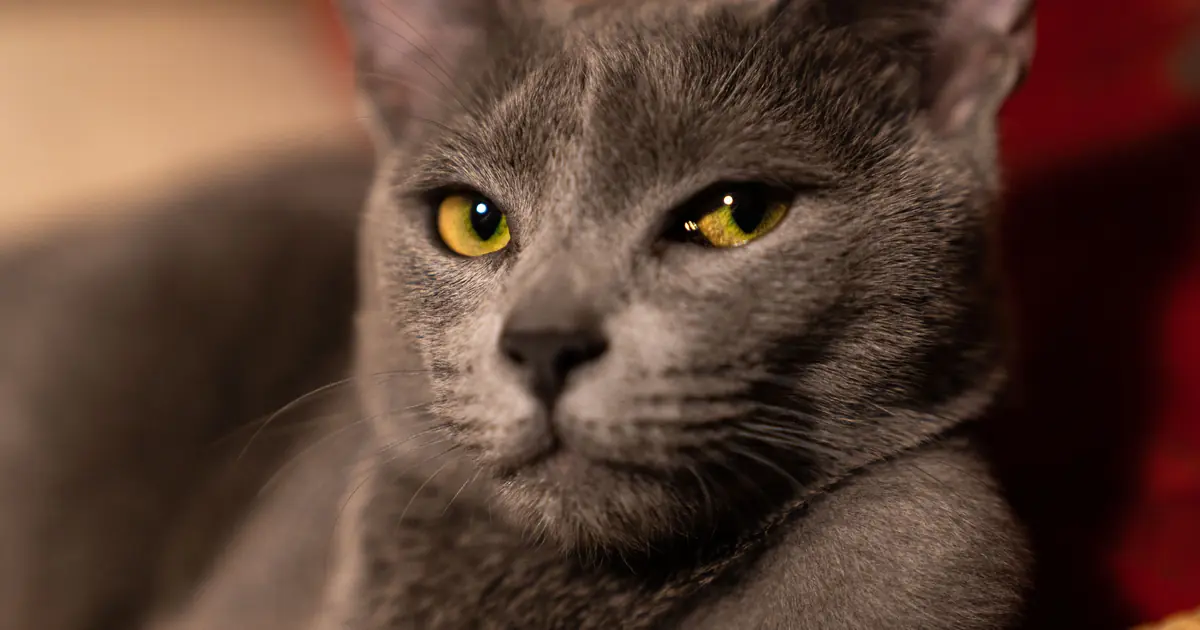
Picture a cat the color of storm clouds, curled up in a sunbeam. There’s something about a grey cat that just looks expensive, right? Like they should have a butler.
Here’s a fun bit of insider knowledge before we dive in: cat people don’t call these cats grey. They call them blue. Same beautiful smoky coat, fancier name. Below you’ll meet the most popular grey (blue) cat breeds, from the famous Russian Blue to the rare French Chartreux, plus the truth about whether “grey” is a breed and whether these cats are easier on allergies. Spoiler: one of those answers might surprise you.
- “Grey” in cats is officially called “blue,” a diluted version of black fur caused by a recessive gene (the MLPH dilution gene).
- The Russian Blue, Chartreux, Korat, and Nebelung are bred to always be grey, so every purebred cat in these breeds is blue.
- Grey is a color, not a breed, and it can appear in dozens of breeds plus everyday mixed-breed cats.
- Grey cats are not hypoallergenic; no cat truly is, since all cats produce the Fel d 1 allergen.
- Russian Blues have green eyes, while the Chartreux and British Blue have copper or gold eyes, an easy way to tell look-alikes apart.
Why is a grey cat called a “blue” cat?
A grey cat is called “blue” because that soft slate-grey color is genetically a diluted form of black. The color comes from a recessive gene called the dilution gene (a mutation in the MLPH gene). When a cat inherits two copies of it, the black pigment in each hair spreads out unevenly instead of packing in tightly, so the fur reads as smoky grey rather than jet black.
Breeders and cat registries have used the word “blue” for this shade for over a century. To your eyes it’s grey. To a show judge it’s blue. Both are right. And the same gene has a partner effect: it turns orange cats into cream and brown tabbies into soft “blue tabbies.” So that gorgeous storm-cloud coat is really just black fur that got beautifully watered down.
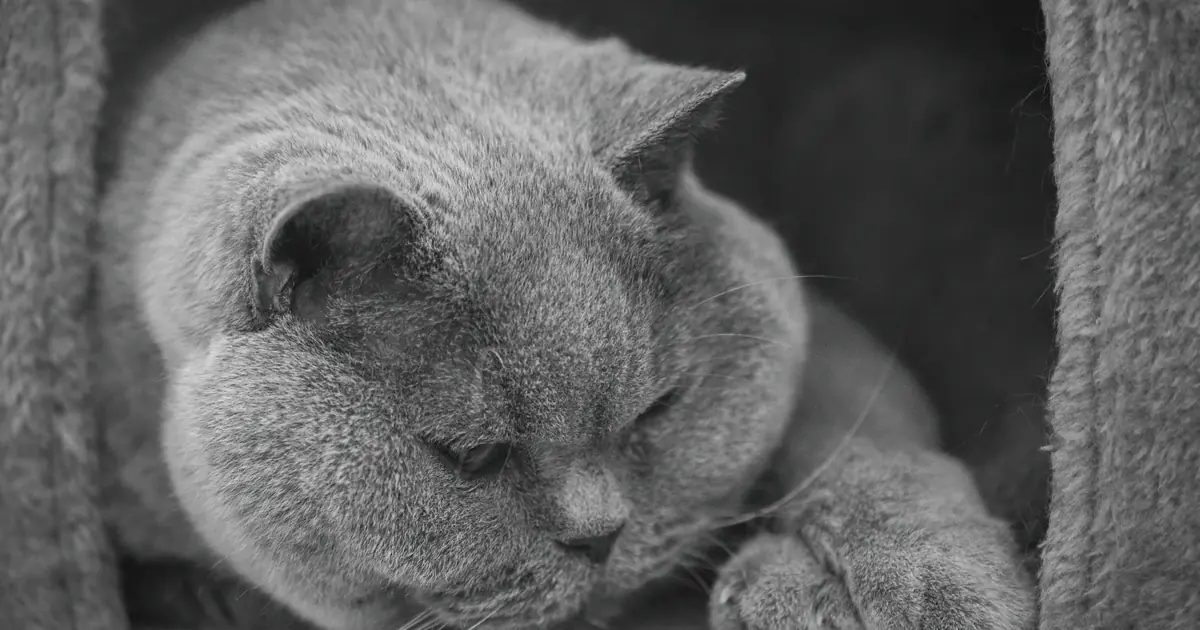
What are the most popular grey cat breeds?
The most popular grey cat breeds are the Russian Blue, Chartreux, British Shorthair (in its blue variety), Korat, and Nebelung. A handful of breeds, like the Russian Blue, Chartreux, and Korat, are only ever grey, while many others simply carry grey as one color option among many. Here’s how the best-known blue breeds stack up at a glance.
| Breed | Origin | Coat | Eyes | Personality in a nutshell |
|---|---|---|---|---|
| Russian Blue | Russia | Short, dense double coat with a silver sheen | Vivid green | Gentle, reserved, deeply loyal to their person |
| Chartreux | France | Woolly, water-resistant double coat | Copper to orange | Quiet, calm, doglike and devoted |
| British Shorthair (blue) | United Kingdom | Plush, dense, teddy-bear coat | Copper or gold | Easygoing, mellow, undemanding |
| Korat | Thailand | Single, close-lying silky coat with silver tips | Luminous green (matures by age 4) | Social, playful, bonded and a bit jealous |
| Nebelung | United States | Semi-long, silky coat with a silver shimmer | Green | Gentle, shy with strangers, cuddly at home |
| Scottish Fold (blue) | Scotland | Dense, plush; folded ears | Gold or copper | Sweet, chill, people-oriented |
| Persian (blue) | Iran (Persia) | Long, flowing, high-maintenance coat | Copper | Quiet, regal, low-energy lap cat |
| Maine Coon (blue) | United States | Long, shaggy, weatherproof coat | Green, gold, or copper | Big, friendly, “gentle giant” |
| American Shorthair (blue) | United States | Short, dense, easy-care coat | Gold or green | Adaptable, laid-back, family-friendly |
| Sphynx (grey-skinned) | Canada | Hairless; grey pigment shows on the skin | Varies | Warm, clingy, attention-loving goofball |
| Norwegian Forest (blue) | Norway | Long, thick, waterproof double coat | Green, gold, or copper | Sturdy, mellow, quietly affectionate |
Want the deep dives? We have full guides on the Russian Blue, the Chartreux, and the gentle-giant Maine Coon. Now let’s meet each grey breed properly.
Russian Blue: the famous one
The Russian Blue is the world’s most recognizable grey cat, a short-haired breed from Russia known for its shimmering silver-blue coat and bright green eyes. The coat is a dense double layer that stands out slightly from the body, and each hair is tipped with silver, which is where that signature sheen comes from. Those emerald eyes against grey fur? Unforgettable.
Personality-wise, Russian Blues are gentle and a little shy. They often pick one favorite human and shadow them everywhere, while playing it cool with strangers. They’re quiet, tidy, sensitive to routine, and famously low-shedding.
Chartreux: the smiling monk cat
The Chartreux is a rare French breed with a woolly blue-grey coat and warm copper eyes, said to have been raised by monks in the French Alps centuries ago. Its double coat is thick and slightly water-resistant, with a texture more like sheep’s wool than typical cat fur. The rounded face and upturned mouth give the Chartreux a permanent gentle “smile.”
These cats are calm, observant, and famously quiet. Some Chartreux barely meow at all, and a few are nearly silent. They bond hard with their families and tend to follow their favorite person from room to room, doglike, without being needy about it.
British Shorthair (blue): the teddy bear
The blue British Shorthair, often called the “British Blue,” is the most popular color of Britain’s most popular breed, with a plush grey coat and round copper eyes. The coat is dense and crisp, standing up off the body like a teddy bear’s, and the whole cat has a chunky, rounded look. This is the breed that inspired the Cheshire Cat.
British Blues are the definition of easygoing. They’re calm, undemanding, and happy to supervise your day from a nearby cushion rather than your lap. Independent but affectionate, they’re a great fit for busy households.
Korat: the good-luck cat
The Korat is an ancient Thai breed prized as a symbol of good luck, with a silver-tipped blue coat and large, luminous green eyes. Unlike most grey breeds, the Korat has a single coat that lies close to the body, and the silver tipping creates a shimmering “halo” effect in the light. Fun fact: those green eyes can take up to four years to reach their full color.
Korats are social, playful, and deeply people-focused. They love to snuggle and bond closely, and they can get a touch jealous if another pet steals the spotlight. In Thailand, giving a pair of Korats is still considered a wish for prosperity.
Nebelung: the long-haired Russian Blue
The Nebelung is a semi-longhaired grey breed developed in the United States in the 1980s, essentially a Russian Blue with a longer, silkier coat. The name comes from a German word meaning “creature of the mist,” which fits the soft, shimmering silver-blue fur perfectly. The coat is medium-long rather than fully fluffy, with a fine, flowing texture.
Nebelungs are gentle, intelligent, and a little reserved. They’re shy with strangers but wonderfully affectionate with their own people, and many will happily learn to play fetch. Think of them as the plush, long-haired cousin of the Russian Blue.
The rest of the grey crew
Plenty of other breeds wear grey beautifully, even if they aren’t grey-only. The Scottish Fold shows up in a lovely blue with its famous folded ears. The Persian has a stunning long blue coat that needs daily brushing. The Maine Coon, Norwegian Forest Cat, and American Shorthair all come in blue as one color among many. And the hairless Sphynx can be “grey” too, since the dilution pigment shows right on its warm, suede-like skin. Grey, it turns out, gets around.
Is grey a cat breed?
No, grey is not a cat breed. Grey (blue) is a coat color that appears across many different breeds and in countless mixed-breed cats. So a “grey cat” could be a purebred Russian Blue, a blue British Shorthair, or the smoky rescue kitten from down the street.
This trips people up all the time. When someone says they have a “grey cat,” they’re describing color, not lineage, the same way “black cat” or “orange cat” describes a look rather than a breed. Only a few breeds, like the Russian Blue, Chartreux, and Korat, are grey and nothing else. Everyone else just happens to carry the dilution gene.
Are grey cats hypoallergenic?
No, grey cats are not hypoallergenic. No cat is truly hypoallergenic, because every cat produces Fel d 1, the protein in saliva and skin oils that triggers most cat allergies. Coat color has nothing to do with it.
The Russian Blue often gets tagged as “hypoallergenic,” but that’s a myth, and even the Russian Blue Fanciers say they don’t know how the idea started. Here’s the kernel of truth: Russian Blues have a dense, low-shedding coat that can trap allergens closer to the skin, so slightly less dander floats around your home. That may help people with mild allergies, but the cat still makes plenty of Fel d 1. In fact, allergen levels vary wildly from one individual cat to the next, even within the same breed. If allergies are a real concern, read our honest breakdown of which cat breeds are actually easier on allergies before you commit.
What about grey-and-white or grey tabby cats?
Grey-and-white and grey tabby cats are simply grey coats with an added pattern, and they’re extremely common in everyday house cats. A grey-and-white cat carries white spotting on top of its blue base color, while a grey tabby (often called a “blue tabby”) shows the classic striped or swirled tabby pattern in soft grey instead of brown.
These patterned greys usually aren’t purebreds. Most are wonderful mixed-breed cats who inherited the dilution gene plus a pattern gene. If your grey cat has stripes, a big “M” on the forehead, or swirls on the sides, you’ve got a blue tabby on your hands. Curious how tabby patterns work? Our guide on what makes a cat a tabby explains the stripes, the “M,” and everything in between.
For breed standards and official color descriptions, the Cat Fanciers’ Association and The International Cat Association keep detailed, vet-reviewed breed profiles worth a look.
Grey cat breeds FAQ
Q: What is the most popular grey cat breed?
The Russian Blue is the most popular and recognizable grey cat breed worldwide, known for its shimmering silver-blue coat and bright green eyes. The blue British Shorthair is a close second and is the top-selling color of the UK’s most popular breed.
Q: Why is a grey cat called a blue cat?
Cat breeders and registries call grey cats “blue” because the color is genetically a diluted form of black fur, created by a recessive dilution gene. To the human eye it looks grey, but the official color name in the cat world has always been blue.
Q: Are grey cats rare?
Grey is one of the more common cat colors overall, since the dilution gene is widespread in domestic cats. However, some grey breeds are genuinely rare, like the Chartreux, which was nearly wiped out during the World Wars and is still uncommon today.
Q: What is the difference between a Russian Blue and a Chartreux?
The easiest tell is the eyes: Russian Blues have vivid green eyes, while the Chartreux has copper or gold eyes. Russian Blues also have a silvery, tipped double coat, while the Chartreux has a woolly, water-resistant coat and a rounder, “smiling” face.
Q: Are all grey cats purebred?
No. Most grey cats, especially grey-and-white and grey tabby cats, are mixed-breed house cats that simply inherited the dilution gene. Only a few breeds, such as the Russian Blue, Chartreux, and Korat, are exclusively grey.
Q: Do grey cats have a specific personality?
No, coat color does not determine personality. A cat’s temperament comes from its breed, genetics, and upbringing, not its color. Even so, popular grey breeds like the Russian Blue and Chartreux happen to share a reputation for being calm, gentle, and loyal.
Q: What color eyes do grey cats have?
It depends on the breed. Russian Blues, Korats, and Nebelungs have green eyes, while the Chartreux and blue British Shorthair have copper or gold eyes. Mixed-breed grey cats can have green, gold, yellow, or copper eyes.
Q: Are grey cats good pets?
Yes, grey cats make wonderful pets, and the popular grey breeds are especially known for being affectionate and easygoing. Since grey is just a color, focus on matching a breed’s energy and grooming needs to your home rather than picking by coat shade.
Bottom line: grey cats aren’t a breed, they’re a color, and one of the prettiest ones going. Whether you fall for a green-eyed Russian Blue, a smiling Chartreux, or a smoky tabby rescue with an “M” on its forehead, you’re looking at the same lovely dilution gene at work. Pick the cat whose personality fits your life, and let that gorgeous storm-cloud coat be the happy bonus.

Hello and welcome to The Ideal Cat!
We are some passionate cat owners from different professions. We love our cats and have a lot of experience in how to care for our pets. We are incredibly excited to share our knowledge, experience, and research with you. So you can take good care of your loving cat. We will answer most of the common questions about owning cats, taking care of them, etc. If you have any question contact with us. Thanks for visiting! Enjoy the content.
