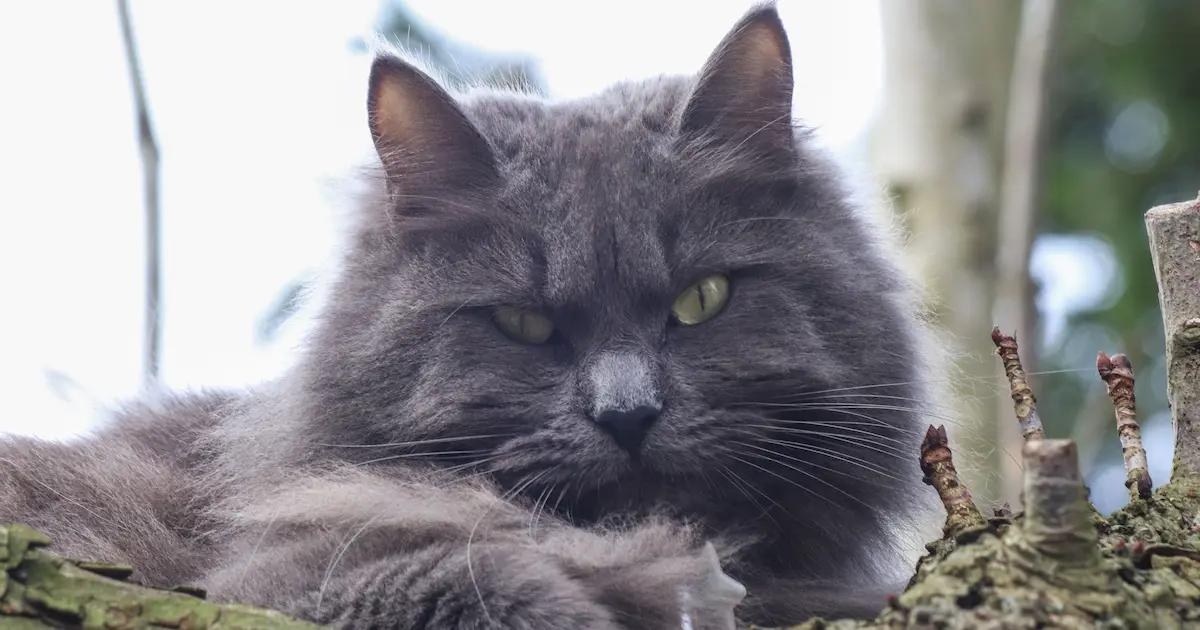
You spot a grey cat with a silvery shimmer and big green eyes, and your brain immediately goes: “Is that a Russian Blue? Or something fancier?” If the fur is long and soft instead of short and sleek, you might be looking at one of the rarest cats in the world.
That’s the Nebelung. A cat so uncommon that most people have never heard the name, let alone met one in person. They’re sweet, they’re shy, and honestly, the hardest part of owning one is finding one at all.
So before you start picturing this misty grey beauty curled on your shoulder, let’s talk about what living with a Nebelung is really like. The good, the quirky, and the stuff the breeder websites tend to skip.
The Nebelung at a Glance
| Origin | United States (Colorado), 1980s |
| Weight (Male) | 10 to 15 lbs |
| Weight (Female) | 7 to 11 lbs |
| Lifespan | 11 to 18 years |
| Coat | Medium-long, soft double coat |
| Colors | Blue (grey) with silver-tipped guard hairs |
| Energy Level | Moderate |
| Grooming Needs | Low to Moderate |
| Good With Kids | With supervision (calm kids ideal) |
| Good With Other Pets | Yes, with slow intros |
| Average Price | $600 to $1,200 from breeders (sometimes higher) |
What Is a Nebelung Cat?
The short version: a Nebelung is basically a Russian Blue with long, silky hair. Same elegant build, same shimmering blue coat, same green eyes, just fluffier.
The name comes from the German word for mist, “Nebel,” which suits a cat whose silver-tipped fur seems to glow softly in the right light. People sometimes call them “Long-Haired Russian Blues,” and while that’s technically not the correct breed name, you can see why it sticks.
Here’s the thing that surprises most people: this isn’t some ancient bloodline. The Nebelung is one of the youngest pedigree cats around, and it started almost by accident with one woman and a single fluffy kitten.
History: A “Creature of the Mist” Born in Colorado
The Nebelung story begins in the 1980s with a cat lover named Cora Cobb. She had a black domestic shorthair and a longhaired black male who looked a bit like an Angora. In 1984, that pairing produced a litter with one standout: a longhaired, all-blue kitten she named Siegfried.
A second litter the next year gave her a matching blue female, Brunhilde. Both names come from an old German saga, which is likely where the “Nebelung” name partly comes from too. Cobb looked at these two shimmering grey cats and thought: there might be a whole breed in here.
She reached out to a feline geneticist, Solveig Pflueger, who helped her shape a breeding plan. The early standard leaned heavily on the Russian Blue, since these cats looked so similar. In fact, the Russian Blue became the breed’s accepted outcross, which is how Nebelungs keep enough genetic variety to stay healthy.
The International Cat Association granted the Nebelung new breed status in 1987 and full championship recognition in 1997. Several other registries followed, including the WCF, ACF, and GCCF. One big name still hasn’t signed on though: the Cat Fanciers’ Association does not currently recognize the breed, which is part of why they stay so rare in the United States.
What a Nebelung Actually Looks Like
A Nebelung is a medium-sized cat with a long, lean, graceful body. They look elegant rather than chunky, with long legs, a long plumed tail, and a wedge-shaped head. Males usually carry a bit more size and often grow a fuller neck ruff, almost like a tiny lion’s mane.
The coat is the showstopper. It’s a soft, double-layered, medium-long blue that runs evenly grey from root to tip. Silver-tipped guard hairs give the fur its signature shimmer, usually most visible around the head and shoulders. There are little tufts between the toes and behind the ears, which is one of those small details that makes them so charming up close.
Then there are the eyes: wide-set, oval, and a vivid green that deepens as the cat matures. Kittens often start with yellowish eyes that shift toward green over time.
One thing worth knowing: a Nebelung is a slow bloomer. That gorgeous adult coat and rich eye color can take up to two years to fully come in. So if your kitten looks a little plain at first, give it time.
Nebelung vs Russian Blue: How to Actually Tell Them Apart
This is the question that brings most people here, so let’s settle it properly. Nebelungs and Russian Blues share a coat color, eye color, and a lot of DNA, so the mix-up is constant. Here’s how to tell which one you’re looking at.
Look at the coat length first. This is the easiest tell. A Russian Blue has a short, dense, plush coat that feels like velvet. A Nebelung has visibly longer fur, a feathery tail, and those little toe and ear tufts. If the cat looks fluffy, it’s not a Russian Blue.
Check the body shape. Both are long and elegant, but the Nebelung tends to look a touch sturdier and longer overall, partly because of all that fur.
Notice the personality, over time. Both breeds are reserved with strangers and devoted to family. But many owners find the Nebelung leans a bit more clingy and “velcro,” following you room to room, while the Russian Blue is a little more independent.
Now the honest part. If a grey cat showed up in a shelter with no papers, no breeder, and no pedigree, there is almost no way to confirm it’s a true Nebelung. The breed is so rare that a fluffy grey rescue is far more likely to be a mixed-breed longhair that happens to be the same color. That’s not a bad thing at all, but it matters a lot if someone is charging you a “purebred” price. More on that scam later.
Living With a Nebelung: The Real Personality
If you want a cat that ignores you and lives its own life, this is not your breed. Nebelungs are deeply attached to their humans. They’re the type to follow you into the bathroom, supervise your cooking, and drape themselves across your shoulders like a warm grey scarf.
With their own family, they’re affectionate, gentle, and often surprisingly chatty in a soft, melodic way. A lot of owners describe them as “dog-like,” and they mean it: these cats can learn to sit, come, and play fetch, and they genuinely want to be near you.
With strangers, though? Totally different cat. A Nebelung will often vanish under the bed the moment your doorbell rings. They’re shy, slow to warm up, and they hate chaos. A loud, busy, unpredictable household stresses them out.
They’re also creatures of habit. Move their feeding time, rearrange the furniture, or suddenly start working from the office after months at home, and a sensitive Nebelung may sulk or get anxious. The flip side of that loyalty is sensitivity, and it’s worth respecting.
One contradiction you’ll see online: some sources say Nebelungs are fine left alone, others say they get anxious. Both are true, and the deciding factor is socialization. A well-socialized adult on a steady routine can handle a regular workday just fine. A poorly socialized or change-stressed cat will struggle. The routine is what protects them.
Is a Nebelung Right for You?
Let’s be real about fit, because the wrong home makes for an unhappy cat.
A Nebelung is a great match if you:
- Have a calm, fairly quiet home with a predictable rhythm
- Want a cat that bonds hard and wants to be involved in your day
- Can offer a quiet retreat where your cat can hide when overwhelmed
- Are patient enough to let a shy cat warm up on its own timeline
- Don’t mind a bit of grooming and a slow-developing coat
A Nebelung is probably the wrong choice if you:
- Host a lot of guests or live in a noisy, high-traffic household
- Want a confident, social cat that greets everyone at the door
- Travel constantly or have a wildly unpredictable schedule
- Have very young, very loud kids who can’t give a shy cat space
- Need a cat you can find and bring home quickly (these take patience and a waitlist)
Honestly, the hardest requirement isn’t temperament or space. It’s the search itself. We’ll get to that.
Health Issues to Know About
Here’s some genuinely good news: the Nebelung is considered one of the healthier pedigree breeds, with no breed-specific inherited diseases that have been pinned down so far.
But let’s be honest about what “no known genetic conditions” actually means. It does not mean bulletproof. The breed is young and rare, so there simply isn’t decades of large-scale health data yet. Fewer cats studied means fewer documented patterns. So treat that clean record as “reassuring but incomplete,” not a guarantee.
The one thing genetics genuinely flags is the Russian Blue link. Because Russian Blues are used as an outcross, Nebelungs share DNA with a breed that’s reported to be prone to bladder and oxalate stones. This is the closest thing to a breed-relevant concern, so it’s worth understanding.
Bladder stones are hard mineral deposits that form in the bladder. Watch for straining in the litter box, frequent tiny trips with little result, or blood in the urine. A male cat who suddenly can’t pass urine at all is a medical emergency, full stop. Get to a vet immediately. The good news is that diet and early vet care manage most cases well.
Beyond that, the risks are the same ones every cat faces:
- Dental disease: extremely common in all cats; regular dental care helps a lot
- Obesity: a real risk for this breed (more below)
- Hyperthyroidism and kidney issues: typical senior-cat concerns, not breed-specific
The smartest move is simple: yearly vet checks, and twice-yearly once your cat hits its senior years. Catching things early is half the battle.
Grooming and Coat Care
The good news is that grooming a Nebelung is low-drama. That gorgeous double coat doesn’t mat as easily as you’d fear, and a thorough brushing once or twice a week is usually plenty to keep it sleek and tangle-free.
A stainless steel comb works well for getting through the longer fur and undercoat. Expect a bit more shedding during seasonal coat changes in spring and fall, so you may want to brush more often then. Most Nebelungs actually enjoy the attention, which makes it a nice bonding ritual.
Round out the routine with regular nail trims, occasional ear checks, and dental care. And one myth to bust now: a soft, silvery coat does not make a cat hypoallergenic. Nebelungs are not a “safe” choice for serious cat allergies.
Feeding and Diet
Nebelungs have a funny relationship with food. Many are picky eaters who turn their nose up at things, right up until they find something they love, at which point they’ll happily overeat. That combination is exactly how a sleek cat slowly turns into a chubby one.
Like all cats, they thrive on a protein-rich diet built around real meat. A measured portion split into a couple of meals beats free-feeding a full bowl all day, which makes overeating way too easy. If you’re out during the workday, an automatic feeder can portion things out so your cat isn’t tempted to graze nonstop.
Keep treats to a small slice of daily calories, and weigh your cat’s food rather than eyeballing it if you can. A Nebelung should keep a gentle hourglass shape when you look down from above, with ribs you can feel but not see.
Exercise, Play, and Keeping a Smart Cat Busy
Nebelungs sit in the moderate-energy zone. They’re not bouncing off the walls like a Bengal, but they’re smart, and a bored smart cat finds its own (often annoying) entertainment.
They love to climb and perch up high where they can survey their kingdom, so a tall cat tree near a window is close to a must-have. Interactive play is the real winner though. Wand toys, puzzle feeders, and a daily game of fetch keep both their body and their clever brain satisfied.
Most Nebelungs do beautifully as indoor cats, which is honestly safer given how rare and valuable they are. Just make sure indoor life comes with enough vertical space, scratching options, and one-on-one play time with you.
Living With Kids, Dogs, and Other Cats
A Nebelung can absolutely thrive in a multi-pet, family home, with one big caveat: everyone has to respect that this is a sensitive, shy cat.
Kids: Best with calm, gentle children who understand “leave the cat alone when it hides.” Toddlers who chase and grab will simply send a Nebelung into permanent hiding. Teach kids to let the cat come to them.
Dogs: Fine with a cat-friendly, mellow dog, introduced slowly. A boisterous dog that thinks the cat is a toy is a recipe for a stressed Nebelung. Take it in stages.
Other cats: Generally good companions, especially if your Nebelung is alone during workdays. Just do proper slow introductions over days or weeks rather than tossing them together. A second calm cat can actually ease their separation worries.
Lifespan and Aging Tips
Nebelungs are long-lived cats, commonly reaching 15 years and beyond, with some stretching toward 18 or more on good care. To get there, the basics matter more than anything fancy.
Keep their weight in check, since obesity quietly shortens lifespan and brings on arthritis and diabetes. Stay on top of dental health. And as they enter their senior years, switch to twice-yearly vet visits so things like kidney decline or thyroid issues get caught early.
Older Nebelungs may slow down and want more warmth and quiet. Soft bedding, easy litter box access, and a little extra patience go a long way as your misty friend grows grey in the muzzle, not just the coat.
How Much Does a Nebelung Cost?
From a reputable breeder, a Nebelung kitten typically runs $600 to $1,200, though pedigree, bloodline, and location can push prices higher, sometimes into the $1,500 to $2,500 range. If you have to import one from Europe or the UK, add shipping and paperwork costs on top.
Then there’s the rest of the budget. First-year costs (vaccines, spay or neuter, microchip, supplies) add several hundred dollars, and ongoing care like food, litter, and vet visits is an annual commitment. A long-lived cat is a long financial relationship, so plan accordingly.
Now the warning. If you see a “free Nebelung” or a suspiciously cheap one, be skeptical. Real Nebelungs are too rare and too much work to give away. A free or bargain “Nebelung” is usually one of two things: a scam, or a well-meaning person who assumes any fluffy grey cat must be the breed. Neither comes with the health screening or pedigree you’re paying a breeder for.
Where to Find a Nebelung Ethically
This is the part nobody tells you upfront: finding a Nebelung is genuinely hard. The original US cattery has long since retired, active American breeders are nearly nonexistent, and the breed is more common in the UK and parts of Europe than where it started.
Your realistic paths are:
- A registered breeder: Start with breed registries like TICA. Expect a waitlist, possibly a long one, and possibly an import.
- Breed-specific rescue: Rare, but worth a search. True Nebelungs almost never land in general shelters.
- Patience: The single most important “tool” here.
A good breeder will happily talk health, show you where the kittens are raised in the home, provide a written health guarantee, and never push a kitten out the door before it’s properly socialized. Run, don’t walk, from anyone who won’t offer a health guarantee, keeps kittens isolated, or sells through pet stores. Those are classic red flags in any breed.
Similar Breeds to Consider
If you love the Nebelung look or vibe but can’t find one, these come close:
- Russian Blue: The obvious one. Same color and temperament, short coat, far easier to find.
- Chartreux: A quiet, blue-grey French breed with a sweet, calm nature.
- British Shorthair (blue): Plush blue coat, mellow and sturdy, much more available.
- Korat: A silvery-blue, devoted, people-focused cat with big green eyes.
- Maine Coon (blue): If it’s the long fluffy coat you adore, a blue Maine Coon delivers, with a bigger, bolder personality.
Common Myths and Misconceptions
Myth: A Nebelung is just a long-haired Russian Blue.
Close, but not quite. They share ancestry and looks, but the Nebelung is its own recognized breed with its own standard, not simply a fluffy Russian Blue.
Myth: They’re hypoallergenic.
Nope. Their coat is lovely, but they still produce the allergens that trigger cat allergies. No cat is truly hypoallergenic.
Myth: Any grey fluffy cat is a Nebelung.
This one causes the most heartbreak. Lots of beautiful grey longhairs are mixed-breed cats, not Nebelungs. Color alone proves nothing.
Myth: They’re cold and aloof like their reputation suggests.
Only toward strangers. With their own people, Nebelungs are some of the most affectionate, velcro cats you’ll ever meet.
Frequently Asked Questions
Q: Are Nebelung cats rare?
Yes, very. They’re considered one of the rarest cat breeds in the world. Registry data shows only a few hundred registered over several decades, with very few active breeders today, especially in the United States.
Q: Are Nebelung cats hypoallergenic?
No. Despite their elegant coat, Nebelungs are not hypoallergenic. They produce the same allergy-triggering proteins as other cats, so they’re not a safe bet for people with significant cat allergies.
Q: How much does a Nebelung kitten cost?
Most reputable breeders charge between $600 and $1,200, though some lines and imports run higher. A “free” or very cheap Nebelung is usually a scam or a misidentified mixed-breed cat.
Q: Are Nebelungs good with children and other pets?
They can be, with calm kids and slow introductions. Because they’re shy and sensitive, they do best in homes where children and pets respect their need for quiet and space.
Q: Do Nebelung cats shed a lot?
They’re moderate shedders. Their double coat sheds more during seasonal changes in spring and fall, but weekly brushing keeps it under control most of the year.
Q: What is the difference between a Nebelung and a Russian Blue?
The biggest difference is coat length. Russian Blues have short, plush fur, while Nebelungs are clearly longhaired with a plumed tail and toe tufts. They share color, eye color, and a reserved temperament.
Q: How long do Nebelung cats live?
Typically 11 to 18 years, with many reaching 15 or more on good care. Keeping them at a healthy weight and staying current on vet visits helps them live a long, comfortable life.
Q: Are Nebelung cats high maintenance?
Not really, physically. Grooming is light and they’re healthy overall. The bigger commitment is emotional: they need routine, gentle handling, and a calm home, or they can get anxious.
Final Verdict: Should You Get a Nebelung?
The Nebelung is one of the most quietly lovable cats out there. Devoted, gentle, beautiful, and happiest curled up close to the person it adores. If you have a calm home and the patience to let a shy cat blossom, you’ll get a loyal little shadow that bonds for life.
But go in with eyes open. They need routine, they don’t love chaos, and they’re genuinely tough to track down. For most people, the real question isn’t “is this the right cat for me,” it’s “am I willing to wait and search for one.” If the answer is yes, a Nebelung will reward that patience for many soft, misty-grey years.

Hello and welcome to The Ideal Cat!
We are some passionate cat owners from different professions. We love our cats and have a lot of experience in how to care for our pets. We are incredibly excited to share our knowledge, experience, and research with you. So you can take good care of your loving cat. We will answer most of the common questions about owning cats, taking care of them, etc. If you have any question contact with us. Thanks for visiting! Enjoy the content.
