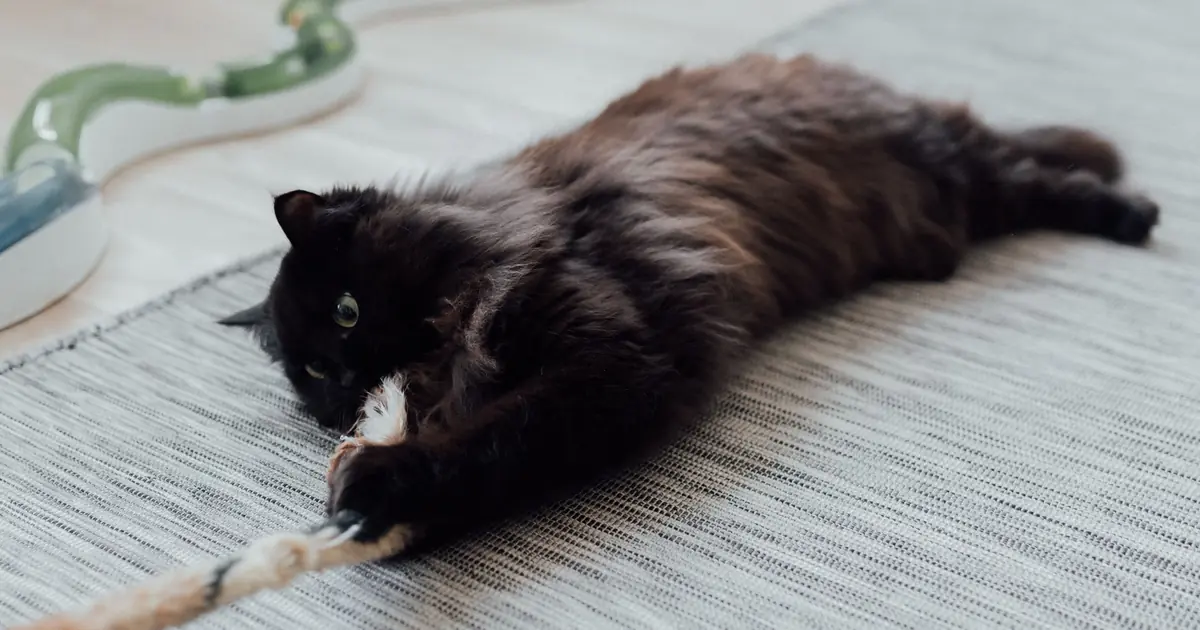
You throw the hair tie across the room without thinking. Two seconds later, it lands back in your lap. You throw it again. It comes back again. At some point you stop and think: wait, is my cat playing fetch with me?
Yes. Yes she is. And she’s not broken, weird, or secretly part dog. Fetch in cats is a real, documented behavior, and once you know why it happens, that little hair tie ritual makes a lot more sense.
- A 2023 study of 924 cat owners and 1,154 fetching cats found that 94.4% of cats started fetching entirely on their own, with no training from their owner.
- Fetch is rooted in a cat’s natural hunt-catch-carry sequence, the same instinct that drives them to chase and pounce on toys, bugs, and moving leaves.
- Cats in the study most often started fetching before age one, though plenty picked it up later in life too.
- Siamese, Tonkinese, Burmese, and Bengal cats showed up as the breeds most likely to fetch in that same research.
- Cats control the game. Researchers found cats started and ended fetch sessions more often than their owners did, so a cat who quits after three throws isn’t being difficult, she’s just done.
Do cats really play fetch?
Yes, cats really do play fetch, and it’s far more common than most people assume. Researchers Jemma Forman, Elizabeth Renner, and David Leavens at the University of Sussex ran a survey published in 2023 in the journal Scientific Reports and got responses about 1,154 cats who fetch. That’s not a handful of quirky outliers. It’s a real, widespread behavior that’s simply gone under-reported.
What made the study surprising wasn’t that cats fetch. It’s how they fetch. Cats retrieved everything from crumpled paper balls and bottle caps to pens, hair ties, and actual toys, across every age, indoor and outdoor cats, purebred and mixed-breed alike.
Why do cats play fetch?
Cats play fetch because it plugs directly into their hunting instinct: the hunt-catch-carry sequence hardwired into every domestic cat, from a barn mouser to a lap cat who’s never seen a mouse in her life. A thrown toy checks every box in that sequence at once.
Watch a fetch session and you’ll see the same pattern every time. She locks onto the moving object (the stalk), pounces and grabs it in her mouth (the catch), then trots it back toward you (the carry). That carry step mirrors how a mother cat brings food back to her kittens. You just happen to be the safe spot she’s carrying it to.
Fetch also doubles as a bonding ritual. A cat who initiates play with you is choosing to engage on her own terms, and that’s a pretty clear sign of trust.
If you want to keep that instinct engaged between fetch rounds, interactive cat toys that mimic prey movement scratch the same itch.
Which cat breeds fetch the most?
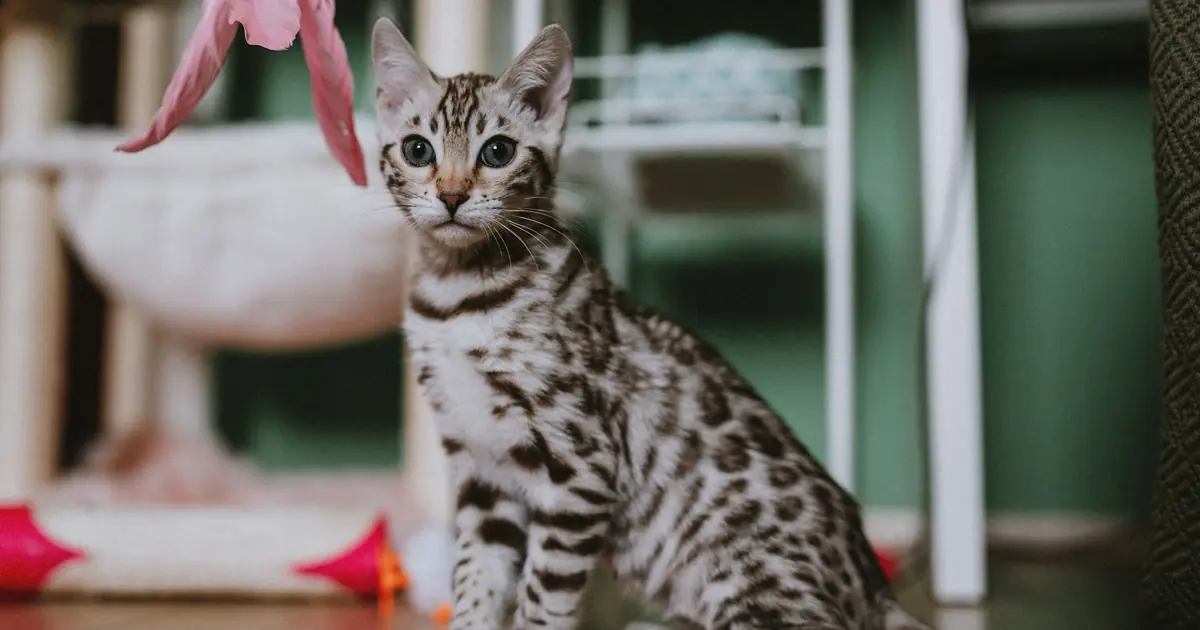
Siamese, Tonkinese, Burmese, and Bengal cats fetched the most often in the 2023 Sussex survey, breeds known for being vocal, people-oriented, and high energy. Maine Coons and Abyssinians aren’t part of that specific study’s top list, but owners and breed guides commonly report them as enthusiastic fetchers too, likely for the same reasons: smart, food-motivated, and closely bonded to their people.
Here’s how some of the most talked-about fetch breeds compare:
| Breed | Fetch Tendency | Why |
|---|---|---|
| Siamese | Very high | Vocal, people-focused, high energy, craves interaction |
| Tonkinese | Very high | Siamese-Burmese mix, playful and social |
| Burmese | High | Affectionate, dog-like attachment to owners |
| Bengal | High | Wild ancestry, strong prey drive, athletic |
| Maine Coon | Moderate to high (anecdotal) | Intelligent, trainable, food-motivated |
| Abyssinian | Moderate to high (anecdotal) | Active, curious, enjoys interactive games |
| Persian, British Shorthair | Lower | Calmer, lower-energy temperament overall |
Don’t let this table talk you out of trying, though. Breed is a tendency, not a rule. Plenty of ordinary mixed-breed cats fetch just as hard as any Bengal.
How do you teach a cat to fetch?
You teach a cat to fetch by starting with a toy she already loves, tossing it a short distance, and rewarding any interest in bringing it back. Most fetching cats figure this out on their own, but you can nudge a curious cat in that direction:
- Pick the right toy. Small, lightweight, and easy to carry in the mouth works best. Crinkle balls, small plush mice, and pom-poms tend to outperform big or heavy toys.
- Toss it a short distance. Start with just a few feet. A long throw across the room is intimidating and less likely to spark interest.
- Get excited when she chases it. Cats read your energy. A happy voice and some enthusiasm reinforce that this is a game worth playing.
- Reward any return, even a partial one. If she picks it up and wanders three steps toward you, that counts. Praise it, and toss a treat if she’ll take one.
- Keep sessions short. Five minutes is plenty. Cats lose interest fast, and a session that drags on kills the fun.
- Let her end the game. If she walks off after two throws, that’s fine. Forcing more reps tends to backfire with cats.
Some cats catch on in a single session. Others never quite get the “bring it back” part and are perfectly happy just chasing. Both outcomes are normal.
What are the best toys for playing fetch with a cat?
The best fetch toys for cats are small, light, and easy to grip in the mouth, think crinkle balls, felt mice, and pom-poms rather than anything bulky. A few solid options:
- Crinkle balls, the noise and light weight make them easy to bat and carry
- Small plush mice, close to a real prey shape and size
- Pom-pom balls or felt balls, soft, silent, and easy on teeth and gums
- Hair ties, a genuine cat favorite, but only under supervision since they’re a swallowing hazard
- Wadded-up paper balls, free, lightweight, and a lot of cats love the crinkle sound
Skip anything with small detachable parts, ribbon, or string left unsupervised. If you want a rotating lineup that keeps a cat engaged past week one, our guide to the best cat toys breaks down options by play style.
Why doesn’t my cat play fetch?
Your cat probably doesn’t play fetch simply because fetch isn’t her play style, and that’s completely normal. Personality, not defectiveness, explains most of the gap. Some cats are wired to chase and pounce but have zero interest in the “carry it back” step. Others would rather bat a toy under the couch and call it done.
Age and mood play a part too. A cat who never fetched as a kitten can suddenly start at age six, and a lifelong fetcher can lose interest entirely. Don’t force it. If she’s not a fetcher, she’s not failing at being a cat, she’s just playing a different game. Wand toys and puzzle feeders scratch that same hunting itch without a single retrieve required.
If your cat gets sudden bursts of sprinting energy instead of fetch-style play, that’s a separate and equally normal behavior, often called the zoomies.
Is playing fetch good for cats?
Yes, fetch is good for cats. It delivers real physical exercise plus mental stimulation in one activity, exactly what an indoor cat needs to stay at a healthy weight and avoid boredom-driven problem behaviors. A few short sessions a day burn energy that might otherwise turn into 2am zoomies or scratched furniture. PetMD notes that playing with purpose, the way you do with fetch, gives a cat both exercise and enrichment at once.
Play also gives cats a safe outlet for natural predatory behavior. The International Cat Care organization notes that regular, predictable play sessions help reduce stress and support wellbeing, since play lets cats express hunting instincts they’d otherwise have no outlet for indoors. Fetch checks that box especially well because it’s interactive: your cat isn’t just burning energy, she’s engaging with you.
Frequently Asked Questions
Q: Do all cats play fetch?
No, not all cats play fetch. It’s a real and fairly common behavior, but plenty of cats show zero interest in the “bring it back” part even if they love chasing toys. A 2023 study found fetching in over a thousand cats, but it’s still an individual trait, not something every cat does.
Q: Why does my cat bring me toys but drop them somewhere else?
Your cat is likely still completing the hunt-catch-carry sequence, just not delivering to the exact spot you’d expect. Cats often carry an object toward a person or a favored resting spot rather than directly into a hand, which is still a form of fetch behavior even if it looks incomplete.
Q: Can you teach an older cat to fetch?
Yes, you can teach an older cat to fetch, though not every cat will pick it up. Start with short, low-pressure sessions using a small, soft toy and reward any interest, even just chasing without retrieving. Some cats in the 2023 fetching study started this behavior well past kittenhood, so age alone isn’t a barrier.
Q: What breeds are most likely to fetch?
Siamese, Tonkinese, Burmese, and Bengal cats were the breeds most associated with fetching behavior in a 2023 survey of over 900 cat owners. Mixed-breed cats fetch plenty too, since breed is a tendency, not a guarantee.
Q: Is it safe to play fetch with hair ties?
Only under direct supervision. Cats genuinely love hair ties as fetch objects, but they’re a real swallowing and intestinal blockage risk if left unattended. Swap in a similarly small, soft toy like a pom-pom ball for unsupervised play instead.
Q: How long should a fetch session last?
Around five to ten minutes works well for most cats. Cats tend to lose interest faster than dogs do, and letting your cat end the game when she’s ready keeps fetch feeling fun instead of like a chore.
Q: Why did my cat suddenly stop playing fetch?
A sudden drop in play interest can be totally normal, cats’ interests shift with age, mood, and environment. But if it comes with other changes like reduced appetite, hiding, or lethargy, it’s worth a vet visit to rule out pain or illness, since cats are experts at masking discomfort.
Q: Is fetch better exercise than a laser pointer?
Fetch has one advantage a laser pointer doesn’t: a physical catch at the end. With laser play, a cat never actually gets to grab the “prey,” which some behaviorists say can build frustration over time. If you use a laser toy, pairing it with a physical toy for the final catch helps close that loop. Our guide on whether laser pointers are bad for cats covers this in more detail.
This article is educational and not a substitute for advice from your veterinarian. If your cat’s play habits change suddenly alongside signs like lethargy, appetite loss, or hiding, check in with a vet to rule out an underlying health issue.

Hello and welcome to The Ideal Cat!
We are some passionate cat owners from different professions. We love our cats and have a lot of experience in how to care for our pets. We are incredibly excited to share our knowledge, experience, and research with you. So you can take good care of your loving cat. We will answer most of the common questions about owning cats, taking care of them, etc. If you have any question contact with us. Thanks for visiting! Enjoy the content.
