
You slice up a bowl of strawberries, turn around for two seconds, and there’s your cat, nose deep in the bowl, batting one across the counter like it just insulted her. It’s a weirdly common scene. And it confuses a lot of cat parents, because cats are supposed to be obligate carnivores who couldn’t care less about fruit, right?
Here’s the thing: your cat isn’t sneaking strawberries because she has a sweet tooth. She physically can’t taste sweetness at all. So what’s actually going on when your cat likes strawberries? Let’s break down the real reasons, whether a nibble is safe, and how to handle it if your cat just won’t leave your fruit bowl alone.
- Cats lack functional sweet taste receptors, so a strawberry’s appeal is about its smell, juicy texture, and coolness, never its sugar.
- Strawberries are listed as non-toxic to cats, but they offer no nutritional benefit since cats are obligate carnivores that need meat, not fruit.
- A small piece of washed, stem-free strawberry once in a while is unlikely to hurt a healthy cat.
- Too much strawberry can cause diarrhea or vomiting because of the sugar and fiber, and cats can’t process plant sugars well.
- Diabetic, overweight, or sensitive-stomach cats should skip strawberries entirely.
Why Do Cats Like Strawberries?
Cats like strawberries because of the smell, the soft juicy texture, and plain old curiosity, not because they taste something sweet. Cats are missing a working copy of the Tas1r2 gene, the one that lets mammals detect sugar. Monell Chemical Senses Center researchers confirmed this back in 2005, showing that a mutation leaves cats essentially unable to register sweetness on a genetic level.
So when your cat shows interest in a strawberry, she’s responding to everything except the sugar. The fruity aroma catches her attention first. The wet, slightly squishy texture might remind her of prey. And honestly, a lot of cats are just nosy. If you’re holding something new, they want to know what it is, full stop. If you’ve also wondered why your cat likes sweets like ice cream or cake frosting, the answer is the same story: it was never about sweetness at all.
What Exactly Attracts a Cat to a Strawberry?
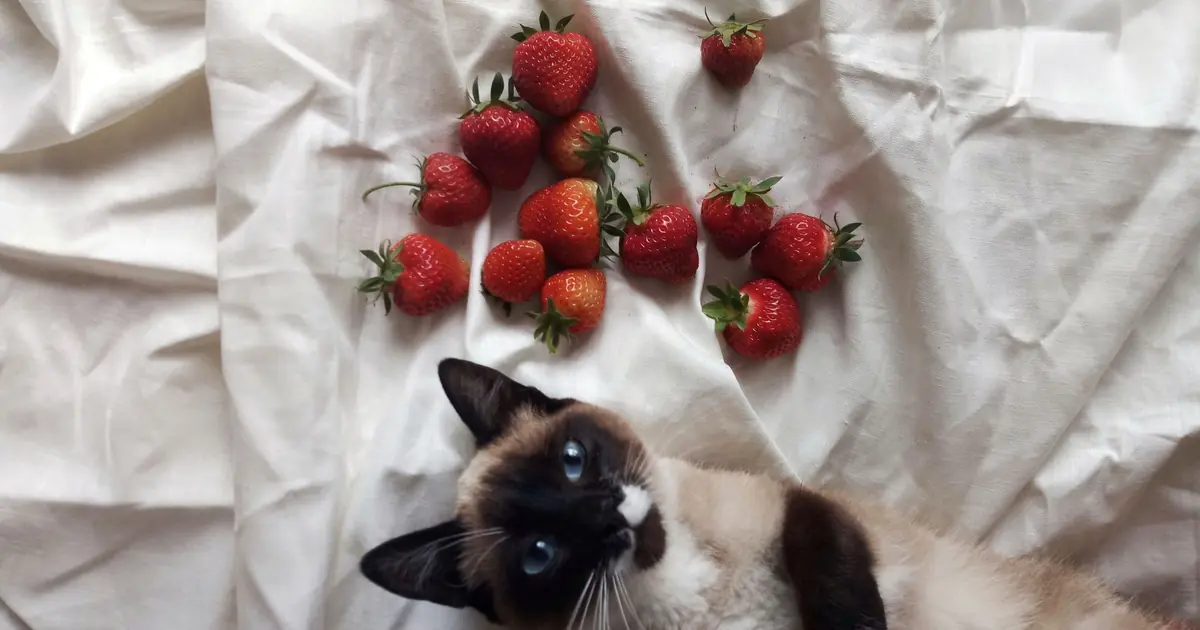
A handful of specific things pull cats toward strawberries: the scent, the moisture, the round shape, and the fact that you’re eating it. Cats have an extraordinarily sharp nose, and some research suggests they can detect certain food smells from surprising distances, which is part of why cats can smell food from another room and come running.
Add in the juicy, slightly cool texture of a fresh strawberry, and you’ve got something that feels novel in a cat’s mouth compared to dry kibble. Then there’s the shape. A whole strawberry rolls. Cats can’t resist a small object that moves unpredictably across a table, so plenty of cats end up batting one around like a toy before they ever taste it. And don’t discount plain food envy either. Cats often want whatever’s on your plate simply because you’re eating it, the same reason so many cats hover when you’re drinking a glass of fruit juice or a bowl of cereal with milk.
Can Cats Safely Eat Strawberries?
Yes, cats can safely eat a small piece of strawberry once in a while. The ASPCA lists strawberry as non-toxic to cats, so a bite here and there isn’t an emergency. But safe isn’t the same as beneficial. Cats are obligate carnivores, which means their bodies are built to run on meat, not plant matter. They don’t need fruit for any nutrient their diet is missing.
So think of strawberries the way you’d think of a cat sniffing a houseplant: mostly harmless curiosity, not something that adds anything useful to her diet. A cat could eat zero strawberries in her entire life and be perfectly fine.
What Are the Downsides of Giving Your Cat Strawberries?
The main downsides of feeding a cat strawberries are the sugar content, the risk of an upset stomach, and choking on a large piece. Cats have a much harder time digesting sugar and plant fiber than we do, so even a small amount can occasionally cause loose stool. Vet-reviewed guidance from PetMD notes that vomiting and diarrhea are the most common reactions when a cat eats too much. A whole strawberry, especially for a small cat, is also a real choking hazard.
The leaves and green stem (the calyx) aren’t listed as toxic either, but they’re fibrous and can irritate a cat’s mouth or stomach, so they’re worth skipping even though the fruit itself is fine. Here’s a quick breakdown of the different parts of a strawberry:
| Strawberry Part | Safe for Cats? | Note |
|---|---|---|
| Ripe flesh, small piece | Yes, in moderation | Wash it first, cut it small, treat only, not a regular snack |
| Leaves and green stem (calyx) | Better avoided | No nutritional value and can irritate the mouth or stomach |
| Whole large strawberry or several at once | No | Choking risk plus a higher chance of stomach upset |
| Strawberry jam, syrup, or flavored yogurt | No | Loaded with added sugar and sometimes artificial sweeteners |
Diabetic cats, overweight cats, and cats with sensitive stomachs should skip strawberries entirely. The extra sugar can throw off blood glucose in a diabetic cat, and if your cat is already managing weight or a health condition through a specific diet, like a cat eating diabetic cat food, random fruit treats work against that plan. It’s a small thing, but consistency really does matter for cats managing a condition like this.
How Do You Safely Offer Your Cat a Strawberry?
If you want to let your cat try a strawberry, wash it well, remove the leaves and stem, and cut off a piece about the size of a pea. That’s it. Here’s a simple way to do it right:
- Wash the strawberry thoroughly to remove any pesticide residue or dirt.
- Cut off and discard the green leaves and stem completely.
- Slice off a tiny piece, roughly pea sized for an average adult cat.
- Offer it once, then watch your cat for the next few hours.
- Keep it to an occasional treat, not something you offer daily or weekly.
Watch for any change in behavior afterward, like scratching at the mouth, drooling, or an upset stomach. Most cats show zero reaction to a small piece, but every cat is different, and there’s no reason to push it if yours seems uninterested after the first sniff.
What Other Fruits Do Cats Get Curious About?
Strawberries aren’t the only fruit that catches a cat’s attention. Cats often show the same curious sniff-and-bat behavior around watermelon, cantaloupe, and even sweet potato, again driven by smell and texture rather than any craving for sweetness. If your cat has ever gone after a chunk of melon at a summer barbecue, you already know the drill: it’s the same story explained in our guide on whether cats can eat watermelon.
Some cats get just as nosy around starchy vegetables, which is why so many people search for whether cats can eat sweet potatoes safely. And if your cat begs at the table no matter what’s on it, that’s usually less about the specific food and more a cat being a cat. It’s the same instinct that makes some cats obsess over milk, even though most adult cats are lactose intolerant, something we cover in our piece on why cats like milk.
What Are the Signs Your Cat Had a Bad Reaction to Fruit?
Vomiting or diarrhea within a few hours of eating strawberries or any new fruit is the main sign of a problem, and it usually means it’s time to call your vet. Most reactions are mild and pass on their own, but you should reach out to a vet right away if you notice repeated vomiting, diarrhea that doesn’t stop, lethargy, or any sign your cat is in pain.
Choking is the other real risk with a whole strawberry. If your cat is pawing at her mouth, gagging, or drooling excessively right after eating one, treat it as urgent and get her checked out. This article is meant to inform, not replace an actual vet visit. When in doubt about anything your cat ate, a quick call to your veterinarian is always the safer move.
The short version: a tiny bite of strawberry now and then is a low-risk curiosity for most healthy cats, not a treat you need to build into her routine. Skip the leaves and stem, keep portions small, and call your vet if her stomach reacts badly.
Frequently Asked Questions About Cats and Strawberries
Q: Can cats taste the sweetness in strawberries?
No. Cats lack a working sweet taste receptor because of a mutation in the Tas1r2 gene, confirmed by Monell Chemical Senses Center researchers. Whatever draws your cat to a strawberry, it isn’t the sugar.
Q: Are strawberries poisonous to cats?
No, strawberries are not toxic to cats and appear on the ASPCA’s non-toxic plant list. Even so, non-toxic doesn’t mean beneficial, so they’re best offered only as a rare, tiny treat.
Q: Why does my cat try to steal strawberries off my plate?
Your cat is likely reacting to the smell, the wet texture, and simple curiosity about what you’re eating. Some cats also enjoy batting a whole strawberry around like a toy because of its round, rolling shape.
Q: How many strawberries can a cat eat safely?
A single pea-sized piece, offered occasionally, is plenty for most adult cats. Strawberries add nothing essential to a cat’s diet, so there’s no reason to offer more than a small taste now and then.
Q: Can kittens eat strawberries?
Kittens have more sensitive digestive systems than adult cats, so it’s best to skip fruit entirely until they’re fully grown. If you do offer a taste to an older kitten, keep the piece even smaller than you would for an adult cat.
Q: Do cats need fruit in their diet?
No. Cats are obligate carnivores, meaning their nutritional needs are met entirely through animal protein and fat. A cat could go her whole life without eating a single piece of fruit and lose nothing nutritionally.
Q: What should I do if my cat eats a whole strawberry or several at once?
Watch her closely for the next several hours for vomiting, diarrhea, or signs of choking like gagging and pawing at the mouth. Mild stomach upset often passes on its own, but call your vet if symptoms are severe or don’t improve.
Q: Are strawberry leaves or stems dangerous to cats?
They aren’t considered toxic, but the leaves and green stem are fibrous and can irritate a cat’s mouth or stomach. It’s simple enough to remove them before offering any strawberry to your cat.

Hello and welcome to The Ideal Cat!
We are some passionate cat owners from different professions. We love our cats and have a lot of experience in how to care for our pets. We are incredibly excited to share our knowledge, experience, and research with you. So you can take good care of your loving cat. We will answer most of the common questions about owning cats, taking care of them, etc. If you have any question contact with us. Thanks for visiting! Enjoy the content.
