Picture this. You sit down to work, and within ten seconds a warm, wide-eared little creature has scaled your back, draped itself across your shoulders, and started purring directly into your ear. You didn’t invite it. You don’t get a vote.
That’s a Devon Rex. People call them the pixie cat, the alien cat, the elf cat. The Cat Fanciers’ Association famously sums them up as “99% personality and 1% cat,” and honestly, that tracks.
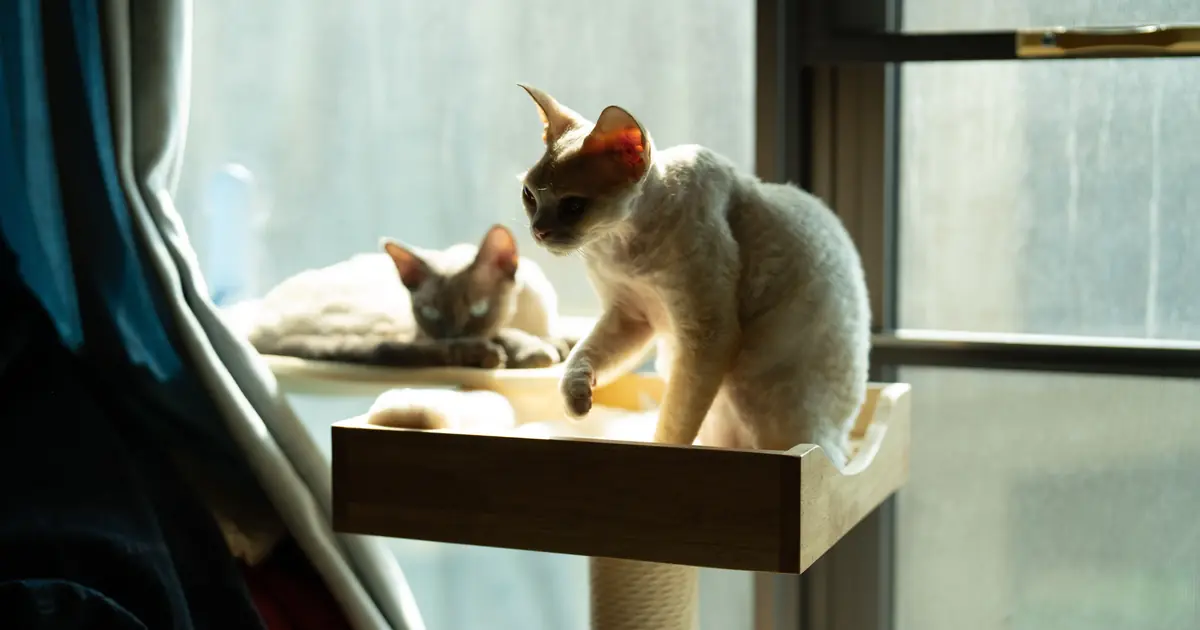
They look like they were sketched by someone who’d only had a cat described to them over the phone. Huge low-set ears, a tiny wedge of a face, enormous eyes, and a soft curly coat that feels like crushed velvet. Cute, weird, and deeply clingy. Let’s get into whether one belongs in your home.
| Origin | Devon, England (1960) |
| Weight (Male) | 7 to 9 lbs |
| Weight (Female) | 5 to 7 lbs |
| Lifespan | 9 to 15 years |
| Coat | Short, soft, wavy/rexed, sparse in places |
| Colors | All colors and patterns accepted |
| Energy Level | High |
| Grooming Needs | Low brushing, but regular skin and ear care |
| Good With Kids | Yes, with gentle handling |
| Good With Other Pets | Yes, including cat-friendly dogs |
| Average Price | $1,500 to $3,000 from breeders |
Where Did the Devon Rex Come From?
The Devon Rex traces back to a single curly kitten born in Devon, England, in 1960. Every Devon Rex alive today descends from that one cat. His name was Kirlee.
Here’s the story. A woman named Beryl Cox noticed a curly-coated stray tom hanging around an abandoned tin mine near Buckfastleigh. Soon after, a stray female she’d taken in had a litter, and one kitten came out with the same odd ripply coat. That kitten was Kirlee.
At first, everyone assumed Kirlee was related to the Cornish Rex, a curly cat that had popped up in nearby Cornwall a decade earlier. So breeders paired Kirlee with Cornish Rex cats. The result? Litters of straight-coated kittens. No curls at all.
That was the big clue. The curl in the Devon came from a completely different gene than the curl in the Cornish. Two separate mutations, two separate breeds. Breeders started calling the Cornish version “Gene 1” and the Devon version “Gene 2.”
Kirlee was sadly killed by a car in 1970, but his line lived on. The Devon Rex earned championship recognition from The International Cat Association (TICA) in 1979, the same year the Cat Fanciers’ Association granted it separate breed status, with full CFA championship following in 1983.
What Does a Devon Rex Look Like?
A Devon Rex looks like no other cat, and that’s the whole point. The coat mutation that gives this breed its waves exists in no other recognized breed. Once you’ve seen those ears, you can spot a Devon across a crowded room.
The Ears, Eyes, and Pixie Face
The ears are the headline. They’re huge, set low and wide on the head, and slightly rounded at the tips. Pair them with big mischievous eyes, prominent cheekbones, and a short muzzle, and you get that “elfin” or “pixie” look everyone talks about. Some folks see an alien. Some see a bat. Either way, it’s charming.
The body underneath is small but surprisingly athletic. Devons have a hard, muscular little frame, long legs, and the build of a tiny gymnast. They stand a bit taller at the shoulder than a Sphynx, around 10 to 12 inches.
That Curly Coat
The Devon Rex coat is short, soft, and wavy, with a texture that’s hard to describe until you’ve touched it. Think suede or a worn-in velvet blanket. Unlike the Cornish Rex, the Devon does have some guard hairs, but they’re sparse, short, and rexed, which gives the coat an open, loose wave rather than tight ripples.
One thing new owners don’t expect: the coat can be patchy. Some Devons have thinner fur on the chest, belly, or in front of the ears, and a few go through a “balding” phase as kittens before filling back in. This is normal for the breed, not a health problem on its own.
Whiskers are another quirk. A Devon’s whiskers are short, crinkled, and often broken off, because the same gene that curls the coat weakens the whiskers too. Don’t panic if they look stubby.
Devon Rex cats come in every color and pattern, from solid black and white to tabby, tortoiseshell, colorpoint, and everything in between. Registries accept the full range.
What Is a Devon Rex’s Personality Like?
If you want an aloof, do-its-own-thing cat, close this tab now. The Devon Rex is one of the most people-oriented cats in the world. They bond hard, follow you everywhere, and treat your lap, shoulders, and keyboard as prime real estate.
This is the breed people call a “monkey in a catsuit,” and it fits. They climb everything. They jump like they’re spring-loaded. They’ll perch on your shoulder to supervise dinner, then dive-bomb a toy mouse across the room two seconds later. The energy is real, and it lasts well into adulthood.
Devons are also clever and a little goofy. Many learn to play fetch, open cabinets, and beg for food with a level of commitment that’s frankly impressive. They’re chatty, but in a soft, chirpy way, not the foghorn yowl of a Siamese.
And they’re cuddlers. Big ones. Because of that thin coat, a Devon runs warm and seeks warmth, so they gravitate to your lap, your chest, your spot under the blanket. Owners often say snuggling one feels like holding a purring hot water bottle.
The flip side of all that devotion? Devons hate being alone. A bored, lonely Devon can get destructive or anxious. This is not a cat you leave home alone for twelve hours a day and expect to thrive.
Is a Devon Rex Right for You?
A Devon Rex is right for you if you want a constant, affectionate, slightly chaotic companion who’s genuinely involved in your day. They’re not right for you if you want a cat that mostly minds its own business.
A Devon Rex is a great fit if you:
- Are home a lot, or have another pet to keep one company
- Want a cat that actively wants to be with you
- Enjoy interactive play and don’t mind a busy, climby cat
- Can keep your home reasonably warm (they chill easily)
- Are okay with a small amount of routine skin and ear care
Think twice if you:
- Travel constantly or work very long hours away from home
- Want a calm, independent, low-interaction cat
- Are hoping for a truly hypoallergenic pet (more on that myth below)
- Keep a cold house and won’t provide warm spots
- Want a cat that needs zero upkeep
Honestly, the biggest dealbreaker is loneliness. If your Devon will be solo and ignored most of the day, get a different breed or a second pet. These cats need company.
Devon Rex Health Issues to Know About
Devon Rex cats are generally hardy, but the breed carries a few specific inherited conditions worth knowing before you buy. Responsible breeders test for these, and good early care goes a long way.
This section is educational, not a diagnosis. If your cat shows any worrying signs, talk to your veterinarian, who can examine your individual cat and recommend the right tests.
Devon Rex Myopathy (Hereditary Myopathy)
Devon Rex myopathy is a breed-specific muscle disorder, sometimes called spasticity. It causes general muscle weakness, often most obvious when a cat eats, swallows, or exercises. Signs usually show up young, between about three weeks and six months of age.
There’s no cure, but many affected cats live comfortable lives with careful management. The good news: scientists identified the gene behind it (the COLQ variant), and a DNA test now exists. A reputable breeder should test their breeding cats so affected kittens aren’t produced.
Hypertrophic Cardiomyopathy (HCM)
HCM is the most common heart disease in cats overall, and it shows up in Devon Rex lines too. It causes the heart muscle walls to thicken, which makes the heart work harder and can lead to serious problems over time. HCM can be sneaky, with few outward signs early on.
Regular cardiac screening, often a heart ultrasound (echocardiogram), helps catch it early. Ask whether the breeder screens their breeding cats for HCM.
Patellar Luxation
Patellar luxation means the kneecap slips out of its normal groove. You might see your Devon skip, hop, or briefly hold up a back leg, then carry on like nothing happened. Mild cases often pop back on their own. Severe cases can need surgery, so a vet should check it during routine exams.
Skin and Ear Conditions
Because of that unusual coat, Devon Rex cats are prone to oily, waxy skin and a yeast called Malassezia. Some develop seborrhea, with skin that turns either greasy or flaky. Their large ears also build up wax faster than most breeds. None of this is dangerous on its own, but it does mean regular gentle upkeep (covered in the care section below).
How Do You Groom and Care for a Devon Rex?
Here’s the surprise: a Devon Rex needs almost no brushing, but more skin and ear care than your average cat. That short coat means hair maintenance is easy, while the oily skin underneath needs attention.
Coat and Skin
Skip the slicker brush. A Devon’s coat is too delicate for vigorous brushing, and you can actually break those fragile hairs. A soft cloth, a gentle rubber grooming mitt, or just your hands once or twice a week is plenty to spread natural oils and remove loose fur.
The real job is managing grease. Devons produce more skin oil than coated breeds, and with so little fur to absorb it, that oil can build up on the skin, paw pads, and even leave faint marks on light bedding. Many Devons benefit from an occasional bath with a gentle, cat-safe shampoo. Some need it monthly, some far less. Watch your cat and adjust.
A gentle, soothing cat shampoo made for sensitive skin works well for the occasional Devon bath. Look for a fragrance-free, moisturizing formula so you don’t dry out their skin, and always rinse thoroughly. Never use human shampoo, which is too harsh for feline skin.
Those Big Ears
Devon Rex ears collect wax fast. Check them weekly and clean them when you see brown buildup, using a vet-approved ear cleaner and a cotton pad (never a cotton swab pushed down into the canal). A little reddish-brown wax is normal. Foul smell, dark crumbly debris, or head-shaking means a vet visit, since that can signal infection or mites.
Don’t forget nails and paw pads. Trim claws every couple of weeks, and wipe greasy paw pads with a damp cloth or pet wipe as needed.
What Should You Feed a Devon Rex?
Feed a Devon Rex a high-quality, protein-rich diet, and don’t be shocked by the appetite. These cats run a busy little engine, so they often eat more for their size than you’d expect.
That high metabolism plus thin coat means they burn energy keeping warm and bouncing off the furniture. A meat-first wet or dry food formulated for active cats suits them well. Many owners feed a mix of both, which adds moisture and keeps mealtimes interesting.
Watch the portions anyway. Devons are world-class beggars and will absolutely con you into a second dinner. Free-feeding can lead to weight gain, so measured meals are the safer bet. Always keep fresh water available, and ask your vet to confirm the right amount for your cat’s age and activity.
How Much Exercise and Enrichment Does a Devon Rex Need?
A Devon Rex needs daily play and plenty of vertical space, because this is a high-energy climbing breed that gets bored easily. A bored Devon finds its own fun, and you won’t always like the results.
Give them height. Tall cat trees, shelves, window perches, the top of the fridge. Devons love being up where they can survey their kingdom (and your shoulders count as a peak). Climbing options keep their athletic bodies and clever brains satisfied.
Plan on a couple of real play sessions a day with wand toys, balls, or puzzle feeders. Many Devons will fetch, so a crumpled paper ball can buy you a solid twenty minutes. Rotate toys so they stay novel, and consider a second pet if you’re often out, since these cats genuinely crave companionship.
How Does a Devon Rex Do With Kids, Dogs, and Other Cats?
Devon Rex cats are one of the more sociable breeds, and they usually get along great with kids, dogs, and other cats. Their friendly, playful nature makes them a solid pick for a busy household.
With kids: Devons love the attention and the games. They’re sturdy and tolerant, though their delicate coat and small frame mean gentle children only. Teach kids to handle them softly and not to squeeze.
With dogs: A Devon often befriends a cat-friendly dog, sometimes wrestling and napping together. Introduce them slowly and supervise early meetings, but the social Devon temperament usually wins out.
With other cats: Devons generally do well with feline housemates, especially another playful, social cat. In fact, a second pet is a great answer to their fear of being alone. Go slow with introductions, as always.
Devon Rex Lifespan and Aging Tips
Devon Rex cats live an average of 9 to 15 years, and many reach the upper end with good care. Their long-term health hinges on early screening for breed conditions and steady vet checkups.
Through the kitten and young-adult years, focus on play, good nutrition, and that early health testing. As your Devon hits the senior years (around 10 and up), book vet visits at least once a year, ideally twice, and keep an eye out for changes in appetite, weight, energy, or breathing, since HCM can develop later in life.
Older Devons still feel the cold, so make sure aging cats always have warm, soft, draft-free spots to curl up. Heated beds and sunny windowsills become even more popular with the gray-muzzle crowd.
How Much Does a Devon Rex Cost?
A Devon Rex kitten typically costs $1,500 to $3,000 from a reputable breeder, with some top show or rare-color lines running higher. Adoption, when you can find one, usually runs far less, often a few hundred dollars.
Why the steep price? Devons aren’t common, there aren’t many breeders, and good ones invest in health testing and careful, well-socialized litters. Don’t be surprised to land on a waiting list or travel a bit to find one.
| Cost Type | Typical Range |
|---|---|
| Kitten from a breeder | $1,500 to $3,000+ |
| Adoption / rescue | $100 to $600 |
| Initial setup (litter box, tree, supplies) | $150 to $400 |
| Food per month | $25 to $55 |
| Routine vet care per year | $200 to $500 |
Be wary of any “Devon Rex” priced suspiciously low or sold with no health testing, no pedigree, and a pushy seller. That’s a classic backyard-breeder or scam red flag. A real breeder will happily talk about myopathy and HCM testing.
Where Can You Find a Devon Rex Ethically?
Find a Devon Rex through a registered breeder who health-tests their cats, or through a breed-specific rescue. Skip pet stores and random online listings, which often hide poor breeding and sick kittens.
What a good breeder looks like:
- Tests breeding cats for Devon Rex myopathy (the COLQ DNA test) and screens for HCM
- Raises kittens in the home, not in cages, so they’re well socialized
- Lets kittens go no earlier than around 12 to 14 weeks
- Provides a written health guarantee and registration papers
- Asks you plenty of questions and welcomes yours
Red flags to walk away from:
- Multiple breeds and constant litters available
- No mention of health testing
- Won’t let you meet the kitten’s parents or see where they’re raised
- Pressure to pay fast or buy sight unseen
Don’t rule out rescue, either. Purebred Devons do turn up in breed-specific rescues and shelters, and adopting an adult means you skip the kitten chaos and know the cat’s personality up front.
What Breeds Are Similar to the Devon Rex?
If you love the Devon Rex but want to compare, here are a few breeds in the same orbit:
- Cornish Rex: The other English curly cat. Tighter, finer waves, no guard hairs, an egg-shaped head, and a similarly playful, people-loving temperament. (See the comparison below.)
- Sphynx: The famous “hairless” cat. Shares a related gene family with the Devon and the same warm, clingy, attention-hungry personality, but with far more skin care needed.
- Selkirk Rex: A plush, teddy-bear curly cat with a fuller coat and a calmer, more laid-back vibe.
- Oriental Shorthair: Slim, chatty, athletic, and intensely bonded to their people, like a sleeker, smoother-coated cousin in personality.
- Abyssinian: If it’s the busy, climby, into-everything energy you want (with a normal coat), the Aby delivers.
Devon Rex vs Cornish Rex
Devon Rex and Cornish Rex are two different breeds with two different curl genes, even though both came from England and both are curly, playful, and people-focused. The easiest tells are the head and the coat.
| Feature | Devon Rex | Cornish Rex |
|---|---|---|
| Curl gene | “Gene 2” (different mutation) | “Gene 1” (different mutation) |
| Coat | Loose, open waves; some sparse guard hairs | Tight, fine ripples; no guard hairs |
| Head shape | Wedge, pixie/elfin look | Narrow, egg-shaped |
| Ears | Huge, set low and wide | Large, set high |
| Whiskers | Short, crinkled, often broken | Curled and fragile |
We’ve got a full Cornish Rex guide if that’s the cat catching your eye.
Devon Rex vs Sphynx
Devon Rex and Sphynx are close in spirit but very different in coat. The Devon has a thin, soft, curly coat, while the Sphynx looks hairless (it’s actually covered in fine peach-fuzz down). Interestingly, the two share a related gene family, which is why they feel so similar to live with: warm, clingy, and endlessly social. The Sphynx just needs more frequent bathing because there’s no coat to manage its oily skin.
Common Devon Rex Myths and Misconceptions
The Devon Rex collects myths the way it collects ear wax. Let’s clear up the big ones.
Myth: Devon Rex cats are hypoallergenic
No cat is truly hypoallergenic, and the Devon Rex is no exception. The protein that triggers cat allergies, Fel d 1, lives in saliva and dander, not just fur. Devons shed less and may spread less dander, which can mean fewer reactions for some sensitive people. But “fewer reactions for some people” is not the same as allergy-proof. Always spend real time with a Devon before committing if allergies are a concern.
Myth: Devon Rex is just a fluffier Cornish Rex
Nope. These are two separate breeds with two separate curl mutations. Early breeders proved it the hard way, when crossing a Devon with a Cornish produced straight-coated kittens. Same country, similar vibe, different genes.
Myth: Devons don’t shed at all
They shed less than most cats, but they do shed. Their fine, sparse hair just hides better, until you spot it on a dark sweater or blanket. Low-shedding, not no-shedding.
Myth: Curly cats are high-maintenance to groom
Their coat is actually low-effort, since you barely need to brush it. The maintenance is skin and ears, not fur. Different kind of upkeep than people expect.
Devon Rex FAQ
Q: Are Devon Rex cats hypoallergenic?
No, Devon Rex cats are not truly hypoallergenic, because no cat is. They produce Fel d 1, the protein that causes cat allergies, in their saliva and dander. That said, their low shedding may spread less dander, so some allergy sufferers tolerate them better. Spend time with one first to test your reaction.
Q: Do Devon Rex cats shed?
Yes, Devon Rex cats shed, but very little compared to most breeds. Their fur is fine, short, and sparse, so loose hair is easy to miss. Expect a slight seasonal increase in spring and fall. Low-shedding is accurate; no-shedding is a myth.
Q: Are Devon Rex cats cuddly?
Yes, Devon Rex cats are extremely cuddly and bond closely with their people. They seek warmth and company, so they love sitting on laps, riding on shoulders, and sleeping under the covers. Because their coat is thin, they feel pleasantly warm to hold, like a small purring hot water bottle.
Q: How much does a Devon Rex cost?
A Devon Rex kitten typically costs $1,500 to $3,000 from a reputable breeder, with rare colors or show lines costing more. Adoption through a rescue usually runs $100 to $600. The breed is uncommon, so expect possible waiting lists and some travel to find an ethical breeder.
Q: What is the difference between a Devon Rex and a Cornish Rex?
The Devon Rex and Cornish Rex are separate breeds with different curl genes. The Devon has loose, open waves, a pixie face, and huge low-set ears, while the Cornish has tight, fine ripples and a narrow, egg-shaped head. Crossing the two produces straight-coated kittens, proving the genes differ.
Q: How long do Devon Rex cats live?
Devon Rex cats live an average of 9 to 15 years, and many reach the higher end with good care. Lifespan improves with early screening for breed conditions like HCM and Devon Rex myopathy, plus regular vet checkups and a healthy weight.
Q: Why is my Devon Rex always warm and seeking heat?
Devon Rex cats feel warm and seek heat because their thin, sparse coat lets body heat escape easily, and they have a high metabolism. They naturally gravitate to sunny spots, laps, and blankets. Provide warm bedding, especially in cooler homes, to keep your Devon comfortable.
Q: Do Devon Rex cats need baths?
Many Devon Rex cats benefit from occasional baths because their skin produces extra oil that the thin coat can’t absorb. Some need a gentle bath monthly, others less often. Use a fragrance-free, cat-safe shampoo, rinse well, and keep them warm afterward since they chill easily.
Final Verdict: Should You Get a Devon Rex?
The Devon Rex is one of the most charming, interactive cats you can share a home with, as long as you actually want a clingy little sidekick and not a tidy decoration. They’re warm, funny, athletic, and devoted to the point of comedy. They’ll ride your shoulder, steal your warm spot, and out-cuddle just about any other breed.
The honest trade-offs: they need company, daily play, warm spots, and a bit of skin and ear upkeep. They’re not hypoallergenic, they’re not cheap, and they do not do well left alone all day.
If you’re home often, love an affectionate goofball, and don’t mind the occasional bath, a Devon Rex will reward you with years of head-bumps and purring. If you want a quiet, independent cat, look elsewhere. Either way, now you know exactly what living with this pixie-faced little weirdo really looks like.

Hello and welcome to The Ideal Cat!
We are some passionate cat owners from different professions. We love our cats and have a lot of experience in how to care for our pets. We are incredibly excited to share our knowledge, experience, and research with you. So you can take good care of your loving cat. We will answer most of the common questions about owning cats, taking care of them, etc. If you have any question contact with us. Thanks for visiting! Enjoy the content.
