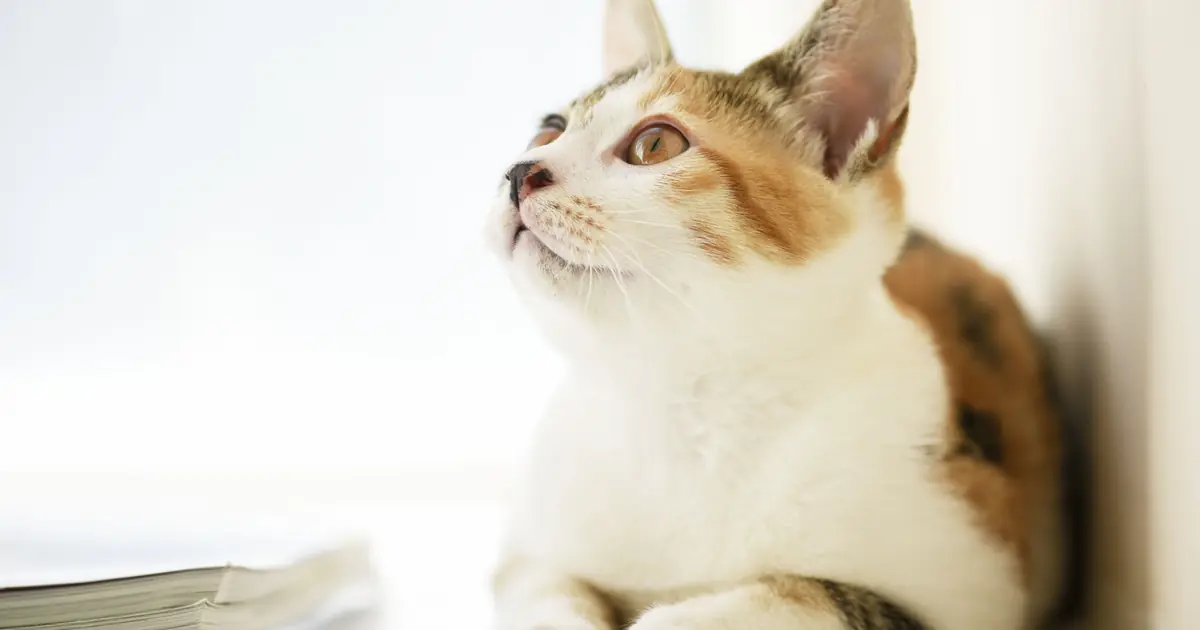
You’ve seen this cat a thousand times. That little gold statue by the cash register, paw raised like it’s waving you in for good luck? That’s the maneki-neko, and the cat it’s based on is real. It’s the Japanese Bobtail.
Meet one in person and the calm statue act falls apart fast. These cats talk back, carry toys in their mouths, splash in the water bowl, and sprint across the room at full tilt for no reason at all.
If you want a quiet lap cat that naps all day, keep reading, but adjust your expectations. The Japanese Bobtail is more like a chatty little dog in a cat suit.
- The Japanese Bobtail’s short tail comes from a different gene than the Manx and causes no spinal or health problems, so the breed is generally very healthy.
- Each Japanese Bobtail’s tail is one of a kind, like a fingerprint, and no two pom-poms look exactly alike.
- The prized “Mi-Ke” coat is a tricolor of black, red, and white, the pattern most linked to Japan’s lucky beckoning-cat statue.
- Japanese Bobtails are active, very chatty, and dog-like, often fetching toys and playing in water on their own.
- A Japanese Bobtail kitten from a breeder usually costs $800 to $2,000, and the breed is fairly uncommon outside Japan.
What Is a Japanese Bobtail?
A Japanese Bobtail is a small-to-medium, naturally short-tailed cat breed from Japan, instantly recognized by its fluffy, rabbit-like “pom-pom” tail. The breed comes in both shorthair and longhair varieties and is famous as the model for the maneki-neko, Japan’s lucky “beckoning cat” figurine.
This is one of the oldest cat breeds around. Japanese Bobtails appear in scrolls, woodblock prints, and carvings going back centuries, long before “purebred cat” was even a concept in the West. They’re a natural breed, meaning the bobtail showed up on its own in Japan’s cat population, not from human breeding tricks.
The Cat Fanciers’ Association (CFA) gave the shorthair championship status in 1976 and the longhair in 1993. The International Cat Association (TICA) recognizes the breed too. So this is a fully established, championship-level breed, not a designer fad.
Breed Snapshot
| Origin | Japan (centuries old; a natural breed) |
| Weight (Male) | 7 to 10 lbs (some larger males up to 12 lbs) |
| Weight (Female) | 5 to 8 lbs |
| Lifespan | 15 to 18 years |
| Coat | Shorthair and longhair varieties; soft, silky, low-undercoat |
| Colors | Many, with the tricolor “Mi-Ke” (black, red, white) most prized |
| Energy Level | High; playful and athletic |
| Grooming Needs | Low (shorthair) to moderate (longhair) |
| Good With Kids | Yes, very |
| Good With Other Pets | Yes, including dogs |
| Average Price | $800 to $2,000 from a breeder |
Where Does the Japanese Bobtail Come From?
The Japanese Bobtail comes from Japan and has been part of Japanese life for well over a thousand years. Cats are thought to have arrived in Japan from the Asian mainland around the sixth century, and short-tailed cats became a common, beloved fixture across the islands.
The maneki-neko connection
The maneki-neko is the famous Japanese figurine of a seated cat with one paw raised in a beckoning wave, believed to bring good luck and prosperity. The cat in those statues is traditionally a calico (Mi-Ke) Japanese Bobtail. So every time you see a lucky cat statue at a shop counter, you’re looking at a stylized version of this breed.
The most famous legend points to Gotoku-ji Temple in Tokyo. As the story goes, a feudal lord was beckoned inside by a cat right before a thunderstorm struck where he’d been standing. He credited the cat with saving his life, and the beckoning-cat good-luck symbol grew from there. Folklore, sure. But it tells you how deeply this breed is woven into Japanese culture.
From silkworms to America
Here’s a fun piece of history. For a long time cats in Japan were status symbols, kept on leashes by the wealthy. Then around 1602 an official decree set the cats loose to hunt the rodents threatening Japan’s silkworm trade. Working cats, not lap ornaments. The breed first came to the United States in 1968, and the CFA recognized the shorthair in 1976.
What Does a Japanese Bobtail Look Like?
A Japanese Bobtail is a lean, muscular, medium-sized cat with high cheekbones, large upright ears, and big oval eyes set at a slight slant. But the showstopper is the tail. Instead of a long tail, it has a short, kinked, fluffy pom-pom that looks more like a bunny’s tail than a cat’s.
The tail: unique as a fingerprint
No two Japanese Bobtail tails are the same. Each one has its own pattern of curves, kinks, and angles, and the fur fans out to create that pom-pom look. In the show ring the tail is usually no longer than about three inches from the body, even though the cat could “unfold” the bones to a slightly longer length. Run your hand down it and you feel a series of little curves, not one straight line.
And here’s the reassuring part: that tail is structural, not a defect. More on the genetics below, because it’s the question people worry about most.
Shorthair vs longhair
Japanese Bobtails come in two coat types, and both are recognized by the major registries.
- Shorthair: a soft, silky single-ish coat with very little undercoat. Easy care, minimal matting.
- Longhair: a medium-to-long, silky coat with a fuller tail pom, britches on the hind legs, and a slight ruff. Still surprisingly low-maintenance because there’s not a heavy, dense undercoat.
Colors, and the prized Mi-Ke
Japanese Bobtails come in a wide range of colors and patterns, from solids to bicolors. But the star is the Mi-Ke (pronounced “mee-keh”), a bold tricolor of black, red, and white. That’s the calico pattern, and it’s the one most tied to good luck and to the maneki-neko statue. Because of how calico genetics work, Mi-Ke cats are almost always female, which makes a tricolor Bobtail extra special.
Kitten vs adult
Bobtail kittens are leggy, bright-eyed, and into everything. The pom-pom tail is visible from birth and just gets fluffier as the coat fills in. These cats grow slowly and stay playful and kitten-like in personality well into adulthood, so the goofball energy doesn’t fade the way it does in some breeds.
What Is the Japanese Bobtail’s Personality Like?
The Japanese Bobtail is an outgoing, intelligent, deeply people-oriented cat that acts more like a small dog than a typical aloof feline. They’re active, affectionate, and famously talkative, and they want to be part of whatever you’re doing.
The chatty one
Bobtails don’t just meow. They chirp, trill, and run through a whole range of soft, musical sounds, almost like they’re singing. Talk to a Japanese Bobtail and it’ll usually answer you. People often describe the breed as carrying on actual conversations. If silence is what you want in a cat, this is not your breed.
The dog in a cat suit
This is the trait owners rave about. Japanese Bobtails fetch. A lot of them learn it with zero training, you toss a toy once and they bring it back for another round. Many also walk on a harness, learn tricks, and greet you at the door. They’re easy to clicker-train because they’re smart and food-motivated.
And yes, they like water
Plenty of Bobtails are fascinated by water. Dripping faucets, the water bowl, the edge of the tub, it all gets a paw test. Don’t be shocked if yours fishes ice cubes out of your glass.
The honest downsides
Let’s be real about who this cat is not for. Japanese Bobtails are busy and need interaction. They can get bored, loud, and mischievous if left alone all day with nothing to do. They’re chatty enough to annoy a noise-sensitive household. And they bond hard, so a home where everyone’s gone 12 hours a day isn’t ideal unless there’s a buddy. This is a cat that wants a job and a roommate, not a quiet decoration.
Is the Japanese Bobtail Right for You?
A Japanese Bobtail is a great match if you want an interactive, playful, sociable cat and you’re around enough to engage with it. It’s a poor match if you want a low-key, quiet, independent cat that entertains itself.
| Great fit if you… | Maybe not if you… |
|---|---|
| Want a cat that fetches and learns tricks | Want a quiet, low-energy lap cat |
| Like a chatty cat that “talks” to you | Are sensitive to vocal cats |
| Have kids or a dog | Are away from home most of the day with no second pet |
| Can do daily play and enrichment | Don’t have time for interactive play |
| Want a healthy, hardy breed | Want a famously calm “couch potato” cat |
Do Japanese Bobtails Have Health Problems?
Japanese Bobtails are considered one of the healthiest cat breeds, with no known genetic disorders tied to the breed and a long average lifespan of 15 to 18 years. Most importantly, the short tail causes no health issues at all.
Quick note: this article is for general education, not veterinary advice. Always work with a licensed vet for your individual cat’s health, vaccines, and any symptoms.
The big myth-bust: the tail is safe
This is the question that worries people, so let’s settle it. The Japanese Bobtail’s short tail does not come from the same gene as the Manx, and it does not cause spinal problems. The Manx tailless trait is linked to a gene that can cause “Manx syndrome,” a set of serious spinal and nerve defects. The Japanese Bobtail’s tail comes from a completely different, recessive genetic path. Research has linked the breed’s kinked, shortened tail to a change in the HES7 gene, and that change is not associated with spinal or skeletal abnormalities.
Bottom line: a Japanese Bobtail’s pom-pom tail is a healthy, normal feature. Two Bobtails can be safely bred together, which is not the case with Manx-to-Manx breeding.
General health to stay on top of
Even hardy breeds still need routine care. Keep up with the usual stuff that affects all cats: dental disease, healthy weight, parasite prevention, and senior screening as they age. There’s no breed-specific condition you have to obsess over, which is part of the Japanese Bobtail’s charm.
How Do You Groom a Japanese Bobtail?
Japanese Bobtails are easy to groom because their silky coats have little undercoat and resist matting. A weekly brush keeps a shorthair tidy, while a longhair does well with brushing two or three times a week.
Shedding
Shedding is light to moderate. Because there’s not a heavy double coat, Bobtails don’t blow their coat the way some thick-furred breeds do. Brushing once or twice a week catches most of the loose hair before it lands on your couch. Note: this breed is not hypoallergenic. No cat truly is.
The rest of the routine
- Nails: trim every couple of weeks.
- Ears: check weekly, wipe gently if dirty.
- Teeth: brush regularly to head off dental disease, the most common health issue in cats overall.
- Tail: the pom-pom needs no special handling; just include it in your normal brushing.
What Should You Feed a Japanese Bobtail?
Feed a Japanese Bobtail a high-quality, protein-rich diet that’s complete and balanced for its life stage, because this is an active, athletic breed that burns real energy. Pick a food labeled to meet AAFCO standards and adjust portions to keep your cat lean.
These cats are busy, so they often have healthy appetites. The goal is fuel, not flab. Measure meals instead of free-feeding a full bowl, since extra weight is hard on any cat’s joints and organs. Fresh water should always be available, and given how many Bobtails love water, a pet fountain can be a hit.
If you’re ever unsure how much to feed or whether to switch foods, your vet can give you a target based on your cat’s weight and body condition.
How Much Exercise Does a Japanese Bobtail Need?
A Japanese Bobtail needs daily active play and mental enrichment to stay happy, ideally a couple of good play sessions a day. This is a smart, athletic breed that gets bored and noisy without an outlet.
Play to their strengths
- Fetch: their favorite game. Toss a small toy and let them bring it back, over and over.
- Wand and feather toys: great for chase-and-pounce energy.
- Puzzle feeders: make that smart brain work for treats.
- Cat trees and shelves: they love to climb and survey.
- Harness walks or a catio: many Bobtails enjoy safe outdoor time.
An interactive fetch or wand toy goes a long way with this breed, since they genuinely want to play with you, not just bat something around alone.
Are Japanese Bobtails Good With Kids, Dogs, and Other Cats?
Yes. Japanese Bobtails are sociable, easygoing cats that typically do very well with children, dogs, and other cats. Their confident, playful nature makes them one of the better breeds for a busy family home.
- Kids: their patience and love of play make them great with gentle, respectful children.
- Dogs: Bobtails often befriend dogs easily, partly because they share that playful, social energy.
- Other cats: they usually enjoy feline company, which helps a lot if you’re away during the day.
As always, do slow, proper introductions with any new pet. But the Japanese Bobtail’s temperament gives you a big head start.
How Long Do Japanese Bobtails Live?
Japanese Bobtails typically live 15 to 18 years, and many reach the upper end thanks to the breed’s robust health. Good food, a safe indoor life, dental care, and regular vet checkups all push toward the longer end of that range.
Caring for a senior Bobtail
As your Bobtail ages, a few small changes help a lot:
- Switch to twice-yearly vet visits to catch issues early.
- Watch weight and appetite closely.
- Keep up dental care, since dental disease is common in older cats.
- Add easy-access litter boxes and soft, warm sleeping spots.
- Keep playing, just gentler; mental stimulation matters at every age.
How Much Does a Japanese Bobtail Cost?
A Japanese Bobtail kitten from a reputable breeder usually costs between $800 and $2,000, with show-quality or rare Mi-Ke tricolor kittens often landing at the higher end. Adoption through a rescue typically runs $50 to $150.
| Source | Typical Price | What’s Usually Included |
|---|---|---|
| Reputable breeder (pet quality) | $800 to $1,500 | Vaccines, vet check, sometimes spay/neuter |
| Breeder (show / Mi-Ke / longhair) | $1,500 to $2,000+ | Pedigree, health screening, registration |
| Rescue or shelter | $50 to $150 | Vaccines, microchip, spay/neuter |
Remember the first-year extras beyond the kitten price: supplies, food, litter, and vet care. And budget for ongoing costs across a 15-plus-year lifespan.
Are Japanese Bobtails Rare? Where Do You Find One?
Japanese Bobtails are fairly uncommon outside Japan, so finding one usually means getting on a waitlist with a dedicated breeder. They’re an established breed, not a rare designer cat, but you won’t trip over them at every shelter.
Finding one ethically
- Start with the registries. Use CFA and TICA breeder directories to find programs that follow breed standards.
- Ask about health and socialization. A good breeder raises kittens underfoot, shares health info, and asks you questions too.
- Expect a waitlist. Quality breeders don’t always have kittens on hand, and that’s a good sign.
- Check rescues. Breed-specific and general rescues occasionally have Bobtails or bobtail mixes. A cat with a short fluffy tail and a chatty streak might be closer than you think.
Steer clear of anyone selling kittens with no health records, no questions, and a “ready today” cart button.
Breeds Similar to the Japanese Bobtail
If the Japanese Bobtail caught your eye, a few other short-tailed breeds share part of its look or vibe. They’re not the same cat, though, so here’s how they compare.
| Breed | How It Compares |
|---|---|
| Manx | Tailless or very short tail, but the trait comes from a different gene that can cause spinal issues. A Japanese Bobtail’s tail is healthy by contrast. |
| American Bobtail | A larger, sturdier, dog-like bobtail bred in the US. Also short-tailed and affectionate, but bigger-boned. |
| Kurilian Bobtail | A rugged Russian short-tailed breed with a fluffy pom tail. Calmer and stockier than the lively Japanese Bobtail. |
| Pixie-Bob | A bobtailed cat bred to look wild and bobcat-like, larger and more reserved. |
Common Myths and Misconceptions
This breed gets a few things pinned on it that just aren’t true. Let’s clear them up.
Myth 1: “The short tail means health problems, like the Manx.”
False. The Japanese Bobtail’s tail comes from a different gene than the Manx and is not linked to any spinal or skeletal defects. The breed is famously healthy, and the tail is a normal, safe feature.
Myth 2: “It’s just the lucky-cat statue, not a real breed.”
The maneki-neko statue is modeled on the Japanese Bobtail, but the breed is very real, very old, and recognized by the CFA and TICA. The statue is the cartoon; this is the cat.
Myth 3: “All Japanese Bobtails are calico.”
The tricolor Mi-Ke is the most prized and most famous pattern, but Japanese Bobtails come in many colors and patterns, including solids and bicolors.
Myth 4: “Their tail was cut or docked.”
Nope. The pom-pom tail is 100% natural and present from birth. Nothing is trimmed or altered.
Myth 5: “They’re quiet, calm lap cats.”
Quite the opposite. Japanese Bobtails are active, chatty, and playful, more likely to fetch your hair tie than nap quietly all afternoon.
Frequently Asked Questions
Q: Are Japanese Bobtails rare?
Japanese Bobtails are fairly uncommon outside Japan, so finding a kitten usually means contacting a registered breeder and joining a waitlist. They’re an established, recognized breed rather than a rare designer cat, but you won’t see them often in shelters.
Q: Are Japanese Bobtail cats friendly?
Yes, very. Japanese Bobtails are outgoing, affectionate, and people-oriented, often described as more dog-like than a typical cat. They bond closely with their families, get along with kids and dogs, and love to interact and “talk.”
Q: How much is a Japanese Bobtail?
A Japanese Bobtail kitten from a reputable breeder usually costs $800 to $2,000, with show-quality or Mi-Ke tricolor kittens at the higher end. Adopting through a rescue typically costs $50 to $150 and often includes vaccines and spay/neuter.
Q: Do Japanese Bobtails have health problems?
Japanese Bobtails are one of the healthiest cat breeds, with no known breed-specific genetic disorders. Their short tail causes no spinal issues, unlike the Manx. Routine care for dental health, weight, and parasites is all most need.
Q: What is the difference between a Japanese Bobtail and a Manx?
Both have short tails, but the cause is different. The Manx tailless gene can lead to “Manx syndrome,” a set of spinal defects. The Japanese Bobtail’s tail comes from a separate, harmless gene and causes no health problems, so the breed is hardier in that respect.
Q: Do Japanese Bobtails shed a lot?
No, shedding is light to moderate. Because the coat has little undercoat, Japanese Bobtails don’t shed heavily, even the longhairs. A weekly brush (two to three times for longhairs) keeps loose hair under control.
Q: Why is the Japanese Bobtail called the lucky cat?
The Japanese Bobtail is the cat behind the maneki-neko, Japan’s “beckoning cat” figurine believed to bring good fortune. The traditional statue depicts a calico (Mi-Ke) Japanese Bobtail with a raised paw, tying the breed to luck and prosperity.
Q: Do Japanese Bobtails really like water?
Many do. Japanese Bobtails are often curious about water, pawing at faucets, bowls, and bathtub edges. Some will play in shallow water or fish ice cubes from a glass, which adds to their playful, dog-like reputation.
The Final Verdict on the Japanese Bobtail
The Japanese Bobtail is a healthy, ancient, lucky little firecracker of a cat. You get a one-of-a-kind pom-pom tail with zero health baggage, a chatty companion that actually answers you, and a fetch-obsessed playmate that’s happiest right in the middle of family life.
It’s not the breed for someone who wants quiet and calm. But if you want an interactive, dog-like, endlessly entertaining cat, and you can give it the play and company it craves, a Japanese Bobtail will reward you with 15-plus years of personality. Lucky cat, indeed.

Hello and welcome to The Ideal Cat!
We are some passionate cat owners from different professions. We love our cats and have a lot of experience in how to care for our pets. We are incredibly excited to share our knowledge, experience, and research with you. So you can take good care of your loving cat. We will answer most of the common questions about owning cats, taking care of them, etc. If you have any question contact with us. Thanks for visiting! Enjoy the content.
