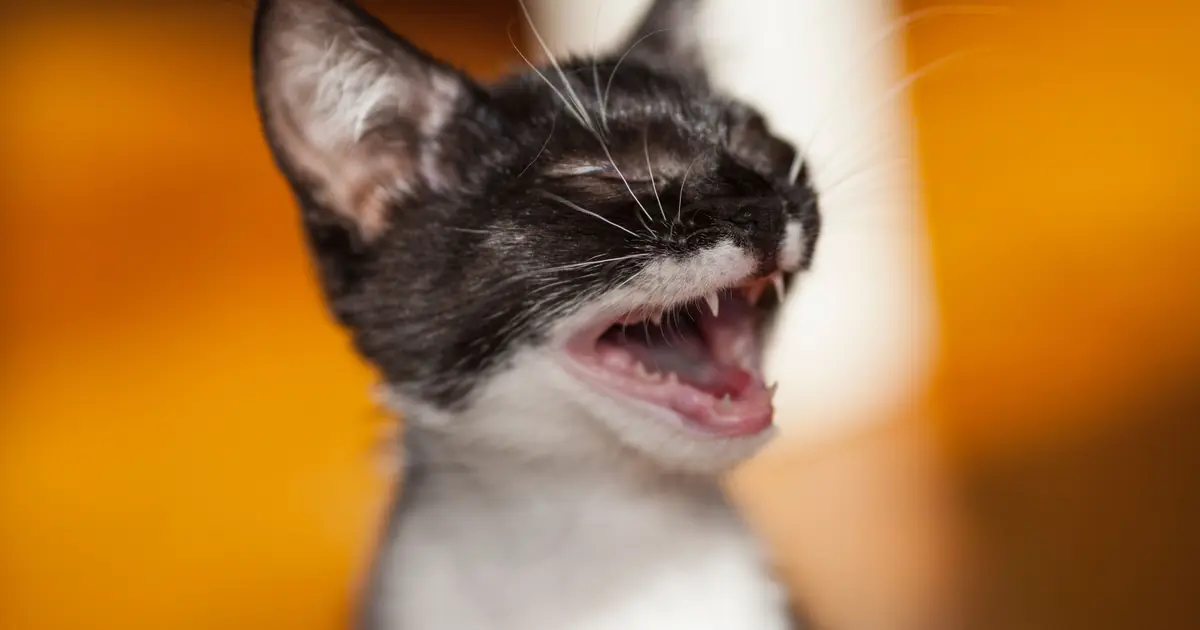
You’ve got a wobbly little kitten in your hands and no idea how old it is. Maybe you found it, maybe someone handed it to you in a box. Either way, the question hits fast: how old is this baby?
Here’s the good news. A kitten’s mouth is basically a tiny calendar. Teeth come in on a fairly predictable schedule, so a quick peek can get you within a couple of weeks. Let’s walk through the whole timeline, from gummy newborn to full set of adult teeth.
This article is educational and isn’t a substitute for veterinary care. A vet can confirm a kitten’s age and check that its teeth are coming in the way they should.
- Kittens have 26 deciduous (baby) teeth and grow into 30 permanent (adult) teeth.
- A newborn kitten has no visible teeth, so a toothless mouth points to under 2 weeks old.
- All 26 baby teeth are usually in by 6 to 8 weeks of age.
- Baby teeth start falling out around 11 to 16 weeks as adult teeth push through.
- A full set of 30 adult teeth means a kitten is roughly 6 to 7 months old.
- Teething signs include extra chewing, mild drooling, and finding tiny teeth on the floor.
Kitten teeth age chart: estimate age by the teeth
You can estimate a kitten’s age by which teeth have come in and which have fallen out. This chart maps the whole journey, from an empty newborn mouth to a complete adult set. Use it as a close guess, not a birth certificate, since individual kittens run a little early or late.
| Kitten age | What’s happening in the mouth | Teeth you’ll see |
|---|---|---|
| Birth to ~2 weeks | No teeth yet, nursing only | Bare gums |
| ~2 to 4 weeks | Deciduous (baby) incisors break through first | Tiny front teeth appear |
| ~3 to 4 weeks | Baby canines (the little fangs) come in | Pointy corner teeth |
| ~5 to 6 weeks | Baby premolars fill in along the sides | Cheek teeth erupting |
| ~6 to 8 weeks | All 26 baby teeth are usually in place | Full set of small, sharp baby teeth |
| ~11 to 16 weeks | Baby teeth loosen and start to fall out | Gaps, wiggly teeth, adult incisors pushing through |
| ~3 to 4 months | Adult incisors erupt | Larger, straighter front teeth |
| ~4 to 6 months | Adult canines, premolars, and molars come in | Big fangs and broad cheek teeth |
| ~6 to 7 months | All 30 adult teeth are in | Complete permanent set |
One quick tell: baby teeth are smaller, whiter, and more needle-sharp, while adult teeth are bigger, a touch more off-white, and set with more space between them. If the front teeth look chunky and even, you’re likely past the 4-month mark.

How many teeth do kittens have vs adult cats?
Kittens have 26 baby teeth, and adult cats have 30 permanent teeth. That’s 4 more teeth in the grown-up mouth, and the extra ones are the molars that only come in with the adult set. Baby teeth are called deciduous teeth, which just means they’re temporary and designed to fall out.
Here’s the simple breakdown of both sets. If you want the full grown-up rundown, we cover it in our guide to how many teeth a cat has.
| Tooth type | Baby (deciduous) set | Adult (permanent) set |
|---|---|---|
| Incisors | 12 | 12 |
| Canines | 4 | 4 |
| Premolars | 10 | 10 |
| Molars | 0 | 4 |
| Total | 26 | 30 |
The molars are the giveaway. Kittens don’t grow any baby molars at all, so those broad back teeth only show up once the adult set arrives. According to the Merck Veterinary Manual, the full 30-tooth adult set is typically complete by around 6 months of age.
When do kittens start getting teeth?
Kittens start getting teeth at about 2 to 4 weeks old, beginning with the small incisors at the front. Before that, a newborn’s mouth is completely bare, which is a handy sign you’re dealing with a very young kitten. The baby canines follow at roughly 3 to 4 weeks, and the premolars fill in by 5 to 6 weeks.
When do kittens lose their baby teeth?
Kittens lose their baby teeth from around 11 to 16 weeks of age, and the process wraps up by about 6 months. You often won’t even notice it happening. Kittens usually swallow the loose teeth while eating, so finding a tiny tooth on the floor is a lucky bonus, not the norm. A little pinprick of blood on a chew toy during this window is normal too.
What are the signs a kitten is teething?
The main signs a kitten is teething are more chewing, mild drooling, tender gums, and the occasional found tooth. Teething runs alongside the baby-teeth-falling-out stage, mostly between 3 and 6 months. It’s usually mild, and most kittens sail through it without much fuss.
Watch for these during the teething stretch:
- Extra chewing. Your kitten gnaws on toys, cords, your fingers, everything. Chewing eases the pressure in sore gums.
- Mild drooling. A little extra drool is normal, just like it is with human babies.
- Tender or slightly red gums. The gumline may look a touch pink or puffy where teeth are moving.
- Slower or messier eating. Some kittens drop kibble or eat carefully because chewing feels sore.
- Pawing at the mouth. A kitten may rub its face or seem a bit cranky for a few days.
- A found tooth. Now and then you’ll spot a tiny baby tooth on the floor or in the food bowl.
Teething should be mild and short-lived. Heavy drooling, real bleeding, a swollen face, or a kitten that stops eating altogether isn’t just teething, and it’s worth a vet call.
How can I help a teething kitten?
You help a teething kitten by giving it safe things to chew and keeping unsafe things out of reach. The goal is simple: redirect that itchy-gum chewing onto something that won’t hurt your kitten or your phone charger. Most kittens need very little beyond a couple of good chew options.
- Offer safe chew toys. Soft rubber or silicone kitten teething toys give the gums something satisfying to work on. Skip anything hard enough to crack a tooth.
- Try a chilled toy. A soft toy cooled in the fridge (not frozen solid) can soothe sore gums. Some cats love a cool, damp washcloth to gnaw on.
- Rethink hard treats for now. If chewing looks painful, ease up on very hard treats until the adult teeth settle in.
- Kitten-proof the room. Move electrical cords, hair ties, and small swallowable objects out of reach, since a teething kitten chews first and thinks later.
- Start gentle dental habits early. This is a great age to get a kitten used to having its mouth touched, so brushing later feels normal.
Once the adult teeth are in, you can build a real dental routine. Vet-approved dental treats for cats and a soft-bristle brush with cat-safe toothpaste go a long way toward keeping those brand-new teeth healthy. Never use human toothpaste, which can be toxic to cats.
What should I feed a teething kitten?
A teething kitten does best on a complete kitten diet that’s easy to chew. If hard kibble seems to bother sore gums, softening it with a little warm water or mixing in wet food can help for a week or two. Our picks for healthy kitten food cover complete options, and if you’ve got a young one, this guide to feeding a 2-month-old kitten breaks down portions and timing.
When should I see a vet about my kitten’s teeth?
See a vet if a baby tooth stays put while an adult tooth is already coming in, or if you notice bad breath, bleeding, or a swollen mouth. Most teething is uneventful, but a few issues need a professional eye so your kitten’s adult teeth come in straight and healthy.
Book a vet visit if you notice:
- A retained baby tooth. When a baby tooth doesn’t fall out and an adult tooth grows in beside it, it’s called a persistent or retained deciduous tooth. It can crowd the mouth and trap food and bacteria.
- Bad breath. Strong, lasting mouth odor in a kitten isn’t normal and can signal infection.
- Bleeding beyond a tiny spot. A pinprick of blood during teething is fine, but ongoing or heavier bleeding is not.
- Swelling or a lump on the gum or face. Any facial swelling deserves same-week attention.
- Refusing to eat. A kitten that won’t eat because its mouth hurts needs to be seen.
- Broken or discolored teeth. A cracked or gray tooth should be checked.
Retained baby teeth are common enough that vets watch for them, especially the canines. The VCA Animal Hospitals note that removing a stubborn deciduous tooth lets the adult tooth settle into its proper spot and helps prevent crowding and gum disease down the road. Your vet will usually flag any that need to come out around spay or neuter time. For more on feline dental health in general, the Cornell Feline Health Center is a trustworthy place to read up.
Kitten teeth FAQ
Q: How old is a kitten with all its baby teeth?
A kitten with a full set of 26 baby teeth is usually around 6 to 8 weeks old. All the deciduous incisors, canines, and premolars are typically in by that point, though no molars appear until the adult set arrives.
Q: How many teeth does a kitten have?
A kitten has 26 deciduous (baby) teeth once they’ve all come in, usually by 6 to 8 weeks of age. That’s 12 incisors, 4 canines, and 10 premolars. Kittens have no baby molars.
Q: At what age do kittens get their adult teeth?
Adult teeth start erupting around 3 to 4 months, beginning with the incisors. Canines, premolars, and molars follow through 4 to 6 months, and all 30 permanent teeth are usually in by 6 to 7 months of age.
Q: Do kittens swallow their baby teeth?
Yes, often. Kittens usually swallow their loose baby teeth while eating, so it’s normal to never find one. Swallowing a tiny tooth is harmless. Spotting one on the floor is just a lucky souvenir.
Q: Is it normal for a teething kitten’s gums to bleed?
A tiny bit of blood on a chew toy during teething is normal as baby teeth loosen. Ongoing or heavier bleeding is not. If you see more than a pinprick, or the gums look swollen and red, call your vet.
Q: How can I tell a baby tooth from an adult tooth?
Baby teeth are smaller, whiter, and very sharp and needle-like. Adult teeth are larger, slightly more off-white, and sit with more space between them. If the teeth look chunky and evenly spaced, the kitten is likely past 4 months.
Q: What is a retained baby tooth in a kitten?
A retained or persistent deciduous tooth is a baby tooth that doesn’t fall out while its adult replacement grows in. It can crowd the mouth and trap bacteria, so vets usually recommend removing it, often during spay or neuter surgery.
Q: Can I estimate my kitten’s age from teeth alone?
Teeth give a close estimate, usually within a couple of weeks, especially under 6 months. For the best guess, pair the tooth timeline with weight and eye color. A vet can confirm the age and check dental development at the same time.
Bottom line: a kitten’s teeth are one of the easiest ways to guess its age, from bare newborn gums to a full set of 30 adult teeth by about 6 to 7 months. Keep an eye on the timeline, offer a safe chew or two during teething, and loop in your vet if a baby tooth overstays its welcome. Those little teeth grow up fast.

Hello and welcome to The Ideal Cat!
We are some passionate cat owners from different professions. We love our cats and have a lot of experience in how to care for our pets. We are incredibly excited to share our knowledge, experience, and research with you. So you can take good care of your loving cat. We will answer most of the common questions about owning cats, taking care of them, etc. If you have any question contact with us. Thanks for visiting! Enjoy the content.
