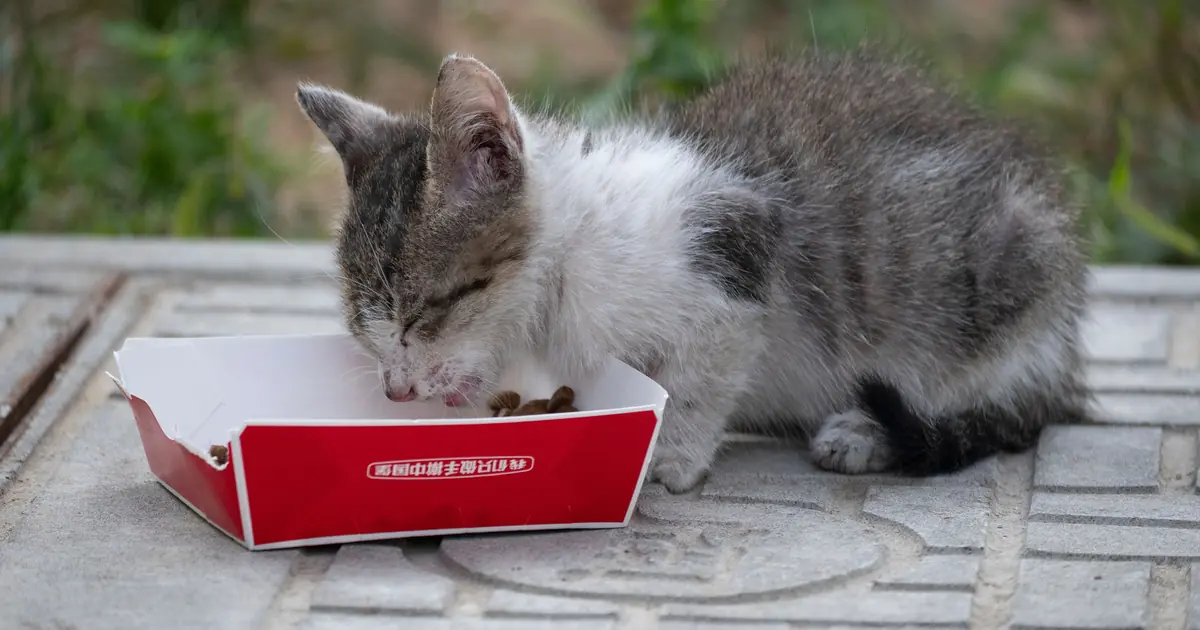
You brought home a 2-month-old kitten. She’s tiny, loud, and clearly starving every three hours. And now you’re standing in the pet aisle wondering what on earth to actually feed her.
Take a breath. Feeding an 8-week-old kitten isn’t complicated once you know the numbers. This little one is done nursing, running on rocket fuel, and growing fast. A few weeks earlier the plan looks quite different, closer to a 5-week kitten feeding schedule. Get the food right now and you set her up for a strong, healthy start.
Here’s exactly what to feed, how much, how often, and what to skip.
This article is educational and isn’t a substitute for veterinary care. Your vet can fine-tune portions for your specific kitten.
- A 2-month-old (8-week-old) kitten should eat complete kitten food, not adult cat food, because kitten formulas are higher in protein, calories, and DHA for growth.
- Most 8-week-old kittens weigh about 2 pounds and need roughly 160 to 200 calories a day, split into 3 to 4 small meals.
- By 8 weeks a kitten is fully weaned and should be eating solid food and drinking water on its own, so no milk replacer is needed.
- Wet food, dry food, or a mix all work at this age; wet food adds hydration and dry food can be left out to graze.
- Never feed cow’s milk to a kitten, since most cats can’t digest lactose well and it causes diarrhea.
What should a 2-month-old kitten eat?
A 2-month-old kitten should eat food labeled “kitten” or “for growth,” because those formulas carry the extra protein, fat, calories, and nutrients a growing body needs. Kitten food packs about twice the calories of adult cat food and runs higher in protein (roughly 30 to 35%). It also adds key growth nutrients like DHA for brain and eye development, taurine for the heart and vision, and calcium for bones. As PetMD notes, kittens have much higher energy and nutrient needs than adult cats while they grow.
Look for a label that says the food is “complete and balanced for growth” or “for all life stages.” That phrase means it meets the nutritional standards a kitten needs, so you’re not guessing.
Skip adult cat food for now. It simply doesn’t have enough fuel for a kitten growing this fast. And skip the DIY route: homemade meals are easy to get wrong at this age, and a small deficiency can cause big problems while she’s still developing.
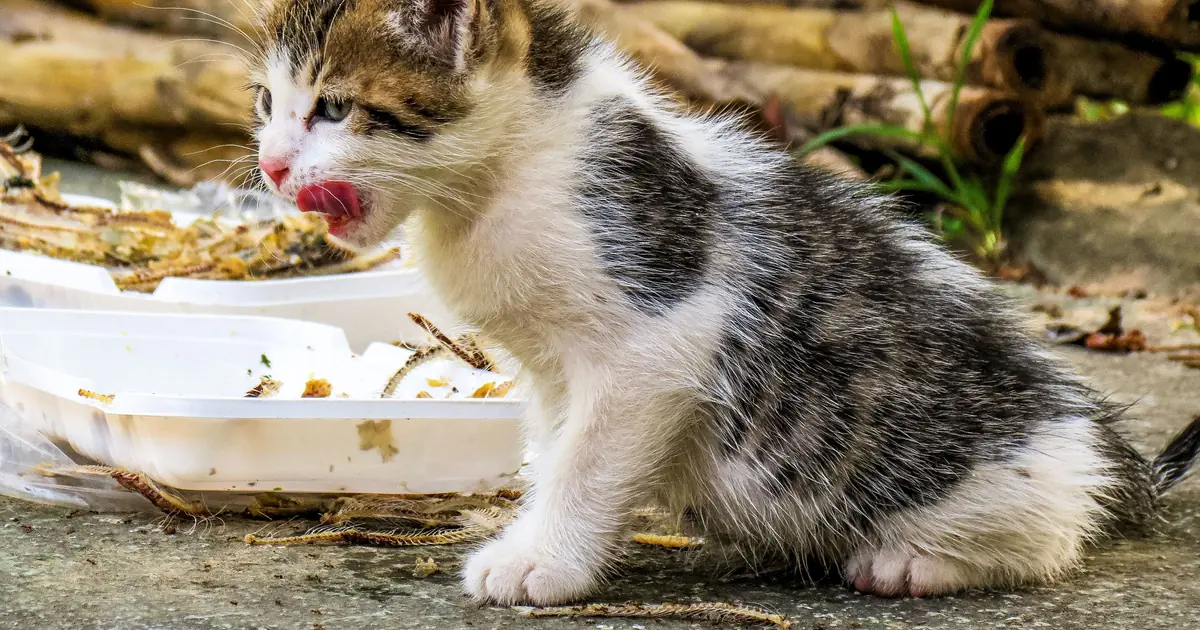
Wet food or dry food for an 8-week-old kitten?
Both wet and dry kitten food work at 8 weeks, and many cat parents feed a mix of the two. Wet food is high in moisture, which keeps a kitten hydrated and is gentle on tiny teeth. Dry food (also called kibble) is convenient, can be left out for grazing, and helps a kitten learn to crunch. There’s no single “right” answer, so pick what fits your kitten and your routine.
A popular approach is to lean on wet food for most of the daily calories and offer a little dry food on the side. Wet food’s water content matters because cats aren’t naturally big drinkers, and getting moisture through meals helps their kidneys and bladder over a lifetime.
| Food type | Why it helps | Keep in mind |
|---|---|---|
| Wet food | High moisture for hydration, soft on new teeth, very palatable | Spoils if left out, needs fresh servings at meals |
| Dry food | Convenient, can be left out to graze, budget-friendly | Low moisture, so fresh water is a must |
| Mix of both | Combines hydration with grazing convenience | Count calories from both so you don’t overfeed |
If you ever move to a schedule-based routine, our guide on how much wet food to feed a cat breaks the portions down further, and a timed wet-food feeder can help with those frequent small meals kittens love.
How much should I feed a 2-month-old kitten?
A 2-month-old kitten needs roughly 160 to 200 calories a day. Kittens need about 50 to 60 calories per pound of body weight daily until around 6 months old, and most 8-week-old kittens weigh about 2 pounds. Feeding charts from sources like Purina line up with these ranges, though every kitten is a little different. That’s a lot of fuel for such a small body, which is why growth food is so calorie-dense.
The exact grams or cans depend on the brand, so the feeding chart on your food’s packaging is your real guide. Calorie counts vary a lot between formulas. Use the chart below as a starting range, then adjust to your kitten’s own numbers.
| Kitten age | Typical weight | Approx. calories/day | Meals per day |
|---|---|---|---|
| 8 weeks (2 months) | ~2 lb (0.9 kg) | ~160 to 200 kcal | 3 to 4 |
| 10 weeks | ~2.5 lb (1.1 kg) | ~200 to 250 kcal | 3 to 4 |
| 12 weeks (3 months) | ~3 lb (1.4 kg) | ~240 to 300 kcal | 3 |
The best gut check isn’t a bowl, it’s your kitten’s body. You should be able to feel her ribs under a light layer, not see them poking out, and she should have a slight tuck at the waist. If she’s ballooning or looking scrawny, adjust and check with your vet. For the general grown-up version of this math later on, see our guide on how much to feed a cat.
How often should a 2-month-old kitten eat?
A 2-month-old kitten should eat 3 to 4 small meals a day. Their stomachs are tiny, about the size of a marble, so they can’t handle big portions. Small, frequent meals keep their energy and blood sugar steady through all that playing and growing.
You have two easy ways to do this:
- Scheduled meals. Offer measured wet or dry food 3 to 4 times a day at roughly the same times. This makes it easy to track how much she’s eating and to spot appetite changes.
- Free-feeding dry food plus wet meals. Leave out a measured amount of dry kibble for grazing, and add 2 to 3 wet meals. Only free-feed dry, since wet food spoils.
Whichever you choose, stick to a routine. Kittens thrive on predictability, and a regular schedule now makes for a calmer, less food-obsessed cat later.
Is my kitten still weaning at 8 weeks?
No, a healthy 8-week-old kitten is fully weaned. According to the Cornell Feline Health Center, kittens are typically weaned onto solid food by around 8 weeks of age. By 7 to 8 weeks, kittens are off their mother’s milk and eating solid food and drinking water on their own. That’s a big reason 8 weeks is the earliest a kitten should be separated from its mom and littermates.
So you don’t need kitten milk replacer for a 2-month-old. Milk replacer (a special formula that mimics cat milk) is for orphaned or very young bottle-fed kittens, not weaned ones. Your job now is simply to feed complete kitten food and keep water available.
One exception: if your kitten seems reluctant to eat dry food, you can soften it. Soak the kibble in a little warm water for a few minutes until it’s mushy. It’s a gentle bridge from the soft textures of weaning to crunchy food.
How do I switch a kitten to a new food?
Switch kitten food slowly over about 7 days so you don’t upset her stomach. A sudden change is one of the most common causes of kitten diarrhea, and a tummy this small doesn’t have much to spare. Whether you’re changing brands or the shelter fed something different, go gradual.
- Days 1 to 2: Mix about 25% new food with 75% old food.
- Days 3 to 4: Move to a 50/50 blend.
- Days 5 to 6: Shift to 75% new food, 25% old.
- Day 7: Feed 100% new food.
If you see soft stools along the way, slow down and hold at the last step that agreed with her. Loose poop that lasts more than a day or two in a kitten is worth a vet call, since little ones dehydrate quickly.
What foods should a 2-month-old kitten avoid?
A 2-month-old kitten should avoid cow’s milk, adult cat food, and human foods that are toxic to cats. The biggest surprise for new kitten parents is milk: despite the cartoon image, most cats can’t digest lactose well, so cow’s milk often leads straight to diarrhea. Water is all she needs to drink.
Keep these off the menu:
- Cow’s milk and dairy: triggers digestive upset in most cats.
- Adult cat food: too low in calories and protein for a growing kitten.
- Raw or homemade diets (unbalanced): easy to get wrong and risky at this age without vet guidance.
- Toxic human foods: onions, garlic, chocolate, grapes, raisins, and anything with xylitol.
- Bones and rich table scraps: a choking or stomach-upset risk.
- Dog food: it lacks taurine and other nutrients cats must have.
When in doubt, stick to complete kitten food and treats made for kittens. That covers her nutrition without the guesswork.
Does my kitten need water too?
Yes, a 2-month-old kitten needs constant access to fresh, clean water, especially if she eats mostly dry food. Now that she’s weaned, water is her only drink. Put a shallow bowl near (but not right next to) her food, and refresh it daily.
Some kittens ignore still water. If yours seems uninterested, wet food adds a lot of moisture to her day, and a small pet fountain can tempt reluctant drinkers with moving water. Good hydration habits started young pay off for her kidneys and bladder for life.
2-month-old kitten feeding FAQ
Q: How much food does a 2-month-old kitten need per day?
A 2-month-old kitten needs roughly 160 to 200 calories a day, based on about 50 to 60 calories per pound and a typical weight near 2 pounds. Because calorie counts vary by brand, follow the feeding chart on your kitten food, split into 3 to 4 small meals.
Q: Can a 2-month-old kitten eat dry food?
Yes, an 8-week-old kitten can eat dry kitten food. If she finds the kibble hard to chew, soak it in a little warm water for a few minutes to soften it. Always keep fresh water available alongside dry food.
Q: How many times a day should I feed my 8-week-old kitten?
Feed an 8-week-old kitten 3 to 4 small meals a day. Their stomachs are tiny, so frequent small portions keep their energy steady. You can also free-feed measured dry food and add a couple of wet meals.
Q: Can I give my 2-month-old kitten milk?
No, don’t give cow’s milk to a 2-month-old kitten. Most cats can’t digest lactose well, so milk often causes diarrhea. A weaned kitten only needs water to drink, plus its complete kitten food.
Q: Is wet or dry food better for a 2-month-old kitten?
Both are fine, and a mix works well. Wet food adds hydration and is easy on new teeth, while dry food is convenient and can be left out to graze. Many cat parents feed mostly wet with some dry on the side.
Q: When can a kitten eat adult cat food?
Most kittens should stay on kitten (growth) food until about 12 months old, when they reach adult size. Large breeds like Maine Coons may need kitten food a bit longer. Switching to adult food too early shortchanges a growing kitten on calories and nutrients.
Q: How do I know if I’m feeding my kitten enough?
A well-fed kitten is playful, growing steadily, and has a light layer of padding over the ribs with a slight waist tuck. If you can see the ribs and spine, feed more; if there’s no waist, feed a bit less. Check with your vet if you’re unsure.
Bottom line: feed your 2-month-old kitten a complete kitten food, wet or dry or both, in 3 to 4 small daily meals, keep water flowing, and skip the milk. Weigh her against the chart, watch her body, and let her vet fine-tune the portions. Nail the basics now and you’re giving your new kitten the best possible start.

Hello and welcome to The Ideal Cat!
We are some passionate cat owners from different professions. We love our cats and have a lot of experience in how to care for our pets. We are incredibly excited to share our knowledge, experience, and research with you. So you can take good care of your loving cat. We will answer most of the common questions about owning cats, taking care of them, etc. If you have any question contact with us. Thanks for visiting! Enjoy the content.
