You drop a rubber band on the kitchen floor and, within seconds, your cat is on it. Batting it under the fridge, digging it back out, tossing it in the air like it just won the lottery. It’s a weirdly reliable trick, and almost every cat parent has seen it.
Here’s the thing, though. That same rubber band your cat loves so much can also send you both to the emergency vet. This isn’t about ruining the fun. It’s about understanding why cats are drawn to rubber bands so you can give them something just as exciting, minus the risk of a midnight vet visit.
- Cats chase rubber bands because their light, erratic movement mimics scurrying prey like insects or mice.
- The small size and stretchy snap of a rubber band trigger a cat’s natural pounce-and-bite hunting sequence.
- Swallowed rubber bands and hair ties can cause choking or an intestinal blockage that may need surgery to fix.
- A cat that swallows a rubber band may vomit, stop eating, act lethargic, or paw at its mouth, and needs a vet visit right away.
- Cat-safe alternatives, like spring toys and crinkle balls, give the same batting thrill without the swallowing risk.
Why do cats like rubber bands so much?
Cats like rubber bands because they check every box on a cat’s “this looks like prey” list: small, lightweight, unpredictable, and quick to move with almost no effort. A rubber band flicked across the floor skitters and rolls in a jerky, erratic way, nothing like a ball rolling in a straight line. That randomness is exactly what catches a cat’s eye.
Add in the fact that rubber bands are cheap, always lying around, and never seem to run out, and you’ve got the perfect low-effort cat toy hiding in your junk drawer. Most cats don’t care that it’s not a “real” toy. To them, it moves, it’s grabbable, and that’s enough.
Is it the hunting instinct that makes rubber bands so fun for cats?
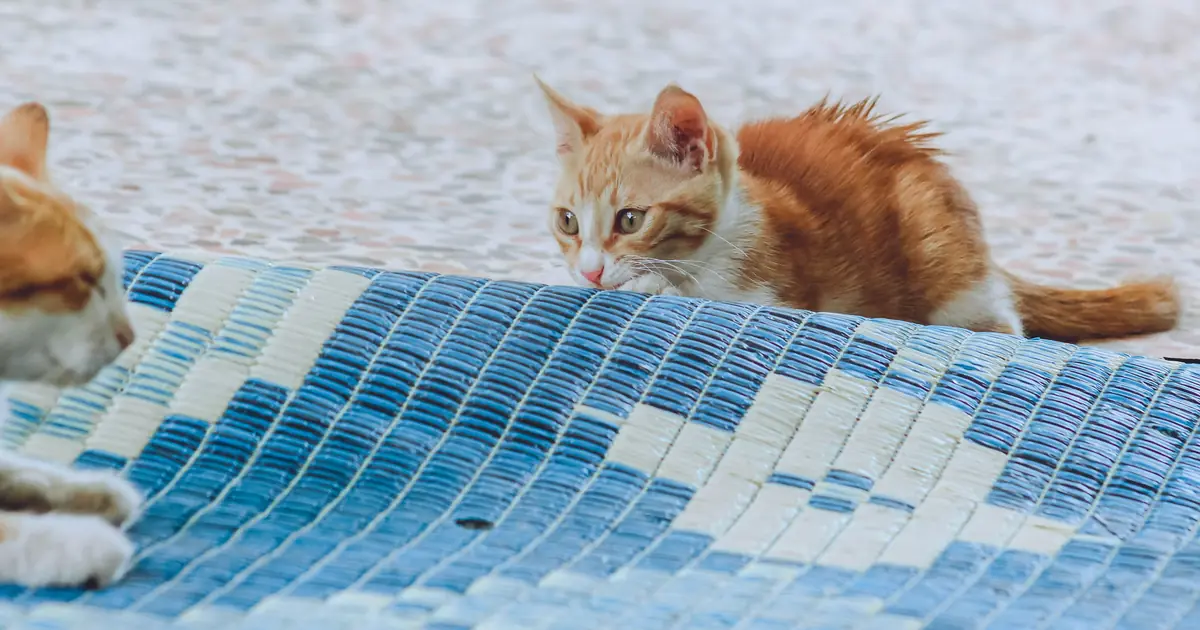
Yes, a rubber band appeals directly to your cat’s hunting instinct. Domestic cats are natural predators, and even a well-fed, fully indoor cat still carries the wiring to stalk, chase, and pounce. A rubber band skittering across tile or wood floors moves a lot like a beetle or a mouse darting for cover.
Watch closely and you’ll usually see the full sequence play out: your cat stares, crouches low, wiggles its hips, then pounces. That wiggle isn’t cute nervousness, it’s your cat loading up its back legs for a more accurate leap, something researchers at International Cat Care describe as normal predatory behavior. A rubber band is basically a free, self-resetting hunting game.
Why do some cats chew on rubber bands, not just bat them?
Some cats chew rubber bands because they’re drawn to the stretchy, slightly rubbery texture, not just the movement. Chewing and mouthing objects is normal exploratory behavior for cats, similar to why your cat might mouth on plastic bags or plastic packaging. The material has a texture and give that some cats seem to find satisfying to gnaw on.
In a smaller number of cases, an unusual urge to chew and eat non-food items (called pica) can be linked to boredom, stress, dental discomfort, or underlying medical issues. If your cat is chewing on rubber bands, string, fabric, or other odd items regularly, it’s worth mentioning to your vet rather than assuming it’s just quirky personality.
What’s the real danger of cats playing with rubber bands?
The real danger is swallowing. A cat’s tongue is covered in tiny backward-facing barbs called papillae, and once a rubber band (or a piece of one) touches those barbs, it’s almost impossible for your cat to spit it back out. It gets pulled further into the mouth and swallowed, whether your cat meant to eat it or not.
Once swallowed, a rubber band can get stuck in the throat and cause choking, or travel into the stomach or intestines and cause a blockage. If a rubber band stretches out and gets tangled around the base of the tongue or catches partway through the intestines, it can act like a string, cutting into tissue as the gut tries to push it along. The School of Veterinary Medicine at the University of Wisconsin and other veterinary sources classify this as a linear foreign body, and it’s a genuine surgical emergency. Hair ties, elastics, and rubber bands all carry this exact same risk, so don’t assume one is safer than the other just because it’s marketed for hair.
What are the signs a cat swallowed a rubber band?
The main signs a cat swallowed a rubber band are vomiting, not eating, lethargy, straining in the litter box, and pawing at the mouth. Some cats will also drool, gag, or seem unusually restless and uncomfortable. Not every cat shows obvious symptoms right away, which is part of what makes this so risky.
- Repeated vomiting or dry heaving
- Skipping meals or sudden lack of interest in food
- Low energy or hiding more than usual
- Straining to poop, or no bowel movements at all
- Pawing at the mouth or drooling
- A visible bit of rubber band hanging from the mouth or rear end
If you see any part of a rubber band or string hanging out of your cat’s mouth or rear end, do not pull it. Pulling can saw into the intestines and cause serious internal damage. Get to a vet immediately instead, according to guidance from the ASPCA Animal Poison Control Center on foreign body ingestion.
What should you do if you catch your cat playing with a rubber band?
If you catch your cat playing with a rubber band, calmly take it away rather than chasing your cat around the house for it. Fast, panicked movements from you can turn it into a game of keep-away, and a cat that feels chased is more likely to gulp the rubber band down out of instinct.
- Distract your cat with a treat or a different toy tossed a few feet away
- Once your cat looks away, pick up the rubber band
- Do a quick count of any rubber bands, hair ties, or elastics you know were in reach
- Check under furniture and rugs for any that rolled out of sight
- Store the rest somewhere your cat genuinely cannot get to
If your cat already swallowed something and later starts vomiting, check out our guide on when cat vomiting is a reason to worry and call your vet the same day rather than waiting it out.
How do you keep rubber bands and hair ties away from cats?
The most reliable way to keep rubber bands away from your cat is to store them in a closed drawer, zippered pouch, or lidded container, never loose on a counter, desk, or nightstand. Cats are curious and surprisingly good at knocking small objects off surfaces just to see what happens next.
The same rule applies to hair ties, bobby pins, paper clips, and rubber jar rings. If it’s small, light, and stretchy or snaps back into shape, treat it like a hazard, the same way you’d rethink letting your cat play with loose yarn or string. A quick sweep of the bathroom counter and home office before bed takes ten seconds and prevents most late-night “why is my cat acting weird” scares.
What are safer toys that give cats the same thrill as rubber bands?
Cat-safe spring toys, crinkle balls, and interactive wand toys give cats that same erratic, bouncy movement without any swallowing risk. Coiled plastic springs skitter across hard floors almost exactly like a rubber band, but they’re too big to fit down a cat’s throat. Crinkle balls add a satisfying sound cats love, similar to why they enjoy batting things around at mealtime.
| Item | Why cats like it | Safe for cats? |
|---|---|---|
| Rubber band | Light, bouncy, erratic movement, satisfying snap | No, choking and blockage risk |
| Hair tie | Same size and stretch as a rubber band | No, same swallowing risk |
| Cat spring toy | Skitters and bounces the same way, but too large to swallow | Yes |
| Cat-safe bouncy ball | Unpredictable bounce, easy to bat and chase | Yes, when sized for cats |
Rotating a few of our favorite interactive cat toys throughout the week keeps things interesting, so your cat isn’t tempted to go hunting for a rubber band out of boredom in the first place.
Frequently Asked Questions
Q: Why does my cat steal rubber bands specifically?
Cats steal rubber bands because they’re small enough to carry, move unpredictably when batted, and are almost always left within easy reach on desks, counters, and bathroom floors. Cats are opportunistic hunters, so an easy, always-available “prey” object gets picked over a toy that’s put away in a bin.
Q: Can a cat digest a rubber band on its own?
Sometimes a small piece passes through without issue, but rubber does not break down in a cat’s digestive system the way food does. Any rubber band swallowed should be treated as a possible medical emergency, and you should call your vet rather than wait to see if it passes.
Q: How do I know if my cat swallowed a rubber band and not something else?
You often won’t know for sure without a vet visit. Missing rubber bands around the house combined with vomiting, not eating, or straining in the litter box are strong red flags. Your vet can check with an x-ray or ultrasound to confirm what’s going on.
Q: Are hair ties as dangerous as rubber bands for cats?
Yes, hair ties carry the exact same risks as rubber bands. Both are small, stretchy, and easy for a cat’s barbed tongue to pull in and swallow, and both can cause choking or an intestinal blockage.
Q: My cat only bats the rubber band and never chews it, is that still risky?
It’s lower risk than a cat that chews and mouths it, but not risk-free. A rubber band can still end up near your cat’s mouth during rough play, or get carried around and chewed later when you’re not watching. It’s safest to pick it up and put it away as soon as play is over.
Q: What should I do right now if I think my cat ate a rubber band?
Call your vet or an emergency animal hospital right away and describe what you saw, including whether any part of the band is visible. Don’t try to induce vomiting or pull anything hanging from your cat’s mouth or rear end, since this can cause more internal damage.
Q: Why do cats like the snapping sound of a rubber band?
The snap and the sudden burst of movement mimic the quick, startling motion of an insect or small prey animal breaking cover. That kind of sudden movement is exactly what triggers a cat’s pounce reflex, which is why a single snapped rubber band can get an instant reaction.
Q: What toys are the closest safe substitute for a rubber band?
Coiled plastic spring toys made for cats are the closest match, since they skitter and bounce across floors in a similarly erratic way. Crinkle balls and feather wand toys are good runners-up, giving your cat that same batting and pouncing satisfaction without the swallowing hazard.
This article is educational and not a substitute for veterinary care. If you suspect your cat swallowed a rubber band, hair tie, or any similar object, or you see part of one hanging from the mouth or rear end, contact your vet or an emergency animal hospital right away rather than waiting or trying to remove it yourself.

Hello and welcome to The Ideal Cat!
We are some passionate cat owners from different professions. We love our cats and have a lot of experience in how to care for our pets. We are incredibly excited to share our knowledge, experience, and research with you. So you can take good care of your loving cat. We will answer most of the common questions about owning cats, taking care of them, etc. If you have any question contact with us. Thanks for visiting! Enjoy the content.
