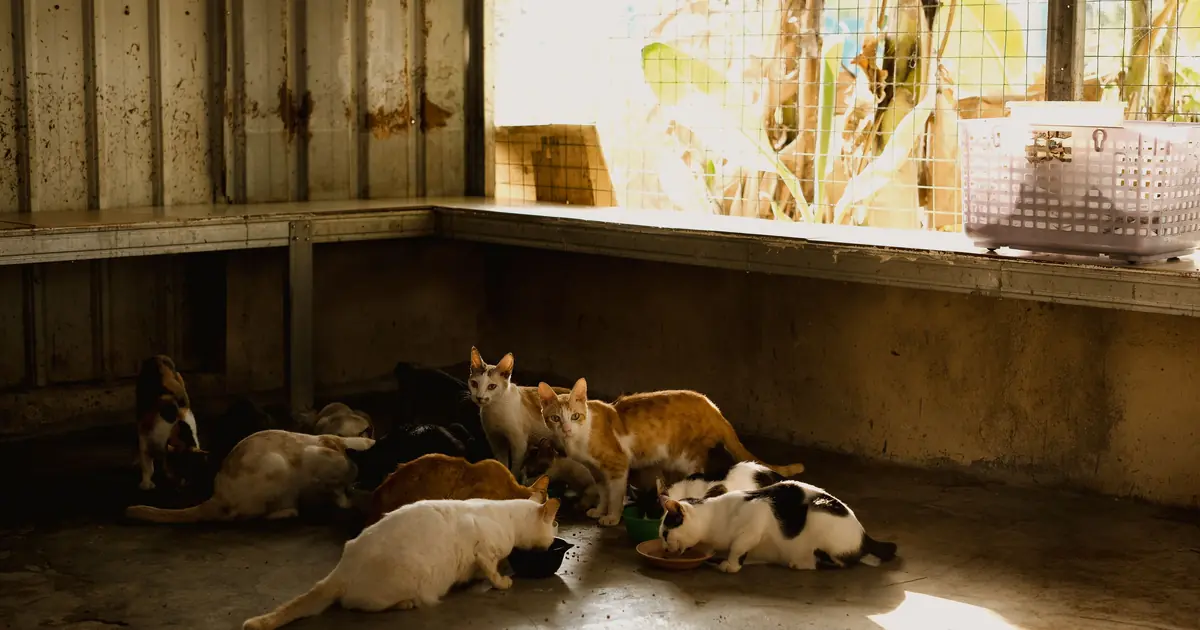
You fill the bowl, walk away, and come back to kibble scattered halfway across the kitchen like tiny hockey pucks. Your cat is sitting a foot away, looking very pleased with herself, food still uneaten in the middle of the mess.
It looks chaotic. It looks a little rude, honestly. But this is one of the most normal things a cat can do, and there’s real biology behind it. Cats are built to hunt, not to graze from a dish, and mealtime play is often that ancient wiring showing up in your kitchen.
- Cats bat and toss food because it mimics the stalk-catch-kill sequence they’d use on real prey in the wild.
- Bored, understimulated indoor cats often turn mealtime into the only “hunt” available to them.
- Whisker fatigue, discomfort from whiskers brushing the sides of a deep or narrow bowl, drives many cats to paw food onto the floor before eating.
- Some cats carry food away from the bowl as an instinct to move a “catch” somewhere quieter or safer to eat.
- Food play is usually harmless, but a cat who plays with food and won’t actually eat it needs a vet check for dental pain or nausea.
Why Do Cats Play With Their Food?
Cats play with their food mainly because eating and hunting are wired together in their brains. A cat’s whole body is built for the hunt: quick reflexes, forward-facing eyes for tracking movement, and a strong instinct to chase, pounce, and bite. In the wild, a cat doesn’t just walk up to a meal sitting in a dish. She stalks it, catches it, and often bats it around before the final bite.
Domestic cats still carry that instinct even though the food shows up free and pre-killed in a bowl. Batting a piece of kibble or tossing a treat into the air gives your cat a small taste of that same catch-and-play sequence. It’s not misbehavior. It’s a house cat doing what a wild cat’s brain expects her to do.
Is Batting and Tossing Food Really Predatory Play?
Yes, in most cases batting and tossing food is a direct extension of predatory, or hunting, behavior. International Cat Care notes that even well-fed pet cats retain the full hunting sequence: watch, stalk, pounce, bite, and kill. Kibble that skitters across a hard floor moves in a way that triggers that same chase response.
You’ll see this most clearly with crunchy kibble or a freeze-dried treat. It rolls, it bounces, and that motion is basically catnip for a cat’s prey drive. She bats it, watches where it lands, pounces again, and only then eats it. If you’ve ever tossed a live bug into the mix by accident, you’ve probably seen the exact same behavior aimed at something actually alive.
Could Your Cat Just Be Bored?
Yes, boredom is a common reason cats turn a simple meal into a ten-minute game. Indoor cats don’t get to spend their day hunting, patrolling territory, or solving problems the way an outdoor or barn cat would. Mealtime can end up being the most exciting, unpredictable part of an otherwise quiet day.
An understimulated cat will often make her food work for its living: batting it, chasing it under the fridge, then fishing it back out. If your cat seems more interested in the game than the meal itself, more enrichment during the day usually helps. A few short play sessions with a wand toy, some vertical space to climb, and a rotating stash of toys all give that hunting energy somewhere else to go. The right toys for a bored cat can take a lot of pressure off dinner time.
Why Does My Cat Paw Food Out of the Bowl?
Cats often paw food out of a bowl because of whisker fatigue, a real discomfort that happens when a cat’s sensitive whiskers repeatedly brush against the sides of a deep or narrow dish. Whiskers, technically called vibrissae, are packed with nerve endings and feed your cat constant information about her surroundings. A bowl that forces her whiskers to bend inward on every bite can get genuinely irritating over time.
VCA Hospitals describes whisker fatigue as a possible reason cats hesitate at the bowl, paw food onto a flatter surface, or eat right at the edge of the dish instead of the center. The fix is usually simple: swap a deep, narrow bowl for a shallow, wide plate or a dedicated low-sided cat dish, so her whiskers never have to touch the sides.
Why Does My Cat Carry Food Away From the Bowl?
Cats sometimes carry food away from the bowl because of an old instinct to move a “catch” somewhere quieter before eating it. In the wild, a cat that just caught prey doesn’t linger out in the open. She drags it somewhere sheltered, away from rivals or bigger predators, before settling in to eat.
At home, that can look like your cat scooping a mouthful of kibble and trotting off to eat it on the rug, in a hallway, or next to the couch. This is especially common in multi-cat households, where a cat may want distance from a housemate she doesn’t fully trust around food. Feeding cats in separate spots, or at least a few feet apart, often cuts down on this kind of food relocating.
Why Does My Cat Paw at the Floor Around the Bowl?
Cats pawing at the floor or the wall near their food bowl are usually acting on a caching instinct, the same behavior wild cats use to “bury” leftover prey and hide it from scavengers. Your cat’s brain treats an empty food bowl or the floor around it the same way, scratching at it as if covering up a meal for later, even though there’s nothing to actually bury.
Sometimes this scratching motion means something else: your cat doesn’t love the food, or she’s not thrilled with the bowl itself, and the pawing is a way of saying “let’s move this along.” If the floor-pawing shows up alongside sniffing and walking away from meals, it’s worth checking whether your cat has gone off her food for a reason beyond pickiness.
| Behavior | Likely Reason | Fix |
|---|---|---|
| Batting kibble across the floor | Predatory play instinct | Add short play sessions before meals; use a food puzzle to channel the drive |
| Pawing food out of the bowl | Whisker fatigue from a deep or narrow dish | Switch to a shallow, wide bowl or flat plate |
| Pawing at the floor around the bowl | Caching instinct, or dislike of the food or bowl | Try a different bowl material, food, or bowl placement |
| Carrying food away from the bowl | Instinct to eat a “catch” somewhere safer | Feed multi-cat households in separate, quiet spots |
Is Playing With Food Ever a Problem?
No, playing with food is not a problem on its own. It’s a normal, healthy expression of a cat’s hunting instinct and it doesn’t need to be trained away. The behavior only becomes a red flag when it’s paired with other signs.
Watch for a cat who plays with food but consistently won’t eat it, drops food out of her mouth mid-chew, paws at her own mouth or face after eating, or loses weight. Those signs can point to dental pain, a sore tooth, or nausea rather than simple play. The ASPCA notes that sudden changes in eating behavior are always worth mentioning to a vet, since cats are experts at hiding pain until it’s fairly advanced.
This article is educational and isn’t a substitute for veterinary advice. If your cat plays with food but skips actual eating for more than a day, or shows other signs like vomiting, drooling, or bad breath, get her checked out. Dental disease and nausea are both treatable once you know what’s going on.
How Do You Reduce Messy Food Play?
You can cut down on messy food play by matching your cat’s meals to her hunting instinct instead of fighting it. Here’s what actually works:
- Switch to a shallow, wide bowl or a flat plate to rule out whisker fatigue.
- Use a food puzzle or slow feeder so the “hunt” happens with the food staying mostly contained.
- Run a five to ten minute play session with a wand toy right before mealtime, so some of that predatory energy burns off first.
- Serve smaller, more frequent portions instead of one big bowlful, which tends to reduce batting and tossing.
- In multi-cat homes, feed cats a few feet apart or in separate rooms to ease any food-guarding instinct.
- Rotate a few interactive toys through the week so your cat has other outlets for chasing and pouncing besides her dinner.
A cat who gets enough physical and mental exercise through the day tends to treat meals more like meals and less like the evening’s main event. If you’re not sure how much activity your cat actually needs, our guide on how much exercise cats need is a good place to start. And if the zoomies and food-batting seem to show up together, that’s often the same restless energy looking for a way out, similar to what drives the cat zoomies or a sudden urge to knock things off the counter.
Frequently Asked Questions
Q: Why does my cat bat her food across the floor before eating it?
Batting food is predatory play. Kibble that rolls or skitters across a hard floor triggers the same stalk-and-pounce instinct a cat would use on real prey, so she “catches” it a few times before finally eating.
Q: Why does my cat scoop food out of the bowl with her paw?
This is most often whisker fatigue, discomfort caused by whiskers brushing against the sides of a deep or narrow bowl. Scooping the food onto a flatter surface lets her eat without her whiskers touching the dish.
Q: What is whisker fatigue in cats?
Whisker fatigue is sensory overstimulation that happens when a cat’s whiskers, which are packed with nerve endings, repeatedly touch the sides of a bowl or other tight space. It can cause hesitation at the food bowl and pawing food out onto a wider surface.
Q: Why does my cat carry food away from the bowl to eat it somewhere else?
Carrying food off is an old instinct to move a catch somewhere quieter and safer before eating, away from other pets or perceived competition. It shows up most in multi-cat households.
Q: Why does my cat paw at the floor or wall near the food bowl?
Pawing near the bowl usually points to a caching instinct, the same motion wild cats use to bury leftover prey. It can also mean your cat isn’t fully happy with the food or the bowl itself.
Q: Should I worry if my cat plays with food but doesn’t eat it?
Occasional play before eating is normal. If your cat plays with food but consistently refuses to actually eat it, drops food from her mouth, or paws at her face, see a vet, since this can signal dental pain or nausea.
Q: Can boredom really make a cat play with its food?
Yes. Indoor cats that don’t get enough physical or mental stimulation during the day often treat mealtime as their main source of excitement, turning kibble into an impromptu game.
Q: What kind of bowl stops a cat from pawing food out?
A shallow, wide bowl or a flat plate works best, since it keeps a cat’s whiskers from touching the sides while she eats. This is the standard fix vets recommend for whisker fatigue.

Hello and welcome to The Ideal Cat!
We are some passionate cat owners from different professions. We love our cats and have a lot of experience in how to care for our pets. We are incredibly excited to share our knowledge, experience, and research with you. So you can take good care of your loving cat. We will answer most of the common questions about owning cats, taking care of them, etc. If you have any question contact with us. Thanks for visiting! Enjoy the content.
