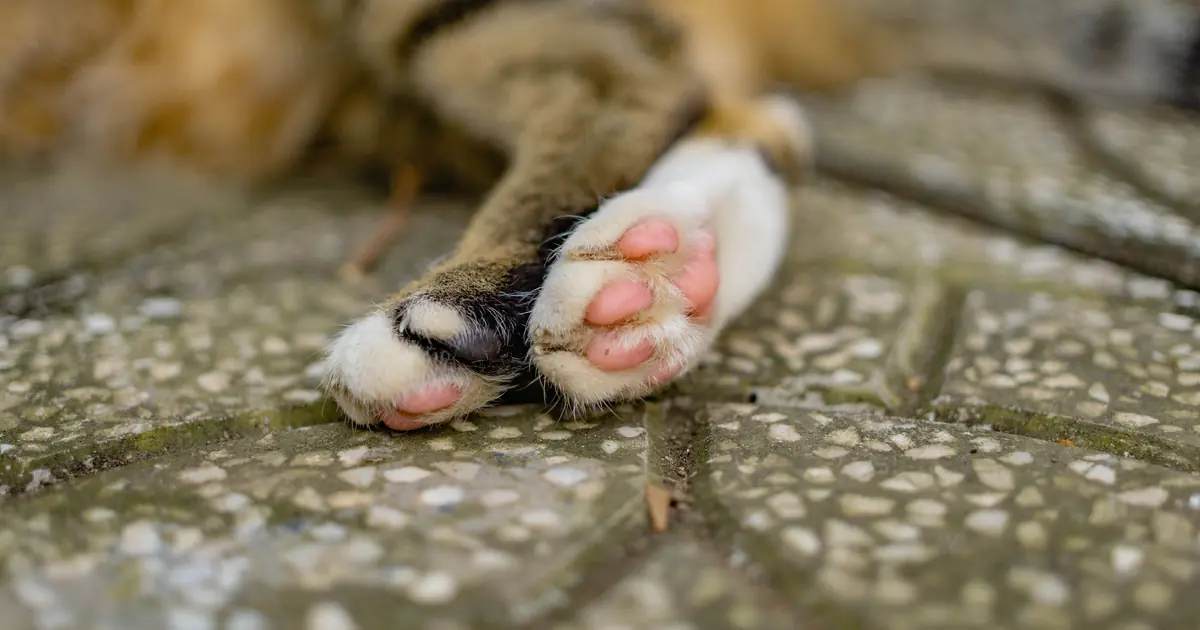
Ever flipped your cat’s paw over to trim their claws and noticed a thin bit of skin connecting the toes? You’re not imagining things. That little strip of skin has a job, and it’s been there since your cat was born.
Here’s the thing: cats aren’t secretly part duck. But that faint webbing between their toes isn’t random either. It’s a small, practical piece of paw engineering that helps with everything from stalking a toy mouse to sticking a landing off the couch.
- Nearly all cats have a small amount of skin webbing between their toes, but it’s nowhere near as extensive as a duck’s or otter’s webbed feet.
- The webbing helps a cat’s toes spread apart for better balance, grip, and shock absorption when jumping or running.
- Maine Coons are known for extra-large, well-furred paws sometimes called “snowshoe” paws, which help them walk on top of snow.
- Turkish Vans are famous for enjoying water and have slightly more webbing than average, though they still aren’t built like true swimming animals.
- Paw webbing is different from polydactyly (extra toes), which is a separate genetic trait some cats are born with.
Do Cats Actually Have Webbed Feet?
Not in the way you’re picturing. Cats have a thin fold of skin between the base of their toes, not the deep, stretchy webbing you’d see on a duck’s foot or a beaver’s tail. This partial webbing is normal anatomy found in most cats, wild and domestic, and it’s easiest to spot when you gently spread a cat’s toes apart.
Compare that to a genuinely webbed foot, like a duck’s, where skin stretches almost to the tips of the toes to create a paddle for swimming. A cat’s webbing only reaches about a third to halfway up the toe. It’s a support feature, not a swim fin.
What Is the Skin Between a Cat’s Toes Called?
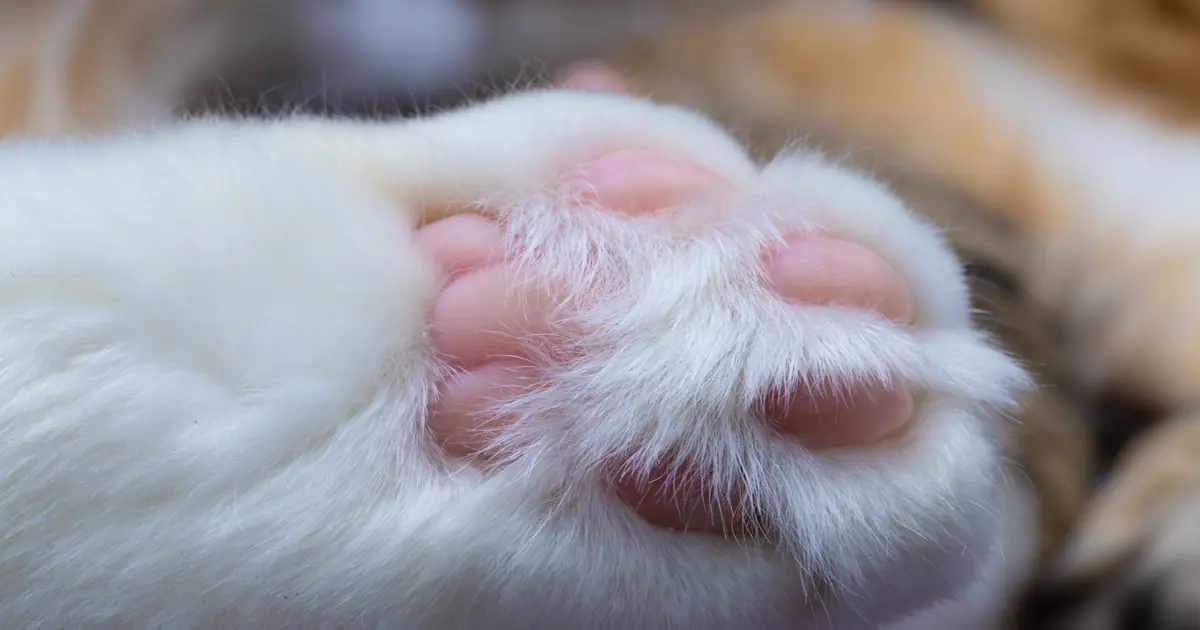
That skin is simply called interdigital webbing, and it’s made of the same thin, flexible skin that covers the rest of your cat’s paw pad area. It connects the base of each toe to its neighbor, so the toes move as a coordinated unit instead of splaying independently with every step.
You’ll find this same basic structure in dogs, foxes, and plenty of other mammals. It’s not unique to cats. What varies from species to species, and even breed to breed, is how much webbing is there and how far up the toe it extends.
Why Do Cats Have Webbing Between Their Toes?
Cats have toe webbing mainly to help their paws spread and stabilize during jumping, climbing, and running. Without it, a cat’s toes could splay too wide on impact, which would waste energy and reduce grip.
- Landing control: Cats jump from impressive heights (up to five or six times their own body length), and the webbing helps the toes act together to cushion and distribute that landing force.
- Traction and grip: Slightly connected toes give a cat’s paw more surface contact when climbing a tree trunk or gripping a scratching post.
- Digging support: A little webbing helps keep the toes aligned when a cat digs in litter or soil, so effort doesn’t leak out sideways.
- Cold and wet surfaces: On snow or soft, uneven ground, webbing helps spread a cat’s weight slightly, similar in concept (though nowhere near as dramatic) to a snowshoe.
None of this makes a cat especially good at swimming. It’s mostly about balance and control on land, which is where the vast majority of cats spend their whole lives. If you’ve ever watched your cat stick a landing off a bookshelf without a wobble, you’ve seen this system doing its job.
Which Cat Breeds Have More Webbing Between Their Toes?
Two breeds stand out for having noticeably more paw webbing than the average house cat: the Maine Coon and the Turkish Van. Both developed their paw traits in tough natural environments long before anyone was selectively breeding for looks.
Maine Coons come from cold, snowy New England winters. Their paws are big, round, and heavily tufted with fur, and the skin between their toes carries a bit more webbing than a typical shorthair. Fans call these “snowshoe” paws because they help distribute the cat’s weight across snow instead of sinking straight through it. You can read more about the breed’s cold-weather build in our Maine Coon cat guide.
Turkish Vans have a real reputation for liking water, which is unusual for cats. Their coat has a water-resistant texture, and their toe webbing is a bit more pronounced than average. Still, “likes water” and “built to swim” aren’t the same thing. A Turkish Van paddling in a shallow bowl of water is having fun and cooling off, not performing a specialized swimming adaptation.
| Paw Feature | What It Is and Does |
|---|---|
| Toe webbing | Thin skin connecting the base of the toes in most cats; helps with balance, grip, and softer landings. |
| Toe tufts | Extra fur growing between and around the toes, common in Maine Coons and Norwegian Forest Cats; adds insulation and traction, not related to skin webbing. |
| Snowshoe paws | A nickname for the large, tufted, slightly webbed paws seen in cold-climate breeds like the Maine Coon; helps spread weight on snow. |
| Polydactyl toes | An inherited trait causing one or more extra toes on a paw; a completely separate genetic quirk from webbing, though the two sometimes appear together. |
Does Toe Webbing Mean a Cat Can Swim?
No, toe webbing doesn’t turn a cat into a strong swimmer. Most cats can swim if they truly need to (it’s an instinct they have, not something they need to learn), but their paws aren’t shaped like the paddle-style feet of true aquatic animals.
A duck, otter, or beaver has webbing that runs almost the full length of the toe, creating an actual paddle surface. A cat’s webbing stops well short of that, so it doesn’t generate the same propulsion in water. Breeds like the Turkish Van enjoy water more than most, but that’s about temperament and coat, not a swimming-specific paw design. According to International Cat Care, cats are naturally capable swimmers when they have to be, even though most avoid water by choice.
What’s the Difference Between Toe Webbing and Toe Tufts?
Toe webbing is skin, and toe tufts are fur, and they show up in completely different spots on the paw. Webbing sits low, connecting the base of the toes underneath. Toe tufts are the little puffs of fur that grow up and around the toes and between the paw pads, sometimes poking out past the edge of the foot.
Maine Coons and Norwegian Forest Cats are known for heavy toe tufts, which act like natural snow boots by keeping ice and cold slush away from the sensitive pads. A cat can have plenty of toe tufts and only average webbing, or vice versa. They’re two separate traits that happen to both show up more in cold-climate breeds.
Is More Toe Webbing Ever a Problem?
No, extra toe webbing on its own isn’t a health problem and doesn’t need any special care. It’s a normal variation, similar to how some cats have longer whiskers or bigger ears than others.
Where things get more complicated is polydactyly, which is a different trait entirely: an inherited condition that gives a cat one or more extra toes, sometimes with a bit of extra webbing tucked in around them. Polydactyl cats (sometimes nicknamed “Hemingway cats”) are generally just as healthy as any other cat, though very rarely, extra toes can crowd together in a way that needs a vet’s attention. Our guide on whether polydactyl cats are rare covers how common the trait actually is and what to watch for. If you’re curious about paw anatomy in general, we’ve also broken down whether cats have thumbs and what a cat’s front legs are actually built like.
How Can You Check Your Cat’s Paws for Webbing?
You can check your cat’s paw webbing by gently pressing a toe pad and spreading the toes apart with a light, careful touch. Most cats tolerate this fine, especially if you do it during a calm cuddle session rather than out of nowhere.
- Pick a moment when your cat is relaxed, not mid-zoomies or freshly woken up.
- Hold the paw gently and press just above the pad to encourage the toes to spread.
- Look at the base of the toes for the thin strip of skin connecting them.
- Check between each toe for any redness, swelling, debris, or odor while you’re at it.
- Stop if your cat pulls away or seems uncomfortable. No need to force it.
This is also a handy time to get your cat used to having their paws handled, which makes future nail trims and vet checks a lot less dramatic. If your cat also shakes their paws a lot after you touch them, it’s usually just a normal reflex, and our piece on why cats shake their paws explains the usual reasons. Understanding how a cat’s whole paw and claw system works together, including how cats retract their claws, also makes more sense once you’ve seen how flexible their toes are. That flexibility ties into the same joint and tendon setup that lets cats twist and stretch the way they do, something we cover in why cats are so flexible.
Toe webbing is completely normal and doesn’t require any grooming or treatment on its own. Even so, it’s worth glancing at the skin between your cat’s toes every so often. If it ever looks red, swollen, sore, or your cat starts limping or licking at a paw obsessively, that’s a reason to call your vet rather than wait it out. This article is for general education and isn’t a substitute for an actual veterinary exam. For a closer look at healthy paw anatomy, the VCA Animal Hospitals guide to cat paws is a solid reference.
Frequently Asked Questions About Cat Toe Webbing
Q: Do all cats have webbed feet?
Nearly all cats have some amount of skin webbing between their toes, but it’s minor compared to a true webbed foot. The amount varies slightly between individual cats and breeds.
Q: Why do Maine Coons have such big, webbed paws?
Maine Coons developed large, tufted, slightly webbed paws to help them handle harsh New England winters. The bigger paw surface and extra webbing help spread their weight on snow, working a bit like natural snowshoes.
Q: Can cats swim because of their toe webbing?
Cats can swim if they need to, since it’s an instinctive ability, but their toe webbing isn’t extensive enough to be a true swimming adaptation. Their paws don’t create the paddle effect that ducks or otters get from full webbing.
Q: Is toe webbing the same as polydactyly?
No, they’re two different traits. Toe webbing is the skin connecting the base of a cat’s toes, while polydactyly is an inherited condition that gives a cat one or more extra toes on a paw.
Q: What cat breed is known for liking water?
The Turkish Van is the breed most known for enjoying water, so much so it’s sometimes nicknamed the “swimming cat.” Its coat has a water-resistant texture and slightly more toe webbing than an average cat, though it’s still not built as a dedicated swimmer.
Q: Are toe tufts the same as toe webbing?
No, toe tufts are fur that grows around and between the toes, while toe webbing is skin at the base of the toes. Maine Coons and Norwegian Forest Cats tend to have heavy toe tufts for extra warmth and traction in snow.
Q: Should I be worried if my cat’s paw webbing looks different on each foot?
Small natural variation between paws is normal and usually nothing to worry about. If one paw looks swollen, red, or your cat is favoring it, that’s worth a call to your vet rather than a wait-and-see approach.
Q: How much does a cat’s paw webbing help with balance?
Toe webbing helps a cat’s toes move together instead of splaying independently, which supports steadier landings and better grip when climbing or running. It’s a small structural assist, not the main reason cats are so agile, which comes mostly from their flexible spine and strong leg muscles.

Hello and welcome to The Ideal Cat!
We are some passionate cat owners from different professions. We love our cats and have a lot of experience in how to care for our pets. We are incredibly excited to share our knowledge, experience, and research with you. So you can take good care of your loving cat. We will answer most of the common questions about owning cats, taking care of them, etc. If you have any question contact with us. Thanks for visiting! Enjoy the content.
