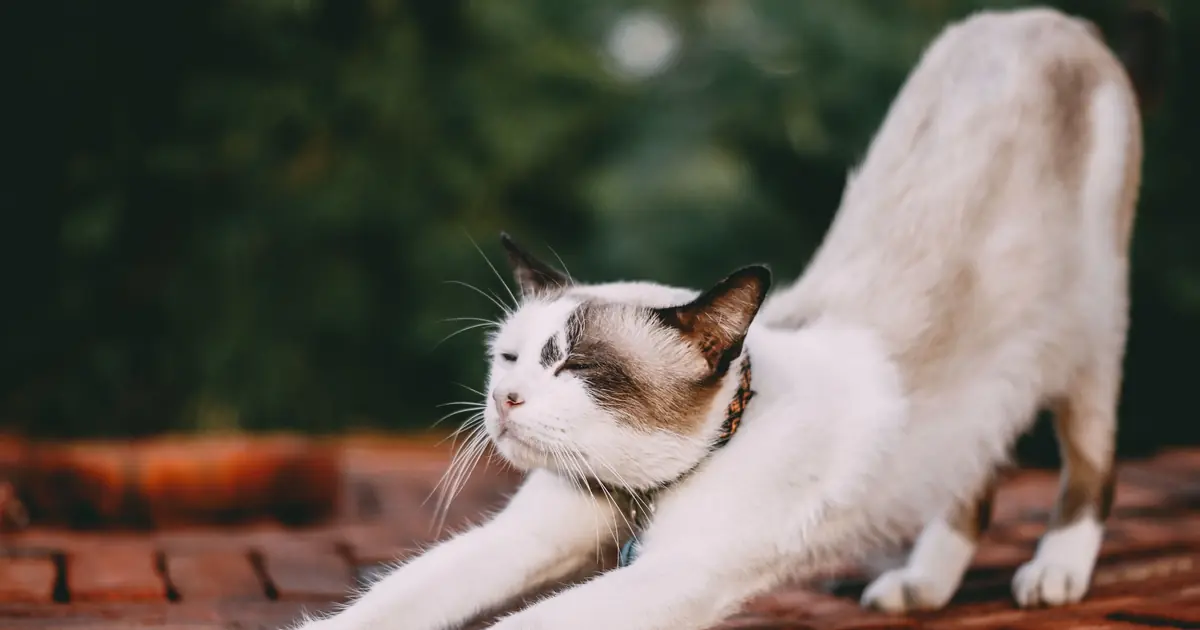
You’ve seen it. Your cat folds herself into a shoebox two sizes too small, tucks her chin under one back paw, and stares at you like nothing about this is strange. Meanwhile you’re wondering if she secretly removed her spine. Fold yourself up like that and your foot would go numb, which raises a fair question: can a cat’s legs fall asleep?
She didn’t. What she has is a body built for exactly this kind of nonsense. Cats aren’t rubber and they don’t have some mystery organ that lets them defy anatomy. They have real bones, real joints, and real muscle, just arranged in a way that gives them way more range of motion than we get. Let’s get into why.
- Cats have about 30 vertebrae in their spine, compared to 24 to 26 in humans, and their backs bend far more freely because of it.
- A cat’s collarbone (clavicle) is vestigial and free-floating, embedded in shoulder muscle instead of connected to other bones like ours is.
- The free-floating collarbone lets a cat squeeze through any gap roughly as wide as its head.
- The righting reflex, a built-in twisting response, lets a falling cat rotate mid-air and land feet-first, often from heights as low as one to two feet.
- A cat’s skeleton has around 230 to 250 bones, roughly 40 to 60 more than a human’s 206, mostly from extra vertebrae and tail bones.
Why are cats so flexible?
Cats are flexible because their skeleton is built differently from ours at almost every joint that matters for bending and twisting. The spine has extra vertebrae and stretchier discs between them. The collarbone floats free in muscle instead of locking into the skeleton. The shoulders and hips sit in loose, rotating joints. Add lean, elastic muscle and quick reflexes, and you get an animal that can turn around inside its own skin, almost literally.
None of this is magic and it’s not unique to any one breed. Every healthy house cat, from a chunky orange tabby to a lean Siamese, has this same basic setup. If you’ve wondered whether cats even have knees under all that fur, they do, tucked up higher on the back leg than most people expect.
How does a cat’s spine make it so bendy?
A cat’s spine bends more than a human’s because it has more bones and more cushioning between each one. Cats typically have around 30 vertebrae total, compared to 24 to 26 in most humans (the exact human count depends on how you tally the tailbone). More segments mean more places the spine can flex, a bit like a bike chain with 30 links instead of 20.
The discs between those vertebrae are also more elastic in cats than in people. That extra give lets the spine curl into a tight U-shape or arch dramatically during a stretch, a hunt, or a bath. The Cornell Feline Health Center notes this flexible spine is a big part of what makes cats such efficient, agile predators.
What is a cat’s free-floating collarbone and why does it matter?
A cat’s collarbone, or clavicle, is a small, free-floating bone buried in shoulder muscle instead of connected to the rest of the skeleton the way a human collarbone is. In people, the clavicle bridges the sternum and shoulder blade and holds the shoulder in a fixed position. A cat’s clavicle does none of that. It just sits there, cushioned in muscle, attached to nothing solid.
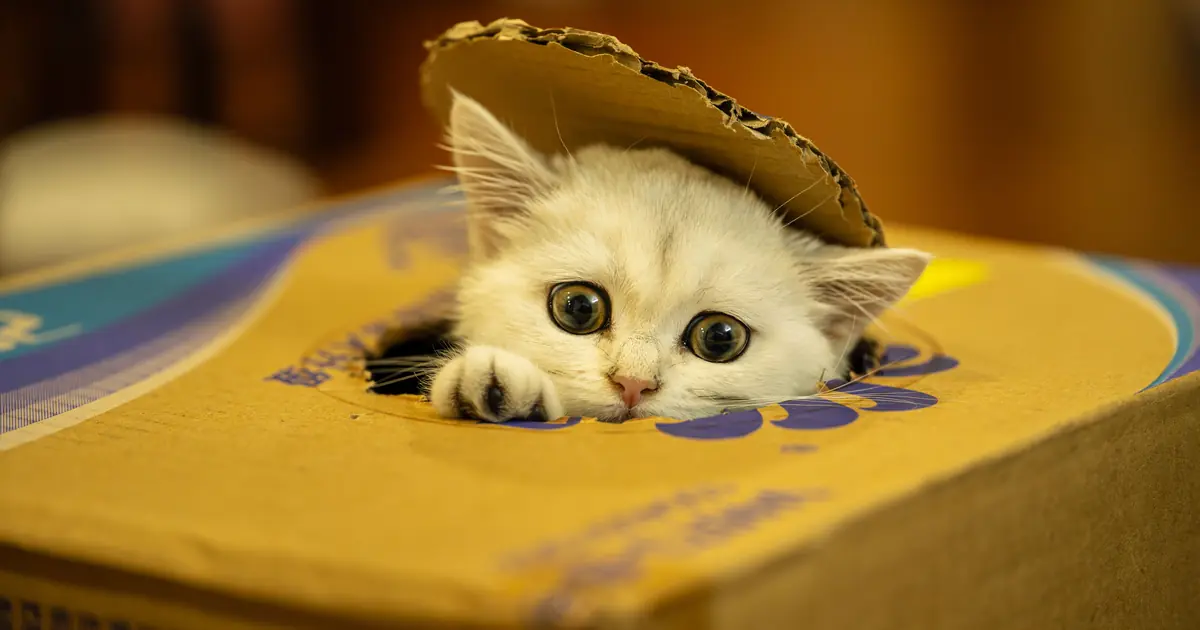
That’s the real trick behind the classic “if it fits, I sits” behavior. Without a rigid collarbone locking the shoulders in place, a cat’s shoulder width can compress down to roughly the width of its skull. So the rule cat parents pick up on is true: if the head fits through a gap, the rest of the body usually follows, including into cramped little burrows under blankets.
Why are a cat’s shoulders and hips so mobile?
A cat’s shoulder and hip joints are looser and more rotational than a human’s, letting the legs swing in a wider arc in every direction. A cat’s shoulder isn’t locked to a rigid collarbone, so it has extra freedom to rotate. The hips work on a similar ball-and-socket setup but with looser ligaments, giving the back legs a longer reach forward and back.
This is why a cat can twist its front half one way and its back half another, something you’ll notice if you’ve watched a cat’s shoulder blades shift and stick out while stalking low across the floor. That loose shoulder movement is normal, not a sign anything’s wrong, as long as the cat isn’t limping or flinching when you touch the area.
How does flexibility actually help a cat day to day?
A cat’s flexibility helps with hunting, escaping danger, grooming, and surviving falls, all things that mattered to its wild ancestors. A flexible spine and shoulders let a stalking cat crouch low, coil its body, and explode forward in one motion to pounce. That same range of motion lets a cat squeeze into a den-like hiding spot, twist around to groom its own back and tail, or reach an itchy spot near a shoulder blade.
Flexibility also powers the righting reflex, the reason cats so famously land on their feet. When a falling cat senses it’s off balance, its inner ear and eyes signal the brain, and the spine twists the front half one way while the back half rotates the opposite way, until the cat is feet-down. That same twist is why people ask whether cats can do backflips. The International Cat Care charity notes this reflex can kick in from falls of just a foot or two, one reason even short tumbles off a counter usually end fine. It’s an impressive reflex, but not a guarantee, and falls from real height can still cause serious injury.
Do cats actually have bones, or are they basically liquid?
Yes, cats absolutely have bones. The “cats are liquid” idea is an internet joke, not biology. A typical cat has around 230 to 250 bones, more than the 206 in an adult human, mostly thanks to extra vertebrae in the spine and tail. What makes cats look boneless is the segmented spine, the loose collarbone and shoulders, and lean, elastic muscle folding into shapes ours can’t manage.
Cats do have real, mobile front legs, even though cats don’t have thumbs the way we do. That same flexible joint system is also why cats shake out a paw so casually after stepping in something wet.
Can cats be too flexible or hurt themselves stretching?
Cats can occasionally overextend a joint or strain a muscle, but true injury from normal stretching is rare in a healthy cat. Their joints are built for this range of motion, so the everyday yoga poses on your couch are well within normal limits. Trouble usually comes from a bad landing, a slip on a hard floor, or an existing joint problem like arthritis or hip dysplasia.
Watch for limping, yelping mid-stretch, reluctance to jump onto usual surfaces, or one leg held differently than the others. Those are signs of a real problem, not just a deep stretch, and worth a vet visit.
How do I keep an older cat’s joints and flexibility healthy?
You keep an aging cat’s joints healthy with a good body weight, gentle regular play, and easier ways to reach favorite high spots. Extra weight strains joints that already handle a full range of motion, so keeping your cat lean matters more with age. Short wand-toy play sessions keep muscles moving without overdoing it, and pet stairs or a ramp near the bed take pressure off aging hips and shoulders.
Stiffness after naps, hesitating before a jump, or a noticeably less bendy cat are common signs of feline arthritis, which VCA Animal Hospitals reports affects a large share of senior cats. This article is educational, not a substitute for a vet’s exam. If your cat’s flexibility drops off noticeably or she seems sore or limping, get her checked out by a licensed veterinarian.
Cat anatomy features and what they do for flexibility
| Feature | What it does for flexibility |
|---|---|
| Spine (about 30 vertebrae) | More segments than a human spine, allowing deeper bending and arching |
| Elastic discs between vertebrae | Extra cushioning and stretch that lets the back curl and twist further |
| Free-floating collarbone | Not attached to other bones, so shoulders compress to squeeze through tight gaps |
| Loose shoulder and hip joints | Wider rotation and reach in the legs for stalking, climbing, and grooming |
Frequently Asked Questions
Q: Why are cats so flexible compared to dogs?
Cats have a free-floating collarbone and looser shoulder joints than dogs, plus a more elastic spine built for stalking and squeezing into tight cover. Dogs evolved more for sustained running, so their shoulders and spine trade some bendiness for stability over long distances.
Q: How many bones does a cat have?
A cat typically has around 230 to 250 bones, compared to 206 in an adult human. The extra bones come mostly from a longer, more segmented spine and tail.
Q: Do cats have a collarbone?
Yes, but it’s tiny and free-floating, embedded in shoulder muscle instead of connected to the sternum or shoulder blade like a human collarbone. That’s the main reason a cat’s shoulders can compress down to fit through gaps about the width of its head.
Q: Why do cats always land on their feet?
Cats usually land on their feet because of the righting reflex, a built-in response where the inner ear and eyes sense a fall and trigger the spine to twist the front and back halves of the body in opposite directions until the paws face down. This reflex can activate from falls as short as one to two feet, though it doesn’t guarantee a safe landing from any height.
Q: Is it bad for a cat to stretch and bend so much?
No, deep stretching and bending are completely normal for a healthy cat’s joints and don’t cause injury on their own. Problems usually come from a bad fall, a slip, or an underlying joint condition like arthritis, not from ordinary stretching.
Q: Can a cat’s spine actually rotate more than a human’s?
Yes, a cat’s spine has around 30 vertebrae compared to a human’s 24 to 26, with more elastic discs between each one. That combination gives cats a noticeably wider range of spinal rotation and flexion than people have.
Q: Does every cat breed have the same flexibility?
Every healthy domestic cat shares the same basic skeletal features that create flexibility, including the free-floating collarbone and segmented spine. Body type can shift how flexible a cat looks day to day, with leaner, more athletic breeds like the Siamese often appearing bendier than a stockier breed like the British Shorthair, though the underlying anatomy is the same.
Q: Should I worry if my older cat seems less flexible than before?
A noticeable drop in flexibility, along with stiffness, limping, or hesitation to jump, can be a sign of arthritis or another joint problem in an older cat. It’s worth having a veterinarian examine your cat rather than assuming it’s just normal aging.

Hello and welcome to The Ideal Cat!
We are some passionate cat owners from different professions. We love our cats and have a lot of experience in how to care for our pets. We are incredibly excited to share our knowledge, experience, and research with you. So you can take good care of your loving cat. We will answer most of the common questions about owning cats, taking care of them, etc. If you have any question contact with us. Thanks for visiting! Enjoy the content.
