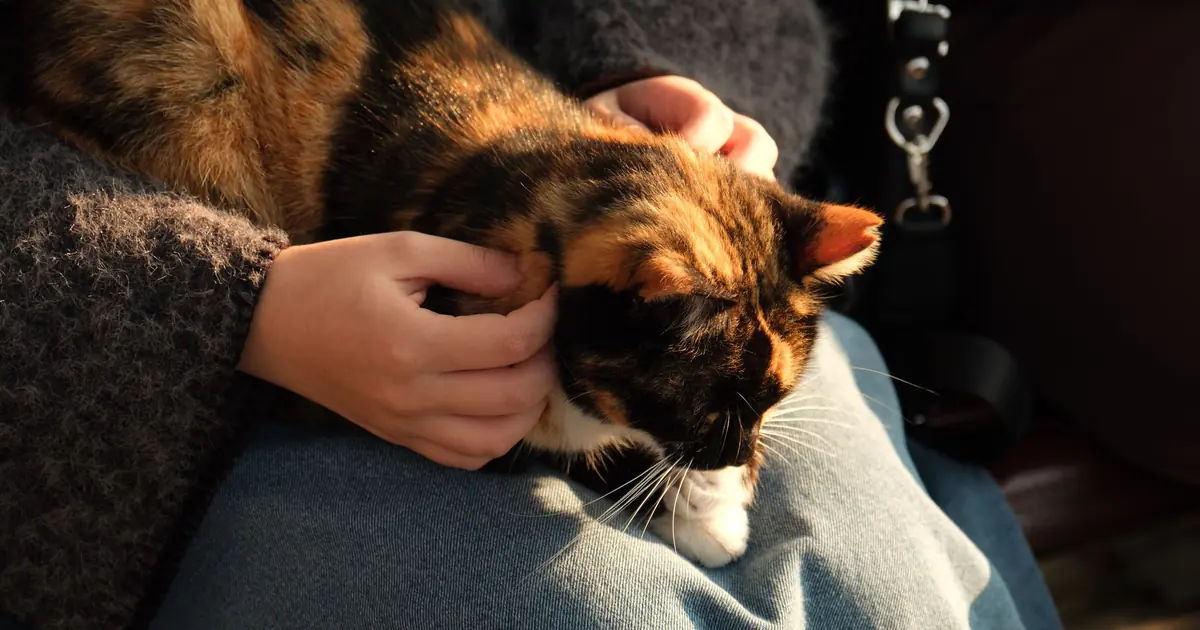
Your cat curls up on your lap and within seconds the whole couch seems to vibrate. It’s not a gentle hum. It’s practically a motorbike idling in your living room. You might wonder if that’s normal, or if you somehow ended up with the loudest cat on the block.
Here’s the thing: a loud purr is almost always a good sign. But volume alone doesn’t tell the whole story, and a few cats purr loud for reasons that have nothing to do with pure happiness. Let’s get into why some cats sound like a small engine, and what that racket actually means for your cat.
- Cats purr at a frequency of roughly 25 to 150 Hz, a range linked to calming effects and possibly even bone and tissue healing.
- A loud purr almost always means a cat feels safe, relaxed, or wants closer contact with you.
- Purr volume depends on a cat’s anatomy, age, breed, and mood, not just how content it feels in the moment.
- Big, large-chested breeds like Maine Coons tend to purr louder and lower because of their larger vocal folds and chest resonance.
- Cats also purr to self-soothe when they’re in pain, scared, or sick, so a loud purr paired with hiding or appetite loss is worth a vet call.
Why is my cat purring so loud?
A loud purr usually means your cat is feeling really good, or really wants your attention. Purring starts as a sign of contentment, but the volume often ramps up when the emotion behind it gets stronger. A cat curled up half asleep on the couch might purr softly. That same cat greeting you at the door after eight hours alone might purr like a chainsaw, because the feeling (relief, excitement, “please pet me now”) is bigger.
Individual personality plays a big role too. Just like some people talk louder than others, some cats are simply more expressive. If you want the full rundown on what purring means emotionally, our guide on what a cat’s purring means covers every context, from happy purrs to anxious ones. This article zooms in specifically on the volume question: why some cats are quiet purrers and others sound like a tiny outboard motor.
What makes some cats purr louder than others?
Purr volume comes down to a mix of emotion, anatomy, age, and breed. The stronger the feeling behind the purr, the more sound a cat tends to push out, similar to how a person’s voice gets louder when they’re excited. But there’s also a physical side to it.
A cat’s purr is produced by fast twitching of the laryngeal muscles around the voice box, which causes the vocal folds to vibrate as air moves in and out. Cats with thicker vocal folds, a bigger larynx, or a larger chest cavity to act as a resonating chamber naturally produce a deeper, louder sound. That’s part of why big-bodied breeds like the Maine Coon and the vocal Oriental Shorthair are known for booming purrs, according to International Cat Care. Age matters too. Kittens tend to purr softly at first and often get louder as their bodies mature, and senior cats sometimes purr more insistently as a way of asking for comfort or closeness.
Is loud purring good or bad?
In most cases, loud purring is a good thing. It usually signals a cat that feels safe, relaxed, and bonded to you, whether that’s a Maine Coon rumbling on your chest or a rescue cat finally letting its guard down. Loud, steady purring paired with a loose body, half-closed eyes, and slow blinks is about as good a sign as your cat can give you.
The volume itself isn’t a warning sign. What matters is the context around it. A cat purring loudly while kneading a blanket and looking totally relaxed is a happy cat. A cat purring loudly while hunched in a corner is telling you something very different, and we’ll cover that shortly. If you’re also curious whether purring is your cat’s way of showing affection, our post on how to tell if your cat loves you digs into the other signals worth watching for.
What is a “solicitation purr” and why is it so loud?
A solicitation purr is the urgent, almost grating purr a cat uses to ask for food, and it’s louder and harder to ignore on purpose. Researchers at the University of Sussex recorded cats purring while soliciting food and compared them to normal, contented purrs. They found solicitation purrs have a high-frequency sound embedded inside the low purr, in the 220 to 520 Hz range, that closely resembles the pitch of a crying human infant, according to the University of Sussex research.
That’s not an accident. Cats appear to exploit a built-in human instinct to respond to a cry-like sound, which is exactly why that 6am food purr feels so much more urgent and impossible to ignore than an evening cuddle purr, even at the same volume. Cats are clever communicators in general. If you’ve ever wondered how much they can actually “say” to you, check out our piece on whether cats can talk to us.
Can loud purring mean stress or illness?
Yes, loud purring can sometimes mean a cat is stressed, in pain, or unwell, not just happy. Purring isn’t only a happiness signal. Cats also purr to self-soothe, the same way a person might hum or rock during a stressful moment. Vets and researchers have documented cats purring at the vet clinic, during labor, when injured, and even in the final hours of life.
This is why volume alone is never the full picture. A loud purr from a cat that’s tense, hiding, or hunched over is a self-soothing purr, not a happy one. Our article on whether cats purr when they’re sick goes deeper into this pattern, and if you’re navigating an older or seriously ill cat, why cats purr when they’re dying explains that heartbreaking version of the same behavior.
When should I pay attention to my cat’s loud purring?
Pay closer attention when loud purring shows up alongside hiding, skipped meals, or labored breathing. On its own, a loud purr is rarely a red flag. But purring is often a cat’s way of coping with discomfort it can’t otherwise express, so it’s the surrounding behavior that tells you whether to worry.
Watch for these together with the purring:
- Hiding more than usual or avoiding people
- Not eating or drinking for more than a day
- Labored, fast, or open-mouth breathing
- Limping, hunching, or reluctance to jump
- Squinted eyes or a hunched, tucked-up posture
Learning to read the rest of your cat’s body language makes it much easier to tell a content purr from a coping one. This article is educational and isn’t a substitute for veterinary care. If your cat is purring loudly and showing any of the signs above, it’s worth a call to your vet, since cats are experts at hiding pain according to VCA Animal Hospitals.
How does purring actually work, and what frequency is it?
Purring is produced when a cat’s brain sends rapid signals to the muscles around its voice box, causing the vocal folds to twitch open and closed as the cat breathes in and out. This happens at a steady frequency of roughly 25 to 150 Hz, according to PetMD. That specific range has been linked in animal studies to lower stress and even to promoting healing in bone and soft tissue, which may explain why cats purr through injury and recovery, not just happy moments.
Louder purring simply means more air moving and stronger vibration, usually because a cat is more emotionally activated, physically larger, or anatomically built for a bigger sound. The Guinness World Record for loudest purr by a domestic cat sits at 67.8 decibels, about as loud as a running dishwasher, a mark set by a UK cat named Smokey in 2011 and matched by another cat, Merlin, in 2015. Most house cats purr well under that, but it shows just how much range is possible.
Loud Purring: What Different Contexts Usually Mean
| Loud purr context | Other signs to look for | What it likely means |
|---|---|---|
| Happy or relaxed | Slow blinks, loose body, kneading, half-closed eyes | Contentment and comfort |
| Attention-seeking | Rubbing against you, following you, meowing between purrs | Wants closeness, play, or petting |
| Solicitation purr | Loud purring at feeding time, pacing near the food bowl | Urgent request for food |
| Self-soothing (stressed or sick) | Hiding, hunched posture, not eating, labored breathing | Coping with pain, fear, or illness; check with a vet |
Frequently Asked Questions
Q: Is it normal for some cats to purr way louder than others?
Yes, purr volume varies a lot between individual cats. Anatomy, breed, age, and personality all affect how loud a purr comes out, so a naturally loud cat isn’t doing anything wrong.
Q: What is the loudest a cat has ever purred?
The Guinness World Record for loudest purr by a domestic cat is 67.8 decibels, set by a UK cat named Smokey in 2011 and equalled by Merlin in 2015. That’s roughly as loud as a running dishwasher.
Q: Why does my cat purr so loud right before feeding time?
That’s likely a solicitation purr. Research from the University of Sussex found these food-time purrs contain a high-pitched sound, similar in frequency to a crying infant, layered inside the normal low purr, which makes them harder for humans to ignore.
Q: Can a loud purr mean my cat is in pain?
Yes. Cats often purr to self-soothe when they’re hurt, sick, or scared, not just when they’re happy. If loud purring comes with hiding, appetite loss, or labored breathing, call your vet.
Q: Do certain cat breeds purr louder than others?
Yes. Large, big-chested breeds like the Maine Coon, along with vocal breeds like the Oriental Shorthair, are commonly reported to have deeper, louder purrs thanks to bigger vocal folds and more chest resonance.
Q: Why does my kitten purr so loud for such a small cat?
Kittens can purr surprisingly loud relative to their size, often as a way to signal to their mother that they’re nursing and doing fine, since newborn kittens can’t yet see or hear well and rely on touch and vibration.
Q: Should I worry if my cat suddenly starts purring louder than usual?
A sudden jump in purr volume alone usually isn’t an emergency, but pair it with other changes, like hiding, skipped meals, or breathing trouble, and it’s worth a vet visit. Purring can be a coping mechanism as much as a happy signal.
Q: What frequency do cats purr at, and does it matter?
Cats typically purr between 25 and 150 Hz. That range has been linked in studies to reduced stress and to supporting healing in bone and soft tissue, which may be part of why cats purr even while injured or unwell.

Hello and welcome to The Ideal Cat!
We are some passionate cat owners from different professions. We love our cats and have a lot of experience in how to care for our pets. We are incredibly excited to share our knowledge, experience, and research with you. So you can take good care of your loving cat. We will answer most of the common questions about owning cats, taking care of them, etc. If you have any question contact with us. Thanks for visiting! Enjoy the content.
