You pack for a weekend away, top off the feeder, and feel like a genius. Then the power flickers at 2am, the feeder resets, and your cat is staring at an empty bowl by morning. That right there is the whole game with automatic feeders. The fancy app is nice. The thing that actually matters is whether it feeds your cat on schedule when you are not watching.
The best automatic cat feeder is the one that does not jam, does not skip meals, and keeps running if the lights go out. After digging through hundreds of owner reviews and feeding-tech reports, here are seven we trust, sorted by the kind of cat and home you have.
- A good automatic cat feeder offers programmable portions, a power-outage battery backup, and jam-resistant dispensing.
- Dry-food feeders use a rotating dispenser, while wet-food feeders use compartments cooled with ice packs.
- Microchip feeders open only for a specific cat, which helps in multi-cat homes and with special diets.
- Automatic feeders support portion control and steady mealtimes, but they don’t replace daily interaction.
- Always keep a backup feeding plan in case a feeder jams or loses power.
Related reading: automatic wet cat food feeder. cat food bowls. how much wet food to feed a cat.
Our Top Picks
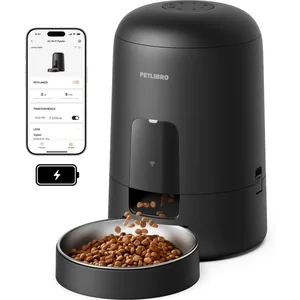
Petlibro Air Wi-Fi Automatic Dog & Cat Feeder, Black, 2-L
Best Overall
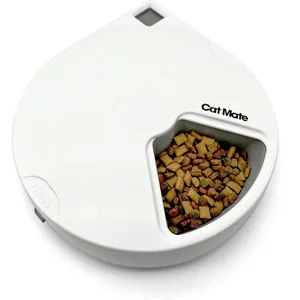
Cat Mate C500 Digital 5 Meal Automatic Dog & Cat Feeder
Best Budget for Wet Food
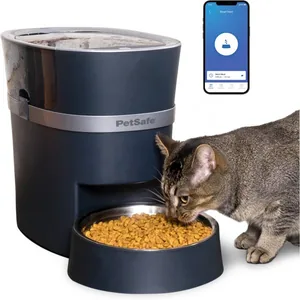
PetSafe Smart Feed 2.0 Wifi-Enabled Automatic Dog & Cat Feeder, Blue
Best Wi-Fi App Feeder
Automatic cat feeder comparison table
| Feeder | Best For | Food Type | Power & Backup | Price Tier |
|---|---|---|---|---|
| PETLIBRO Air | Best Overall | Dry | Plug-in or 3 D batteries (about 180 days) | $$ |
| Cat Mate C500 | Best Budget Wet Food | Wet or dry | Battery only (AA), ice packs | $ |
| PETLIBRO Polar | Best for Wet Food | Wet | Plug-in with AA battery backup, built-in cooling | $$$ |
| PetSafe Smart Feed | Best Wi-Fi App | Dry | Plug-in or 4 D batteries | $$$ |
| PETLIBRO Granary Wi-Fi | Best with Camera | Dry | Plug-in or 3 D batteries | $$$ |
| SureFeed Microchip | Best for Multiple Cats | Wet or dry | 4 C batteries (about 6 months) | $$$ |
| Van Ness Auto Feeder | Best Gravity | Dry | None (gravity) | $ |
Not sure how many meals your cat should even get? Our guide on how many times a day a cat should eat pairs perfectly with any of these.
How we chose these automatic cat feeders
We focused on the things that actually break a feeder, not the spec sheet. The biggest one is reliability when you are away: a missed meal is the real risk, so battery backup for power outages and jam-resistant dispensing carried the most weight. We read large pools of verified owner reviews on Chewy and Amazon, watched for repeat complaints about jamming and over-feeding, and cross-checked feeding guidance from feline health sources like the Cornell Feline Health Center.
We also weighed portion accuracy, how easy each unit is to clean (wet-food residue is a quiet dealbreaker), food compatibility, and whether the warranty holds up. We have not lab-tested every unit, so where owner reports conflict, we say so plainly instead of pretending otherwise.
The best automatic cat feeders, reviewed
PETLIBRO Air: Best Overall Automatic Cat Feeder
Verdict: The best pick for most cat parents feeding dry food who want quiet, reliable scheduling with real outage protection.
Mini-spec: 2L hopper, up to 6 meals a day, 1 to 16 portions each, plug-in or 3 D batteries (about 180-day life), desiccant slot, 4.3 stars across 900-plus Chewy ratings.
The PETLIBRO Air does the boring stuff well, which is exactly what you want. It runs on the wall or on three D batteries, so a power cut does not wipe your schedule or starve your cat. The conveyor-style dispensing resists the jams that plague cheaper hopper feeders, and a desiccant pocket in the lid keeps kibble crunchy. With over 900 owner ratings sitting at 4.3 stars, it has the track record budget feeders cannot match. It is also genuinely quiet, which matters if it sits near where you sleep.
Pros:
- Battery backup keeps meals on schedule through power outages.
- Anti-jam dispensing handles most standard kibble shapes.
- Desiccant slot keeps dry food fresh longer.
- Large, proven review base at a fair price.
Cons:
- Dry food only, so wet-food households need a different pick.
- Very large or odd-shaped kibble can still slow dispensing.
Best for: single or two-cat homes feeding dry food who want set-and-forget reliability.
Cat Mate C500: Best Budget Feeder for Wet Food
Verdict: The pick for owners who feed wet meals on a schedule and do not want to pay for an app or Wi-Fi.
Mini-spec: 5 sealed compartments, up to about 11.6 oz (330g) per section, twin ice packs included, digital timer, runs on AA batteries.
The Cat Mate C500 solves a real problem cheaply: feeding wet food while you are out without an internet connection or a refrigerated unit. Five separate compartments rotate open on a digital timer, and the twin ice packs keep pate cool for several hours. Because each meal sits in its own sealed wedge, there is no hopper to jam. Owners report years of dependable use, though a few note the timer programs in coarser steps and the display can fail after heavy use. For the price, it is the most practical wet-food option that does not need power beyond batteries.
Pros:
- Handles both wet and dry food in sealed compartments.
- Twin ice packs keep wet meals cool for hours.
- No hopper means nothing to jam.
- Affordable and app-free, so nothing to disconnect.
Cons:
- Ice packs lose their chill on long, hot days.
- Some owners report the digital display failing over time.
Best for: budget-minded owners feeding wet food who want simple, offline scheduling.
PETLIBRO Polar: Best Automatic Feeder for Wet Food
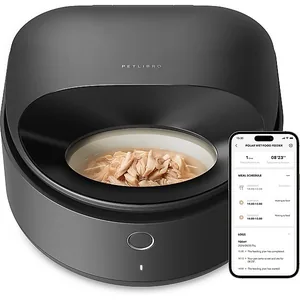
Verdict: The top choice for cats on a wet or prescription diet who need meals to stay genuinely fresh, not just cool.
Mini-spec: refrigerated trays, keeps wet food fresh up to 72 hours, app scheduling over Wi-Fi, plug-in with AA battery backup, audible meal chime.
The PETLIBRO Polar is one of the few feeders that actually refrigerates wet food instead of relying on ice packs. A built-in cooling system holds pate at a safe temperature for up to three days, then can pre-warm a portion before serving. That makes it the standout for cats on scheduled wet meals, prescription diets, or twice-daily feeding while you work. A meal chime trains cats fast. The trade-offs are honest ones: it costs more, it hums softly like a tiny fridge, and a small share of feeds can mis-rotate if food residue builds up under the trays. Clean it regularly and it earns its price.
Pros:
- Active cooling keeps wet food safe for up to 72 hours.
- Pre-warms meals so food is not served cold.
- Battery backup protects the schedule during outages.
- Meal chime helps cats learn the routine quickly.
Cons:
- Pricey compared with ice-pack feeders.
- Constant low hum and occasional mis-rotation if not cleaned.
Best for: wet-fed cats, diabetic cats, and prescription diets that need reliable fresh meals.
Wondering how much wet food each portion should be? See our guide on how much to feed your cat before you program any feeder.
PetSafe Smart Feed: Best Wi-Fi App Feeder
Verdict: The pick for owners who want to schedule, tweak, and dispense meals from their phone anywhere.
Mini-spec: 24-cup hopper, up to 12 meals a day, portions from 1/8 to 4 cups, slow-feed mode, plug-in with 4 D battery backup, iOS and Android app.
The PetSafe Smart Feed earns its spot for app flexibility. You can schedule up to twelve meals, dispense an extra portion remotely, and use a slow-feed mode that spreads a meal over about 15 minutes to ease scarf-and-barf cats. The conveyor design fights jams better than spiral augers, and battery backup covers outages. Be honest with yourself about Wi-Fi, though: the most common owner complaint across PetSafe smart models is the unit dropping offline and needing a reset. The scheduled feeds still fire locally when that happens, so your cat eats either way, but app control can get flaky. Great if you want remote control, less ideal if you want zero fuss.
Pros:
- Full phone scheduling plus remote, on-demand feeding.
- Slow-feed mode helps cats that eat too fast.
- Conveyor dispensing resists clogging.
- Battery backup keeps scheduled meals running.
Cons:
- Wi-Fi connection can drop and need re-syncing.
- Dry food only, and pricier than basic timers.
Best for: tech-comfortable owners who travel and want remote control of dry-food meals.
PETLIBRO Granary Wi-Fi: Best Feeder with a Camera
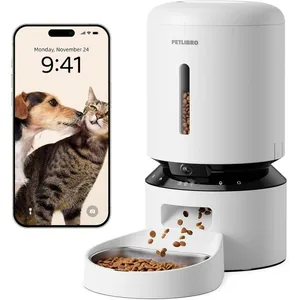
Verdict: The pick for owners who want to watch their cat eat, talk to them, and check meals from the road.
Mini-spec: 5L stainless hopper, HD camera, two-way audio or voice recorder, app scheduling, plug-in with 3 D battery backup, desiccant bags included.
The PETLIBRO Granary Wi-Fi turns a feeder into a check-in tool. The built-in HD camera lets you watch mealtimes live, the two-way audio (or recorded voice on some models) calls your cat over, and the app tracks portions and food levels. The 5L stainless hopper suits bigger appetites or two cats sharing, and the desiccant bags keep food fresh. It is one of the few feeders savvy cats struggle to break into for an early snack. The main gripes match every smart feeder: setup takes patience and Wi-Fi can occasionally disconnect. Scheduled meals still dispense offline, so the camera dropping does not mean a missed meal.
Pros:
- HD camera and audio let you see and call your cat.
- Large 5L stainless hopper for bigger or shared appetites.
- Tamper-resistant lid even food-motivated cats struggle with.
- Battery backup and desiccant bags included.
Cons:
- Initial setup is fiddly for some owners.
- Wi-Fi and app can disconnect now and then.
Best for: owners who travel and want eyes on their cat at every meal.
Planning a longer trip? Read how long you can safely leave a cat alone before relying on any feeder solo.
SureFeed Microchip Feeder: Best for Multiple Cats
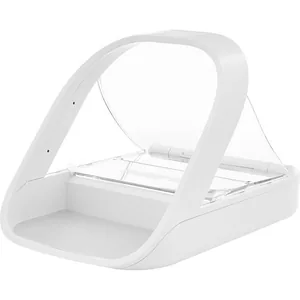
Verdict: The clear winner for multi-cat homes where one cat steals another’s food or eats a special diet.
Mini-spec: holds 32 pet IDs, opens only for the right cat via microchip or RFID, sealed lid for wet and dry food, runs on 4 C batteries (about 6 months), 3-year warranty.
The SureFeed Microchip Feeder is not a scheduler, it is a gatekeeper. The lid only opens for the cat whose microchip or RFID tag it recognizes, so the diet cat eats hers and the food thief stays out. It stores up to 32 pets, works with wet and dry food, and the sealed lid keeps wet meals fresh and bugs out. Owner ratings sit around 4.5 stars, the highest in this roundup, and the 3-year warranty backs that up. It runs six months on batteries, so outages are a non-issue. Pair it with a timed feeder if you also need scheduling, since this controls access, not mealtimes.
Pros:
- Stops food stealing in multi-cat and multi-pet homes.
- Protects prescription and weight-control diets.
- Sealed lid works for wet and dry food, keeps it fresh.
- Long battery life and a 3-year warranty.
Cons:
- Does not schedule meals, only controls who can eat.
- Premium price for a single-bowl unit.
Best for: homes with a food thief, a dieter, or a cat on a prescription diet.
Van Ness Auto Feeder: Best Simple Gravity Feeder
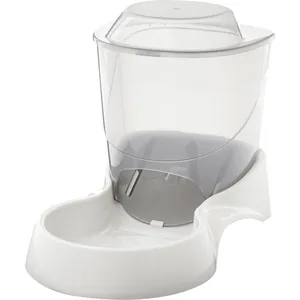
Verdict: The pick for free-feeding dry-food cats and short trips when you want zero electronics.
Mini-spec: gravity refill, food-safe plastic made in the USA, capacity options up to 10 lb, no power or programming needed.
The Van Ness Auto Feeder is the opposite of smart, and that is the point. Gravity drops fresh kibble into the bowl as your cat eats, with nothing to jam, drain, or disconnect. It is cheap, durable, and a fixture in plenty of homes for years. The honest catch is that gravity feeders give zero portion control, so they suit cats that self-regulate, not chunky grazers who will eat the whole hopper. Kibble can also bridge and stop falling, so check the bowl. For free-feeders or a weekend backup, it is hard to beat the simplicity and price.
Pros:
- No power, batteries, app, or programming.
- Nothing electronic to fail during an outage.
- Durable, food-safe, and very affordable.
- Great low-cost backup alongside a smart feeder.
Cons:
- No portion control, so it can encourage overeating.
- Kibble can bridge and stop refilling the bowl.
Best for: self-regulating dry-food cats and simple, no-tech feeding.
How to choose the best automatic cat feeder
The right feeder depends on what your cat eats and how long you leave it running. Here are the factors that actually change which one you should buy.
Dry food vs wet food capability
Most automatic feeders only handle dry kibble, because hoppers and augers cannot move pate. If you feed wet food, you need a compartment feeder with ice packs (like the Cat Mate C500) or a refrigerated unit (like the PETLIBRO Polar). Putting wet food in a dry-food hopper is a recipe for a clogged, smelly mess.
Battery backup for power outages
This is the single most important spec and the one buyers skip. A plug-only feeder loses its schedule the moment the power blinks, and your cat misses meals. Look for a feeder that runs on the wall but falls back to batteries, like the PETLIBRO Air, PetSafe Smart Feed, or Granary. Microchip and ice-pack feeders run on batteries from the start, so they sidestep the problem entirely.
Jam resistance and reliability
Jamming is the number one owner complaint, full stop. Cheap spiral-auger feeders choke on large or oddly shaped kibble and skip meals without warning. Conveyor and rotating-compartment designs jam far less. If your cat eats big kibble, check that the feeder lists your kibble size, and steer clear of the bargain hopper units that flood Reddit with jam complaints.
Portion accuracy
Programmable feeders measure portions by volume, not weight, so accuracy drifts a little as the hopper empties or kibble shape changes. For weight management, weigh a few dispensed portions on a kitchen scale and adjust the setting. If precise control matters most, a compartment feeder (you pre-measure each meal yourself) beats any auger.
Cleaning
Wet-food feeders need washing after nearly every use, since food left at room temperature can grow bacteria within an hour or two. Dry-food hoppers need a wipe-down and a full wash every week or two. Look for dishwasher-safe, removable bowls and trays, and avoid units where food gets trapped in crevices you cannot reach. Pair any feeder with easy-to-clean cat food bowls for backup meals.
Common automatic cat feeder mistakes to avoid
A feeder fails more often from how it is used than from a broken part. Dodge these and yours will run for years.
- Buying plug-only. One power cut and your cat misses meals. Always choose battery backup.
- Using the wrong food size. Large kibble jams narrow augers. Match kibble size to the feeder’s rating.
- Skipping a test run. Run the feeder for two or three days while you are home before you trust it on a trip.
- Putting wet food in a dry feeder. It clogs, smells, and can make your cat sick. Use a wet-food unit.
- No backup plan. Leave a gravity feeder or extra water out, and never leave a cat alone past two or three days on a feeder alone.
- Trusting Wi-Fi to feed. Confirm meals dispense locally without the app connected, so a dropout never means a missed meal.
For portion guidance, the American Animal Hospital Association has helpful feeding resources. The American Veterinary Medical Association adds guidance on healthy weight.
Frequently asked questions about automatic cat feeders
Q: Are automatic cat feeders safe to use?
Yes, automatic cat feeders are safe when you pick a reliable model and test it before relying on it. The main risks are jamming, over-dispensing, and power loss, all of which a feeder with battery backup and anti-jam design largely prevents. Always do a two to three day trial run while you are home first.
Q: What happens to an automatic feeder during a power outage?
A plug-only feeder stops working and may lose its schedule during a power outage, meaning your cat misses meals. Feeders with battery backup, like the PETLIBRO Air or PetSafe Smart Feed, keep dispensing on schedule when the power drops. This is the single most important feature to look for.
Q: Can automatic cat feeders use wet food?
Some can. You need a feeder built for wet food, either a sealed-compartment model with ice packs like the Cat Mate C500 or a refrigerated unit like the PETLIBRO Polar. Standard dry-food hopper feeders cannot handle wet food and will clog. Wet food also needs cleaning after every meal to stay safe.
Q: Do cheap automatic cat feeders jam?
Yes, budget feeders jam more often, and jamming is the top owner complaint. Inexpensive spiral-auger hoppers choke on large or irregular kibble and can skip meals silently. Conveyor and rotating-compartment designs jam far less, which is why our picks favor those mechanisms over bargain augers.
Q: How accurate are automatic feeder portions?
Programmable feeders measure by volume, not weight, so portions vary slightly as the hopper empties or kibble shape changes. For weight control, weigh a few dispensed servings on a kitchen scale and fine-tune the setting. Pre-measured compartment feeders give the most consistent portions.
Q: Can one automatic feeder serve multiple cats?
A timed feeder dispenses to whichever cat reaches the bowl first, so it does not control who eats. For multi-cat homes where one cat steals food or eats a special diet, a microchip feeder like the SureFeed opens only for the registered cat. Many owners run one timed feeder per cat plus a SureFeed for the dieter.
Q: How often should I clean an automatic cat feeder?
Clean a wet-food feeder after nearly every meal, since food left out can grow bacteria within an hour or two. Wash a dry-food hopper and bowl every one to two weeks, and wipe the bowl between refills. Choose models with dishwasher-safe, removable trays to make this painless.
Q: Can I leave my cat alone with just an automatic feeder?
An automatic feeder covers meals for a short trip, but it is not a full pet-sitter. Cats should not be left completely alone for more than two to three days, even with food and water handled, because litter, water, and health emergencies still need a human. Have someone check in for anything longer.
The bottom line on the best automatic cat feeder
If you only buy one thing, make it the PETLIBRO Air. It is the best automatic cat feeder for most homes because it nails the basics: it feeds dry food on schedule, resists jamming, and keeps running on batteries when the power quits. Feed wet food? The PETLIBRO Polar keeps meals genuinely fresh, and the Cat Mate C500 does the budget version with ice packs. Multiple cats fighting over the bowl? The SureFeed Microchip Feeder ends that for good. Whichever you pick, test it for a few days at home first, choose battery backup, and your cat eats on time even when life gets in the way.

Hello and welcome to The Ideal Cat!
We are some passionate cat owners from different professions. We love our cats and have a lot of experience in how to care for our pets. We are incredibly excited to share our knowledge, experience, and research with you. So you can take good care of your loving cat. We will answer most of the common questions about owning cats, taking care of them, etc. If you have any question contact with us. Thanks for visiting! Enjoy the content.
)