
One second your cat is sitting on the kitchen floor looking completely uninterested in life. The next, she’s on top of the fridge, staring down at you like she’s always lived there. No running start. No warm-up. Just a quiet crouch, a little wiggle, and suddenly she’s six feet up, grooming a paw as if nothing happened.
It looks like magic, but it’s actually biology doing exactly what it evolved to do. Cats are built from nose to tail for exactly this kind of explosive vertical movement, and once you know what’s happening under all that fur, the fridge stunt makes a lot more sense.
- Cats can typically jump five to six times their own body length in a single standing leap, which works out to around 5 to 6 feet for most house cats.
- A cat’s back legs contain a high percentage of fast-twitch muscle fibers, the same type sprinters rely on for quick, powerful bursts of speed.
- The feline spine has extra vertebrae and looser connections between them, letting a cat’s back stretch and coil like a spring before takeoff.
- Cats land safely thanks to the righting reflex, a built-in inner-ear and spine mechanism that helps them twist their body midair and land paws-first.
- A senior cat or young adult that suddenly stops jumping onto favorite spots is a common early sign of arthritis or joint pain, not just laziness.
Why can cats jump so high in the first place?
Cats jump so high because their whole body is engineered around three things working together: strong hind legs, a bendy spine, and a light, muscular frame. Nothing about a cat is wasted on bulk it doesn’t need. Every part of that body, from the shoulder blades to the tail, exists to make jumping, climbing, and pouncing easier.
Think of a cat as a compact, coiled machine. Where a dog’s build favors stamina and steady running, a cat’s build favors short, explosive movements: the pounce on a toy, the leap onto a windowsill, the vertical scramble up a cat tree. Evolution shaped cats to be ambush hunters, and ambush hunting rewards a body that can go from perfectly still to airborne in a fraction of a second.
What makes a cat’s hind legs so powerful?
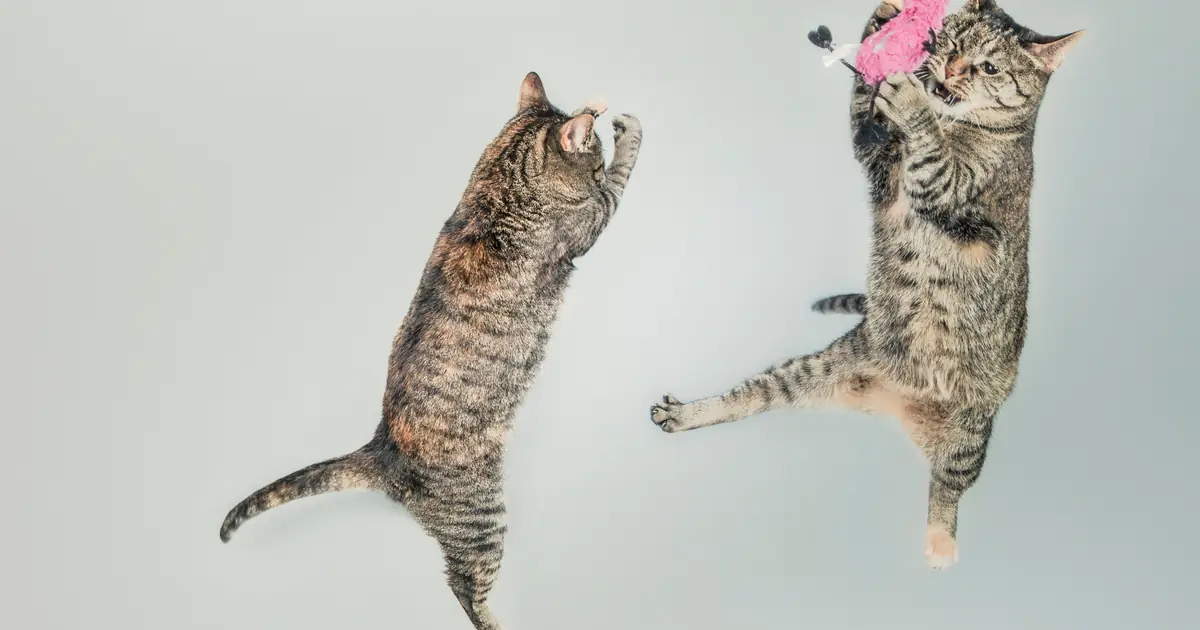
A cat’s hind legs are so powerful because they’re longer, more muscular, and packed with more fast-twitch muscle fibers than the front legs. Fast-twitch fibers are the type built for quick, forceful bursts rather than long endurance, the same kind that give human sprinters their speed off the blocks.
When a cat crouches before a jump, she’s loading her back legs like a set of springs. Her hips and knees bend deep, storing energy in the muscles and tendons (yes, cats really do have knees, tucked up higher on the leg than most people expect). The moment she releases that crouch, the hind legs snap straight almost instantly, launching her body upward and forward in one clean motion. It’s the same basic principle behind a human standing long jump, just with a lot more natural horsepower built in. If you’ve ever paused mid-scroll wondering whether cats actually have knees, the answer is yes, and those joints do serious work every time she leaps.
How does a cat’s flexible spine help her jump?
A cat’s flexible spine helps her jump by acting like an extra spring on top of the legs. Cats have around 53 vertebrae (compared to roughly 33 in humans), and the discs between them are more elastic, which lets the spine flex, stretch, and curl far more than ours can.
During the crouch, the spine curves and stores energy alongside the leg muscles. As the cat launches, that stored energy releases and adds extra lift and reach to the jump, sort of like a diving board flexing before it snaps back. This same spinal flexibility is also why cats can twist their whole body midair. If you’ve ever wondered why cats are so flexible in general, the spine is the biggest piece of that puzzle, and it does double duty for jumping and for squeezing through tight spaces.
Does a cat’s light body play a role too?
Yes, a cat’s light, muscular body plays a big role in her jumping power. Most house cats weigh somewhere between 8 and 10 pounds, and a healthy cat carries very little excess fat relative to that weight. Less mass means the powerful hind legs have less weight to launch, so the same amount of muscle force translates into a higher, farther jump.
This is also part of why extra weight matters so much for a cat’s mobility. A few extra pounds on an 8-pound frame is proportionally a much bigger deal than it sounds, and it’s one reason overweight cats often jump less and lower than they used to.
What’s with the butt wiggle before a big jump?
That pre-jump butt wiggle is a cat fine-tuning her aim and loading her muscles before launch. It looks silly, but it’s actually a quick mechanical check: shifting weight onto the back paws, adjusting foot placement, and pre-tensing the hind leg muscles for maximum spring.
Cats do a similar wiggle before pouncing on toys, and it’s driven by the same instinct. If you want the full picture of why cats wiggle before pouncing, it comes down to proprioception, or your cat’s sense of exactly where her paws and body are in space, making sure everything lines up before she commits to the leap.
How high can a cat actually jump?
A healthy adult cat can generally jump five to six times her own body length from a standing start, which works out to roughly 5 to 6 feet for an average house cat. Some especially athletic cats, particularly agile breeds like the Abyssinian or Bengal, can clear even more.
To put that in perspective, if a similarly proportioned adult human could jump the same relative distance, they’d be clearing something like 30 feet in a single standing jump. No running start, no pole, just standing there one moment and airborne the next. That comparison is usually the moment people realize just how wild feline jumping ability really is.
| Feature | How it helps the jump |
|---|---|
| Hind legs | Longer and more muscular than the front legs, packed with fast-twitch fibers for an explosive, spring-like launch |
| Spine | About 53 flexible vertebrae let the back curve, store energy, and release it for extra lift and midair twisting |
| Body weight | A light 8 to 10 pound frame means less mass to launch, so the same muscle power produces a higher jump (heavier breeds need a cat tree built for large cats that will not sway) |
| Paws | Padded, shock-absorbing paw pads and flexible joints cushion the landing and protect the bones and joints |
How do cats land safely from such high jumps?
Cats land safely from high jumps thanks to the righting reflex, a natural ability that lets a falling or jumping cat twist her head and spine to orient her body paws-down before touching ground. The inner ear senses which way is up, and the flexible spine does the rest of the twisting work.
Once she’s paws-first, a cat’s front legs and shoulders flex to absorb the impact, and thick paw pads cushion the landing itself. According to the Cornell Feline Health Center, this reflex typically develops by around three to four weeks of age, which is remarkably early for such a complex skill. It’s a big part of why cats can leap down from tall furniture and walk away like nothing happened, though it’s not an invincibility cloak: falls from a real height can still cause serious injury, so it’s not something to test on purpose. If you’ve ever watched your cat freeze partway down and wondered about the descent side of things, our guide on whether cats can climb down trees covers why going down is actually trickier for cats than going up.
Why do some cats jump less than others?
Some cats jump less than others because of age, weight, breed, or joint health. An overweight cat has more mass for the same muscles to launch, an older cat has naturally declining muscle mass and flexibility, and certain breeds are simply built differently than others.
Persians and other flat-faced, stockier breeds tend to be more grounded and low-key jumpers by build, while lean, athletic breeds like the Abyssinian or Bengal are often enthusiastic, high-flying jumpers well into adulthood. None of this is a flaw. It’s just a different body plan suited to a different lifestyle.
When does a cat losing her jumping ability signal a real problem?
A cat losing her jumping ability can signal arthritis, an injury, extra weight, or vision loss, especially if the change happens gradually in a middle-aged or senior cat. Watch for hesitating before a jump, taking a lower route to get somewhere she used to jump directly, or missing landings she used to make easily.
Feline arthritis is far more common than most owners realize. The International Cat Care organization notes that joint disease affects a large share of older cats, and because cats hide pain so well, a drop in jumping is often the clearest early clue something’s wrong. This article is educational, not a substitute for veterinary care, so if your cat suddenly jumps less, seems stiff after resting, or avoids her favorite high perches, it’s worth booking a vet visit rather than assuming it’s just old age.
Frequently Asked Questions
Q: How high can the average house cat jump?
Most healthy house cats can jump about 5 to 6 feet from a standing start, roughly five to six times their own body length. Athletic breeds like the Bengal or Abyssinian can sometimes clear even more.
Q: Why do cats crouch down before jumping?
Crouching lets a cat load her hind leg muscles and flex her spine like a spring, storing up energy that releases in one burst at takeoff. Skipping the crouch would mean a much weaker, shorter jump.
Q: Do all cats jump equally well?
No, jumping ability varies by breed, age, weight, and health. Lean, athletic breeds like Bengals and Abyssinians tend to jump higher and more often, while stockier breeds like Persians and cats carrying extra weight typically jump less.
Q: Can kittens jump as high as adult cats?
Not right away. Kittens develop the righting reflex by around three to four weeks old, but full muscle strength, coordination, and jumping confidence keep improving until they’re closer to a year old.
Q: Is it bad if my cat suddenly stops jumping onto the counter?
It can be a sign of arthritis, an injury, weight gain, or vision changes, especially in an older cat. A sudden drop in jumping is a common early symptom of joint pain, so a vet visit is a smart next step.
Q: How do cats always land on their feet?
Cats use a built-in righting reflex, sensing orientation through the inner ear and twisting the flexible spine to rotate their body paws-down before landing. This reflex develops in kittens by roughly three to four weeks of age.
Q: Does being overweight affect a cat’s jumping ability?
Yes, extra weight adds mass that the same hind leg muscles have to launch, which noticeably lowers how high and how often a cat jumps. Keeping a cat at a healthy weight helps protect both her jumping ability and her joints long term.
Q: What muscles do cats use most when jumping?
Cats rely mainly on the muscles in their hind legs, particularly around the hips and thighs, which are packed with fast-twitch fibers built for quick, explosive power. The lower back and spine muscles also contribute extra lift and flexibility during the launch.

Hello and welcome to The Ideal Cat!
We are some passionate cat owners from different professions. We love our cats and have a lot of experience in how to care for our pets. We are incredibly excited to share our knowledge, experience, and research with you. So you can take good care of your loving cat. We will answer most of the common questions about owning cats, taking care of them, etc. If you have any question contact with us. Thanks for visiting! Enjoy the content.
