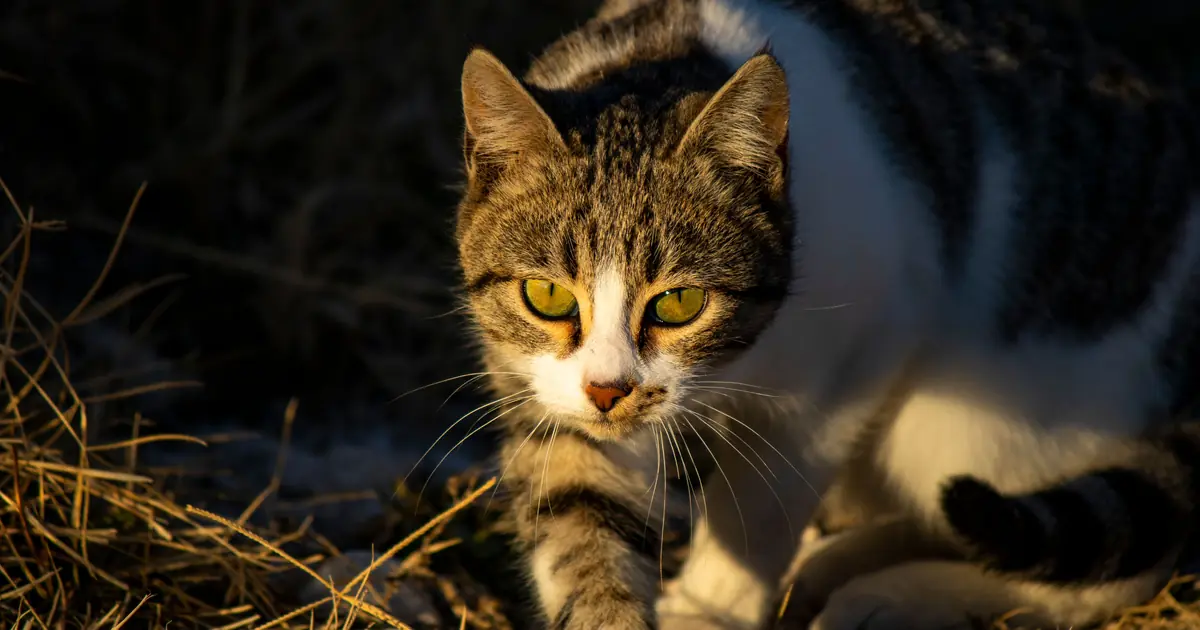
You know the pose. Your cat is frozen behind the couch, eyes locked on a toy (or your ankle), tail twitching like a metronome. Then, right before the attack, comes the wiggle. That little butt shimmy that looks equal parts silly and deadly serious.
It’s one of the most recognizable moves in cat body language, and it turns out there’s real biomechanics behind it. Your cat isn’t just hyping itself up. It’s doing a quick physics check before launch.
- The pre-pounce wiggle helps a cat’s hind feet find solid footing before it commits to a jump.
- Wiggling loads the hind-leg muscles with tension, similar to a sprinter settling into starting blocks.
- The movement lets a cat make small position adjustments to judge distance and angle right before the strike.
- Both kittens and adult cats wiggle, and it shows up in play, hunting, and even random attacks on toes under a blanket.
- The behavior is a normal, healthy part of feline predatory instinct, not a sign of stress or discomfort.
Why do cats wiggle their butt before they pounce?
Cats wiggle before pouncing to fine-tune their body position for a fast, accurate jump. The shimmy is a mix of foot placement, muscle loading, and last-second aim adjustment, all packed into a second or two of movement. Think of it as your cat’s version of a runner shaking out their legs at the starting line.
This behavior is rooted in hunting instinct. Even a cat that’s never caught anything but a feather wand still runs this same sequence, because it’s wired in from birth. A cat’s body language during a hunt follows a predictable pattern, and the wiggle is one of its most reliable signals.
Does the wiggle help cats get better footing?
Yes, getting secure footing is the leading theory behind the pre-pounce wiggle. When a cat shifts its weight side to side, its back paws press against the ground and test the surface for grip.
Carpet, grass, hardwood, and a slick kitchen floor all offer different amounts of traction. A cat that’s about to launch its whole body weight off its back legs needs to know its paws won’t slip out from under it mid-jump. The wiggle is a quick way to check that the launch pad is solid before committing.
You’ll often notice the wiggle gets more pronounced on smooth or unfamiliar surfaces, which supports this idea. A cat pouncing on a soft rug barely wiggles at all. The same cat pouncing across a hardwood floor toward a toy usually wiggles longer.
Is the wiggle about loading up the leg muscles?
Yes, the wiggle also works like a physical warm-up that stretches and pre-tenses the hind-leg muscles right before the spring. Cats jump using powerful muscles in their thighs and lower back, and those muscles work best when they’re already primed with a bit of stored tension.
The side-to-side motion stretches the hip flexors and hamstrings, similar to how a sprinter bounces on their toes before a race. That quick loading and release of muscle tension helps a cat generate more force in the actual leap, which is part of why cats are so flexible in the first place. Their spine and hips are built for exactly this kind of explosive movement.
Does the wiggle help cats aim their pounce?
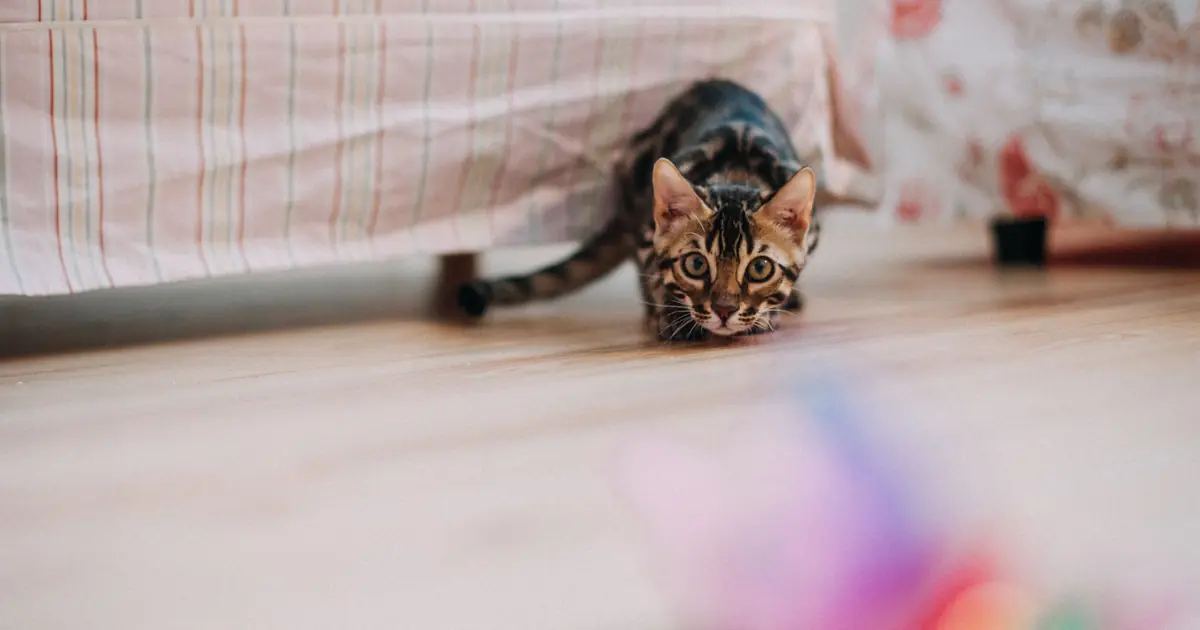
Yes, the wiggle gives a cat a final chance to judge distance and angle before it jumps. Small shifts in body position change the cat’s line of sight to the target and help it calculate exactly how far and how high to spring.
Cats rely heavily on binocular vision, meaning both eyes work together to judge depth. That overlapping field of view is what lets a cat measure distance to a moving target with real precision. The wiggle lets the cat make micro-adjustments to that alignment right before the muscles fire, so the jump lands closer to the mark. This is also why a wiggling cat’s head often stays almost perfectly still while the rear end shifts. The eyes are locked on target while the body finishes its math.
Is wiggling before a pounce instinct or just excitement?
It’s both. The wiggle comes from deep-rooted hunting instinct, but genuine excitement and arousal amplify it. Every cat, from a barn cat to a pampered house cat that’s never seen a mouse, still runs through stalk, wiggle, and pounce because it’s built into feline predatory behavior.
According to International Cat Care, hunting sequences like stalking and pouncing are instinctive and show up in play even when a cat is well fed and has never needed to hunt for food. The instinct doesn’t disappear just because the food bowl is full. That’s why a bored house cat gets just as fired up over a wiggling shoelace as a working farm cat does over an actual rodent. Excitement just cranks up the intensity and speed of the wiggle.
Do all cats wiggle before they pounce?
Most cats wiggle before pouncing, though the intensity varies from cat to cat. Some cats give a dramatic, full-body shimmy. Others do a subtle little hip shift you’d miss if you blinked.
The wiggle is one stage in a longer hunting sequence that most cats follow in order:
| Hunt sequence stage | What the cat is doing |
|---|---|
| Stalk | Creeping low and slow toward the target, staying hidden and quiet |
| Crouch | Dropping into a low position with hind legs tucked under the body |
| Wiggle | Shifting weight side to side to test footing, load muscles, and fine-tune aim |
| Pounce | Springing forward off the hind legs in one fast, explosive jump |
| Grab | Trapping the target with the front paws and claws, often followed by a bite |
Some cats skip the wiggle if the target is very close or catches them off guard, since there’s no time for a warm-up. But when a cat has a clear runway and a moment to prepare, the wiggle almost always shows up.
Why do kittens wiggle before pouncing too?
Kittens wiggle before pouncing because play is how they practice real hunting skills. From around 4 weeks old, kittens start stalking, wiggling, and pouncing on littermates, toys, and random moving objects, and this rough-and-tumble practice teaches them timing, coordination, and how to judge distance.
A kitten’s wiggle often looks extra clumsy and exaggerated compared to an adult cat’s, and that’s normal. Their muscle control and balance are still developing. Watching a kitten wobble, wiggle, then flop over sideways mid-pounce is one of the more charming parts of raising one, and it’s also exactly how they build the coordination they’ll rely on as adults.
Is the wiggle-before-pounce behavior healthy?
Yes, wiggling before a pounce is a completely normal and healthy behavior. It’s part of natural feline play and predatory instinct, and it doubles as good physical exercise for your cat’s muscles, reflexes, and coordination.
You don’t need to discourage it. In fact, giving your cat regular chances to stalk, wiggle, and pounce on appropriate targets, like wand toys or interactive cat toys, helps burn off pent-up energy and can reduce problem behaviors like scratching furniture or pouncing on you at 2am. The ASPCA notes that regular structured play helps satisfy a cat’s predatory drive in a safe, appropriate way.
If your cat suddenly stops wiggling or pouncing during play it used to love, or seems reluctant to jump at all, that can sometimes point to joint pain or an underlying health issue worth a vet visit. This article is educational, not a substitute for veterinary advice, so check with your vet if you notice a real drop in your cat’s usual playfulness or mobility.
What should you do if your cat pounces on you?
If your cat pounces on you, the best response is to redirect that energy toward a toy, not your hands or feet. Pouncing on ankles or fingers usually means your cat has too much pent-up hunting drive and not enough appropriate outlets for it.
A few things that genuinely help:
- Schedule short, active play sessions with a wand toy a couple of times a day, especially before bedtime if you’re dealing with nighttime ambushes (a lot of cat parents notice a link between skipped playtime and sudden zoomies or ankle attacks later).
- Never use your hands as a toy, even with a kitten. It teaches them that skin is fair game.
- Keep a toy stashed near doorways or hallways where ambush attacks tend to happen, so you can redirect fast.
- Rotate toys weekly to keep your cat’s interest sharp instead of letting them get bored of the same mouse toy.
Honestly, skip the laser pointer as the only outlet. As VCA Animal Hospitals points out, cats never get to physically catch a laser dot, and that can build frustration over time. If you use one, always end the session by letting your cat pounce on a real toy so the hunting sequence gets to finish. You can read more on whether laser pointers are bad for cats before making one your go-to toy.
If you’ve got more than one cat, you may have noticed the wiggle turns into a full-on comedy routine during a two-cat chase. That’s normal too, and often just play rather than real aggression, as long as both cats seem relaxed afterward with no yowling or hiding.
Frequently Asked Questions
Q: Why does my cat wiggle its butt before pouncing?
Your cat wiggles its butt to check its footing, load its hind-leg muscles, and fine-tune its aim right before the jump. It’s a quick physical warm-up, not a random quirk, and it makes the actual pounce faster and more accurate.
Q: Do all cats wiggle before pouncing?
Most cats wiggle before pouncing, though some do a big dramatic shimmy while others give a subtle hip shift. A cat may skip the wiggle entirely if the target is very close and there’s no time to prepare.
Q: Why do kittens wiggle before they pounce on toys?
Kittens wiggle before pouncing because play helps them practice real hunting skills like timing, balance, and judging distance. This practice starts as early as 4 weeks old and continues through their play into adulthood.
Q: Is the wiggle-before-pounce behavior a sign of aggression?
No, the wiggle is a normal part of predatory play, not aggression. It shows up during hunting and harmless play with toys, littermates, or other cats in the home, and doesn’t signal a problem on its own.
Q: Why does my cat wiggle more on hardwood floors than on carpet?
Cats often wiggle longer on smooth or slippery surfaces because they’re testing their traction before committing to a jump. Carpet already offers reliable grip, so the footing check tends to be quicker there.
Q: Should I stop my cat from wiggling and pouncing on me?
You shouldn’t punish the behavior, but you should redirect it toward toys instead of your hands or feet. Regular play sessions with a wand toy give your cat an appropriate outlet for its natural hunting drive.
Q: Why does my cat stop wiggling and just freeze before pouncing?
A cat may skip straight from crouch to pounce without wiggling when the target is close, moving fast, or catches it by surprise. There simply isn’t time for the usual footing and aim check in that split second.
Q: Is it bad if my older cat has stopped wiggling and pouncing during play?
A sudden drop in play, wiggling, or jumping can sometimes point to joint pain, arthritis, or another health issue in older cats. It’s worth mentioning to your vet, especially if it’s a new change rather than a lifelong quiet personality.

Hello and welcome to The Ideal Cat!
We are some passionate cat owners from different professions. We love our cats and have a lot of experience in how to care for our pets. We are incredibly excited to share our knowledge, experience, and research with you. So you can take good care of your loving cat. We will answer most of the common questions about owning cats, taking care of them, etc. If you have any question contact with us. Thanks for visiting! Enjoy the content.
