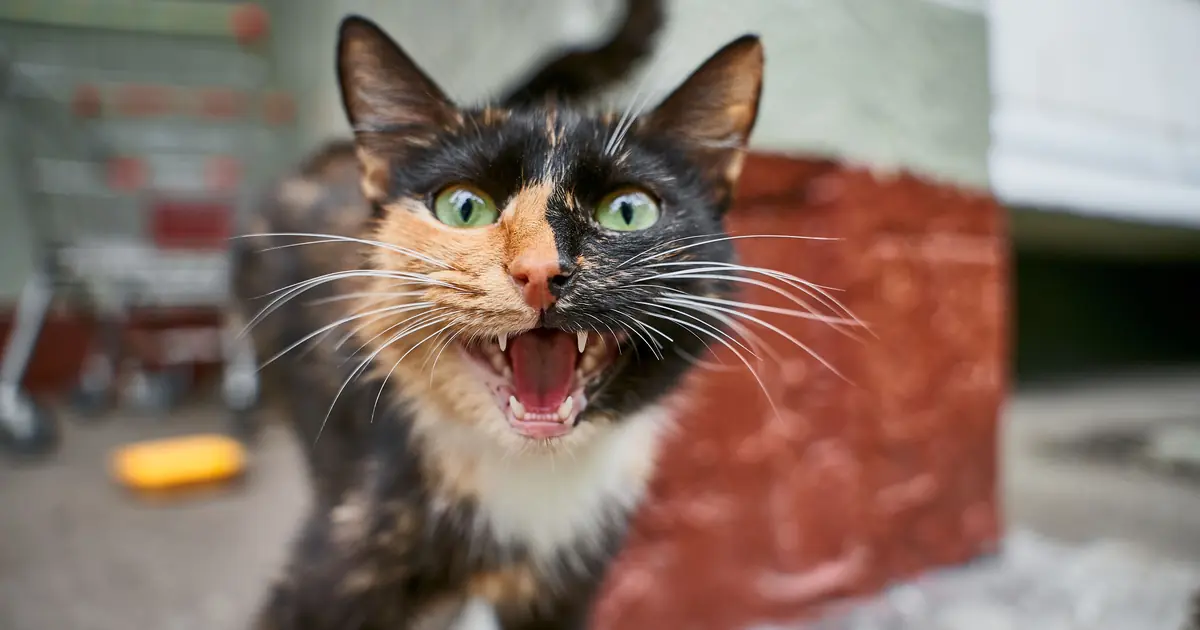
You ask your cat a question, and she answers back with a little chirp. You walk into the kitchen, and he greets you with a specific meow that means “food, now, please.” It sure feels like a conversation. And in a way, it is.
Cats aren’t saying words. But they’re not staying silent either. Your cat has built an entire vocabulary of sounds, tail flicks, ear positions, and stares just for you, and once you learn to read it, the chattiness starts to make a lot more sense.
- Cats do not talk in human words. They communicate through vocalizations (meows, chirps, trills, purrs, yowls) plus body language and scent.
- Adult cats rarely meow at other cats. Meowing is mostly reserved for humans and is largely a behavior carried over from kittenhood.
- Cats often develop their own “signature” sounds that specific owners learn to interpret, even though the sounds themselves aren’t a shared language.
- Siamese and Oriental cats are among the most vocal breeds, while Maine Coons are known for soft chirps and trills instead of loud meows.
- Sudden or excessive meowing can signal hunger, stress, pain, or in senior cats, cognitive decline, so it’s worth paying attention to changes.
Can Cats Talk?
No, cats cannot talk in the way humans do. They don’t have the vocal anatomy or brain structures needed to form words, and no cat has ever spoken a language the way a parrot mimics speech. What cats do instead is communicate, and honestly, they’re remarkably good at it.
Cats use a layered system of sound and body signals to get what they want and to tell you how they feel. A raised tail says one thing, a low growl says another, and a particular meow at 6am says “I am starving and this is an emergency.” It’s not language in the linguistic sense. But it works, and it’s built specifically to work on you.
How Do Cats Actually “Talk” to Us?
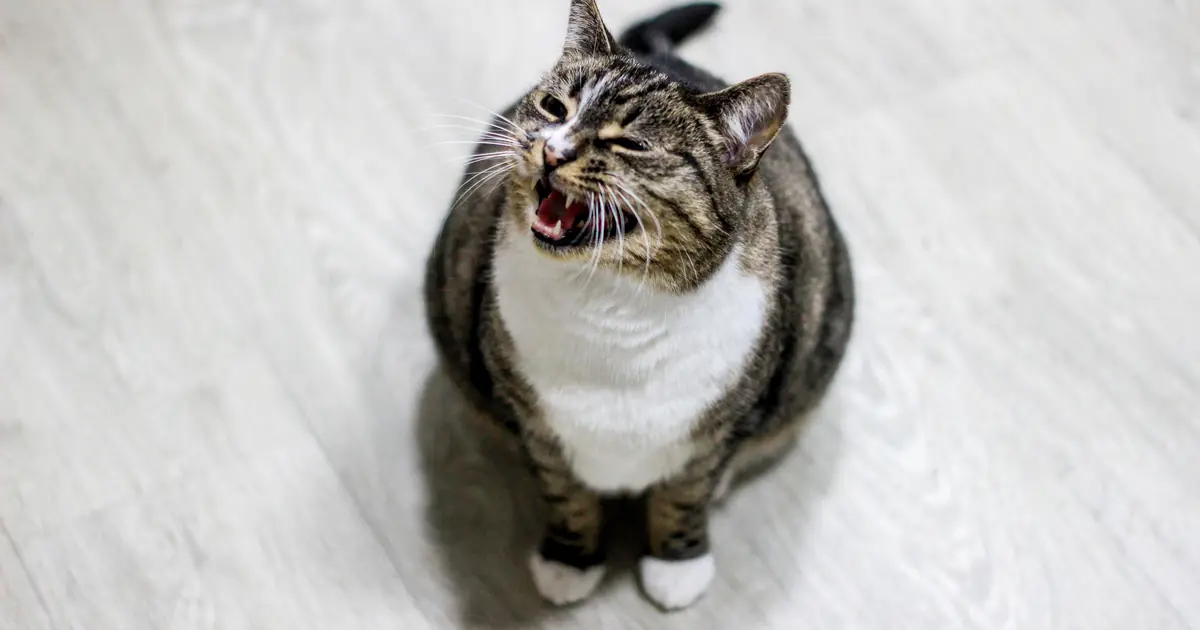
Cats “talk” through a mix of vocal sounds and body language, not words. Each sound type carries a different general meaning, and reading them together with your cat’s posture gives you the clearest picture of what’s going on.
Here’s a breakdown of the main sounds cats make and what they usually mean:
| Sound | What It Usually Means |
|---|---|
| Meow | A request or greeting aimed at a person: food, attention, or “let me out” |
| Chirp or chirrup | A friendly hello, often used by mother cats calling kittens, or a cat greeting you |
| Trill | An excited, upbeat greeting sound, sometimes triggered by watching birds or prey outside |
| Purr | Usually contentment, but can also signal pain, stress, or self-soothing |
| Yowl | A long, drawn-out complaint or distress call, often tied to discomfort, mating behavior, or a territorial dispute |
| Hiss | A clear warning: back off, I feel threatened |
Body language does just as much heavy lifting as sound. A slow blink, an upright tail with a curled tip, or a cat rolling onto its back are all part of the same conversation. If you want the full picture, our guide to reading your cat’s body language breaks down what those tail flicks and ear positions actually mean.
Why Do Cats Meow at Humans and Not Other Cats?
Adult cats mostly meow at humans because meowing is largely a kitten behavior that many cats never fully grow out of. Kittens meow to call their mother, but once cats mature, they typically stop meowing at each other and switch to scent marking, body posture, and touch instead.
Toward people, it’s a different story. Researchers at Cornell University found that domestic cats have shaped their meows over generations of living alongside humans, making them sound more pleasant and harder to ignore than the calls of wild cats according to Cornell’s research on feline vocalization. In other words, cats have essentially kept a kitten sound in their adult toolkit because it works so well on us. Vets at VCA Animal Hospitals note that cats will purr, yowl, growl, and hiss at each other, but meowing itself is reserved almost entirely for their human housemates as explained on VCA’s cat communication resource.
That’s also why your cat’s meow can sound so different depending on the moment. Many cats develop a handful of distinct meows, a short chirp-like one for greeting, a lower one for food, a sharp one for “let me out,” and their owner learns to tell them apart even though no two cats share the exact same “words.”
Do Cats Understand What We’re Saying Back?
Cats don’t understand human words the way people do, but they pick up on tone, patterns, and repetition remarkably well. Your cat learns to associate certain sounds, like the word “treat” or the rattle of a food bag, with specific outcomes, and that association can look a lot like understanding.
Studies have shown cats can recognize their own name and tell it apart from other similar-sounding words, even if they don’t always bother to respond (classic cat). They also read your tone of voice and body language closely, which is part of why a calm, warm voice settles a nervous cat faster than words alone ever could. If you’ve wondered whether your cat’s constant chatter is a sign of real affection, our piece on how cats show they love you goes deeper into the specific behaviors to watch for. And if your cat seems to react to little moments like kisses on the head, check out whether cats understand kisses for what’s actually going on there.
For a wider look at how much of our speech cats genuinely process, see our guide on whether cats understand words.
Can You Teach a Cat to “Talk” With Sound Buttons?
Yes, some cats can learn to press recordable buttons linked to specific words, like “food,” “outside,” or “play,” to communicate basic needs. This is called augmentative and alternative communication, or AAC, and it’s become popular thanks to devices like FluentPet.
Researchers at the University of California San Diego are running one of the largest studies into this so far, analyzing footage from thousands of pet owners using button boards with their cats and dogs. Early results are interesting: cats that learn the buttons tend to favor single presses over stringing several buttons into phrases, which is different from what’s been seen in some dogs.
Here’s the honest part, though: the science is still emerging. Researchers haven’t confirmed whether cats truly grasp the buttons as symbolic words the way toddlers learn language, or whether they’re mostly forming strong associations through repetition and reward, similar to how a cat learns that a can opener means dinner. It’s a genuinely exciting area of animal cognition research, but it’s not settled science yet, so it’s worth treating “talking cat” videos with a healthy dose of curiosity rather than certainty.
Which Cat Breeds Are the Most Vocal?
Siamese and other Oriental breeds are widely considered the most vocal cats, known for loud, frequent, almost conversational meows. Maine Coons are vocal too, but in a quieter, chirpier register.
- Siamese: Famous for a loud, low, almost human-sounding meow and a habit of “talking back” throughout the day. Our Siamese cat breed guide covers what to expect if you’re considering one.
- Oriental Shorthair: A close Siamese relative that shares the same chatty streak and expressive range of meows and chirps.
- Maine Coon: Not as constantly vocal as a Siamese, but known for distinctive chirps and trills instead of loud meowing.
- Sphynx and Burmese: Also frequently described by owners as unusually talkative, social breeds that like to narrate their day.
Quieter breeds exist too (Persians and Russian Blues tend to be on the reserved side), so if a peaceful home matters to you, breed really is worth researching before you adopt.
When Is Excessive Meowing a Problem?
Excessive meowing can be a problem when it’s a clear change from your cat’s normal behavior, especially if it happens at night, comes with pacing or confusion, or is paired with changes in appetite or litter box habits. A sudden increase in vocalizing is your cat’s way of flagging that something feels off.
Common causes worth ruling out include:
- Hunger or an empty water bowl
- Boredom or a need for more play and enrichment
- Stress from a new pet, move, or change in routine
- Pain or illness, including dental disease, arthritis, or an overactive thyroid
- Cognitive decline in senior cats, sometimes called feline cognitive dysfunction, which can cause confused yowling, especially at night
If your cat has suddenly gotten louder or is meowing well past normal, our guide to why cats meow excessively walks through the most common triggers and what to do about each one. This article is educational, not a substitute for veterinary care. If the change is sudden, severe, or paired with other symptoms like not eating, hiding, or straining in the litter box, it’s worth getting your cat checked out by a vet rather than waiting it out.
Frequently Asked Questions
Q: Can cats actually say human words?
No, cats cannot form human words. Their vocal anatomy isn’t built for speech, and even trained cats using AAC buttons are pressing recorded sound buttons, not producing spoken words themselves.
Q: Why does my cat meow so much when I’m on the phone or busy?
Cats often meow more when they sense they’re being ignored, since it’s a behavior that’s worked to get attention before. Some cats have also simply learned that persistence pays off, so the meowing escalates until you respond.
Q: Do cats understand their own name?
Yes, studies suggest cats can distinguish their own name from other similar-sounding words, even if they choose to ignore it. Recognition and obedience are two very different things in the cat world.
Q: Why does my cat meow when I sneeze?
A sudden sneeze is a sharp, unexpected sound, and many cats respond to it with a startled or curious meow, the same way they might react to a dropped object. For more on this specific reaction, see our piece on why cats meow when you sneeze.
Q: Is it true that only kittens meow at their mother?
Kittens do meow to call their mother, and most cats carry a version of that behavior into adulthood, but redirect it toward their human family instead of other cats. Adult cat-to-cat interactions rely much more on scent, posture, and touch.
Q: Can cats learn to communicate using buttons like the ones on social media?
Some cats can learn to press specific buttons to request things like food or playtime, and researchers are actively studying this through large citizen-science projects. Whether this counts as true language use is still being debated by scientists.
Q: Which cat breed talks the most?
The Siamese is generally considered the most vocal cat breed, known for a loud, persistent meow and a habit of “conversing” with its owner throughout the day. Oriental Shorthairs, close relatives of the Siamese, are a close second.
Q: When should I worry about my cat’s meowing?
Worry when there’s a clear, sudden change in how much or how your cat meows, especially with other symptoms like appetite changes, hiding, or nighttime confusion. That combination points to pain, illness, or cognitive decline rather than normal chattiness, and it’s worth a vet visit.

Hello and welcome to The Ideal Cat!
We are some passionate cat owners from different professions. We love our cats and have a lot of experience in how to care for our pets. We are incredibly excited to share our knowledge, experience, and research with you. So you can take good care of your loving cat. We will answer most of the common questions about owning cats, taking care of them, etc. If you have any question contact with us. Thanks for visiting! Enjoy the content.
