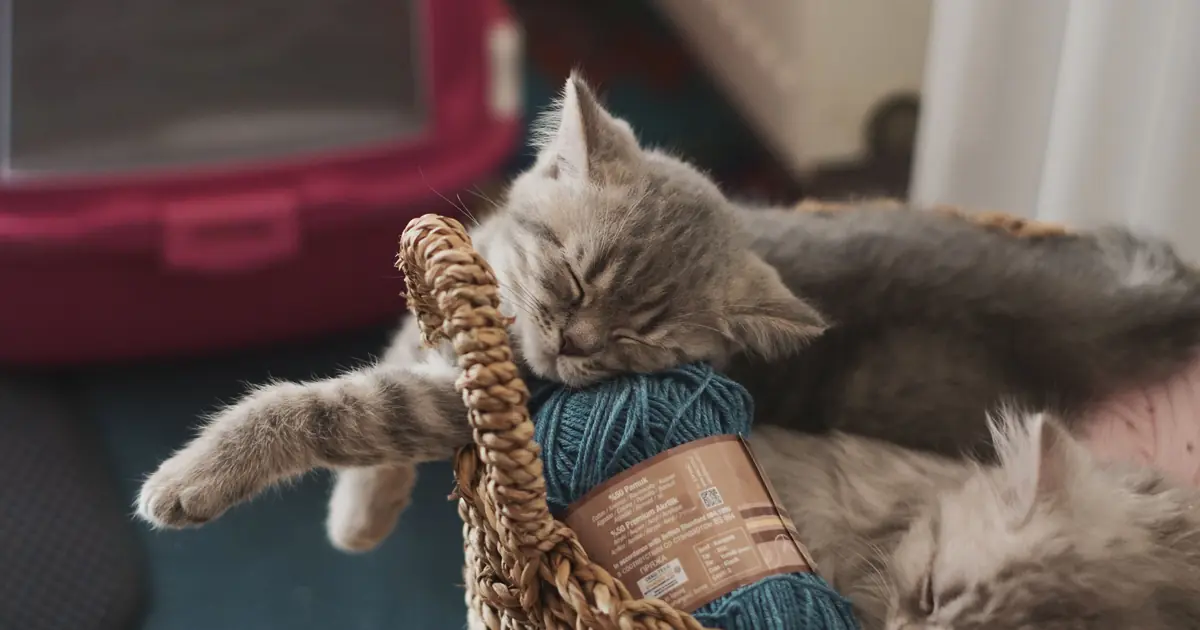
You’ve seen the picture a thousand times: a kitten tangled in a ball of yarn, batting it around a sunny living room floor. It’s adorable. It’s also, honestly, one of the more dangerous images in cat culture.
Here’s the thing. Cats are hardwired to love yarn, and that same hunting instinct is exactly what makes it risky. A cat who loves batting yarn around often loves chewing and swallowing it too, and that’s where a fun toy turns into a trip to the emergency vet.
- Cats can play with yarn, but only under direct supervision, never left alone with it.
- Swallowed string or yarn can cause a linear foreign body, a condition where the intestines bunch up like an accordion and require emergency surgery.
- A cat’s tongue has backward-facing barbs that make it almost impossible to spit out string once it’s caught, so cats often keep swallowing instead.
- Signs of swallowed string include vomiting, not eating, straining to poop, and lethargy.
- If you ever see string hanging from your cat’s mouth or rear end, do not pull it. Call your vet right away.
Can Cats Play With Yarn?
Yes, cats can play with yarn, but only while you’re watching, and only if you put it away the second playtime ends. Yarn itself isn’t toxic. The risk comes from what happens when nobody’s around to stop your cat from chewing off a piece and swallowing it. That cute photo of a kitten wrestling a yarn ball never shows what happens five minutes later, when the ball is shredded and a few inches of string have gone missing.
The Cornell Feline Health Center specifically advises against toys with string-like parts that can separate and be swallowed, and recommends supervising any string play and putting the toy away afterward.
Why Do Cats Love Yarn So Much?
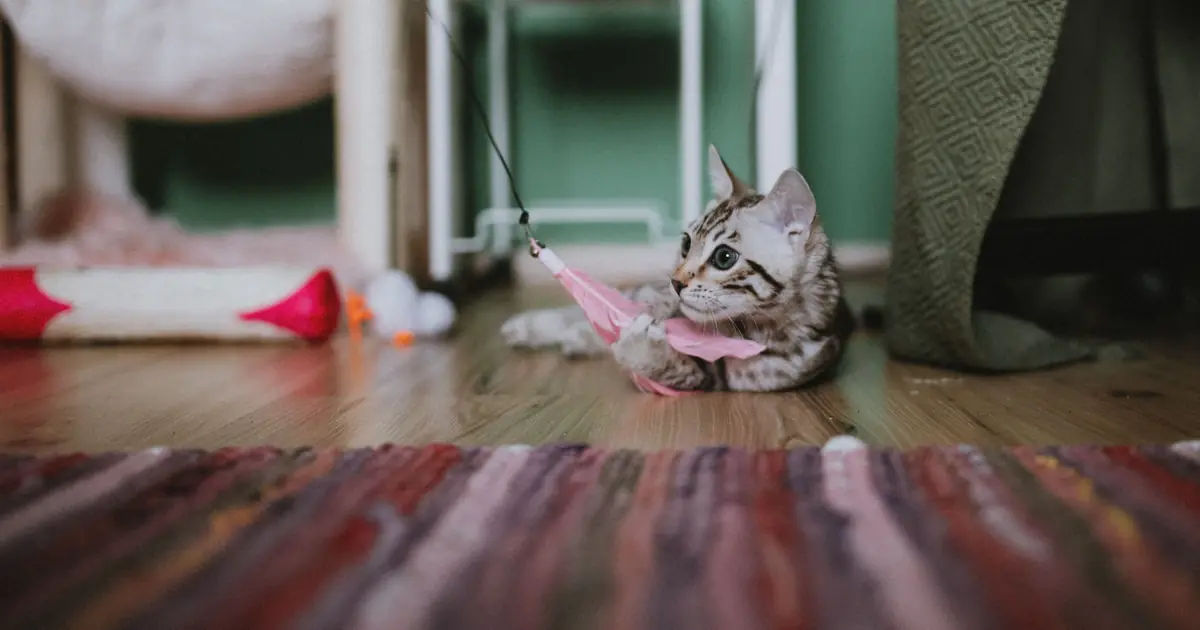
Cats love yarn because it moves, feels, and behaves like something they’d hunt in the wild. A dangling, dragging strand mimics the movement of a small prey animal’s tail or a snake slithering through grass, and that triggers a cat’s chase-and-pounce instinct almost automatically.
A few other reasons yarn is so irresistible:
- Texture: the soft, springy give of yarn feels good between a cat’s paws and teeth, similar to fur or feathers.
- Unpredictable motion: yarn tangles, bounces, and rolls in ways that keep a cat guessing, which is exactly what makes real prey exciting to chase.
- Batting and pouncing satisfaction: cats are built to stalk, swat, and pounce. Yarn gives them an easy target to practice all three.
None of that is a problem by itself. The trouble starts when the “hunt” ends with your cat biting off a piece and swallowing it, a normal next step for a predator finishing off its catch.
What’s the Real Danger of Yarn and String for Cats?
The real danger is a condition called a linear foreign body, where a swallowed length of yarn, string, or thread gets stuck at one end (often at the base of the tongue) while the rest travels into the intestines. As the gut tries to move the string along, the intestines bunch up on themselves like the folds of an accordion. The string can then saw through the intestinal wall from the inside, causing perforation, infection, and a life-threatening emergency.
According to VCA Animal Hospitals, this bunching and sawing action can lead to intestinal perforation and peritonitis, a serious abdominal infection, and it almost always requires emergency surgery to fix. Linear foreign bodies are one of the more common surgical emergencies vets see in cats, precisely because cats are so drawn to playing with and chewing on string-type objects.
There’s a physical reason cats can’t just cough the string back up, either. A cat’s tongue is covered in tiny backward-facing barbs that grip food and pull it toward the throat. Those same barbs make it almost impossible for a cat to spit string back out once it catches, so the cat often ends up swallowing more instead. International Cat Care points to this exact anatomy as a reason string-based toys carry more risk than most owners realize. Loose yarn can also wrap around a cat’s neck or a limb and cut off blood flow, especially with kittens who wrestle and roll around with toys.
| Item | Safe? | Main Risk |
|---|---|---|
| Yarn, supervised play only | Yes, with full attention | Low risk if put away immediately after play |
| Yarn ball left out unsupervised | No | Swallowing risk, linear foreign body |
| Thread with a needle attached | No, never | Swallowed needle can perforate the mouth, throat, or gut |
| Wand toy, used by you and put away after | Yes | Very low, string stays attached to a rod you control |
What Are the Signs of a Swallowed String, and What Should You Do?
The signs of a swallowed string include vomiting (sometimes repeated), refusing food, straining in the litter box, lethargy, and a hunched or painful posture. Some cats also drool or paw at their mouth if the string is anchored under the tongue. Occasional vomiting can have plenty of everyday causes, and our guide on when to worry about cat vomiting walks through those. But vomiting paired with not eating, straining, or visible string needs same-day vet attention.
Watch for:
- Vomiting, especially if it keeps happening over several hours
- Loss of appetite or refusing treats your cat normally loves
- Lethargy or hiding more than usual
- Straining to defecate, or visible discomfort near the belly
- String visible under the tongue, or trailing from the mouth or rear end
If you ever spot string hanging out of either end of your cat, do not pull it. Pulling can drag it further into a bunched, damaged section of intestine and make the injury worse. Call your vet or an emergency animal hospital immediately and let them handle removal, which usually means sedation, x-rays, and often surgery.
How Do You Let Your Cat Play With Yarn Safely?
You can let your cat play with yarn safely by staying in the room the entire time, holding one end yourself instead of letting the whole ball loose, and putting every scrap away the moment playtime ends.
- Only bring out yarn when you’re right there watching, never as a toy your cat has free access to.
- Hold the yarn yourself and move it like prey, rather than handing your cat a loose ball to wrestle alone.
- Cut play short the moment your cat starts biting off and swallowing bits, rather than letting them keep chewing.
- Store all yarn, thread, and craft supplies in a closed drawer, bin, or cupboard your cat can’t get into.
- Be extra careful with kittens. They’re more likely to wrestle, roll, and chew aggressively on anything string-like.
If your cat is often left alone for hours at a time and loves batting things around, a interactive cat toy that doesn’t rely on loose string is a much lower-risk way to keep them entertained while you’re out.
What Other String-Like Household Items Are Just as Risky?
Yarn isn’t the only string-like object that can cause a linear foreign body. Anything long, thin, and stringy carries a similar risk once a cat starts chewing on it.
- Holiday tinsel, which shines and moves in a way cats find irresistible
- Sewing thread and dental floss, especially when a needle is still attached
- Ribbon from gift wrapping or crafts
- Hair ties and rubber bands, which cats often mistake for prey
- Elastic and drawstrings on clothing, blinds, or bags
The ASPCA specifically calls out craft supplies like yarn, thread, and ribbon as household hazards for pets, and recommends keeping all of it stored well out of paw’s reach between projects.
What Are Safer Toy Alternatives to Yarn?
Safer alternatives to yarn include wand toys, solid balls, crinkle balls, plush mice, and puzzle feeders, since none of them can be swallowed a piece at a time the way string can. These toys still let your cat stalk, chase, and pounce, the whole point of yarn in the first place, just without the swallowing risk.
- Wand toys: you control the string, and the toy gets put away when playtime is over
- Solid rubber or plastic balls: great for batting and chasing, nothing to chew off
- Crinkle balls: satisfying texture and sound without any loose fibers
- Plush mice: mimic real prey size and shape for pouncing practice
- Puzzle feeders: channel hunting instinct into a food reward instead of a string
If your cat seems bored between sessions, that restless energy is often behind the 3am zoomies a lot of cat parents deal with, and it’s the same drive that makes them target yarn and cords. Some cats redirect that hunting instinct toward mealtime too, which is why you might notice your cat batting kibble around the bowl, a behavior explained in our guide on why cats play with their food.
This article is educational and isn’t a substitute for veterinary care. A swallowed string is a genuine surgical emergency, not a wait-and-see situation. If you suspect your cat swallowed yarn or string, even a small piece, contact your vet or the nearest emergency animal hospital right away rather than waiting for symptoms to get worse.
Frequently Asked Questions
Q: Is it OK for kittens to play with yarn?
Kittens can play with yarn only under close, constant supervision, and arguably need it more than adult cats. Kittens explore mostly with their mouths and tend to chew and swallow more aggressively during play, which raises the risk of a linear foreign body.
Q: How long does a linear foreign body take to become dangerous?
Symptoms from a linear foreign body can show up within hours to a couple of days after swallowing, but the internal damage can progress quickly once the string starts bunching the intestines. Vomiting, not eating, and lethargy are early warning signs that call for an immediate vet visit, not a wait-and-see approach.
Q: Can a small piece of string really hurt my cat?
Yes. Even a few inches of string can anchor at the base of the tongue while the rest travels into the intestines, which is enough to cause bunching and internal injury. Size doesn’t make string safe, only supervision and storage do.
Q: What should I do if I see string coming out of my cat’s mouth or rear end?
Do not pull it. Pulling can drag a bunched or damaged section of intestine and make the injury worse. Call your vet or an emergency animal hospital immediately and let a professional remove it safely, usually with sedation and imaging first.
Q: Is tinsel as dangerous as yarn for cats?
Yes, tinsel carries the same linear foreign body risk as yarn and string, and its shiny movement often makes it even more tempting to cats. Most vets recommend skipping tinsel entirely in homes with cats.
Q: Are wand toys safer than a loose ball of yarn?
Yes. A wand toy keeps the string attached to a rod that you control the entire time, and it gets put away after each session, so your cat never has unsupervised access to loose string. A ball of yarn left on the floor gives a cat free rein to chew and swallow pieces whenever they want.
Q: Can cats choke on yarn without swallowing it?
Yes. Yarn can wrap around a cat’s neck, tongue, or a limb during rough play and restrict breathing or blood flow, separate from the swallowing risk. This is more common in kittens, who tend to wrestle and roll with toys more than adult cats do.
Q: What does a vet do to treat a linear foreign body?
Treatment usually involves x-rays or ultrasound to confirm the string’s location, followed by surgery to remove it and repair any damaged sections of intestine. This is a real surgical emergency, and cats generally need to be hospitalized for recovery afterward.

Hello and welcome to The Ideal Cat!
We are some passionate cat owners from different professions. We love our cats and have a lot of experience in how to care for our pets. We are incredibly excited to share our knowledge, experience, and research with you. So you can take good care of your loving cat. We will answer most of the common questions about owning cats, taking care of them, etc. If you have any question contact with us. Thanks for visiting! Enjoy the content.
