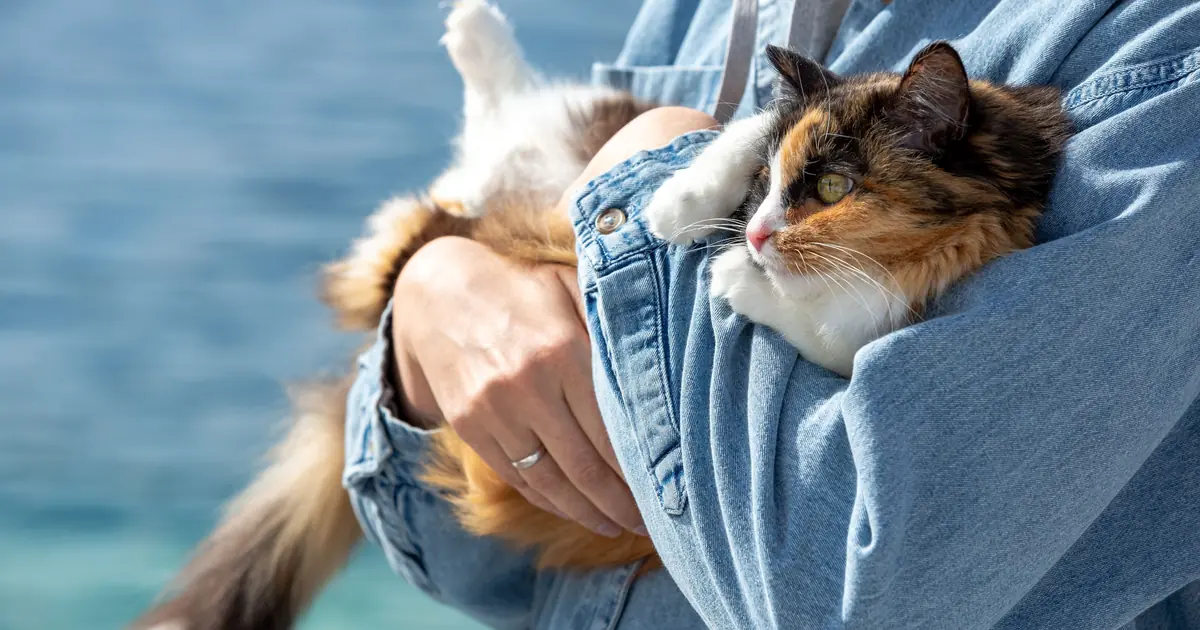
If you’ve ever reached for your cat and ended up with a wriggling, annoyed bundle of fur, you’re not alone. Picking up a cat isn’t as simple as scooping. Do it the wrong way and your cat feels unsafe. Do it the right way and your cat relaxes into your arms. Learning how to pick up a cat correctly keeps your cat comfortable, protects their spine, and makes vet trips and nail trims a whole lot easier.
- A cat should always be lifted with two hands: one under the chest behind the front legs, one supporting the hindquarters, so the body stays level and the spine stays aligned.
- Never pick up a cat by the scruff of the neck, the tail, the front legs alone, or belly-up like a baby, since these holds can hurt or frighten an adult cat.
- Most cats are comfortable being held for only one to two minutes, so set your cat down before it starts to squirm.
- A cat that suddenly hates being touched or picked up may be in pain and should be checked by a licensed veterinarian.
- Kittens and cats both need full two-hand support; the difference is you rest a kitten’s bottom in your hand rather than the crook of your elbow.
What’s the safest way to pick up a cat?
The safest way to pick up a cat is the two-hand method: one hand under the chest just behind the front legs, and the other hand cupping the hind legs and bottom. This lets you lift the cat’s whole body at once so the weight stays balanced and nothing dangles. Bring the cat close to your chest right away, since cats feel far more secure pressed against a warm, steady body than floating in mid-air.
Think of it as supporting both ends of a bridge. If one end sags, the structure feels unstable, and your cat will feel that instability instantly. Veterinarians and animal welfare groups like the ASPCA and Cats Protection all point to this same balanced, fully supported lift as the gold standard.
How to pick up a cat in 6 gentle steps
Picking up a cat well is a short sequence: ask permission, support both ends, and hold the cat close. Follow these six steps every time and your cat learns that being lifted is calm and predictable, not a sneak attack.
- Approach calmly and from the side. Crouch down to your cat’s level and face the same direction your cat is facing instead of looming over the front. Cats find a head-on approach from above intimidating.
- Ask first with a gentle touch. Offer the back of your hand to sniff, then give a light stroke along the cheek or back. This is your cat’s chance to say yes or no before you lift.
- Read the answer. A relaxed cat with soft eyes and a loose body is saying yes. A cat that pulls away, flattens its ears, or flicks its tail is saying not now. Respect a no.
- Place one hand under the chest. Slide your hand under the chest right behind the front legs so your palm cradles the breastbone.
- Support the hindquarters with your other hand. Bring your second hand under the back legs and bottom, then lift both ends together in one smooth, gentle motion. Never let the back legs dangle.
- Hold the cat close to your body. Tuck the cat against your chest with its weight resting along your forearm. Stand still or move slowly so your cat feels stable the whole time.
The whole point is that your cat never feels like it’s falling. Two hands, both ends supported, body held close. That’s the formula.
How do you put a cat back down safely?
Put a cat down by keeping both hands supporting it as you lower it slowly toward the floor, then letting it set all four paws down before you release. The mistake most people make is letting go too early, so the cat has to jump or scramble the last few inches. That little drop teaches your cat that being held ends badly.
Here’s the part that surprises people: the best time to put a cat down is before it wants to leave, while your cat is still calm and content. If you wait until your cat is squirming, hissing, or trying to launch off you, you’ve already missed the moment, and your cat learns that struggling is what finally gets it free. Set your cat down on its terms and it will trust the next pickup more.
What should you never do when picking up a cat?
You should never pick up a cat by the scruff of the neck, the tail, or the front legs alone, and you should never flip an adult cat belly-up like a baby. Each of these holds either hurts the cat, leaves the spine unsupported, or puts your cat in a vulnerable position that triggers fear. Mother cats do carry tiny kittens by the scruff, but an adult cat is far too heavy for that, and scruffing a grown cat can cause real pain and panic.
| Always do this | Never do this |
|---|---|
| Support the chest and hindquarters with two hands | Lift by the scruff of the neck |
| Lift both ends together so the body stays level | Lift by the front legs while the back end dangles |
| Hold the cat upright against your chest | Hold the cat belly-up like a human baby |
| Keep the spine naturally aligned and weight balanced | Pull or lift by the tail |
| Lower the cat fully before releasing | Drop or let the cat jump from a height |
If a hold leaves any part of your cat’s body unsupported or forces it into a position it can’t control, it’s the wrong hold. Stick with the balanced two-hand lift every time.
How long can you hold a cat?
Most cats are comfortable being held for only one to two minutes at a time, with wide variation from cat to cat. Feline behavior specialists, including Fear Free and Cat Behavior Associates, describe most cats as having a short comfort window for being restrained, even gently, because cats like to stay in control of their own movement. Watch the clock less and watch your cat more: the moment your cat shifts from relaxed to restless, it’s time to set it down.
If you want your cat to enjoy longer cuddles, build up slowly. Hold your cat for just a few seconds, set it down while it’s still calm, and reward it with a treat or praise. Over days and weeks, your cat starts to associate being picked up with good things, and it will happily stay in your arms longer. Forcing a long hold does the opposite and makes the next pickup harder.
How can you tell a cat doesn’t want to be picked up?
A cat that doesn’t want to be picked up will tell you clearly through its body language, usually before you even touch it. Reading these signals and backing off keeps you from getting scratched and keeps your cat from learning to dread your hands. When in doubt, don’t lift.
Watch for these signs that your cat wants to be left alone:
- Walking or leaning away as you reach toward it
- Ears flattening or turning sideways
- A swishing, thumping, or fast-flicking tail
- Tense, frozen muscles or a crouched body
- Hissing, growling, or a low warning meow
- Skin rippling along the back or sudden grooming when you approach
If your cat starts struggling once it’s already in your arms, don’t grip tighter. Gently lower it to the floor right away. Holding a stressed cat in place only makes it more frightened and more likely to bite or scratch next time. To better read these moments, it helps to understand why cats sometimes lash out during handling.
How do you pick up a kitten safely?
Pick up a kitten the same way you pick up an adult cat, with two-hand support, but rest the kitten’s bottom in the palm of your hand instead of the crook of your elbow. Kittens are small and fragile, so even though they feel light enough to scoop one-handed, they still need both ends supported to feel secure and stay safe. Never dangle a kitten by the legs or carry it like a toy.
Gentle, frequent handling during kittenhood pays off for life. Kittens that are picked up calmly and often, especially between two and seven weeks of age, usually grow into adult cats that tolerate handling, vet exams, and grooming far better. Keep early sessions short and positive.
Why does my cat suddenly hate being picked up?
A cat that suddenly hates being picked up when it used to be fine is often telling you something is wrong, frequently pain. Arthritis, an injury, dental disease, or a tender belly can all make handling hurt, and your cat shows it by squirming, hissing, or hiding when you reach for it. A sudden change in how your cat reacts to being touched or lifted is worth a call to your veterinarian.
This article is educational and not a substitute for professional veterinary care. See a vet promptly if your cat shows any of these red flags along with not wanting to be held:
- Crying out, growling, or flinching when you touch a specific area
- Limping, stiffness, or trouble jumping
- Hiding much more than usual or skipping meals
- A tense or swollen belly
- Any sudden, out-of-character change in temperament
If pain isn’t the cause, the reason may simply be personality, a past bad experience, or a former feral cat’s lasting wariness of being handled. Cornell Feline Health Center and other feline experts note that handling preferences vary widely from cat to cat, and that’s completely normal.
How do you teach kids to pick up a cat?
Teach kids to pick up a cat by showing them the two-hand hold first, then supervising every early try until the support becomes second nature. Children naturally want to squeeze, carry, or grab a cat around the middle, which leaves the back legs dangling and makes the cat panic. The goal is calm hands and a gentle, supported lift, always with an adult watching.
Here’s a simple way to coach a child through it:
- Ask the cat first. Teach the child to let the cat sniff a hand and to only pick up a cat that comes over willingly.
- One hand under the chest, one under the bottom. Use the phrase “hug the front, hold the back” so the support is easy to remember.
- Keep the cat close and stay seated. Have younger children sit on the floor so a startled cat has nowhere to fall.
- Put the cat down the second it wants down. Teach kids that letting go is kind, and chasing or re-grabbing is not.
For very young toddlers, it’s often safest to let them pet a calm cat rather than carry it. A good rule: if a child can’t yet support both ends reliably, they’re not ready to lift the cat on their own.
Frequently Asked Questions
Q: Is it okay to pick up a cat by the scruff?
No, it is not okay to pick up an adult cat by the scruff. Scruffing can cause pain, fear, and a loss of control for grown cats, and it leaves their body weight unsupported. Always lift a cat by supporting the chest and hindquarters with two hands instead.
Q: How long should I hold my cat?
Most cats are comfortable being held for only one to two minutes. Set your cat down while it’s still relaxed rather than waiting for it to struggle. To build tolerance for longer holds, start with brief sessions and reward your cat with treats.
Q: Why does my cat bite or scratch when I pick it up?
A cat that bites or scratches when picked up is usually overstimulated, frightened, or in pain, or it simply wasn’t ready to be held. Watch for warning signs like a flicking tail or flattened ears, and put your cat down at the first sign of stress. A sudden new biting reaction is worth a vet check.
Q: How do I pick up a cat that doesn’t want to be held?
Don’t force a cat that doesn’t want to be held unless it’s a true emergency. Instead, build positive associations over time by luring your cat with treats, rewarding calm contact, and keeping early pickups very short. Forcing the issue only makes future handling harder.
Q: Can I hold my cat like a baby on its back?
Most cats dislike being held belly-up like a baby because it leaves them feeling exposed and vulnerable. Some confident, trusting cats will tolerate it, but the safe default is to hold a cat upright against your chest with both ends supported.
Q: At what age can children pick up a cat alone?
A child can pick up a cat alone once they can reliably support both the chest and the hindquarters and stay calm if the cat squirms, which is usually around school age and varies by child. Younger children should pet a seated cat instead and only lift one with adult supervision.
Q: Should I pick up a cat that’s sleeping or hiding?
Avoid picking up a cat that’s sleeping or hiding, since startling it can trigger a defensive scratch or bite. Wake your cat gently with your voice first, and treat hiding as a clear request for space. Lift a hiding cat only if it’s a genuine emergency.
Q: Why does my cat go limp when I pick it up?
A cat that goes relaxed and slightly limp when picked up usually feels safe and supported, which is a good sign. A cat that goes stiff, then suddenly limp and frozen, may instead be shutting down from fear. If your cat seems frightened rather than content, set it down gently.
The bottom line on how to pick up a cat
Knowing how to pick up a cat the right way comes down to a few simple habits: ask permission, support the chest and hindquarters with two hands, hold your cat close, and set it down before it wants to leave. Skip the scruff, never lift by the tail or front legs, and always read your cat’s body language. Get those basics right and even handling-shy cats start to trust your hands. And if your cat’s feelings about being held change suddenly, check in with your veterinarian, because comfort and pain often hide in plain sight.

Hello and welcome to The Ideal Cat!
We are some passionate cat owners from different professions. We love our cats and have a lot of experience in how to care for our pets. We are incredibly excited to share our knowledge, experience, and research with you. So you can take good care of your loving cat. We will answer most of the common questions about owning cats, taking care of them, etc. If you have any question contact with us. Thanks for visiting! Enjoy the content.
