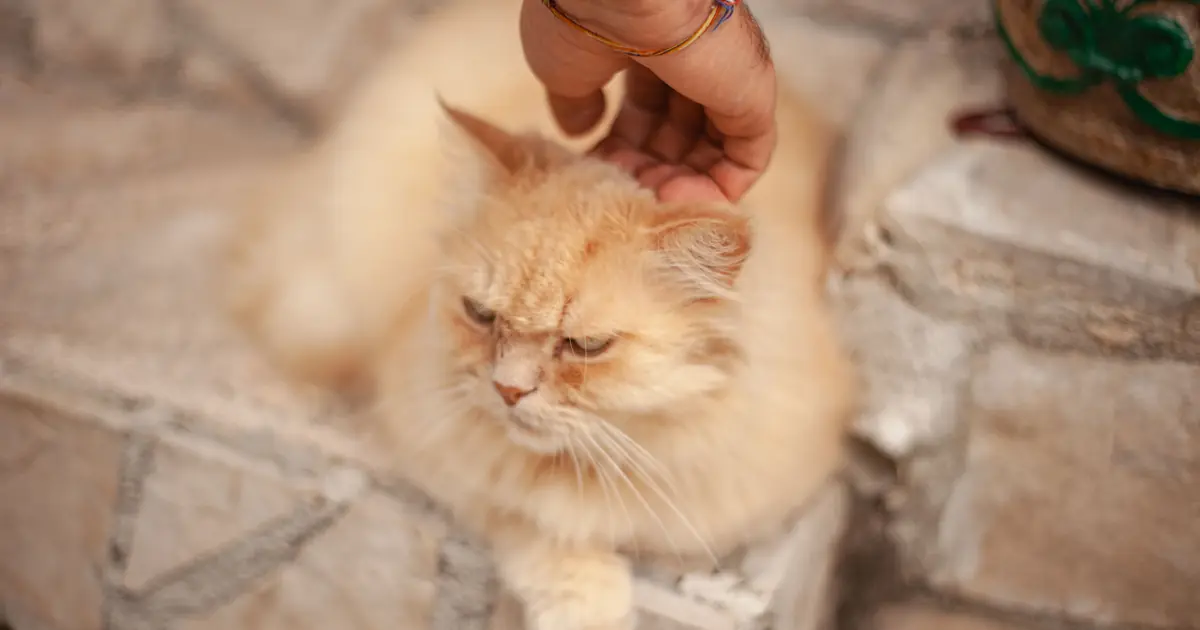
You’re cozied up on the couch, your cat is purring, you’re stroking her back, and then… chomp. She sinks her teeth into your hand and stalks off like you wronged her. If you’ve ever wondered why does my cat bite me when I pet her, you’re not alone, and you’re not doing anything terrible. Most of the time, your cat is simply telling you she’s had enough.
- Overstimulation is the most common reason cats bite during petting, and it is a normal cat response, not bad behavior.
- Cats almost always give warning signs before they bite: tail flicking or thrashing, skin rippling along the back, ears turning back, dilated pupils, and a stiff, tense body.
- Every cat has a touch-tolerance threshold, and once stroking passes it, a pleasant sensation can flip to an irritating one within seconds.
- The safest petting zones for most cats are the cheeks, under the chin, and the base of the ears; the belly, tail base, and paws are common bite triggers.
- A sudden change, where a normally gentle cat starts biting when touched in one spot, can signal pain and is worth a vet visit.
Why does my cat bite me when I pet her?
Cats bite during petting mainly because of overstimulation, a buildup of touch your cat finds irritating after a pleasant start. It is one of the most common reasons cats nip mid-cuddle, and behavior specialists call it petting-induced aggression. The bite usually is not anger. It is your cat’s way of saying, “That’s enough, thanks.” Here are the seven reasons cats bite when you pet them, from most common to least.
1. Overstimulation (the most common reason)
Overstimulation happens when repeated stroking overwhelms your cat’s sensitive skin and she bites to make it stop. Cats have nerve endings packed along the back and tail base, so long, repetitive strokes can build up a static-like, irritating sensation. What felt good in the first few strokes becomes too much, and the bite is the off switch.
2. She hit her touch-tolerance threshold
Every cat has a touch-tolerance threshold, a personal limit for how much petting feels good before it feels like too much. Some cats happily melt into a ten-minute massage; others tap out after thirty seconds. Crossing that line is the moment many bites happen, which is why timing your sessions matters more than how gently you pet.
3. You touched a sensitive spot
Many cats bite when you pet a sensitive area like the belly, the base of the tail, or the paws. These spots are vulnerable or ticklish for cats, so touch there can trigger a defensive nip even from an affectionate cat. The belly is the classic trap: your cat rolls over, you reach in, and she grabs your hand because that exposed tummy is an instinctively protected zone.
4. It’s a love bite, not aggression
A love bite is a gentle, soft mouthing some cats give as a sign of affection, often paired with licking, purring, or a slow blink. Love bites usually do not break the skin. The behavior traces back to kittenhood, when littermates and mom groomed each other with little nibbles. If the “bite” is slow, soft, and quiet and comes with a relaxed body, it is likely affection, not a warning.
5. She’s in pain
A cat in pain may bite when touched, even if she is normally the gentlest lap cat in the world. Conditions like arthritis, dental disease, an injury, or a sore spot can make a particular area hurt, so stroking it triggers a defensive bite. Pain is the reason to take seriously when a friendly cat suddenly starts biting, especially in one specific place.
6. She wants the petting to stop or start
Sometimes a cat bites during petting simply to control the interaction, telling you to stop now or, occasionally, to keep going. Biting is real communication, not an attack. A cat who nips and then walks away is usually saying she is done. A cat who nips and stays put may be redirecting you toward play or a different kind of attention.
7. Leftover play or kitten habits
Some cats bite during petting because hands feel like fair game from their playful, predatory side. Cats who were allowed to wrestle with human hands as kittens often grow into adults who mix petting with mouthing. The fix is redirecting that energy onto toys so your hand stops reading as prey.
What are the warning signs a cat is about to bite?
Cats almost always give warning signs before a petting bite, usually a few seconds of body language that says “I’m reaching my limit.” Learning to spot these signs is the single best way to stop bites before they happen. The good news is that the signals are consistent across most cats once you know what to look for.
| Warning Sign | What It Looks Like |
|---|---|
| Tail flicking or thrashing | The tail twitches, swishes, or thumps, often picking up speed like a metronome that is winding up |
| Skin rippling | A twitch or ripple of the skin along the back or spine while you pet |
| Ears turning back or flattening | Ears rotate sideways or pin back against the head |
| Dilated pupils | The eyes look darker and wider, with large round pupils |
| Tense, stiff body | Your cat freezes, stops purring, or her muscles go rigid under your hand |
| Head whip toward your hand | A quick turn of the head to watch, sniff, or nip the petting hand |
| Pawing, low growl, or huff | A paw pressed on your hand, or a quiet growl, meow, or huff |
The moment you see any of these, it is time to stop. Keep your hand still and let your cat move away. Catching one warning sign and pausing teaches your cat that you listen, which slowly builds her trust and stretches her tolerance.
How is a love bite different from a warning bite?
A love bite is a soft, gentle mouthing that does not break the skin and comes with relaxed body language, while a warning bite is faster, firmer, and follows clear tension signals. Telling the two apart helps you know whether your cat is showing affection or asking you to back off. The body language around the bite usually gives it away.
| Feature | Love Bite (Affection) | Warning Bite (Overstimulation) |
|---|---|---|
| Pressure | Soft, gentle, rarely breaks skin | Firmer and faster, can break skin |
| Body language | Relaxed body, slow blinks, purring | Tense body, flat ears, dilated pupils |
| Tail | Still or gently swaying | Flicking, thrashing, or thumping |
| Extras | Often paired with licking or grooming | Often paired with a growl or huff |
| What it means | “I like you” | “That’s enough for now” |
If your cat licks you and then bites, that bite-then-lick combo is usually grooming behavior or mild overstimulation rather than aggression. Cats groom the people and cats they bond with, and a little nibble is part of how they do it.
Where can I safely pet my cat without getting bitten?
Most cats prefer being petted around the face and head, and dislike strokes over the belly, tail base, and paws. Sticking to the friendly zones lowers the odds of a bite and makes petting more enjoyable for your cat. When in doubt, let your cat guide your hand toward the spots she likes.
- Usually welcome: the cheeks, under the chin, the base of the ears, and the forehead. These are the spots cats rub on things to mark them, so they tend to feel good.
- Hit or miss: the back and along the spine. Many cats enjoy a few strokes here but tip into overstimulation if you keep going.
- Often off-limits: the belly, the base of the tail, and the paws. These are sensitive or vulnerable areas that trigger bites in lots of cats.
How do I stop my cat from biting when I pet her?
You stop petting bites by learning your cat’s tolerance window, watching for warning signs, and ending the session before she reaches her limit. The aim is to pet on your cat’s terms, not push past them. Here is a simple, step-by-step approach.
- Time her tolerance. Notice how long she enjoys petting before the first warning sign. If she tends to nip after two minutes, stop at one minute and let her come back for more.
- Stick to the friendly zones. Focus on the cheeks, chin, and base of the ears, and skip the belly, tail base, and paws.
- Watch the tail and ears. Stop the instant you see flicking, rippling skin, flat ears, or dilated pupils.
- Freeze, don’t yank. If she grabs your hand, go still rather than pulling away. Sudden movement can trigger her hunting instinct and a harder bite.
- Let her leave. End on a calm note and let her walk off. Forcing more petting backfires.
- Redirect play biters to toys. If your cat treats hands as prey, swap in a wand toy or kicker so your fingers stop being the target.
- Never punish. Do not yell, hit, or squirt water. Punishment increases fear and makes biting worse, and it damages trust.
Stay patient. With consistent, short, sign-aware sessions, many cats gradually relax and tolerate longer petting over time.
When should a biting cat see a vet?
See a vet if a normally gentle cat suddenly starts biting when touched, especially in one specific spot, because pain is a common hidden cause. A clear, sudden change in how your cat reacts to petting is the biggest red flag. This article is educational, and a licensed veterinarian is the right person to rule out a medical cause.
Book a vet visit if you notice any of these alongside the biting:
- A friendly cat suddenly bites or flinches when you touch one area, like the back, hip, or mouth.
- Biting comes with limping, hiding, less grooming, reduced appetite, or litter box changes.
- She cries out, hisses, or whips around the moment a certain spot is touched.
- The aggression is escalating, frequent, or breaking the skin often.
One more health note for you, not your cat: cat bites that break the skin can get infected because of bacteria in their mouths. Wash any deep bite with soap and water and call your own doctor if it swells, reddens, or becomes painful, since cat-bite infections can move fast.
Frequently Asked Questions
Q: Why does my cat bite me when I pet her even though she was purring?
Purring and then biting is classic overstimulation. Cats can enjoy petting and still hit their touch-tolerance limit, at which point a pleasant feeling flips to an irritating one. The purr means she liked it; the bite means she has had enough for now.
Q: Is my cat biting me out of love or aggression?
Look at the bite and the body language. A soft nibble that does not break the skin, paired with licking, purring, or a relaxed body, is usually a love bite. A faster, firmer bite with flat ears, a flicking tail, and dilated pupils is a warning that she wants the petting to stop.
Q: Why does my cat bite me and then lick me?
Bite-then-lick is usually grooming or mild overstimulation, not aggression. Cats groom the humans and cats they bond with, and a gentle nibble is part of that social grooming. If the bite is soft and the body stays relaxed, it is affection rather than a real warning.
Q: Why does my cat bite my hand when I touch her belly?
The belly is a vulnerable, instinctively protected zone for cats. When your cat rolls over and exposes her tummy, it is often a trust signal, not an invitation to rub it. Touching it can trigger a defensive grab even from an affectionate cat, so stick to the head and cheeks.
Q: How do I know when to stop petting my cat?
Stop at the first warning sign: tail flicking or thrashing, skin rippling along the back, ears turning back, dilated pupils, or a sudden tense, still body. These usually appear a few seconds before a bite. Pausing the moment you see one prevents most petting bites.
Q: Can biting during petting mean my cat is in pain?
Yes. A cat in pain may bite when touched, especially near a sore spot, even if she is normally gentle. Arthritis, dental disease, or an injury can all cause this. If a friendly cat suddenly starts biting when petted in one area, see your vet to rule out a medical cause.
Q: Should I punish my cat for biting me when I pet her?
No. Never yell, hit, or squirt your cat for petting bites. Punishment increases fear and stress, makes biting more likely, and damages your bond. Instead, freeze, let her move away, and pet for shorter sessions while watching her body language closely.
Once you start reading your cat’s tail, ears, and eyes, the answer to why does my cat bite me when I pet her mostly stops being a mystery. She has been telling you all along; you just needed the translation. Pet in the spots she loves, stop at the first flick of the tail, and watch for any sudden change that points to pain, and your cuddle sessions will get a lot less bitey for both of you.

Hello and welcome to The Ideal Cat!
We are some passionate cat owners from different professions. We love our cats and have a lot of experience in how to care for our pets. We are incredibly excited to share our knowledge, experience, and research with you. So you can take good care of your loving cat. We will answer most of the common questions about owning cats, taking care of them, etc. If you have any question contact with us. Thanks for visiting! Enjoy the content.
