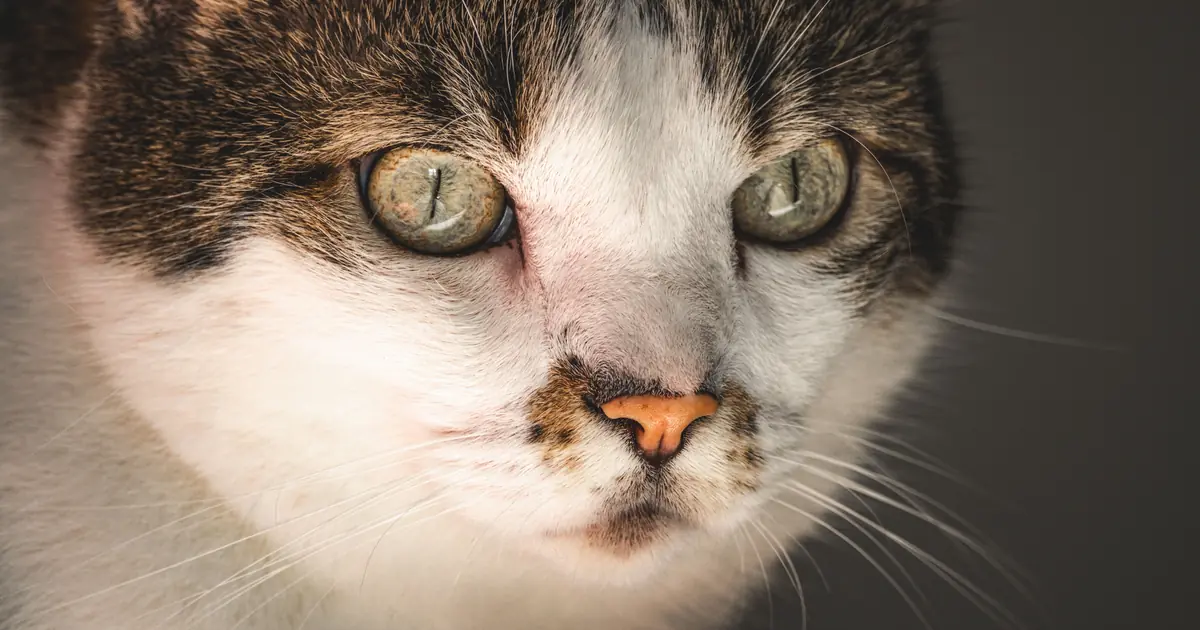
You brought home a cat with no paperwork, no birthday, and no clue about her past. Now you’re staring at her thinking, “How old are you, really?” If you’ve adopted a stray, a shelter cat, or a surprise porch visitor, you’re in good company. Plenty of cat parents have no idea how old their cat is.
The good news is you can get a solid estimate at home. Here’s how to tell how old a cat is using six signs: teeth, eyes, coat, muscle tone, body condition, and behavior. None of these clues is perfect on its own, so the trick is stacking them together, the same way a vet does.
- Kittens can be aged accurately to within a week or two using teeth, eye opening, ear position, and the 1-pound-per-month weight rule.
- Adult cat age is estimated from a range of clues, mainly dental tartar and wear, and usually lands on a several-year range rather than an exact number.
- Clean white teeth point to a young adult, while heavy tartar, yellowing, and missing teeth suggest a cat is older.
- Cloudiness in the eye lens (nuclear sclerosis) typically starts around age 8 to 10 and is a normal aging change, not the same as cataracts.
- A veterinarian gives the most reliable age estimate, because diet, genetics, and dental cleanings can throw off the home clues.
How to Tell How Old a Cat Is at Home
You can estimate a cat’s age at home, but how precise that estimate is depends on whether you have a kitten or an adult. Kittens grow fast and predictably, so you can often pin their age down to within a week or two. Adult cats age slowly and unevenly, so home clues usually point to a range like “3 to 6 years” rather than an exact birthday.
Vets estimate age the same way you can: by reading physical signs. The difference is a vet can look deep into the eye, check the mouth thoroughly, and feel for changes you might miss. As the team at PetMD notes, even a vet often narrows an adult cat’s age to a span of several years, not a single number.
So set your expectations right. With a kitten, aim for a near-exact age. With an adult, aim for a confident range.
How to Tell How Old a Cat Is by Their Teeth
Teeth are the single most useful clue for telling a cat’s age, especially in kittens. In young cats, the timeline of baby teeth and adult teeth coming in is predictable. In older cats, the amount of tartar buildup, yellowing, and wear gives a rough age range.
Here’s the general dental timeline most vets use:
- 2 to 4 weeks: Tiny baby (deciduous) teeth start pushing through. Incisors come first, then the canines around 3 weeks.
- 4 to 6 weeks: The premolars come in, completing the baby set of 26 teeth.
- 4 to 6 months: Baby teeth fall out and 30 permanent adult teeth come in. By 6 months, a healthy kitten usually has a full adult set.
- 1 to 2 years: Adult teeth are white and clean, but a little tartar may start to show on the back teeth.
- 3 to 5 years: Some tartar and slight yellowing are normal. Minor wear may appear on the tips.
- 5 to 10 years: Tartar is more obvious, teeth look more yellow, and some wear or gum changes show up.
- 10+ years: Heavy tartar, brown staining, worn or missing teeth, and red or receding gums are common.
One honest caveat: teeth are not foolproof for adults. A cat who eats kibble, gets dental cleanings every year or two, or has had teeth brushed at home will look younger by the mouth than she really is. And a stray who survived a rough life may have the worn, tartar-coated teeth of an 8-year-old while only being 5. Use teeth as your strongest single clue, then confirm with the others.
What do a cat’s eyes tell you about age?
A cat’s eyes shift in clarity with age, so they’re a helpful second clue. Kittens and young adults have bright, smooth, clear eyes with crisp irises. As cats reach their mature and senior years, the lens inside the eye can take on a slight haze.
That haze has a name: nuclear sclerosis. Nuclear sclerosis is a normal, age-related cloudiness of the lens that usually begins around age 8 to 10. It doesn’t blind the cat and it isn’t painful. An owner often won’t spot it until a cat is about 10, while a vet can catch it earlier with the right light.
Don’t confuse this normal haze with cataracts. Cataracts are a denser, whiter cloudiness that can affect vision and signals a health issue worth a vet visit. If your cat’s eye looks milky, bluish, swollen, or is causing bumping into furniture, that’s a “see a vet” sign, not just an age clue.
Eye texture helps too. Older cats can show a slightly more sunken or less vivid look to the iris, and the surface may seem a touch duller than a kitten’s glassy brightness.
Can coat and fur reveal a cat’s age?
A cat’s coat changes with age, so fur is a useful supporting clue, though never proof on its own. Young cats have soft, sleek, evenly colored coats because they groom themselves often and well. Older cats tend to have coarser, duller, sometimes patchy fur, and they may show gray or white hairs.
Here’s how a coat usually shifts over a lifetime:
- 6 months to 3 years: Soft, glossy, smooth fur with no graying.
- 3 to 7 years: Coat is still healthy but may lose a little shine.
- 7 to 10 years: Texture turns coarser or thicker, and a few silver hairs may appear around the face and paws.
- 10+ years: More graying, occasional matting or dandruff, and a coat that looks less kept because seniors groom less.
One thing to know: graying is far less reliable in cats than in dogs. Many cats never go visibly gray, and dark cats may show silver hairs while orange or pale cats hide them completely. Treat coat changes as a hint, not a verdict.
How do muscle tone, body shape, and behavior show age?
A cat’s muscle tone and energy level shift with age, so body condition and behavior round out your estimate. Young cats are lean, springy, and built like little athletes. Mature cats often gain a bit of weight, and senior cats tend to lose muscle, especially over the spine and hind legs.
Watch how your cat moves and acts:
- Kittens and young adults: Bouncy, playful, fluid jumps, and bursts of zoomies. Firm muscle, good weight.
- Mature adults (around 7 to 10): Calmer, may carry extra weight as metabolism slows, still active but less frantic.
- Seniors (10+): Slower movements, stiffer joints, more napping, reluctance to jump up high, and visible muscle loss along the back.
Stiffness and hesitation to jump often point to arthritis, which is common in older cats. Bony shoulders and a thinner back end usually mean a cat is well into the senior years. Behavior alone can mislead you, since a shy young cat may seem sleepy and a lively senior may still play, so pair it with the physical clues.
How can you tell how old a kitten is?
You can tell a kitten’s age quite precisely using a few fast-changing milestones: eyes opening, ears unfolding, teeth coming in, and body weight. Because kittens develop on a tight schedule, these signs can place a kitten’s age within a week or two.
Use this newborn-to-kitten timeline:
- 0 to 1 week: Eyes and ears closed, umbilical cord may still be attached, can’t walk yet.
- 1 to 2 weeks: Eyes start to open (and look blue and hazy), ears begin to unfold.
- 3 weeks: Ears upright, eyes fully open, baby teeth (incisors and canines) appearing, wobbly walking.
- 4 to 5 weeks: Premolars in, running and pouncing, starting to lap food.
- 6 to 7 weeks: Eye color shifts from baby blue toward its permanent shade, fully mobile.
- 3 to 4 months: Baby teeth start falling out as adult teeth push in.
- 6 months: Full set of adult teeth, near adult size, may reach sexual maturity.
There’s also a handy weight shortcut for young kittens: a kitten’s weight in pounds roughly matches their age in months, up to about 4 to 5 months. So a 2-pound kitten is around 2 months old, and a 4-pound kitten is around 4 months. Research summarized in a peer-reviewed study found this rule lands within about a week of true age for most kittens up to 8 weeks. After 5 months, growth slows and the weight rule stops working, so lean on teeth instead.
Cat age clues by life stage (chart)
Cats fall into four main life stages, and each stage has a recognizable mix of dental, eye, coat, and body signs. The 2021 AAHA/AAFP Feline Life Stage Guidelines define these stages as kitten (birth to 1 year), young adult (1 to 6 years), mature adult (7 to 10 years), and senior (over 10 years). Use the chart below to match your cat’s clues to a stage.
| Life Stage | Teeth | Eyes | Coat & Body | Behavior |
|---|---|---|---|---|
| Kitten (0 to 1 yr) | Baby teeth in, then adult teeth by 6 months; bright white | Clear, bright; eye color settling by ~7 weeks | Soft fluffy coat; small, growing body | Constant play, zoomies, fearless energy |
| Young Adult (1 to 6 yrs) | Clean white teeth; light tartar may start on back teeth | Clear and bright, no cloudiness | Sleek, glossy coat; lean, firm muscle | Active and playful; fluid jumps |
| Mature Adult (7 to 10 yrs) | Visible tartar, some yellowing and wear | Possible slight lens haze (nuclear sclerosis) | Coat may dull; may carry extra weight | Calmer, still active, plays less intensely |
| Senior (10+ yrs) | Heavy tartar, brown stains, worn or missing teeth | Noticeable cloudiness; duller iris | Coarse or patchy coat, graying, muscle loss | More napping, stiffness, reluctant to jump |
Find the stage where most clues line up. If teeth say “young adult” but the coat and muscle tone say “senior,” trust the cluster of clues over any single sign, and let a vet break the tie.
What’s the most accurate way to find out a cat’s age?
A veterinary exam is the most accurate way to find out how old a cat is. A vet checks the same clues you can (teeth, eyes, coat, muscle tone) but can also look inside the eye with proper magnification, examine the mouth thoroughly, feel internal organs, and run bloodwork that hints at age-related changes.
Even then, an adult cat’s age usually comes back as a range, such as “roughly 4 to 7 years.” That’s normal and still genuinely useful. Knowing your cat is mature versus senior changes the care she needs, from diet to how often she should get checkups.
Knowing how old a cat is helps you feed her right, watch for the conditions common in her stage, and plan for senior care before problems start. If you’ve just adopted and want a number for the records, ask your vet to estimate an age and life stage at the first visit. This article is educational and isn’t a substitute for veterinary care. If your cat shows sudden weight loss, eye cloudiness, trouble eating, or a drop in energy, see your veterinarian.
Frequently Asked Questions
Q: Can a vet tell exactly how old my cat is?
A vet can tell a kitten’s age within a week or two, but for an adult cat the answer is usually a range of several years. Vets read teeth, eyes, coat, and body condition, and may add bloodwork, yet no test reveals an exact birthday for a grown cat.
Q: How old is my cat in human years?
A cat reaches about 15 human years by age 1 and about 24 human years by age 2. After that, each cat year adds roughly 4 human years, so a 5-year-old cat is about 36, a 10-year-old is about 56, and a 15-year-old is about 76 in human terms. The “one cat year equals seven human years” idea is a myth.
Q: At what age is a cat considered a senior?
A cat is generally considered a senior at 10 years and older, based on the 2021 AAHA/AAFP Feline Life Stage Guidelines. Cats from 7 to 10 are called mature adults. Many vets start senior wellness screening around age 7 to catch age-related changes early.
Q: How accurate is telling a cat’s age by teeth?
Telling age by teeth is very accurate for kittens because baby and adult teeth erupt on a set schedule. For adult cats it’s less reliable, since diet, genetics, and dental cleanings change how much tartar and wear show up. Teeth give the best single clue but work best combined with eyes, coat, and body condition.
Q: Why are my cat’s eyes getting cloudy?
Mild cloudiness in an older cat’s eyes is often nuclear sclerosis, a normal age change in the lens that starts around 8 to 10 years and doesn’t harm vision. A denser, whiter, or bluish cloudiness can mean cataracts or another problem, so any sudden or strong change in eye clarity should be checked by a vet.
Q: How can I tell how old a kitten is?
Estimate a kitten’s age from eyes opening (1 to 2 weeks), ears upright (about 3 weeks), teeth coming in, and weight. Up to about 4 to 5 months, a kitten’s weight in pounds roughly equals their age in months, so a 3-pound kitten is around 3 months old.
Q: Does coat color graying tell you a cat’s age?
Graying is an unreliable age sign in cats. Unlike dogs, many cats never go visibly gray, and coat color hides or reveals silver hairs differently. A few white hairs around the face or paws can hint at a senior cat, but use graying only as a minor supporting clue.
Q: When is a cat fully grown?
Most cats reach full size around 1 year of age, though some larger breeds like the Maine Coon keep filling out until 3 to 5 years. By 12 months a cat usually has all adult teeth and adult body proportions, which is why kittenhood officially ends at 1 year.
Figuring out how to tell how old a cat is comes down to reading the whole cat, not one feature. Stack the six signs from teeth, eyes, coat, muscle tone, body condition, and behavior, match them to a life stage, and let your vet confirm the range. Whatever number you land on, what matters most is caring for the cat in front of you, today.

Hello and welcome to The Ideal Cat!
We are some passionate cat owners from different professions. We love our cats and have a lot of experience in how to care for our pets. We are incredibly excited to share our knowledge, experience, and research with you. So you can take good care of your loving cat. We will answer most of the common questions about owning cats, taking care of them, etc. If you have any question contact with us. Thanks for visiting! Enjoy the content.
