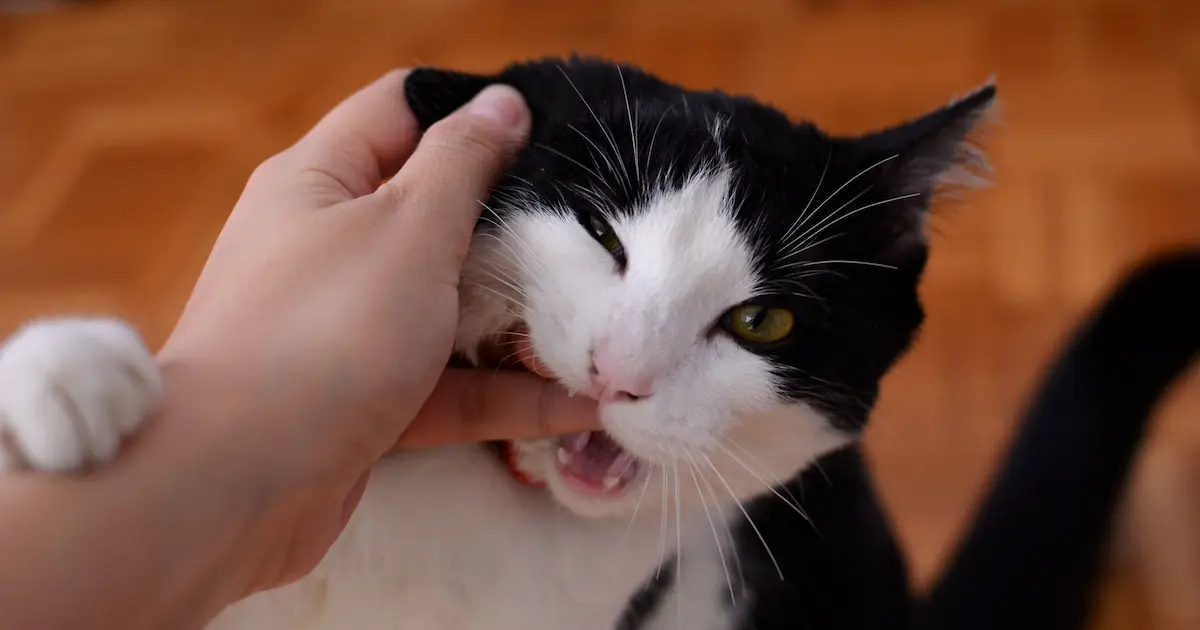
- Overstimulation, often called petting-induced aggression, is the single most common reason cats bite their owners during cuddles.
- A gentle “love bite” that does not break the skin is usually a sign of affection or grooming, not anger.
- Cats almost always warn you before they bite, with signals like a twitching tail, flattened ears, or rippling skin along the back.
- A cat that suddenly starts biting when handled may be in pain, so a new biting habit is worth a vet visit.
- Cat bites that break the skin can become infected quickly, and a hand bite or red streaking from the wound needs same-day medical care for the person.
You’re sitting on the couch, your cat is purring in your lap, life is good. Then out of nowhere, teeth. If you’ve ever pulled your hand back and thought “what did I do?”, you’re in very good company.
Here’s the reassuring part. When your cat bites you, they’re almost never trying to be mean. Biting is one of the main ways cats talk to us. The trick is learning to read what each bite is saying. Below are the seven real reasons your cat bites you, how to tell a love nibble from a “back off” warning, how to stop it, and the bite signs that mean you (not just your cat) should see a professional.
This article is educational and not a substitute for veterinary or medical advice. If your cat’s biting is new, severe, or paired with other changes, talk to your vet.
Why does my cat bite me? The 7 most common reasons
Cats bite you to communicate a feeling or a need. The reason behind any single bite usually comes down to one of seven things: overstimulation, play, affection, fear, a request like food or attention, redirected stress, or pain. Here’s how to recognize each one.
1. Overstimulation (petting-induced aggression)
Overstimulation is the number one reason a happy, purring cat suddenly bites mid-cuddle. Also called petting-induced aggression, it happens when stroking that felt nice tips over into “too much.” Many cats have a low tolerance for repetitive petting, especially around the belly, the base of the tail, and the paws. The bite is your cat saying “okay, I’m done now,” not “I hate you.”
2. Play and hunting instinct
Play biting comes from a cat’s hardwired predator instinct, and it’s especially common in kittens and young cats. Pouncing, grabbing, and nipping are how cats practice hunting. The problem usually starts when a cat is encouraged to play with bare hands and feet, so they learn that fingers are fair game. Kittens taken from their littermates too early often bite harder during play, because siblings are where cats learn bite control.
3. Love bites and grooming
A love bite is a soft, deliberate nibble that doesn’t break the skin, often given while your cat is relaxed and purring. Cats groom the ones they bond with, and grooming naturally includes little nibbles to work through fur. When your cat licks and gently mouths your hand, they’re treating you like family. This is affection, plain and simple.
4. Fear or feeling threatened
A frightened cat bites as a last resort to protect itself. Loud noises, a new person in the home, rough handling, or being cornered with no escape route can all trigger a defensive bite. Fear bites are usually fast and are paired with other scared body language, such as flattened ears, a crouched body, hissing, or trying to hide.
5. A request: food, attention, or a clean litter box
Sometimes a bite is a demand. Cats may nip to wake you for breakfast, to get you to keep playing, or to point out that something they want is missing. Vets note that a cat may even bite to flag a dirty litter box or an empty water bowl. In these cases the bite is basically a tap on the shoulder with teeth attached.
6. Redirected aggression
Redirected aggression is when your cat gets worked up by something they can’t reach, then takes it out on whoever is nearby. A classic example is your cat spotting another cat through the window, becoming agitated, and biting your ankle as you walk past. You weren’t the cause, you were just the closest target.
7. Pain or a medical problem
Pain is one of the most important reasons to take seriously, because a cat in discomfort may bite when you touch a sore spot. Dental disease, arthritis, an overactive thyroid (hyperthyroidism), and a sensitivity condition called feline hyperesthesia can all make normal handling hurt. If your cat starts biting when touched in a place they used to enjoy, treat it as a possible health flag.
What kind of bite is it? Love bite vs play bite vs aggressive bite
The fastest way to understand a bite is to read your cat’s whole body, not just the teeth. A love bite, a play bite, and a true warning bite each come with their own signals. Use this table to tell them apart at a glance.
| Type of bite | What it feels like | Body language | What it means |
|---|---|---|---|
| Love bite | Soft, slow, no broken skin | Relaxed body, purring, often licking you | Affection and bonding |
| Play bite | Quick grabs and nips, paws wrapped around your hand | Crouching, wiggling, pupils wide, “hunting” focus | Predator play, wants action |
| Overstimulation bite | Sudden nip during petting | Twitching tail, ears turning sideways, skin rippling | “I’ve had enough, stop” |
| Fear bite | Fast, defensive, may break skin | Flattened ears, crouched, hissing, trying to flee | Feels threatened, wants space |
| Pain bite | Reaction to being touched in one spot | Flinching, vocalizing, guarding the area | Something hurts, see a vet |
Why does my cat bite me then lick me?
When your cat bites you then licks you, it’s almost always social grooming, which is a sign of trust and affection. Cats groom the family members they feel bonded to, and that grooming naturally mixes licking with gentle nibbles to work through fur. To a cat, you’re a big littermate getting a clean-up.
The lick-then-bite combo can also show up during petting. A cat enjoying the attention may lick you, then nip as a polite “that’s enough.” If the bite stays soft and your cat seems calm, enjoy it as a compliment. If the bite gets harder over time, that’s overstimulation creeping in, and it’s your cue to wrap up the session.
Why does my cat bite me “out of nowhere”?
Bites that feel random almost never are. Cats give warning signals before they bite, but the signals can be quick or subtle, so they’re easy to miss. Once you know what to watch for, the “surprise” attacks start making a lot more sense.
Here are the warning signs that a bite is coming. Stop touching your cat the moment you see one:
- Tail flicking, twitching at the tip, or thumping
- Ears flattening or rotating to the sides (“airplane ears”)
- Skin rippling or twitching along the back
- Pupils growing wide and round
- The body going stiff or suddenly still
- Head turning sharply toward your hand
- Purring that abruptly stops
Read those signals as your cat’s version of a yellow light. Back off at the first one and the bite usually never happens.
Why does my cat suddenly bite me when they never used to?
A sudden change in biting, especially in a cat that used to love being handled, is a reason to call your vet. New biting often means new discomfort. A cat that bites when you touch their mouth may have dental pain. A cat that snaps when you stroke their lower back or hips may have arthritis or feline hyperesthesia, a condition where the skin becomes hypersensitive.
Older cats can also develop hyperthyroidism, which can make them irritable and quick to react. Because cats are experts at hiding illness, a behavior change is sometimes the first clue you get. If the new biting sticks around, comes with hissing or growling, or pairs with changes in appetite, weight, or grooming, get a checkup to rule out a medical cause before treating it as “just behavior.”
How do I get my cat to stop biting me?
You stop cat biting by reading the warning signs early, redirecting energy onto toys instead of hands, and never punishing your cat. Punishment teaches fear, not manners. Here’s the approach that actually works.
- Rule out pain first. If the biting is new or sudden, book a vet visit before anything else. You can’t train away a toothache.
- Watch the body language. Learn the warning signs above and stop petting the instant you see one. Most bites are preventable this way.
- Keep petting sessions short. Pet for a few seconds, then pause and let your cat decide if they want more. Stick to safe zones like the head, cheeks, and under the chin, and skip the belly, paws, and tail base.
- Try a consent test. Hold a hand out a couple of inches from your cat. If they lean in, they want pets. If they don’t move or turn away, they’re saying no, and that’s worth respecting.
- Never play with bare hands. Redirect every play bite onto a toy so your cat learns hands are for petting and toys are for biting.
- Don’t yank your hand away. Jerking back mimics fleeing prey and makes cats bite harder. Go still and boring instead, and most cats let go.
- End the session calmly. No yelling, no tapping the nose. If your cat gets mouthy, simply stand up and walk away to signal that biting ends the fun.
A good wand or “kicker” toy gives play-driven biters a legal target and saves your hands.
Frisco Bird Teaser Wand Cat Toy
A wand toy lets your cat stalk, pounce, and bite something that isn’t you, which is the safest way to burn off that hunting energy. It’s a smart pick for kittens and high-energy cats that treat fingers like prey. Daily wand play also tires them out, so they’re calmer at cuddle time.
Is a cat bite dangerous to me?
A cat bite that breaks the skin can be dangerous to you, because feline teeth are thin and sharp and drive bacteria deep into tissue. The most common culprit is Pasteurella multocida, a bacterium that lives in the mouths of most cats. Puncture wounds seal over fast, trapping bacteria inside, which is why even a small cat bite can get infected surprisingly quickly.
Bites to the hand, wrist, or near a joint are the riskiest, since bacteria can reach tendons and joints there. Wash any bite that breaks the skin right away with soap and running water.
See a doctor the same day, or go to urgent care, if you notice any of these:
- Spreading redness, swelling, or warmth around the wound
- Red streaks tracking up your arm or leg (treat this as an emergency)
- Pus or fluid draining from the bite
- A deep puncture, or any bite over a hand, finger, or joint
- Fever, chills, or swollen lymph nodes
- A weakened immune system, pregnancy, or diabetes
Doctors often prescribe antibiotics for cat bites as a precaution, and you may need a tetanus booster if it’s been more than five years since your last one. When in doubt, get it looked at. Cat bites are one of those small injuries that are worth taking seriously.
Frequently Asked Questions
Q: Why does my cat bite me gently and not let go?
A gentle bite where your cat holds on without pressing hard is usually a love bite or grooming behavior. It signals trust, since your cat has full control of their jaw and is choosing not to hurt you. If you don’t enjoy it, slide your hand away slowly rather than yanking it back.
Q: Does my cat bite me because they love me?
Often, yes. Soft “love bites” with no broken skin, especially alongside purring and licking, are a way cats show affection and treat you like family. The key is intensity: a gentle nibble is love, while a hard bite with flattened ears and hissing is a request for space.
Q: Why does my cat bite my hand while I’m petting them?
That’s classic overstimulation, or petting-induced aggression. Repetitive stroking can go from pleasant to irritating for many cats, and the bite means “I’ve had enough.” Watch for a twitching tail or sideways ears and stop petting before the nip arrives.
Q: Is it normal for kittens to bite a lot?
Yes, frequent biting is normal for kittens. They explore the world with their mouths, practice hunting through play, and chew more while teething. Kittens get their first teeth at around two to four weeks and a second teething round near three to four months, which can ramp up nipping.
Q: Should I punish my cat for biting?
No, never punish a cat for biting. Yelling, tapping the nose, or rough handling creates fear and usually makes biting worse. The better approach is to read warning signs, redirect onto toys, and calmly end the interaction when teeth come out.
Q: Why does my cat bite my feet or ankles when I walk by?
Ankle attacks are usually predatory play or redirected energy. Moving feet look like fleeing prey, which triggers a cat’s chase-and-pounce instinct. More daily wand-toy play and a quick toy toss when they target you both help redirect the behavior.
Q: When should I worry about my cat’s biting?
Worry if the biting is brand new, if your cat snaps when touched in a spot they used to enjoy, or if it comes with hissing, growling, hiding, or changes in appetite or grooming. Any of these can point to pain or illness and deserve a vet visit.
Q: Can a cat bite make me sick?
Yes, a cat bite that breaks the skin can cause infection, most often from Pasteurella bacteria. Signs of infection can appear within a day, so watch for spreading redness, swelling, pus, or fever, and see a doctor promptly, especially for hand bites.
The bottom line: your cat isn’t out to get you. Biting is feline language, and once you learn to read the tail, the ears, and the timing, you’ll usually see the bite coming long before it lands. Respect the warning signs, keep toys handy, and loop in your vet if anything changes suddenly.

Hello and welcome to The Ideal Cat!
We are some passionate cat owners from different professions. We love our cats and have a lot of experience in how to care for our pets. We are incredibly excited to share our knowledge, experience, and research with you. So you can take good care of your loving cat. We will answer most of the common questions about owning cats, taking care of them, etc. If you have any question contact with us. Thanks for visiting! Enjoy the content.
)