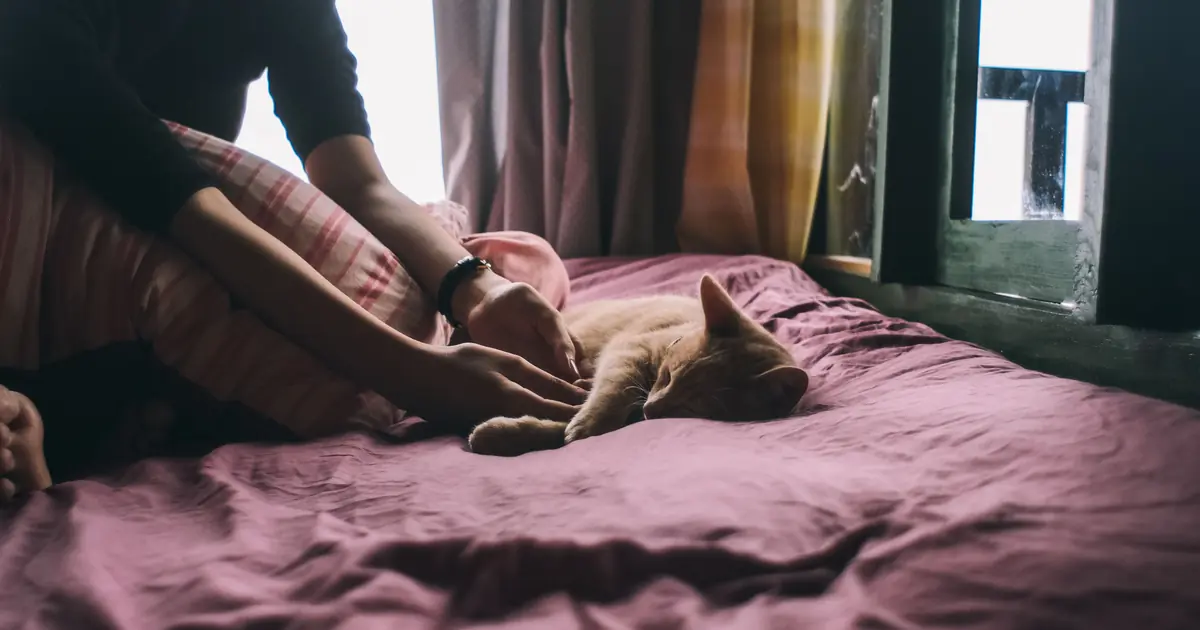
If you’ve ever settled onto the couch and felt a warm, purring weight land squarely on your chest, you already know the feeling. Your cat picked you, out of every soft surface in the house. So why does your cat lay on your chest, of all the places they could nap? The short version: your chest checks every box a cat cares about. It’s warm, it sounds like a heartbeat, it smells like you, and it feels safe.
- A cat laying on your chest is usually showing trust and affection, since sleeping leaves them vulnerable and they only do it where they feel safe.
- Your chest offers steady body heat, and cats run warm at about 101 to 102.5°F, so they instinctively seek out cozy spots like you.
- The sound of your heartbeat and the rise and fall of your breathing soothe cats, echoing the comfort they felt as kittens with their mother.
- Cats have roughly 200 million scent receptors, so lying on your chest lets them surround themselves with your scent and mark you as their own.
- Letting your cat sleep on your chest is safe and hygienic for most healthy people, and petting a purring cat can lower your stress and blood pressure.
So Why Does My Cat Lay on My Chest?
Your cat lays on your chest because it offers a rare combination of warmth, comforting sound, familiar scent, and safety all in one spot. Most cats don’t sleep just anywhere. They choose places that feel secure and cozy, and your chest delivers on every front. Here’s the thing: when your cat sleeps on you, they’re trusting you with their most vulnerable hours, and that’s a quiet way of saying they feel completely at home with you.
Below are the seven reasons cats gravitate to your chest, from the practical (heat) to the heart-melting (love and trust).
| Reason | What it tells you |
|---|---|
| Your chest is warm | Your cat is heat-seeking and your body heat is the comfiest spot in the room. |
| Your heartbeat and breathing | The steady rhythm soothes your cat, like a kitten next to its mother. |
| Your scent | Your cat feels safe surrounded by the smell of you. |
| Marking you as “theirs” | Your cat leaves their scent on you, claiming you as family. |
| Trust and safety | Sleeping on you means your cat feels protected and unthreatened. |
| Bonding and attention | Your cat wants closeness, contact, and a little of your time. |
| Routine and comfort | Your cat has learned your chest is reliably cozy and returns to it. |
Is My Chest Warmer Than Their Cat Bed?
Yes, to your cat, your chest is usually the warmest, coziest spot available. Cats are natural heat-seekers, and their normal body temperature sits around 101 to 102.5°F, a bit higher than ours. That means they’re always on the hunt for warm resting places, and a living, breathing radiator beats a cold cushion every time.
Your chest also rises and falls gently as you breathe, which adds a soft, rocking motion. For a sleepy cat, that’s the difference between a good nap and a great one. If your cat seems to chase warmth more than usual lately, it’s often just the season, but a sudden, dramatic change in how much they seek heat is worth a quick mention to your vet.
Does My Cat Like the Sound of My Heartbeat?
Yes, the sound of your heartbeat and your breathing genuinely soothes many cats. Resting on your chest puts your cat right against the steady thump of your heart and the slow rhythm of your breath. Those sounds are calming in the same way a heartbeat soothes a human baby.
There’s a sweet reason this works. As kittens, cats fall asleep pressed against their mother and littermates, surrounded by warmth and a gentle heartbeat. Lying on your chest recreates that early feeling of safety and comfort. So when your cat melts into a purr on top of you, part of them is right back in the nest.
Is My Cat Marking Me With Their Scent?
Yes, part of why your cat lays on your chest is to mix their scent with yours and claim you as part of their family. Cats have scent glands on their cheeks, chin, forehead, and paws. When your cat rubs against you, kneads you, or simply rests on you, they leave behind their personal scent.
This isn’t about ownership in a bossy way. For a cat, scent equals safety. By making you smell like “us,” your cat is building a shared scent profile that tells their brain, this human is home. Cats have roughly 200 million scent receptors, compared with about 5 million in people, so the smell of you matters far more to your cat than most of us realize. Your chest, close to your face and neck where your natural scent is strongest, is prime real estate for this.
Does My Cat Lay on My Chest Because They Trust Me?
Yes, choosing your chest is one of the clearest signs that your cat trusts you. Sleep is when a cat is most defenseless, and cats only let their guard down where they feel safe. When your cat closes their eyes and drifts off on top of you, they’re telling you they don’t expect any danger from you. That’s a big deal in the cautious world of cats.
This trust often comes bundled with affection and a wish for connection. Cats that are closely bonded to their person seek out physical closeness, and your chest offers the most contact possible. If your cat seeks you out, settles in, and relaxes completely, you’re not imagining the bond. You’ve earned it.
Why Does My Cat Pick My Chest and Not Anyone Else’s?
Cats often choose one person’s chest because that human feels like their safest, most familiar option. In a multi-person home, cats tend to bond most strongly with the person who reads their signals well, respects their space, and shows up for feeding, play, and quiet time. That favorite person becomes the go-to chest.
Your individual scent, your typical schedule, and the way you handle your cat all play a part. Some cats also prefer a particular person’s chest for the view, a slightly raised perch that lets them keep an eye on the room while staying snuggled in. If your cat picks you, take it as a compliment: you’ve become their definition of calm.
Can My Cat Sense My Anxiety, Pregnancy, or Illness?
Cats are sensitive to changes in your body and mood, but there’s no solid scientific proof they can knowingly diagnose pregnancy or illness. What we do know is that cats notice shifts in your scent, body heat, routine, and behavior, and they often respond by sticking closer to you, including on your chest.
Here’s what the science actually supports, stated honestly:
- Anxiety and stress: Cats can pick up on changes in your heart rate, breathing, and body language. If you’re tense or low, your cat may notice the shift and respond by staying near you. Many owners feel comforted by this, and the closeness can be calming for both of you.
- Pregnancy: There’s no clear evidence cats understand pregnancy, but they may detect the hormonal scent changes and the slight rise in body temperature that come with it. To a heat-seeking, scent-driven cat, a warmer, differently-scented chest can simply be more appealing.
- Illness: Cats may notice when something about you changes, such as more rest, a different smell, or a higher temperature. That can draw them to cuddle closer. It does not mean your cat has detected a specific disease, so never treat extra cuddling as a medical sign.
The honest takeaway: your cat is wonderfully tuned in to you, but their chest cuddles are about comfort and connection, not a diagnosis. If you feel unwell, talk to your own doctor, not your cat.
Is It Safe and Hygienic to Let My Cat Sleep on My Chest?
For most healthy people, it’s perfectly safe and hygienic to let your cat sleep on your chest, and it can even be good for you. Petting a calm, purring cat is linked to lower stress and reduced blood pressure, so those chest naps may benefit you both. The bond and the relaxation are real.
A few sensible exceptions are worth knowing:
- Allergies or asthma: If you’re allergic to cats or have asthma, sleeping with a cat on your chest can trigger symptoms. Keep cats off your face and out of the bedroom if that’s you.
- Disrupted sleep: If your cat’s weight, movement, or 4am wake-up calls ruin your rest, it’s fine to set a boundary and offer a cozy alternative.
- Pregnancy and toxoplasmosis worry: You cannot catch toxoplasmosis from cuddling or being near your cat. The real, and small, risk comes from handling cat litter. Pregnant people should avoid scooping the litter box if possible, or wear gloves and wash hands well afterward. Cuddling on the chest is not the concern.
- Very young children or fragile health: A cat on the chest of an infant is not safe due to the risk of restricted breathing. Keep cats off babies and supervise closely around small children.
This article is educational and not a substitute for veterinary or medical advice. If your cat suddenly changes how often they cling to you, or you notice signs like hiding, weight loss, or low energy, check in with your veterinarian. For health questions about yourself, talk to your doctor.
How Do I Gently Redirect a Cat That Won’t Stay Off My Chest?
If you love your cat but need your chest back, the kindest fix is to offer an alternative that’s just as cozy, not to scold. Cats repeat behaviors that pay off, so the goal is to make another spot more rewarding than your ribcage at 3am.
- Set up a warm, soft bed near you. Place it where your cat already likes to be, ideally somewhere with a little height and a good view.
- Try a heated cat bed. Since your cat is chasing your body heat, a gently warmed bed can win them over.
- Move your cat calmly, not crossly. If you need to shift them, lift them gently to their new spot. Avoid punishment, which only erodes the trust that makes them love you.
- Reward the new spot. Offer praise, a treat, or a chin scratch when your cat settles in their own bed.
- Keep a consistent bedtime routine. Feeding and a short play session before bed can help your cat settle and sleep through the night.
A plush, washable bed, or a heated one for a real warmth-seeker, often does the trick within a week or two.
K&H Thermo-Kitty Heated Cat Bed
This is a soft, orthopedic-foam cat bed with a low-wattage heater that warms to your cat’s body temperature only when they curl up in it. Since cats lie on your chest partly for your warmth, a gently heated bed gives them a cozy alternative of their own. Best for warmth-seekers, seniors, and cats in chilly homes.
Frequently Asked Questions
Q: Why does my cat lay on my chest and stare at me?
Cats lay on your chest and stare at you as a sign of trust and affection, not a threat. Slow, soft eye contact and a relaxed body usually mean your cat feels safe and content. A slow blink back is a gentle way to say “I love you too” in cat language.
Q: Is it bad to let my cat sleep on my chest every night?
For most healthy adults, letting your cat sleep on your chest every night is not bad and can be relaxing for both of you. Only reconsider it if you have allergies or asthma, your sleep suffers, or a baby is involved. In those cases, offer your cat a comfy bed of their own instead.
Q: Why does my cat lay on my chest and purr?
Your cat lays on your chest and purrs because they feel safe, warm, and content with you. Purring is often a sign of comfort and bonding, and the closeness lets your cat soak up your heat, scent, and heartbeat. Some cats also purr to self-soothe, so context matters.
Q: Why does my cat only lay on my chest and not my partner’s?
Cats often pick one person’s chest because that human feels like their safest, most familiar choice. Your scent, your routine, and how well you read your cat’s signals all play a role. It usually means you’ve become your cat’s favorite source of calm and security.
Q: Can my cat sense if I’m sad or stressed when they lay on me?
Cats can pick up on changes in your mood, heart rate, breathing, and body language, so they may notice when you’re sad or stressed. Many cats respond by staying close, including on your chest. There’s no proof they understand emotions like we do, but the comfort can be very real.
Q: Why does my cat knead my chest before lying down?
Cats knead your chest before lying down because it’s a leftover comfort behavior from kittenhood, when they kneaded their mother to stimulate milk. As adults, kneading signals contentment and helps your cat settle in. It also spreads their scent from their paws onto you.
Q: Should I move my cat if they lay on my chest while I sleep?
You can move your cat off your chest if it disrupts your sleep, and the kindest way is to lift them gently to a warm bed nearby. Avoid scolding, which damages trust. To prevent repeat visits, make their own spot cozy and rewarding, ideally with a heated bed.
Q: Why has my cat suddenly started lying on my chest?
A cat that suddenly starts lying on your chest is often seeking warmth, comfort, or reassurance, especially after a change in routine, weather, or household stress. It’s usually a positive bonding sign. If it comes with hiding, appetite changes, or low energy, check in with your vet to rule out illness.
At the end of the day, when your cat lays on your chest, they’re choosing you as their safe, warm, familiar home base. It’s trust, comfort, and love rolled into one purring bundle. So the next time you wonder why your cat lays on your chest, take it as the compliment it is, and enjoy the cuddle.

Hello and welcome to The Ideal Cat!
We are some passionate cat owners from different professions. We love our cats and have a lot of experience in how to care for our pets. We are incredibly excited to share our knowledge, experience, and research with you. So you can take good care of your loving cat. We will answer most of the common questions about owning cats, taking care of them, etc. If you have any question contact with us. Thanks for visiting! Enjoy the content.
