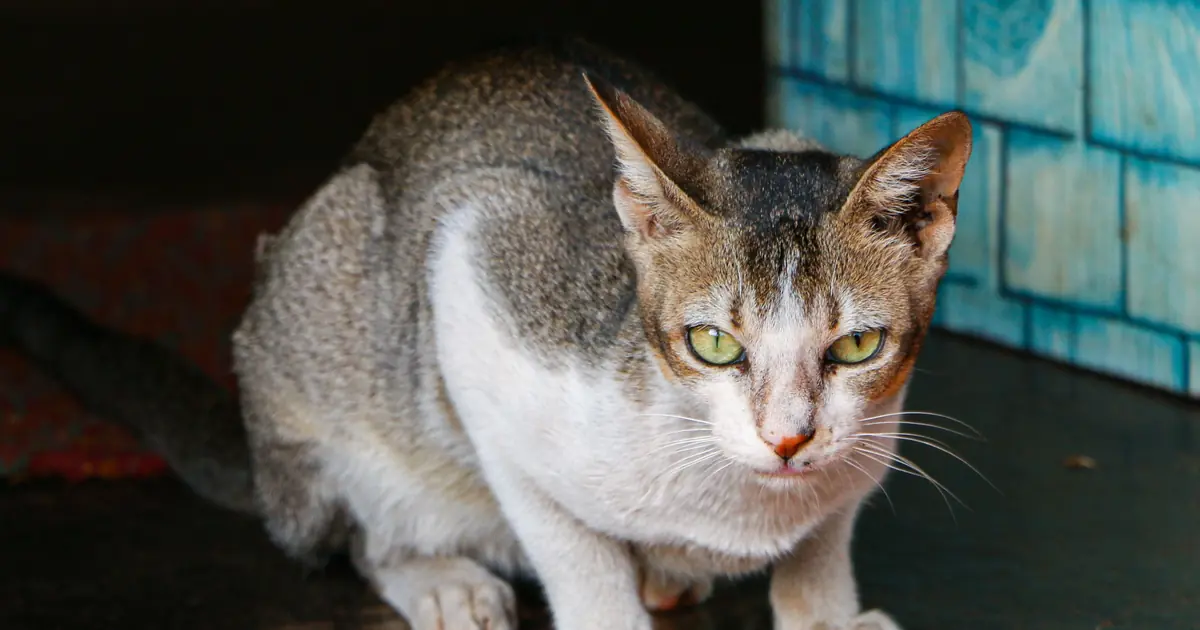
Picture this: your cat squeezes under the bed, realizes there’s nowhere to turn around, and instead of panicking, calmly reverses out tail-first like a tiny furry car in a parking garage. It’s a little funny to watch. It’s also a perfectly normal skill your cat has had all along.
Most of the time we never notice, because cats are built to move forward, stalk forward, and pounce forward. But every cat can shift into reverse when the moment calls for it. Below, we’ll go through exactly why cats can walk backwards, the situations that trigger it, the viral “tape on paws” reaction, and the rare cases where backward walking actually points to something going on with your cat’s balance or nervous system.
- Cats can and do walk backwards, using the same flexible spine and precise body awareness that lets them squeeze through narrow gaps.
- Most backward walking is a normal reaction: retreating from a threat, backing out of a dead-end, or reacting to something weird stuck to their paws or fur.
- Cats usually prefer to move forward because their eyes, whiskers, and hunting instincts are all oriented that way.
- Repeated, uncontrolled, or disoriented backward walking, especially paired with circling or a head tilt, can point to a vestibular or neurological issue.
- The famous “cat walking backwards with tape on its paws” reaction is a startle response to an unfamiliar texture, not a sign of distress that needs recreating for fun.
Can cats walk backwards?
Yes, cats can walk backwards, and they’re actually quite good at it when they need to be. It’s not a stumble or an accident. A cat backing up is making a deliberate, coordinated choice, shifting its weight and stepping in reverse the same way it would step forward, just in the other direction.
You just don’t see it very often, because cats rarely need to. Forward is where the action is: the prey, the doorway, the food bowl. Backward walking tends to show up only in specific moments, like retreating, reversing out of a tight spot, or reacting to something unexpected touching their body.
Why can cats walk backwards in the first place?
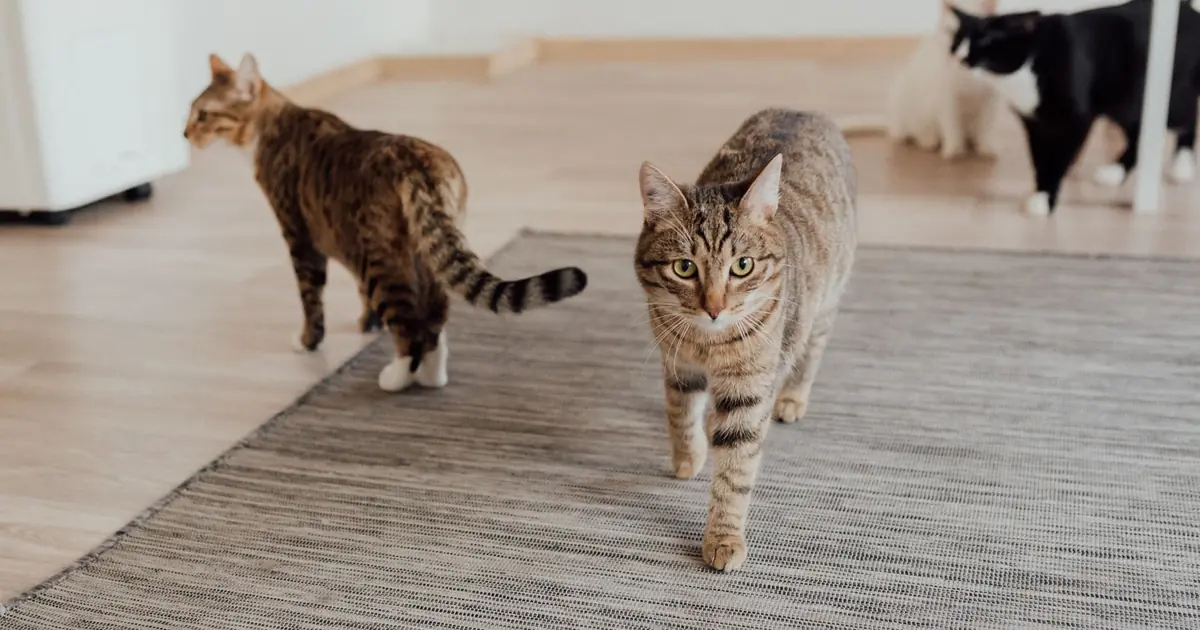
Cats can walk backwards because of their unusually flexible spine, sharp proprioception (the sense of where their own body is in space), and excellent muscle coordination. A cat’s backbone has more vertebrae than a human’s and looser connections between them, which is also why cats are so flexible and can twist, arch, and squeeze into places that look impossible.
That same flexibility, combined with strong leg muscles and constant feedback from their whiskers and paw pads, means a cat always knows roughly where its feet, tail, and body are relative to whatever it’s near. Reversing out of a box or backing away from the vacuum cleaner takes real coordination, and cats have plenty of it.
Why do cats walk backwards? (The normal reasons)
Cats walk backwards for a handful of everyday reasons, and almost all of them are completely normal. Here’s what usually triggers it.
- Fear or defense: A startled cat will often back away from whatever spooked it rather than turn its back and run. Backing up keeps its eyes, teeth, and claws facing the threat the whole time.
- Backing out of a tight or dead-end space: If a cat crawls under a couch or into a box and there’s no room to turn around, reversing out is the only option, and cats handle it without much fuss.
- Something stuck to their body: Tape, a sticker, a bandage, or even a new collar can feel bizarre against a cat’s fur. Backing up (sometimes combined with shaking a paw) is often the first reaction while they figure out what’s going on.
- An unfamiliar object nearby: A new vacuum, a balloon, or a strange bag on the floor can make a cat take a few cautious steps backward while it assesses whether the thing is a threat.
- Play: During a play session, cats sometimes reverse a step or two to reset their pounce distance on a toy, especially with a wand toy or laser pointer.
Why does my cat walk backwards when there’s tape on its paws?
Cats high-step and walk backwards with tape on their paws because the sticky, unfamiliar texture on their pads feels strange, and backing up is an instinctive way to try to get away from the sensation. Their paw pads are packed with nerve endings meant to feel texture, temperature, and vibration, so something clinging to them registers as odd, not just annoying.
It’s harmless and it usually stops the moment the tape comes off. But please don’t do this to your cat for a video. It’s a stress response, even if it looks comical, and repeatedly startling a cat on purpose chips away at its trust in you.
When is a cat walking backwards a cause for concern?
Backward walking becomes a concern when it happens repeatedly, without an obvious trigger, or alongside signs of disorientation. A cat that suddenly starts walking backwards, bumping into furniture, circling in one direction, tilting its head, or struggling to stay upright may have a vestibular or neurological problem, not just a normal startle reaction.
Conditions linked to this kind of backward or unsteady movement include feline vestibular disease, ear infections, inner ear inflammation, and in rare cases neurological issues or exposure to toxins. According to International Cat Care, vestibular disease can come on suddenly and cause a head tilt, loss of balance, and abnormal eye movements, and it needs a veterinary exam to sort out the cause. If your cat is also stumbling or seems wobbly on its feet, or you’ve noticed it walking in circles, treat that as a reason to call the vet, not wait and see.
| Backward walking type | Other signs to watch for | What to do |
|---|---|---|
| Normal defensive retreat | Alert eyes, ears up or flattened, clear trigger nearby (dog, stranger, loud noise) | Give your cat space; no action needed |
| Reaction to something stuck on paws | Paw shaking, high-stepping, stops once the object is removed | Gently remove tape or debris; monitor the paw pad for irritation |
| Possible neurological or vestibular issue | Head tilt, circling, stumbling, rapid eye movement, falling to one side | Contact your veterinarian promptly for an exam |
Do cats prefer walking forward?
Yes, cats overwhelmingly prefer walking forward, and their whole body is built around it. A cat’s eyes face forward for depth perception on prey, its whiskers sweep forward to feel what’s ahead, and its hunting style relies on stalking toward a target in a straight, low line. Backward movement is a backup option, not a default one.
This is also why you’ll notice a healthy cat almost never backs up voluntarily over long distances. A few steps in reverse to get out of a corner, sure. A cat casually strolling backwards across the living room for no reason would actually be unusual and worth watching.
Can you teach a cat to walk backwards on command?
Yes, some cats can learn to walk backwards on cue using positive reinforcement training, the same method used for tricks like sit, high-five, or spin. Because cats already know how to move in reverse, this trick is really about teaching them to do it deliberately when you ask, using a clicker or a treat lure to guide a step or two backward and rewarding the moment they do it.
It takes patience and short sessions, and not every cat will be interested (cats train on their own terms, always). But it’s a fun, low-pressure way to bond with a food-motivated cat, and it’s a good sign of confidence and mental sharpness when it clicks.
A little backward stepping now and then is nothing to worry about. But if you notice your cat backing up over and over with no clear reason, especially combined with circling, a head tilt, or trouble balancing, it’s worth a call to your vet. This article is educational and isn’t a substitute for a hands-on exam from a licensed veterinarian, who can rule out an ear infection, vestibular disease, or anything more serious.
Frequently Asked Questions
Q: Is it normal for a cat to walk backwards sometimes?
Yes. Cats occasionally walk backwards to retreat from something startling, back out of a tight space, or react to something stuck to their fur or paws. A few backward steps here and there is normal cat behavior, not a red flag on its own.
Q: Why does my cat walk backwards after being scared?
A scared cat often backs away instead of turning around because reversing keeps its eyes, claws, and teeth facing the thing that startled it. It’s a defensive move that lets your cat keep watching the threat while creating distance.
Q: Why does my cat back up and shake its paw?
This combination usually means something is stuck to the paw pad, like tape, a sticker, or a bit of debris. Cats have highly sensitive paw pads, so an unfamiliar texture triggers an instant urge to shake it off and step away from it.
Q: Can a cat walk backwards down stairs?
Cats can technically take a step or two backward on stairs, but it’s not something they do naturally or safely for a full flight. Their balance and depth perception work best moving forward, so backing down actual stairs isn’t a normal cat behavior and could lead to a fall.
Q: What does it mean if my cat keeps walking backwards and can’t stop?
Repeated, uncontrolled backward walking, especially with circling or stumbling, can point to feline vestibular disease or an inner ear problem. This needs a veterinary exam rather than home monitoring, since the underlying cause can range from an ear infection to a neurological issue.
Q: Is walking backwards linked to a head tilt in cats?
It can be. A cat that walks backwards along with tilting its head to one side may have vestibular disease, which affects the inner ear’s balance system. The Cornell Feline Health Center notes that sudden balance problems in cats warrant prompt veterinary attention to identify the cause.
Q: Can kittens walk backwards too?
Yes, kittens can walk backwards once their coordination develops, usually by around 4 to 5 weeks old alongside normal forward walking, running, and climbing. Their reversing may look wobblier at first simply because their overall balance and muscle control are still maturing.
Q: Why do cats sometimes back away from a new object slowly?
Cats are naturally cautious around anything unfamiliar, so backing away slowly from a new object lets them keep watching it while retreating to a safer distance. It’s part of how cats assess potential threats before deciding whether to approach, ignore, or avoid something new.

Hello and welcome to The Ideal Cat!
We are some passionate cat owners from different professions. We love our cats and have a lot of experience in how to care for our pets. We are incredibly excited to share our knowledge, experience, and research with you. So you can take good care of your loving cat. We will answer most of the common questions about owning cats, taking care of them, etc. If you have any question contact with us. Thanks for visiting! Enjoy the content.
