- Enzymatic cleaners work by breaking down the uric acid crystals in cat urine, which is the part that regular cleaners cannot remove.
- Cat urine smell returns after normal cleaning because the uric acid stays behind and reactivates whenever the air gets humid.
- Saturate the stain and let the cleaner sit for the time on the label, since a quick wipe never reaches the urine soaked into padding or subfloor.
- Never use ammonia or bleach on cat urine, because ammonia smells like urine to a cat and can encourage them to re-mark the same spot.
- A UV black light shows you hidden dried urine stains you would otherwise never find.
Related reading: best cat litter for odor. best air freshener for cats. best cat litter.
Our Top Picks
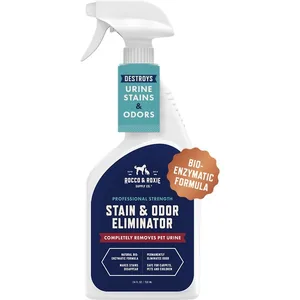
Rocco & Roxie Supply Co. Professional Strength Pet Stain & Odor Eliminator, 24-fl oz spray
Rocco & Roxie Professional Strength
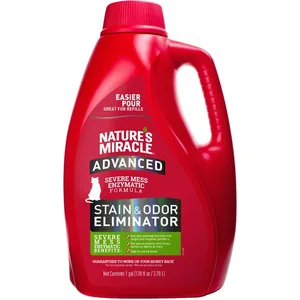
Nature’s Miracle Advanced Cat Enzymatic Stain Remover & Odor Eliminator, 1-gal bottle
Nature’s Miracle Advanced Cat Enzymatic
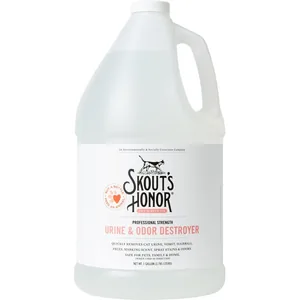
Skout’s Honor Professional Strength Urine & Odor Destroyer, 1-gal
Skout’s Honor Professional Strength Urin
Why Cat Urine Smell Won’t Go Away (Even After You Clean It)
Cat pee is chemically different from almost every other household mess. Here’s what’s happening at a molecular level. Cat urine contains three main components: urea, ammonia, and uric acid. The first two rinse away pretty easily with water and soap. That’s why your spot smells fine for a few days after cleaning. But uric acid is the troublemaker. It forms tiny crystals that bond to whatever surface they land on, carpet fibers, mattress padding, hardwood grain, drywall, you name it. And here’s the kicker: uric acid crystals don’t dissolve in water. They don’t dissolve in soap. They don’t dissolve in most household cleaners. So you mop, you spray, you scrub. The surface smell goes away. But those crystals stay locked in, dormant. Then one humid day, or when the heat kicks on, moisture in the air reactivates them and the smell comes roaring back. Sometimes weeks or months later. This is also why your cat keeps returning to the same spot. Their nose is 10,000+ times more sensitive than yours. Even when you can’t smell anything, they can smell every trace of that uric acid signature. To them, it’s still a marked toilet.How Enzymatic Cleaners Actually Work
Enzymatic cleaners aren’t just another spray bottle of perfume. They contain live, beneficial bacteria and specific enzymes that digest the organic compounds in cat urine. Here’s the breakdown of what’s in a good one:- Protease breaks down proteins in the urine
- Urease breaks down urea into gases that evaporate
- Lipase targets fats and oily residues
- Live bacteria feed on the uric acid crystals and produce more enzymes as they work
The 7 Best Enzymatic Cleaners for Cat Urine
Here are seven enzyme cleaners worth your money. Each one has earned its place through real customer use, and each is genuinely available on Chewy right now.1. Rocco & Roxie Professional Strength Stain & Odor Eliminator
2. Nature’s Miracle Advanced Cat Enzymatic Stain Remover & Odor Eliminator
3. Skout’s Honor Professional Strength Urine & Odor Destroyer
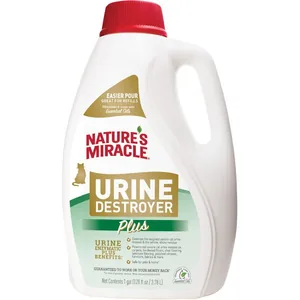
4. Nature’s Miracle Cat Urine Destroyer Plus
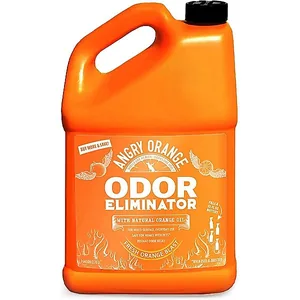
5. Angry Orange Bio-Enzymatic Pet Stain & Odor Eliminator Spray
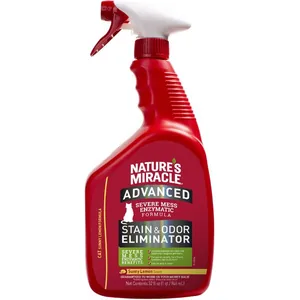
6. Nature’s Miracle Cat Enzymatic Stain Remover & Odor Eliminator
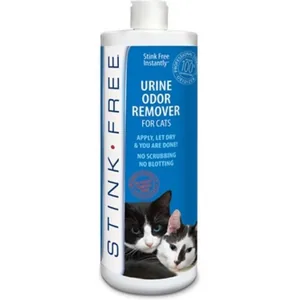
7. Stink Free Cat Urine & Odor Remover
What NOT to Use on Cat Urine
Before we get to the protocol, please don’t reach for any of these. They make things worse, not better. Ammonia-based cleaners. Cat urine already contains ammonia. To your cat, an ammonia-cleaned spot smells like another cat’s territory, basically a fresh invitation to mark again. Bleach. Bleach kills bacteria but does nothing to uric acid crystals. Worse, when bleach mixes with the ammonia in cat urine, it releases toxic fumes. Skip it. Vinegar on hardwood or stone. Vinegar is acidic and can etch finished wood, dull stone, and damage grout. On carpet it’s fine in small amounts, but it’s not breaking down uric acid the way enzymes do. Heat or steam cleaners on fresh urine. This is the big one. Heat permanently sets the proteins in cat urine. Once you steam-clean a fresh stain, the smell is locked in forever. Always treat with enzymes first, let it fully dry, and only then consider any heat-based cleaning. Scented carpet sprinkles or air fresheners. They only mask the surface smell. Your cat still smells the marker underneath, and you’ve now got perfume layered on top of pee.How to Use Enzyme Cleaner Properly (Step-by-Step)
This is the part most articles skip, and it’s the difference between “this product didn’t work” and “the smell is finally gone.” Follow these steps carefully. Step 1: Blot up as much urine as you can. For fresh accidents, press paper towels or a clean cloth into the spot. Don’t rub, just press and lift. Repeat until the towel comes up mostly dry. The less liquid pee left, the better the enzymes can work. Step 2: Saturate the area as deep as the pee soaked in. This is the most important rule. If urine soaked 1 inch into your carpet pad, the enzyme cleaner needs to reach 1 inch too. Spray surface stains generously. For deep stains, remove the spray nozzle and pour directly. A small puddle on the surface usually means dry padding underneath, and that’s where the smell hides. Step 3: Treat an area larger than the visible stain. Urine wicks outward as it soaks in, so the contaminated zone underneath is wider than the spot you see. Spray about 6 inches beyond the visible edge. Step 4: Let it sit for 10 to 15 minutes for fresh stains, or several hours to overnight for old ones. Cover with plastic wrap or a damp towel to slow evaporation. Enzymes only work while the area is wet. Step 5: Blot excess liquid. Press fresh towels into the spot. Place a weighted object on top to wick moisture up from below. Step 6: Let it air dry completely. No fans, no hairdryers, no heaters. Heat shuts the enzymes down and can lock in any remaining smell. Slow drying lets the enzymes keep working until the very last bit of moisture evaporates. Step 7: Repeat if needed. Old, deep, or repeat-marked spots often need 2 or 3 rounds. Don’t give up after one try.Surface-by-Surface Guide
Different surfaces need slightly different approaches. Here’s a quick rundown.Carpet
Soak the carpet fibers, then peel back a corner if possible to apply cleaner directly to the pad and subfloor underneath. For repeat-marked spots, you may need to lift the carpet to reach all three layers: carpet backing, padding, and subfloor.Mattress
Pour cleaner slowly over the spot so it soaks downward. Mattresses are thick, so you may need 2 to 3 applications, each fully dried before the next. Lay an absorbent towel weighted with something heavy on top to wick liquid up. Stand the mattress on its side to air dry, ideally near an open window. Skip the bed for a day if you can.Hardwood and Laminate Floors
Move quickly so urine doesn’t seep into seams. Blot fast, apply enzyme cleaner, let it sit 10 minutes, then wipe with a damp cloth. If the wood is already stained or warped, urine has reached the subfloor underneath, which usually needs to be sealed or replaced.Concrete Subfloor or Garage
Concrete is porous and soaks up cat urine like a sponge. Apply enzyme cleaner generously, let it sit at least an hour, scrub with a stiff brush, and air dry. Multiple treatments are normal. After all smell is gone, sealing the concrete prevents future absorption.Upholstery and Couches
Take the cushion outside if possible. Pour enzyme cleaner slowly into the spot until it soaks through. Use a wet-vac or fresh towels to draw moisture back out. Cushions often need 2 rounds because of their thickness.Clothing and Bedding
Pre-soak in enzyme cleaner for 30 minutes, then wash in cold water (hot water sets stains). Air dry the first time so you can sniff-check before tossing it in the dryer. If you still smell anything, re-soak and re-wash.Leather
Most enzyme cleaners aren’t safe for leather. Spot-test on a hidden area first, and consider a specialty leather pet cleaner instead.Find Hidden Stains First: The UV Black Light Trick
Here’s a small tip that saves a lot of frustration: cat urine glows under UV black light. Old stains, spray marks on baseboards, the underside of your couch, the wall behind the litter box, all light up bright yellow-green when you shine a black light on them in a dark room. Before you start cleaning, turn off the lights and walk through the room with a UV flashlight. You’ll often find stains you didn’t know existed. Mark them with painter’s tape so you can find them again with the lights back on, then treat each one. This is why some cat parents say “the smell is everywhere but I can’t find the source.” It’s because there are 4 sources, and 3 of them are invisible to the naked eye.How to Pick the Right Enzymatic Cleaner
Not every product labeled “enzymatic” is the real deal. Here’s what to look for on the bottle. Live bacteria or enzymes listed in the ingredients. Look for terms like “bacillus spore blend,” “bio-enzymatic formula,” “advanced biological blend,” or specific enzymes like protease and urease. If the ingredients are mostly surfactants, fragrance, and water, it’s not a true enzyme cleaner. Specifically formulated for cat urine. Dog urine and cat urine have different chemistry. Cat-specific formulas target the higher uric acid content and the pheromones in spray marking. No ammonia, no bleach, no harsh chemicals. These cancel out the enzymes or make the problem worse. Safe for the surface you’re treating. Most enzyme cleaners are safe on carpet, fabric, sealed wood, and tile. Always spot-test on a hidden area first. Honest scent. A light fresh or citrus scent is fine. A heavy floral or chemical smell often means the manufacturer is masking weak enzyme content with perfume. Reasonable size for your problem. A small spray bottle is fine for occasional accidents. If you’ve got an ongoing issue, buy the gallon. You’ll use more cleaner than you think.Inappropriate urination can be medical: the Cornell Feline Health Center and the ASPCA say to rule out a UTI or blockage first.
Frequently Asked Questions
Q: What is the best enzymatic cleaner for cat urine?
Rocco & Roxie Professional Strength Stain & Odor Eliminator is the most consistently recommended enzyme cleaner for cat urine. It’s Carpet and Rug Institute approved, safe around pets and kids, and works on both fresh and set-in stains. Nature’s Miracle Advanced Cat is a strong runner-up for severe or repeat stains.Q: How long does it take for an enzymatic cleaner to work on cat urine?
Fresh stains usually take 10 to 15 minutes of dwell time. Older or deeper stains need several hours to overnight. The enzymes only work while the area is damp, so cover the spot with plastic wrap if it dries out too fast. Repeat applications are normal for set-in odors.Q: Why does my cat keep peeing in the same spot even after I clean it?
Because your cat can still smell uric acid crystals that regular cleaners didn’t break down. To them, the spot is still marked as a toilet. Only enzymatic cleaners destroy these crystals at the molecular level. Once the scent marker is gone, most cats stop returning.Q: Can I make a homemade enzymatic cleaner for cat urine?
True enzyme cleaners use specific bacteria and enzymes that aren’t easy to replicate at home. Some DIY recipes involving fermented citrus peels and sugar can produce mild enzyme activity, but they take 2+ weeks to make and rarely match commercial strength. For real results, a store-bought formula is more reliable.Q: Will vinegar and baking soda get rid of cat pee smell?
Vinegar and baking soda mask cat urine smell temporarily but don’t break down uric acid crystals. The smell typically returns within days, especially when humidity rises. Use an enzyme cleaner for actual results.Q: Is enzymatic cleaner safe for cats and kids?
Most enzymatic cleaners formulated for pet messes are non-toxic and safe around cats, dogs, and children when used as directed. Always keep pets away from the treated area until it’s fully dry, and store the bottle out of reach. Check the label for specific safety instructions.Q: Can I use enzyme cleaner on a mattress?
Yes, but apply it generously. Pour cleaner slowly so it soaks down to wherever the urine reached. Press absorbent towels weighted with a heavy object to wick liquid back up, and air dry the mattress fully (ideally upright with airflow). Multiple applications may be needed for deep saturation.Q: How do I find hidden cat urine stains in my house?
Use a UV black light flashlight in a dark room. Cat urine glows bright yellow-green under UV light, including old stains, spray marks on baseboards, and spots on walls or furniture. Mark each one with painter’s tape and treat them all with enzyme cleaner.Final Thoughts
Here’s what most cat parents don’t realize until they’re knee-deep in cleaning sprays: cat pee isn’t just a smell problem, it’s a chemistry problem. Surface cleaners and air fresheners are basically lying to you. The smell isn’t gone, it’s just dormant, waiting for the next humid day. An enzymatic cleaner for cat urine is the only thing that actually solves the issue, because it digests the uric acid crystals that everything else leaves behind. Pick one from the list above, follow the saturation protocol, and let it air dry. That’s the whole game. And if your cat keeps marking the same spots even after a thorough enzyme treatment, that’s a signal worth paying attention to. Repeated marking is often a sign of stress, a litter box issue, or a medical problem like a urinary tract infection. Once your house is finally smell-free, it’s worth a vet checkup and a fresh look at your litter setup. You’ve got this. And so does your cat.
Hello and welcome to The Ideal Cat!
We are some passionate cat owners from different professions. We love our cats and have a lot of experience in how to care for our pets. We are incredibly excited to share our knowledge, experience, and research with you. So you can take good care of your loving cat. We will answer most of the common questions about owning cats, taking care of them, etc. If you have any question contact with us. Thanks for visiting! Enjoy the content.
)