Picture a black cat sitting in a Berlin hospital garden in 1951, fur rippling in little waves like a tiny lamb. A doctor spots her, scoops her up, and accidentally launches one of the rarest cat breeds in the world.
That cat was Lämmchen. And every German Rex alive today traces back to her.
Here’s the thing most people get wrong: they assume the German Rex is just a Cornish Rex with a German passport. It isn’t. Same curl gene, totally separate story, softer and sturdier little cat.
- The German Rex began in 1951 in Berlin with a single curly black cat named Lämmchen, making it the original European rex breed.
- The German Rex carries the same recessive curl gene as the Cornish Rex, but the two breeds arose independently and the German Rex has a rounder head and sturdier body.
- German Rex cats are not hypoallergenic; they shed lightly but still produce the allergens that trigger reactions.
- The breed is recognized by FIFe and the World Cat Federation in Europe but is not recognized by the CFA, and it remains very rare, especially in the United States.
- Expect to pay roughly $500 to $1,000 or more for a German Rex kitten, with availability mostly limited to European breeders.
What Is a German Rex Cat?
The German Rex is a medium-sized curly-coated cat breed that started in Germany in 1951. It’s known for a short, soft, velvety coat that ripples in gentle waves, a rounded head, a sturdy build, and an affectionate, people-focused personality.
Think of it as the friendly, plush original of the rex family. The coat feels like crushed velvet. The body is round and solid, not skinny. And the whole cat is wired to be near you, all the time.
It’s also one of the rarest cats you’ll ever meet. Some estimates put the number of dedicated breeders worldwide in the low dozens. In the US, you could go a whole lifetime without seeing one in person.
German Rex Breed Stats at a Glance
| Origin | Germany (Berlin, 1951) |
| Weight (Male) | 8 to 11 lb (about 4 to 5 kg) |
| Weight (Female) | 6 to 9 lb (about 3 to 4 kg) |
| Lifespan | 12 to 15 years |
| Coat | Short, soft, wavy and velvety; whiskers curl too |
| Colors | All colors and patterns accepted |
| Energy Level | Moderate to high; playful but cuddly |
| Grooming Needs | Low; occasional gentle care, avoid over-bathing |
| Good With Kids | Yes, gentle and tolerant |
| Good With Other Pets | Yes, social with cats and cat-friendly dogs |
| Average Price | $500 to $1,000+ (rare outside Europe) |
Where Did the German Rex Come From?
The German Rex traces back to a single curly black cat named Lämmchen, found in Berlin in 1951. That cat became the maternal ancestor of every German Rex alive today, which makes this breed’s whole family tree start with one little stray.
Here’s how it happened. In the summer of 1951, a doctor named Rose Scheuer-Karpin noticed a black cat with a wavy coat in the garden of a hospital in Berlin-Buch. Staff said the cat had been hanging around since about 1947. She took the cat home and named her Lämmchen, which means “little lamb” in German. Fitting, given the fleece.
The curl turned out to be a natural genetic mutation. To keep it, Lämmchen was later bred back to one of her own straight-coated sons, and curly kittens appeared again in 1957. That confirmed the trait was recessive and could be passed on. The breed was off and running, slowly.
The German Rex and the Cornish Rex share more than a curl
Lämmchen’s descendants didn’t just build the German Rex. Some were sent abroad to help the young Cornish Rex breed, which was struggling with skin problems from a narrow gene pool. So the German Rex actually strengthened the Cornish Rex line. Quietly heroic, for a cat nobody’s heard of.
Most of the breed’s survival came down to a few devoted catteries, including the Vom Grund cattery in former East Germany, which preserved Lämmchen’s last Rex offspring in the 1960s. Without that effort, the breed might have vanished.
What Does a German Rex Look Like?
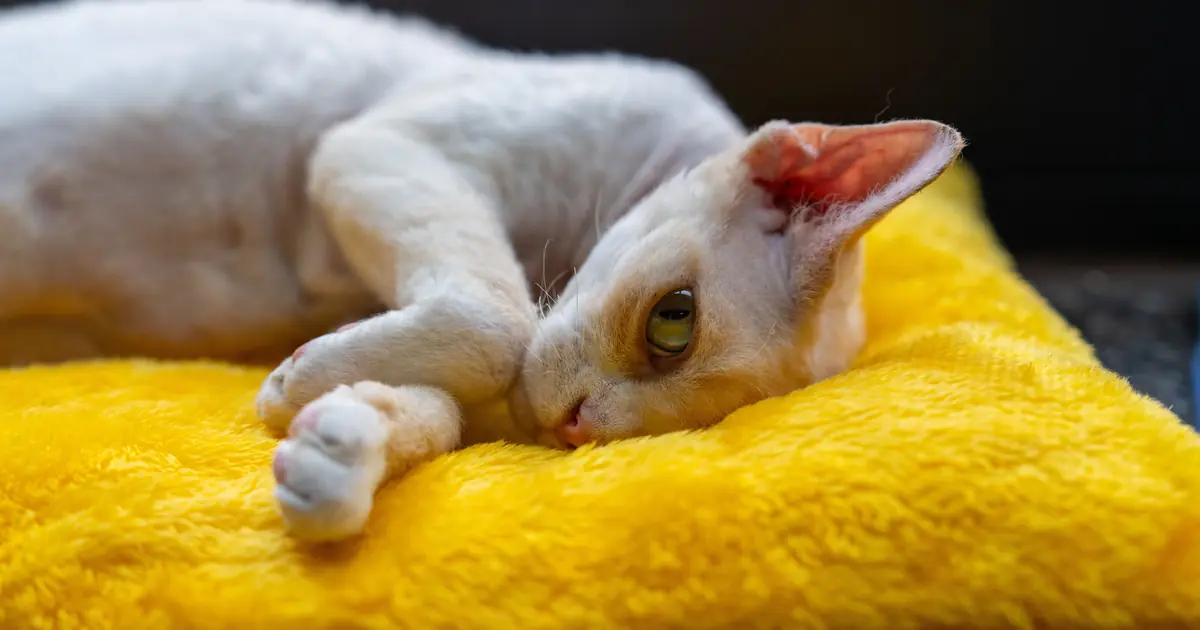
A German Rex is a medium-sized cat with a short, soft, wavy coat, a rounded head, full cheeks, large open ears, and a solid, well-muscled body. The waves are gentle and plush, and even the whiskers curl.
Run your hand down a German Rex and you’ll get it instantly. The fur is fine and dense and feels like velvet or soft lambswool. No coarse guard hairs poking out. Just smooth, rippling waves.
The coat and those curly whiskers
The German Rex coat is short and lies close to the body, with a soft wave running through it. There’s no harsh outer layer, which is what gives it that suede-like feel. The whiskers are a giveaway too: they’re often shorter than a normal cat’s and have a distinct curl or kink to them. Same goes for the eyebrows.
One honest note. The wave can vary. Some German Rex cats have a strong, obvious curl. Others look more lightly tousled, and the coat can shift a bit with age, season, and even hormones. That’s normal for rex cats.
Body, head, and how it differs from the Cornish Rex
This is where the German Rex stands apart from its more famous cousin. The German Rex has a rounder head and a sturdier, more medium build. The Cornish Rex, by contrast, looks slim and racy, with an arched back, a narrow head, and a greyhound-like silhouette. Side by side, the German Rex reads as the softer, rounder, more cobby cat.
| Feature | German Rex | Cornish Rex |
|---|---|---|
| Origin | Germany, 1951 | England, 1950 |
| Body type | Medium, sturdy, rounded | Slim, fine-boned, arched |
| Head shape | Round with full cheeks | Narrow, egg-shaped |
| Coat | Soft, wavy, velvety | Very short, tight curls |
| Curl gene | Same recessive gene | Same recessive gene |
Worth saying clearly: the German Rex and Cornish Rex carry the very same recessive curl gene, but they popped up independently in different countries. Same mutation, separate breeds. (And yes, the Devon Rex curl comes from a different gene entirely, which is why Devons look so different.)
Kitten vs adult
German Rex kittens are often born with a fairly wavy coat, but the curl can change as they grow. Some kittens go through a phase where the coat looks sparse or thin before filling back in. By adulthood, the velvety wave settles into its final form. So don’t judge the coat too hard at eight weeks.
What Is the German Rex Personality Like?
The German Rex is gentle, affectionate, playful, and deeply attached to its people. This is a velcro cat. It wants to be in the room with you, on your lap, or trotting at your heels while you make coffee.
These cats are smart and curious without being destructive maniacs. They’ll learn games, chase toys, and figure out how to open the cabinet you thought was cat-proof. (It wasn’t.) But they balance that energy with a real love of cuddling.
They also tend to be talkative in a soft, chatty way and good at reading your mood. A lot of German Rex owners describe them as almost dog-like in their loyalty. If you want a cat that ignores you, this is not your breed.
A few traits that define the breed
- People-oriented: bonds hard with its family and hates being left out.
- Playful but gentle: enjoys interactive play and learns tricks, yet rarely rough.
- Adaptable: usually fine in apartments and calm households.
- Social: tends to do well with kids, other cats, and friendly dogs.
Is the German Rex Right for You?
The German Rex is a great fit if you want a loving, interactive companion and you’re home enough to give it attention. It’s a tougher fit if you travel constantly or want a low-contact, independent cat.
Let me be honest about the downsides, because every breed has them.
- They need interaction. A bored, lonely German Rex can get clingy or anxious. They’re not happy being home-alone cats for 12 hours a day.
- They’re very people-oriented. Lovely if you want a shadow. Less ideal if you wanted a cat that does its own thing.
- They’re rare, especially in the US. Finding one can mean a waitlist, a deposit, and possibly an international breeder.
If you’re out all day, consider adopting two cats so they keep each other company, or look at a more independent breed. A German Rex really thrives in a busy, affectionate home.
Are German Rex Cats Healthy?
The German Rex is generally a healthy, robust breed with no widely recognized breed-specific genetic diseases. Its gene pool was broadened over the years through outcrossing, which helped keep the breed reasonably sturdy.
That said, this is a rare breed with limited large-scale health data, so we can’t claim it’s bulletproof. The main thing to watch with any rex cat is the coat and skin. Because the fur is fine and lacks a thick protective layer, German Rex cats can be a touch more sensitive to temperature extremes and to skin oils building up.
What to keep an eye on
- Skin and coat: watch for greasy buildup, flaky skin, or bald patches, and keep them out of harsh cold.
- Dental health: like all cats, they benefit from regular dental care to prevent disease.
- Weight: their playful nature helps, but indoor cats can still gain weight, so portion meals.
- Routine vet visits: yearly checkups catch problems early, especially as they age.
This guide is educational, not medical advice. If you notice changes in your German Rex’s coat, appetite, energy, or behavior, talk to your veterinarian. A vet who knows your cat is always the best source for health decisions.
How Do You Groom a German Rex?
The German Rex is low-maintenance to groom. Its short, fine coat doesn’t mat and rarely needs brushing. The bigger risk is actually over-grooming and over-bathing, which strips the natural oils that keep the coat soft.
A gentle once-a-week wipe with a soft cloth or a light stroke with your hand is usually plenty. If you use a brush, pick the softest one you can find. Stiff bristles can damage that delicate wave.
Skip the frequent baths
Rex coats can get a little oily because there’s not much fur to absorb the skin’s natural oils. Some owners notice this around the ears and skin folds. But resist the urge to bathe often. Too many baths dry out the skin and ruin the texture. An occasional bath with a gentle, cat-safe shampoo, only when truly needed, is the right call.
The basics still matter
- Check and gently clean the ears, since thin-coated cats can show wax buildup more.
- Trim nails every couple of weeks.
- Brush the teeth regularly or use vet-approved dental care.
- Keep them warm in winter; that thin coat doesn’t insulate much.
What Should a German Rex Eat?
A German Rex does best on a high-quality, protein-rich cat food appropriate for its age and activity level. There’s no special breed diet, but their playful energy and fine build mean good nutrition matters.
Feed a complete, balanced food that lists real meat as the first ingredient. Measure portions instead of free-feeding, since even active cats can quietly pack on weight indoors. Always keep fresh water available, and many cats drink more from a pet fountain than a bowl.
If you’re unsure how much to feed or want to switch foods, your vet can help you match the diet to your cat’s weight and life stage.
How Much Exercise Does a German Rex Need?
The German Rex needs daily interactive play to stay happy and fit. These are smart, curious cats that get bored easily, so enrichment is part of the deal, not optional.
Aim for a couple of short, focused play sessions each day. Wand toys, feather teasers, and small chase toys are big hits. Because they’re so trainable, German Rex cats often enjoy puzzle feeders and even simple trick training, which tires the brain as much as the body.
- Rotate toys so they don’t lose their novelty.
- Add a cat tree or shelves for climbing and perching.
- Try food puzzles to make mealtime a game.
- Teach a trick or two; they love the attention and the challenge.
A bored German Rex finds its own entertainment, and you may not love its choices. Give it a job and a playmate, human or feline, and you’ll have a much calmer cat.
Does the German Rex Get Along With Kids and Other Pets?
Yes. The German Rex is gentle, social, and tolerant, which makes it a good fit for families with children and homes with other pets. Its easygoing nature is one of the breed’s best selling points.
With kids, the German Rex tends to be patient and playful. As always, teach children to handle cats gently and give the cat a quiet escape spot. With other cats, this breed is usually friendly and even prefers company. With dogs, a German Rex generally does fine, especially with a calm, cat-savvy dog and a proper slow introduction.
Because they hate being alone, a second pet can actually be a gift to a German Rex. A buddy keeps them from getting lonely while you’re at work.
How Long Do German Rex Cats Live?
German Rex cats typically live 12 to 15 years, and many reach the upper end of that range with good care. As an indoor companion cat with a generally healthy background, the German Rex can be a long-term family member.
Helping your German Rex age well
- Keep them warm. Older thin-coated cats feel the cold more, so offer cozy beds and warm spots.
- Watch the weight. Senior cats slow down; adjust food to prevent obesity or sudden weight loss.
- Go to the vet more often. Twice-yearly checkups help catch age-related issues early.
- Make life easy. Lower-sided litter boxes and soft, accessible beds help aging joints.
Any sudden change in an older cat, like drinking more, hiding, or losing weight, is worth a vet visit. Catching things early is how senior cats keep thriving.
How Much Does a German Rex Cost?
A German Rex kitten usually costs about $500 to $1,000, and sometimes more for show-quality cats or rare colors. The bigger challenge isn’t the price, it’s finding one at all, since the breed is concentrated in Europe.
| Cost | Typical Range |
|---|---|
| Pet-quality kitten | $500 to $1,000 |
| Show or breeding quality | $1,000 and up |
| Possible import costs (US buyers) | Several hundred to thousands extra |
| First-year supplies and vet care | $500 to $1,000+ |
If you’re in the US, budget for the real possibility of importing from a European breeder, which adds travel, paperwork, and health-clearance costs. Always factor in ongoing costs too: food, litter, vet care, and the unexpected.
Where Can You Find a German Rex Ethically?
The best place to find a German Rex is through a registered, reputable breeder, most of whom are in Europe, particularly Germany. Because the breed is so rare, expect waitlists and do your homework before sending any money.
A responsible breeder will happily show you the cattery, share health information, let you meet the parents (or video-call them), and ask you plenty of questions in return. Be wary of anyone who pressures you, won’t answer questions, or has kittens always available.
- Look for breeders registered with FIFe or the World Cat Federation.
- Ask about the parents’ health and the kitten’s socialization.
- Expect a written contract and a kitten that stays with its mother until at least 12 weeks.
- Consider rescue too; rex-type cats occasionally turn up in breed-specific rescues.
If a “German Rex” is being sold cheap with no paperwork, be skeptical. With a breed this rare, that’s a red flag.
What Cat Breeds Are Similar to the German Rex?
If you love the German Rex but can’t find one, a few other curly and wavy-coated breeds share its charm. Each has its own quirks.
| Breed | How It Compares |
|---|---|
| Cornish Rex | Same curl gene, but slimmer body, narrower head, tighter curls, and far more common. |
| Devon Rex | Different curl gene, big ears, pixie face, loose tousled coat, very playful. |
| LaPerm | A rexed breed with a curly, sometimes longer coat and a soft, affectionate nature. |
| Selkirk Rex | Plush, randomly curled “teddy bear” coat on a stocky, calm cat. |
The Cornish Rex is the closest cousin and easiest to find, so it’s the usual recommendation for German Rex fans in the US. The Devon Rex offers a similar wavy look with a more mischievous personality.
Common Myths About the German Rex
A rare breed picks up plenty of myths. Let’s clear up the big ones.
Myth 1: German Rex cats are hypoallergenic
This is the biggest one, and it’s false. No cat is truly hypoallergenic, and the German Rex is no exception. Allergic reactions come mostly from a protein in cat saliva and skin (dander), not the length of the fur. A German Rex sheds lightly, so there may be a bit less hair floating around, but it still produces allergens. If you’re allergic, spend time with the breed before committing.
Myth 2: The German Rex is just a Cornish Rex
Also false. Yes, they share the exact same recessive curl gene, but they appeared independently in different countries. The German Rex has a rounder head and a sturdier, more medium body, while the Cornish Rex is slim and racy. They’re related cousins, not the same cat.
Myth 3: Curly cats don’t shed at all
Nope. German Rex cats do shed, just less noticeably than many breeds. Seasonal changes can bump up the shedding. Their short, fine coat simply makes it easier to overlook.
German Rex FAQ
Q: Are German Rex cats hypoallergenic?
No. German Rex cats are not hypoallergenic. They may shed slightly less than some breeds because of their short, fine coat, but they still produce the saliva and dander proteins that trigger most cat allergies. Spend time with one before adopting if you have allergies.
Q: How much does a German Rex cost?
A German Rex kitten typically costs about $500 to $1,000, and more for show-quality cats or rare colors. US buyers often face extra import costs, since most breeders are in Europe. Add first-year supplies and vet care on top.
Q: Do German Rex cats shed a lot?
German Rex cats shed lightly. Their short, fine, wavy coat makes shedding less noticeable than in many breeds, though seasonal changes can increase it. They still shed and still need basic care, so no cat is truly shed-free.
Q: Are German Rex cats rare?
Yes, very. The German Rex is one of the rarest cat breeds in the world, with only a small number of dedicated breeders, most based in Europe. They’re especially uncommon in the United States, so finding one often means a waitlist or an import.
Q: What is the difference between a German Rex and a Cornish Rex?
The German Rex and Cornish Rex share the same recessive curl gene but arose independently. The German Rex has a rounder head and sturdier, medium body with a soft wavy coat. The Cornish Rex is slimmer and racier with a narrow head and tighter curls.
Q: How big do German Rex cats get?
German Rex cats are medium-sized. Males usually weigh 8 to 11 lb (about 4 to 5 kg) and females 6 to 9 lb (about 3 to 4 kg). They have a solid, muscular build rather than a slim or skinny one.
Q: Are German Rex cats good family pets?
Yes. German Rex cats are gentle, affectionate, and social, which makes them great for families with children, other cats, and cat-friendly dogs. They bond closely with their people and prefer not to be left alone for long stretches.
Q: How long do German Rex cats live?
German Rex cats typically live 12 to 15 years. With good nutrition, regular vet care, and a warm, enriching home, many reach the upper end of that range as healthy senior companions.
Final Verdict: Is the German Rex Worth It?
If you want a soft, velvety, devoted little shadow and you’re home enough to love it back, the German Rex is a wonderful cat. It’s gentle with kids, friendly with other pets, easy to groom, and generally healthy.
The catch is rarity. You’ll likely wait, and US buyers may need to import. But for the right person, a cat that traces back to one curly stray in 1950s Berlin, and that still acts like your biggest fan, is absolutely worth it. The German Rex isn’t for everyone. For the people it suits, though, there’s nothing quite like it.
This article is for educational purposes and isn’t a substitute for veterinary advice. Always consult your veterinarian about your German Rex cat’s health, diet, and care.

Hello and welcome to The Ideal Cat!
We are some passionate cat owners from different professions. We love our cats and have a lot of experience in how to care for our pets. We are incredibly excited to share our knowledge, experience, and research with you. So you can take good care of your loving cat. We will answer most of the common questions about owning cats, taking care of them, etc. If you have any question contact with us. Thanks for visiting! Enjoy the content.
