
Ever watch your cat’s ears snap toward a sound you can’t even hear? That’s not a fluke or a coincidence. It’s a cat doing what cats have done for thousands of years: listening for something small, fast, and rustling in the grass.
If you’ve ever wondered just how far your cat’s hearing actually reaches, or why she seems to know someone’s at the door before the knock even lands, you’re in the right place. Let’s break down what makes a cat’s hearing so sharp, how far it really extends, and when it’s worth a vet visit if something seems off.
- Cats hear a frequency range of roughly 45 Hz to 64,000 Hz, one of the widest hearing ranges of any common household pet.
- A cat’s outer ear, called the pinna, can rotate up to 180 degrees using about 32 individual muscles.
- Cats can hear sounds from several hundred feet away, and estimates for loud, high-pitched sounds run up to 900 feet or more.
- Cats can hear ultrasonic sounds well above the human hearing limit of about 20,000 Hz, including many rodent squeaks.
- White cats with blue eyes have a much higher rate of congenital deafness than cats with other coat and eye colors.
How far can a cat actually hear?
A cat can typically hear sounds from several hundred feet away, and under the right conditions, some estimates put that range at up to 900 feet or more for loud, high-pitched noises. That’s roughly three times farther than the average human ear can pick up the same sound.
That number isn’t a fixed rule, though. Distance depends heavily on the pitch of the sound, how loud it is, and what’s in the way. A crinkling treat bag in a quiet house might get noticed from two rooms over. The same sound outside, competing with traffic and wind, won’t travel nearly as far before it’s lost. Think of your cat’s hearing less like a tape measure and more like a very sensitive microphone that works best in a quiet room.
How does a cat’s hearing compare to humans and dogs?
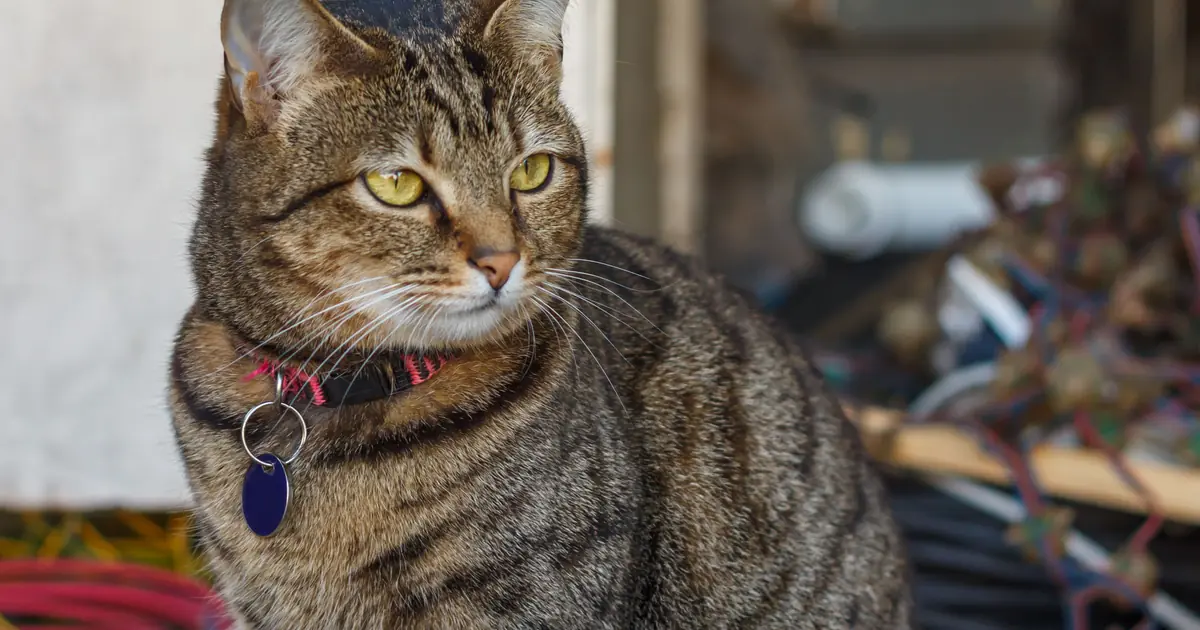
A cat’s hearing range runs from about 45 Hz on the low end to roughly 64,000 Hz on the high end, which beats both humans and dogs at the upper limit. Humans typically max out around 20,000 Hz, and dogs top out somewhere around 45,000 Hz, depending on the source and the individual animal, according to VCA Animal Hospitals.
That extra reach into ultrasonic territory isn’t an accident. It lines up almost perfectly with the high-pitched squeaks small rodents make, which tells you a lot about what cats evolved to hunt.
| Species | Hearing range (Hz) | Estimated hearing distance |
|---|---|---|
| Cat | ~45 to 64,000 | Several hundred feet, up to ~900 feet for loud sounds |
| Human | ~20 to 20,000 | About one-third of a cat’s range |
| Dog | ~67 to 45,000 | Roughly four times a human’s range, less than a cat’s upper limit |
Curious whether your cat can pick up sounds meant for dogs? Yes, in most cases, and you can read more about it in our guide to whether cats can hear dog whistles.
Why do cats hear so well?
Cats hear so well because of their large, mobile outer ears and the sheer number of muscles controlling them. Each ear, or pinna, is shaped like a funnel that catches and channels sound directly into the ear canal, and it can rotate independently of the other ear.
A cat has around 32 muscles per ear, compared to about 6 in a human ear, and that muscle power lets each ear swivel up to 180 degrees. That’s how a napping cat can flick just one ear toward a noise across the room without even opening her eyes. If you’ve noticed your cat’s ears twitching on their own, that reflex is part of the same system, and we cover it in more detail in why cats’ ears twitch.
All that ear real estate exists for one reason: finding prey. A cat in the wild depends on hearing small movements in grass or walls, and evolution built an ear built for exactly that job, according to the International Cat Care guide to feline hearing.
Can cats hear ultrasonic sounds?
Yes, cats can hear many ultrasonic sounds, meaning frequencies above the roughly 20,000 Hz ceiling of human hearing. Their range stretches up to about 64,000 Hz, which covers the high-pitched squeaks of mice and rats, and some “silent” dog whistles that people can’t hear at all.
This is actually a bigger deal than it sounds. A mouse’s alarm call or a rat’s ultrasonic chatter happens at a pitch totally invisible to us, but your cat hears it loud and clear. It’s part of why a cat can seem to “know” something’s in the walls long before you’d ever suspect it.
How does a cat locate sound so precisely?
Cats locate sound precisely by moving each ear independently and comparing the tiny differences in timing and volume that reach each ear. This is called sound triangulation, and cats are remarkably good at it, reportedly able to pinpoint a sound’s source within a few inches from several feet away.
Picture a cat sitting perfectly still, then rotating just one ear a few degrees before the other catches up. That’s the triangulation happening in real time. The brain compares which ear heard the sound first and slightly louder, then calculates the exact direction. It’s the same basic idea as how you’d turn your head toward someone calling your name, just far more refined.
Does a cat’s hearing change with age or coat color?
Yes, a cat’s hearing can decline with age, and certain coat and eye colors carry a much higher risk of deafness from birth. Senior cats often lose some high-frequency hearing over time, similar to age-related hearing loss in people, while white cats with blue eyes have a well-documented genetic link to congenital deafness.
According to the Cornell Feline Health Center, deafness in white cats is tied to the same gene that produces the white coat, and the risk climbs higher when a cat also has one or two blue eyes. If you’re curious about white cats generally, our piece on how rare white cats really are covers the genetics behind that striking look.
What are the signs a cat may be losing its hearing?
Common signs of hearing loss in cats include not responding to their name or the sound of a can opener, meowing much louder than usual, and startling easily when approached from behind. A cat that used to come running at the crinkle of a treat bag but now sleeps right through it is worth watching closely.
- Not waking up to normal household noise
- Sleeping through loud sounds that used to trigger an ear flick or a jump
- Meowing louder or more often, since a cat that can’t hear itself well tends to compensate
- Getting startled more easily, especially when touched without warning
- Turning up the “volume” on play, like batting toys harder than before
Ear health matters here too. Wax buildup, infections, and mites can all make a cat seem hard of hearing when the real problem is something treatable. Keeping up with routine ear care, as covered in our guide to how to clean a cat’s ears safely, can rule out some of the simpler causes before you assume permanent hearing loss.
If your cat suddenly stops responding to sounds, starts meowing unusually loudly, or seems startled far more easily than normal, it’s worth mentioning to your vet. A licensed veterinarian can check for ear infections, wax buildup, or age-related hearing loss with a proper exam. This article is educational and isn’t a substitute for a vet visit if something seems off with your cat’s hearing.
Frequently Asked Questions
Q: How far away can a cat hear a can opener?
Most cats can hear a can opener from another room, easily 20 to 40 feet away inside a typical house, since the sound is sharp and mid to high pitched. Outdoors or in a noisier environment, that distance shrinks considerably.
Q: Can cats hear better than dogs?
Cats have a higher upper hearing limit than dogs, reaching about 64,000 Hz compared to a dog’s roughly 45,000 Hz. Dogs still have a strong sense of smell advantage, but for pure high-frequency hearing, cats edge them out.
Q: Why does my cat’s ear twitch when I talk?
A twitching ear usually means your cat’s pinpointing exactly where your voice is coming from, using tiny muscle movements to fine-tune the angle. It’s a normal reflex tied to how precisely cats can locate sound.
Q: Can all white cats hear normally?
No. White cats, especially those with one or two blue eyes, have a notably higher rate of congenital deafness than cats of other colors, due to a genetic link between the white coat gene and inner ear development.
Q: Do cats lose their hearing as they get older?
Yes, many senior cats experience some gradual hearing loss, particularly at higher frequencies, similar to age-related hearing changes in people. It usually happens slowly, so owners often notice it only after it’s fairly advanced.
Q: Can cats hear ultrasonic pest repellers?
Yes, most ultrasonic pest repellers operate in a range cats can hear clearly, since their hearing extends well above 20,000 Hz. This is worth knowing if your cat seems anxious or avoids a certain room after you install one.
Q: How many muscles control a cat’s ear?
Each cat ear has about 32 muscles, compared to roughly 6 in a human ear. That extra muscle control is what allows each ear to rotate up to 180 degrees independently of the other.
Q: Should I take my cat to the vet if I think she’s going deaf?
Yes, a vet visit is a good idea if your cat stops responding to sounds she used to react to. A veterinarian can check for treatable causes like ear infections or wax buildup before confirming permanent hearing loss.

Hello and welcome to The Ideal Cat!
We are some passionate cat owners from different professions. We love our cats and have a lot of experience in how to care for our pets. We are incredibly excited to share our knowledge, experience, and research with you. So you can take good care of your loving cat. We will answer most of the common questions about owning cats, taking care of them, etc. If you have any question contact with us. Thanks for visiting! Enjoy the content.
