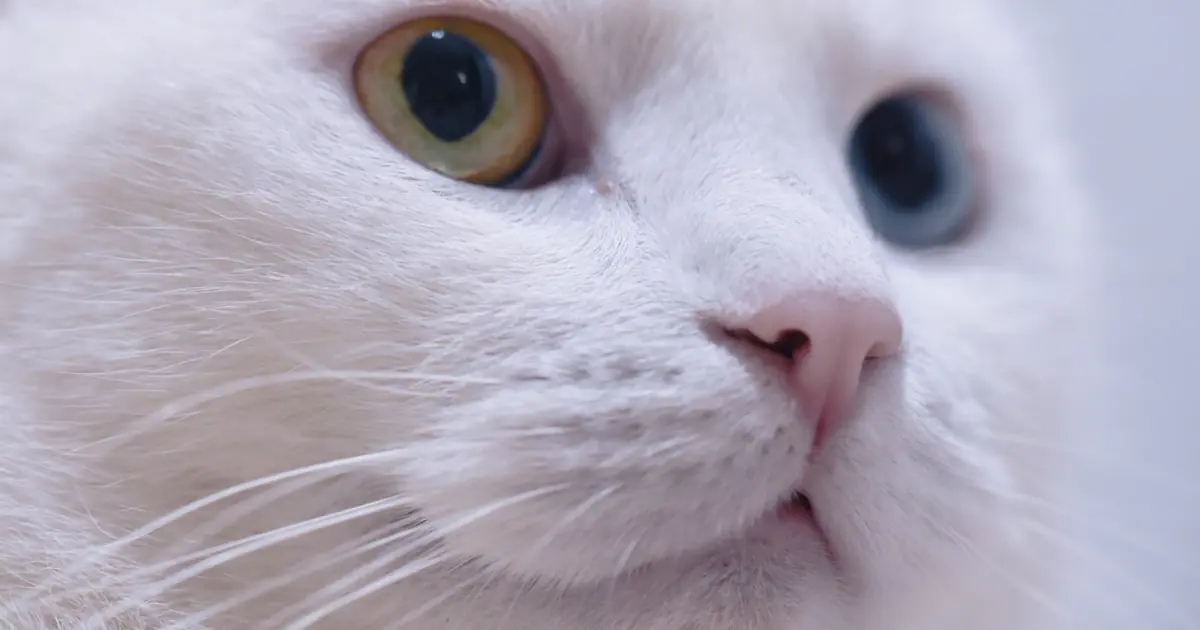
There’s something almost otherworldly about a pure white cat. No stripes, no patches, not even a single stray hair of another shade. If you’ve ever spotted one at a shelter or a cat show and thought “I never see cats that look like this,” your instincts are right. Solid white cats stand out because genetically speaking, they’re an exception, not the rule.
So how rare are white cats, really, and why do so many of them seem to have those striking blue eyes? Let’s get into the genetics, the eye colors, the deafness link nobody explains clearly enough, and which breeds are actually built to be white from nose to tail.
- Solid white cats make up an estimated 5 percent of the domestic cat population.
- The dominant white gene (W) doesn’t create white fur, it hides every other color a cat’s genes carry for.
- Blue-eyed white cats have a significantly higher rate of congenital deafness than white cats with gold or odd eyes.
- True albino cats are a completely different, much rarer condition than dominant white cats, and have pink or pale lavender eyes instead of blue.
- Odd-eyed white cats, one blue eye and one gold, are often deaf only in the ear on the same side as the blue eye.
How rare are white cats compared to other coat colors?
Solid white cats are one of the least common coat colors, showing up in roughly 5 percent of cats. Compare that to true brown or chocolate colored cats, tabbies, or black and white cats, and white sits well below average. That’s because white doesn’t come from a pigment gene doing its job. It comes from a gene that shuts pigment production down entirely, and only a fraction of cats carry it.
What genes make a cat completely white?

Two different genes can produce a white cat, and they don’t work the same way. The dominant white gene, labeled W, is what geneticists call epistatic: it sits on top of every other color and pattern gene a cat has and simply switches it off. A cat could be genetically built to be an orange tabby underneath, but if it carries even one copy of W, you’ll never see a hint of it.
The second path is the white spotting gene (sometimes written S), which controls how much white shows up in a cat’s coat. Most of the time this gene gives you a cat with white feet, a white bib, or white patches mixed with color, like a classic black and white cat. But when a cat inherits a strong enough dose of white spotting, it can end up looking fully white too, even though the underlying genetics are different from a true W-gene cat.
Researchers at the UC Davis Veterinary Genetics Laboratory identified the mutation behind both traits as a retrovirus insertion in the KIT gene, and the size and number of copies of that insertion decide whether you get a white patch, a mostly white cat, or a completely white one.
What’s the difference between a white cat and an albino cat?
A white cat and an albino cat are not the same thing, even though people mix them up constantly. Dominant white cats have completely normal pigment producing cells, those cells are just told not to work in the skin and fur. Albino cats have a broken pigment production system altogether, caused by mutations in the tyrosinase (TYR) gene, and they cannot produce melanin anywhere in their body, including their eyes.
That’s the easiest way to tell them apart: eye color. A dominant white cat usually has normal blue, gold, or green eyes with full color saturation. A true albino cat has pink or very pale, washed out lavender-blue eyes, because there’s no pigment in the iris to give it color, and blood vessels show through instead. True albinism in cats is far rarer than dominant white, and most cats people call “albino” online are actually just solid white cats with blue eyes.
| Type | How common it is | Typical eye color and traits |
|---|---|---|
| Dominant white (W gene) | Uncommon, around 5% of cats | Blue, gold, green, or odd-eyed; higher deafness risk if blue-eyed |
| White spotting (high grade) | More common than dominant white, but less common than partial white patterns | Usually gold or green; deafness risk lower than dominant white |
| True albino (TYR gene) | Extremely rare | Pink or pale lavender eyes; often light sensitive |
What eye colors do white cats have?
White cats can have blue eyes, gold or copper eyes, green eyes, or one of each, a trait called odd-eyed or heterochromia. Blue eyes happen because the W gene interferes with pigment cells in the iris the same way it wipes out coat color, leaving the eye without the pigment that would normally make it gold or green. Not every white cat gets this effect though, which is why plenty of white cats have perfectly normal gold or green eyes instead.
Odd-eyed white cats are especially striking, and genetically they’re a bit of a coin flip: the W gene silences pigment in one eye but not the other. If you’re curious about the full range of feline eye colors and what causes them, our guide on what colors cats’ eyes can be breaks down the genetics further, and cats with striking orange or copper eyes get their own dose of pigment-driven color too.
Are white cats really more likely to be deaf?
Yes, and the link is well documented. According to the Cornell Feline Health Center, white cats with two blue eyes have roughly a 65 to 85 percent chance of being deaf in at least one ear, compared to about 17 to 22 percent of white cats with no blue eyes at all. Cats with just one blue eye fall in between, with deafness rates cited around 40 percent.
The reason comes back to that same W gene. It doesn’t just block pigment, it also affects the cells inside the inner ear that are needed for hearing to develop properly. Most affected kittens lose their hearing within the first few days of life as those inner ear structures degenerate, well before you’d notice any behavior changes. UC Davis VGL genetic testing has found that cats carrying two copies of the dominant white mutation have close to a 75 percent chance of some degree of hearing loss.
Here’s a detail a lot of cat parents don’t know: in an odd-eyed white cat, deafness usually shows up on the same side as the blue eye, not the gold one. So a cat with a blue left eye and a gold right eye is more likely to be deaf in the left ear only. It’s not a guarantee, but it’s a pattern vets see often enough to mention.
Which cat breeds have white cats?
White shows up as an accepted color in dozens of breeds, including the Persian, Maine Coon, British Shorthair, American Shorthair, and Scottish Fold. In those breeds, white is just one color option among many, not the defining trait of the breed itself.
A few breeds, though, are built around being white specifically:
- Khao Manee: an ancient Thai breed whose name literally means “white jewel,” according to the Cat Fanciers’ Association. Every Khao Manee is solid white, with eyes that can be blue, gold, or odd-eyed, and the odd-eyed variety is considered the rarest and most prized.
- Turkish Angora (white): while Turkish Angoras come in many colors today, the pure white version with blue or odd eyes is the most historically famous, and once the only color recognized by some registries.
- Foreign White: essentially a Siamese built in solid white instead of pointed color, with the same sleek body type and always blue eyes.
If you’re weighing coat color against breed traits, our guide on black and white cat breeds is a useful comparison for how differently white spotting can show up from breed to breed.
How do you take care of a white cat?
Caring for a white cat looks a lot like caring for any cat, with one extra thing on your radar: sun protection. White fur means little to no pigment in the skin underneath, especially on thin-skinned spots like the ears and nose, and that skin sunburns easily. Repeated sun exposure over the years raises the risk of squamous cell carcinoma, a skin cancer that’s a genuine concern for white cats who spend time in bright windows or outdoors.
Keep sunbathing sessions short, especially during peak midday sun, and check your cat’s ear tips and nose now and then for crusty patches, redness, or sores that don’t heal. If you spot any of those, get it checked out by a vet rather than waiting. On the flip side, a little supervised sunshine is perfectly fine, and honestly most cats can’t resist a warm patch of light on the floor. If you want to know why they’re drawn to it in the first place, we cover that in our piece on why cats like to sunbathe.
If you suspect your white cat can’t hear well, a simple at-home check can help: clap, jingle keys, or crinkle a treat bag out of their line of sight and watch for a reaction. A vet can confirm hearing loss with a proper test called BAER (brainstem auditory evoked response). Deaf cats can absolutely live full, happy lives, they just need to stay indoors and get a little extra care around startling them awake or approaching from behind.
This article is meant to help you understand your cat better, not replace veterinary care. If you notice skin lesions, sudden behavior changes, or signs your cat isn’t responding to sound, talk to a licensed veterinarian.
What does a white cat symbolize in folklore?
White cats have a long history as good luck symbols across many cultures. In Britain, a white cat crossing your path is traditionally considered lucky, the opposite of the black cat superstition. In Japan, the beckoning Maneki-neko figure is often depicted in white to represent purity and good fortune, and in Thailand, the Khao Manee was historically kept by royalty as a symbol of prosperity. That folklore stands in interesting contrast to some of the darker myths around black cats, which we dig into in our piece on what a black cat symbolizes.
Frequently Asked Questions
Q: What percentage of cats are white?
Solid white cats make up an estimated 5 percent of the domestic cat population, making them one of the least common coat colors compared to tabbies or black and white cats.
Q: Are all white cats deaf?
No. Only white cats carrying the dominant white gene are at elevated risk, and even then it depends on eye color. White cats with two blue eyes have roughly a 65 to 85 percent chance of deafness, while white cats with no blue eyes have closer to a 17 to 22 percent chance.
Q: Why do white cats have blue eyes?
The dominant white gene that removes pigment from a cat’s coat can also remove pigment from the iris, leaving the eye blue instead of gold or green. Not every white cat inherits this effect, which is why some have gold, green, or one eye of each color.
Q: What’s the rarest eye color for a white cat?
Odd eyes, one blue and one gold or green, are the rarest eye combination in white cats, since it requires the pigment-blocking effect to happen in only one eye during development.
Q: Is an albino cat the same as a white cat?
No. A dominant white cat has working pigment cells that are simply switched off, while a true albino cat has a broken pigment production system caused by mutations in the TYR gene. Albino cats have pink or pale lavender eyes rather than blue, and true albinism in cats is far rarer than dominant white.
Q: Are white cats more prone to skin cancer?
Yes. White cats have little pigment in the skin on their ears and nose, which makes those areas prone to sunburn and raises the long-term risk of squamous cell carcinoma. Limiting direct sun exposure helps lower that risk.
Q: Which cat breeds are always white?
The Khao Manee from Thailand is always solid white by breed standard, and the Foreign White is a Siamese-type breed that is always white with blue eyes. Many other breeds, like the Persian and Maine Coon, allow white as one of several accepted colors.
Q: How can I tell if my white cat is deaf?
Try making a sound your cat can’t see coming, like a hand clap or a treat bag crinkle, out of their line of sight, and watch for a reaction. A vet can confirm true hearing loss with a BAER test, which measures the brain’s response to sound.

Hello and welcome to The Ideal Cat!
We are some passionate cat owners from different professions. We love our cats and have a lot of experience in how to care for our pets. We are incredibly excited to share our knowledge, experience, and research with you. So you can take good care of your loving cat. We will answer most of the common questions about owning cats, taking care of them, etc. If you have any question contact with us. Thanks for visiting! Enjoy the content.
