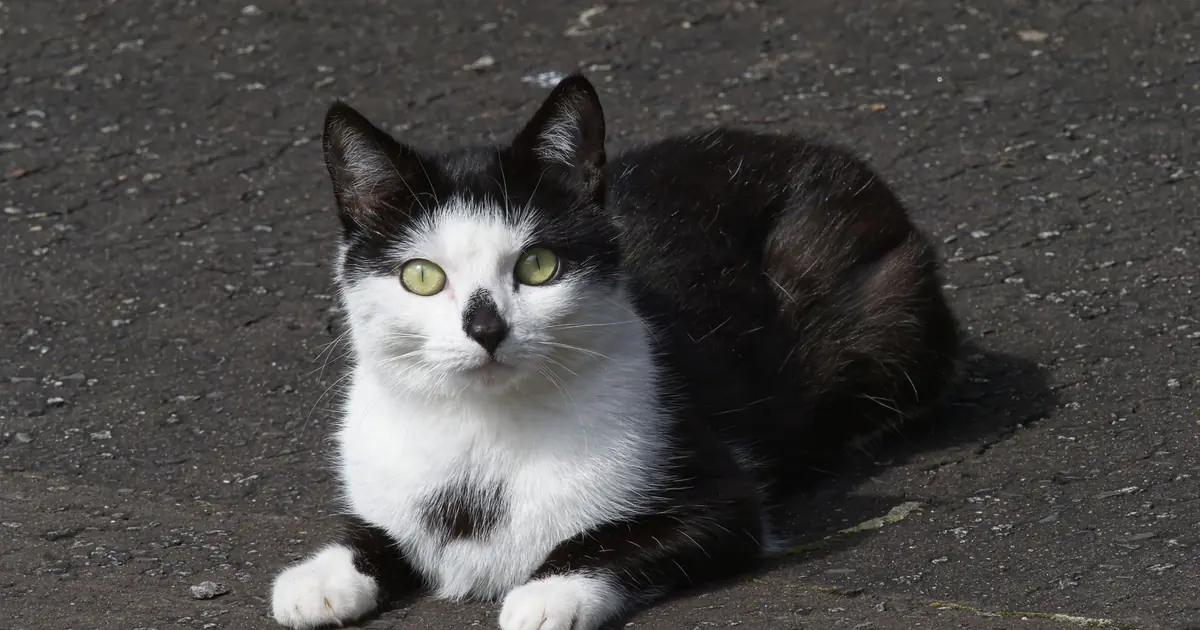
Picture a cat strolling across your kitchen floor in what looks like a tiny formal suit: black back, crisp white chest, little white socks. You’ve just met a tuxedo cat. And if you’ve ever wondered which breed that dapper coat belongs to, here’s the twist that surprises most cat parents.
So when someone says “my black and white cat,” they’re describing the coat, not a pedigree. That coat can wrap around dozens of different cats, from your neighbor’s rescue moggy to a show-ring Maine Coon. Let’s untangle the patterns, meet the breeds that wear them, and clear up the myths people repeat about tuxedo personalities.
- Black and white is a coat pattern caused by the white spotting gene, not a cat breed.
- Most black-and-white cats are Domestic Shorthairs or Longhairs, meaning mixed-breed cats with no single pedigree.
- The Cat Fanciers’ Association recognizes bicolor patterns in breeds like the Maine Coon, American Shorthair, British Shorthair, Manx, and Turkish Angora.
- “Tuxedo” is one specific bicolor look: mostly black with white on the chest, paws, belly, and sometimes the face.
- Coat color does not decide a cat’s personality. Upbringing, socialization, and breed shape temperament far more.
Is “black and white cat” a breed or a coat pattern?
Black and white is a coat pattern, not a breed. The pattern comes from the white spotting gene, which blocks pigment from reaching parts of the coat and leaves patches of white over a black base. Because almost any breed can carry this gene, black-and-white cats turn up everywhere, from random-bred strays to registered pedigrees.
Most black-and-white cats you’ll meet are Domestic Shorthairs or Domestic Longhairs. Those aren’t formal breeds either. They’re the friendly catch-all terms for mixed-breed house cats, the same way “mutt” describes a mixed-breed dog. Your tuxedo rescue is almost certainly one of these. Purebred black-and-white cats do exist, but they’re the minority.
What do tuxedo, bicolor, van, and magpie mean?
These words all describe how much white a cat wears and where it sits. They’re grades of the same bicolor pattern, running from a splash of white to almost fully white. Here’s the quick vocabulary so you can name your cat’s coat correctly.
- Bicolor: the umbrella term for any coat that mixes white with one other color. Every tuxedo is a bicolor, but not every bicolor is a tuxedo.
- Tuxedo: mostly black with white limited to the chest, belly, paws, and often the chin or face. It’s the classic “cat in a suit” look.
- Van: almost entirely white with color left only on the head and tail. The pattern is named after the Turkish Van.
- Magpie: a bold, random splashing of black and white patches, with no neat arrangement. Think ink flicked across a white cat.
- Harlequin: mostly white with a few large color patches over the body, sitting between van and magpie.
The more active the white spotting gene, the more white the cat shows. A little activity gives you a tuxedo. A lot gives you a van.
Which breeds commonly come in black and white?
Plenty of breeds carry the bicolor pattern, so a black-and-white coat can sit on a huge cat or a curly-coated one. Below are the breeds you’re most likely to see wearing black and white, with a quick read on size and temperament for each.
Domestic Shorthair (and Longhair)
The Domestic Shorthair is the most common black-and-white cat in the world, and it’s technically a mixed breed rather than a pedigree. These cats range from small to medium, usually 8 to 12 pounds, with personalities as varied as their coats. Some are lap-loving cuddlers, others are aloof hunters. If you adopted a tuxedo from a shelter, this is almost certainly your cat.
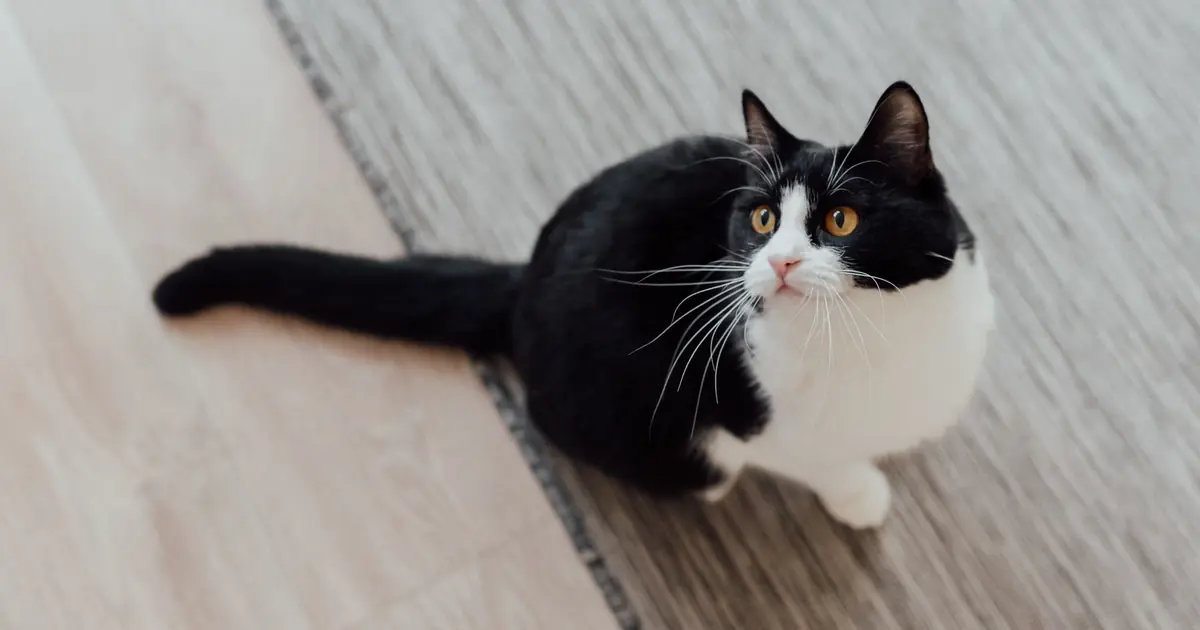
Maine Coon
The Maine Coon is a gentle giant that often comes in striking black and white. Males can reach 13 to 18 pounds, sometimes more, with long fur, tufted ears, and a bushy tail. They’re famously friendly, dog-like, and chatty, earning the nickname “the gentle giant.” A black-and-white Maine Coon looks like a tuxedo cat that hit the gym. You can read more in our full Maine Coon cat guide.
Turkish Van
The Turkish Van gave its name to the “van” pattern: a mostly white cat with color on the head and tail only. This ancient breed from the Lake Van region is medium to large, athletic, and famous for actually liking water. Vans are energetic, playful, and strongly bonded to their people. See our Turkish Van cat guide for the full story.
British Shorthair
The British Shorthair is a stocky, plush-coated breed that comes in a handsome black-and-white bicolor. These cats are medium to large, round-faced, and known for a calm, easygoing nature. They’re not big lap cats, but they’re loyal and steady companions. Our British Shorthair cat guide covers care and grooming.
American Shorthair
The American Shorthair is a sturdy, all-round family cat that wears bicolor coats well. Medium to large and muscular, this breed is easygoing, adaptable, and good with kids and other pets. It’s one of the breeds the CFA recognizes in bicolor. More detail lives in our American Shorthair breed guide.
Manx
The Manx is the tailless (or short-tailed) breed from the Isle of Man, and it appears in black and white fairly often. These cats are medium-sized, round, and powerfully built, with a playful, dog-like loyalty. Many Manx love to fetch and follow you room to room. Learn more in our Manx cat guide.
Cornish Rex
The Cornish Rex is the curly-coated athlete of the group, and its soft, wavy fur shows up in black and white too. These cats are small to medium, slender, and endlessly active, often described as clownish and people-obsessed. If you want a bicolor cat that acts like a kitten for life, this is it.
Turkish Angora
The Turkish Angora is an elegant, silky-coated breed that comes in black and white among many colors. Small to medium and fine-boned, Angoras are smart, lively, and love to be the center of attention. They’re one of the CFA-recognized bicolor breeds and a graceful pick for an active household.
Scottish Fold
The Scottish Fold, known for its folded ears, appears in bicolor black and white as well. These cats are medium-sized, round, and sweet-natured, happy to lounge near their humans. Their calm, affectionate temperament makes them popular family cats.
Norwegian Forest Cat
The Norwegian Forest Cat is a large, thick-furred breed built for cold climates, and black and white is a common look. Males can hit 12 to 16 pounds, with a water-resistant double coat and a friendly, patient personality. Think of a black-and-white “Wegie” as a woodland cousin of the Maine Coon.
How do the popular black-and-white breeds compare?
If you’re choosing a black-and-white cat and want to match size and temperament to your home, this table lines up the most common breeds side by side.
| Breed | Size | Coat Length | Personality Snapshot |
|---|---|---|---|
| Domestic Shorthair | Small to medium (8 to 12 lb) | Short | Varies widely; friendly to independent |
| Maine Coon | Large (13 to 18+ lb) | Long | Gentle, dog-like, chatty |
| Turkish Van | Medium to large | Semi-long | Energetic, water-loving, bonded |
| British Shorthair | Medium to large | Short, plush | Calm, easygoing, loyal |
| American Shorthair | Medium to large | Short | Adaptable, family-friendly |
| Manx | Medium | Short to semi-long | Playful, loyal, fetch-loving |
| Cornish Rex | Small to medium | Short, curly | Active, clownish, people-focused |
| Turkish Angora | Small to medium | Semi-long, silky | Smart, lively, attention-seeking |
| Norwegian Forest Cat | Large (12 to 16 lb) | Long, double | Friendly, patient, sturdy |
Why do so many tuxedo cats look alike?
Tuxedo cats look similar because they share the same coat mechanism, not the same ancestry. The white spotting gene tends to leave white in the same spots on many cats: the chest, belly, paws, and chin. That’s why unrelated tuxedos from opposite sides of the country can look like twins.
White develops on a kitten’s coat from areas where pigment cells arrive last during development, which are usually the underside and the feet. So the “shirt front and socks” arrangement isn’t a breed trait. It’s just where the biology consistently leaves white. Two tuxedo cats can be completely unrelated and still match almost perfectly.
Are tuxedo cats a personality type? Myth vs fact
No, tuxedo cats do not share a set personality. Coat color and pattern are not scientifically linked to temperament. The idea that tuxies are extra smart, extra sassy, or extra affectionate is folklore, not fact. A cat’s personality is shaped mostly by genetics, early socialization, and home environment.
Here’s the nuance. Some owners swear their tuxedos are bold and clever, and those stories are lovely, but they’re anecdotes. Coat pattern doesn’t program behavior. If your tuxedo is confident and chatty, thank their upbringing and individual genes, not their little suit. The same white spotting gene sits on shy cats and outgoing cats alike.
This is educational information, not a substitute for advice from your own veterinarian, especially if you’re noticing sudden behavior changes in your cat.
Which famous cats are black and white?
Black-and-white cats have starred in cartoons, films, and internet history for decades. Their high-contrast coats are simply fun to draw and photograph, which is why so many icons wear a tuxedo. A few you’ll recognize:
- Felix the Cat: the classic black-and-white cartoon cat from the silent-film era.
- Sylvester: the tuxedo cat forever chasing Tweety in Looney Tunes.
- Tom (Tom and Jerry): though grey-and-white, he reads as a bicolor icon to most viewers.
- Real-life “office cats” and shelter mascots: tuxedos are shelter favorites thanks to their photogenic coats.
The takeaway? A black-and-white coat is memorable, and cats wearing it have earned more than their share of fame.
How do I know what breed my black-and-white cat is?
Most black-and-white cats are Domestic Shorthairs or Longhairs, so the honest answer is usually “a wonderful mixed breed.” Coat pattern alone can’t tell you the breed, because the bicolor pattern crosses so many pedigrees. Body type, coat length, and ear or tail shape give better clues than color does.
If you want certainty, a feline DNA test can estimate breed ancestry, though results for random-bred cats often just confirm a mix. For a plain-language walkthrough of the clues, our guide on the rarest cat breeds shows how much breed variety really exists, and how uncommon a true purebred actually is.
The bottom line on black-and-white cats
Black and white cat breeds don’t really exist as a category, because black and white is a coat pattern that shows up across the whole cat world. Whether your tuxedo is a shelter Domestic Shorthair or a pedigreed Maine Coon, the little suit is genetics doing something charming, not a breed label. Love the cat, enjoy the coat, and remember that personality comes from who they are, not what they wear.
Frequently asked questions about black and white cats
Q: What breed is a black and white cat?
Most black and white cats are Domestic Shorthairs or Domestic Longhairs, which are mixed-breed house cats rather than a single pedigree. The black-and-white bicolor pattern also appears in recognized breeds like the Maine Coon, British Shorthair, American Shorthair, Manx, and Turkish Angora.
Q: Is a tuxedo cat a breed?
No. Tuxedo is a coat pattern, not a breed. It describes a mostly black cat with white on the chest, paws, belly, and often the face. Tuxedo coats can appear on mixed-breed cats and many purebreds alike.
Q: What causes the black and white coat pattern?
The white spotting gene causes it. This gene blocks pigment cells from reaching parts of the coat during development, leaving white patches over a black base. More gene activity means more white, ranging from a small chest patch to an almost fully white van pattern.
Q: Are black and white cats rare?
No, black and white cats are very common. The bicolor pattern is one of the most frequently seen coats in random-bred cats worldwide. Purebred black-and-white cats are less common simply because purebred cats overall are a small slice of the cat population.
Q: Do tuxedo cats have a special personality?
No. Research has not linked coat color or pattern to personality. A cat’s temperament comes mostly from genetics, early socialization, and its home environment. Friendly or feisty tuxedos are that way because of their upbringing and individual genes, not their coat.
Q: What is the difference between tuxedo and van patterns?
A tuxedo cat is mostly black with white on the chest, belly, and paws. A van cat is the opposite: almost entirely white with color left only on the head and tail. Both come from the same white spotting gene at different activity levels.
Q: Which large cat breeds come in black and white?
The Maine Coon and Norwegian Forest Cat are the largest breeds that commonly wear black and white, with males often reaching 12 to 18 pounds. The Turkish Van and British Shorthair are also medium to large bicolor breeds.
Q: Are most black and white cats male or female?
Black and white coats appear about equally in males and females, because the white spotting gene is not linked to sex. This is different from orange cats, which are more often male, and calico cats, which are almost always female.
Sources: The Cat Fanciers’ Association breed profiles, bicolor cat pattern overview, and the Cornell Feline Health Center.

Hello and welcome to The Ideal Cat!
We are some passionate cat owners from different professions. We love our cats and have a lot of experience in how to care for our pets. We are incredibly excited to share our knowledge, experience, and research with you. So you can take good care of your loving cat. We will answer most of the common questions about owning cats, taking care of them, etc. If you have any question contact with us. Thanks for visiting! Enjoy the content.
