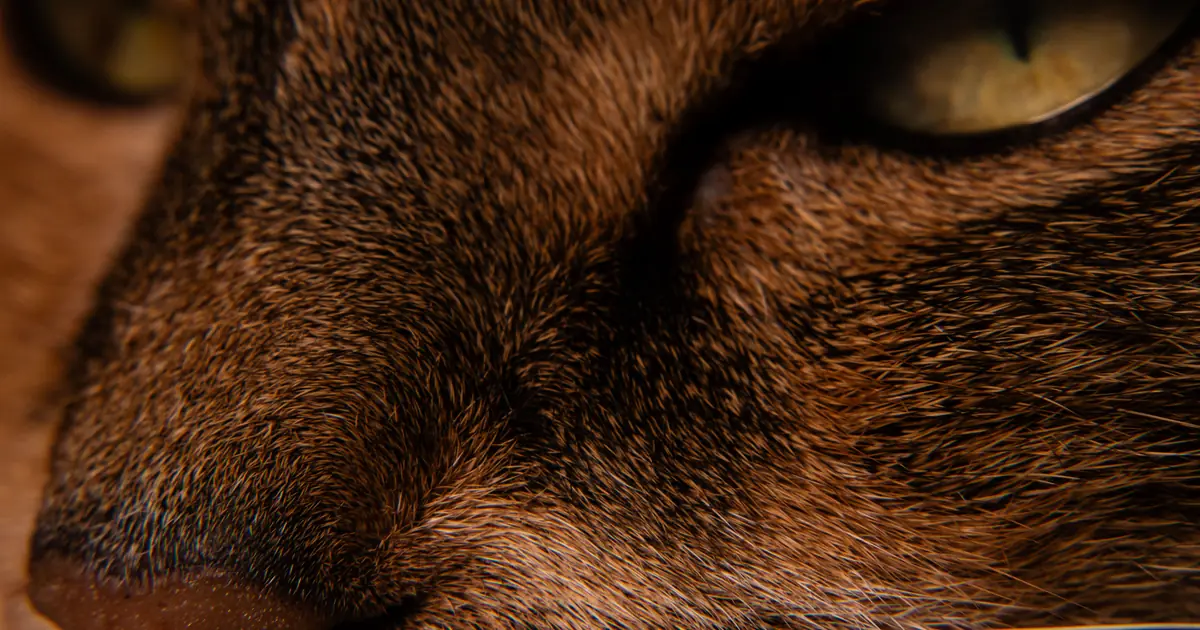
Ever waved a bright red toy mouse at your cat and watched it stare right past it, totally unbothered? You’re not imagining the snub. The truth is, your cat sees colors very differently than you do. So what colors can a cat see, really? Cats live in a softer, blue-and-yellow world where some of the colors that pop for us just fade into gray. Let’s walk through exactly what your cat sees, color by color.
- Cats see blue and yellow most clearly, so blue and yellow toys stand out best to them.
- Reds, oranges, pinks, and greens appear washed out or grayish to a cat, similar to red-green color blindness in humans.
- Cats are dichromatic, meaning their eyes have two main types of color cones, while most humans have three.
- Cats trade color richness for night vision: their retinas hold far more light-sensing rod cells than ours.
- A cat’s color vision is set up to spot movement in dim light, not to admire a sunset.
What Colors Can a Cat See Best?
Cats see blues and yellows the most clearly. These two color families sit right in the sweet spot of feline vision, so a blue feather wand or a yellow ball will look brighter and more defined to your cat than almost any other color. When you ask what colors a cat can see best, blue and yellow are the honest answer.
Here’s the why behind it. Color vision comes from cells in the eye called cones. Cats have two main types of working cones, which makes them dichromatic (two-color). Those cones are most sensitive to blue light (around the 450 nanometer range) and to greenish-yellow light (around the 500 to 550 nanometer range). Anything that lands near those peaks looks crisp and colorful to your cat.
What Colors Can a Cat See Poorly or Not at All?
Cats struggle most with reds, oranges, pinks, and to a lesser degree greens. To a cat, a fire-engine-red toy doesn’t read as “red” at all. It tends to look like a dull gray or brownish blob. That’s why a bright red mouse can be weirdly invisible to your cat while a faded blue one gets pounced.
The reason is simple. Cats lack the cone type that humans use to register reds strongly. So colors at the warm end of the spectrum (reds and oranges) lose their punch and slide toward gray. Greens also look muted and can blur together with reds, which is exactly what happens in people who are red-green colorblind.
Here is how everyday colors look to a cat
| Color | How a cat likely sees it |
|---|---|
| Blue | Clear and vivid, one of the easiest colors for cats to see |
| Yellow | Bright and easy to spot, another standout color |
| Green | Muted, leaning toward grayish-yellow |
| Red | Washed out, often looks dark gray or brownish |
| Orange | Dull and grayish, blends into the background |
| Pink | Faded, reads as a soft gray rather than pink |
| Purple | Tends to look like another shade of blue |
This table shows the best current understanding of feline color perception. We can’t ask a cat to describe a color, so these are informed approximations based on the cones in a cat’s eye.
Are Cats Colorblind?
No, cats are not colorblind in the “everything is black and white” sense. Cats do see color, just a smaller and less saturated range than people do. Calling a cat fully colorblind is a myth that won’t quite die.
The closest human comparison is red-green color blindness. A cat sees blues and yellows fine but has trouble telling reds and greens apart, with both fading toward gray. Interestingly, in lab settings some cats can be trained to tell certain colors apart that they normally seem to ignore in daily life. Out in the real world, though, cats lean on movement and brightness far more than on color.
Why Do Cats See Fewer Colors Than Humans?
Cats see fewer colors than humans because their eyes are built for hunting in the dark, not for spotting a rainbow. Color comes from cone cells, and cats simply have fewer cones than we do. Humans have several times more cone cells packed into the retina than cats.
Instead of cones, a cat’s retina is loaded with rod cells. Rods don’t detect color, but they’re fantastic at picking up dim light and fast motion. That trade-off makes perfect sense for an animal that evolved to hunt at dawn and dusk. Your cat gave up a vivid color palette in exchange for eyes that work beautifully when the lights go down.
How Does Cat Color Vision Compare to Human Vision?
Cat color vision is dimmer and narrower than human vision, but cats win big on night vision and motion detection. Humans see a wide, saturated range of color and sharp fine detail. Cats see a muted blue-yellow world, yet they pick up movement and low-light scenes that we’d miss completely.
| Feature | Cats | Humans |
|---|---|---|
| Color vision type | Dichromatic (two cone types) | Trichromatic (three cone types) |
| Colors seen best | Blue and yellow | Full color spectrum |
| Reds and greens | Muted, grayish | Vivid and distinct |
| Night vision | Excellent, needs about 1/6 the light humans need | Limited in the dark |
| Field of view | About 200 degrees | About 180 degrees |
| Visual sharpness | Roughly 20/100 to 20/200 | Typically around 20/20 |
That 20/100 to 20/200 number means a cat sees at 20 feet what a person with sharp eyes sees clearly from 100 to 200 feet. So your cat is a bit nearsighted and blurry on far-off detail, but it more than makes up for it with wide peripheral vision and unbeatable low-light sensitivity.
What Color Toys and Items Are Best for Cats?
Blue and yellow toys are the best choice for catching your cat’s eye, since those are the colors cats see most clearly. A blue feather wand or a yellow plush mouse will stand out far better than a red or pink one against your floor.
That said, color is only part of the story. Cats are wired to chase movement, so a drab toy that darts and jitters will beat a bright toy that just sits there. Pair a cat-visible color with motion and you’ve got a winner. A few simple tips:
- Pick blue or yellow toys when you want maximum visibility for your cat.
- Skip red and orange toys if your cat seems to lose track of them on the floor.
- Lean on movement: wand toys and rolling balls trigger the hunting instinct hardest.
- For food puzzles or mats, blue and yellow pieces are easier for your cat to find.
Can Cats See in the Dark, and Does Color Matter Then?
Cats can’t see in total darkness, but they see remarkably well in very low light, roughly six times better than we do. In dim light, color barely matters at all, because the rod cells doing the heavy lifting only read brightness and motion, not hue.
Two features power this night vision. First, a cat’s retina is packed with light-sensitive rod cells. Second, cats have a mirror-like layer behind the retina called the tapetum lucidum that bounces light back through the eye for a second chance to catch it. That reflective layer is also why your cat’s eyes glow in a photo. So at 3am, your cat isn’t seeing a colorful room. It’s seeing a clear, grayscale-leaning world built for spotting the slightest twitch.
This article is for general education and isn’t a substitute for veterinary advice. If you notice sudden vision changes, cloudy or color-shifted eyes, bumping into furniture, or unequal pupils, see your veterinarian, since these can signal an eye problem that needs care.
Frequently Asked Questions
Q: What colors can a cat see best?
Cats see blues and yellows best, since their eyes are most sensitive to those wavelengths. A blue or yellow toy will look brighter and more defined to a cat than a red, orange, or pink one. These two colors sit right in the strongest part of a cat’s color vision.
Q: Can cats see red?
Cats cannot see red the way humans do. Red looks muted and grayish or brownish to a cat because feline eyes lack the cone cells that register red strongly. A bright red toy can be surprisingly hard for your cat to notice against the floor.
Q: Are cats fully colorblind?
No, cats are not fully colorblind and do not see only in black and white. Cats see a limited range of color, mainly blues and yellows, while reds and greens fade toward gray. Their color vision is closest to a human with red-green color blindness.
Q: Can cats see the colors on a TV or phone screen?
Cats can see screens, but the picture looks different to them than it does to you. Cats see the blues and yellows on a TV or phone fairly well, while reds and greens look washed out. Many cats react more to the motion and flicker on a screen than to the actual colors.
Q: If cats can’t see red well, why do they chase a red laser dot?
Cats chase a red laser dot because of its fast, darting movement, not its color. A cat’s eyes are built to lock onto motion in low light, so the dot triggers the hunting instinct even though red is not a color cats see vividly. The brightness and quick movement do all the work.
Q: Do kittens see color?
Kittens are born with their eyes closed and open them around one to two weeks of age, with vision developing over the following weeks. Once a kitten’s eyes mature, it sees the same blue-and-yellow-leaning color range as an adult cat. Newborn kittens rely heavily on smell and touch until their eyesight catches up.
Q: Can cats see colors humans can’t?
Cats may pick up some ultraviolet light that humans cannot, since one study found feline eye lenses let UV light pass through. That suggests cats might perceive certain patterns or surfaces a bit differently than we do. Even so, a cat’s overall color world is narrower and less vivid than a human’s.
Q: Why do cats see better in the dark than in bright color?
Cats see better in the dark because their retinas hold far more light-sensing rod cells than color-sensing cone cells. Rods excel at detecting dim light and motion but ignore color, so cats traded a rich color palette for strong night vision. They need only about one-sixth the light a human needs to see.
So, what colors can a cat see? Your cat lives in a gentle blue-and-yellow world where reds and greens melt into gray, paired with night vision and motion-spotting skills that leave ours in the dust. Next time you shop for a toy, reach for blue or yellow, give it a wiggle, and watch your cat light up. Understanding how your cat sees color is one more small way to see the world from their side of the room.

Hello and welcome to The Ideal Cat!
We are some passionate cat owners from different professions. We love our cats and have a lot of experience in how to care for our pets. We are incredibly excited to share our knowledge, experience, and research with you. So you can take good care of your loving cat. We will answer most of the common questions about owning cats, taking care of them, etc. If you have any question contact with us. Thanks for visiting! Enjoy the content.
