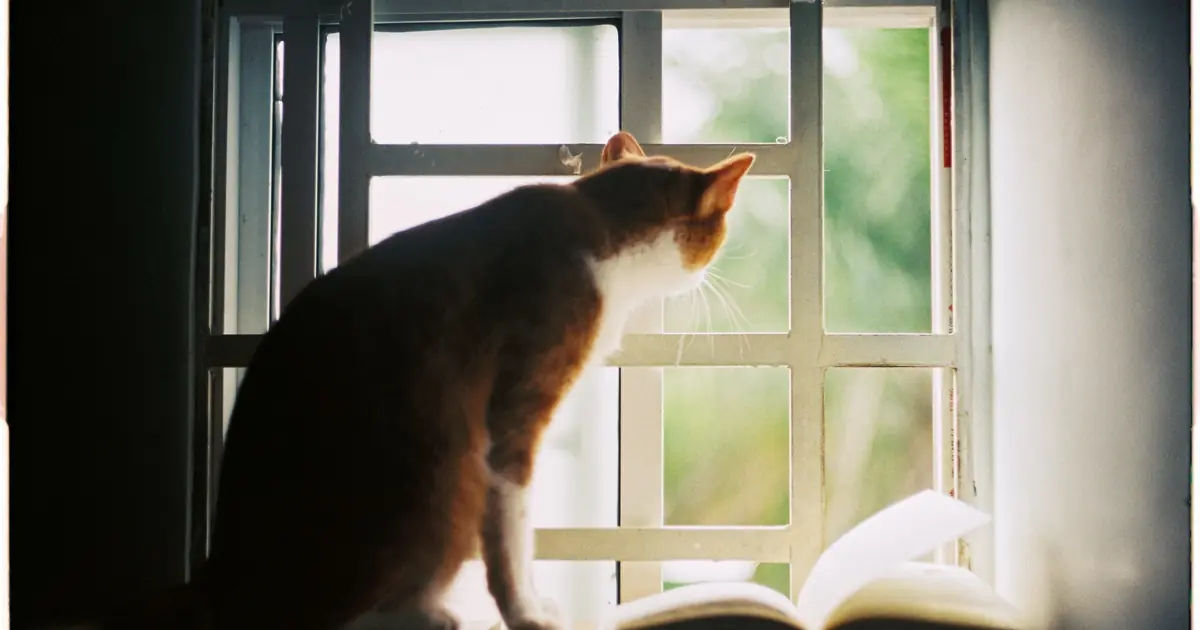
If you’ve ever watched your cat lock onto a toy mouse in a dark room, then completely ignore the treat sitting right under their nose, you’ve seen cat vision in action. So what does cat vision look like, really? It’s a strange mix: amazing in the dark, blurry far away, and painted in much softer colors than the world you see.
- Cats are nearsighted, seeing sharply only to about 20 feet (6 meters), while humans see clear detail at 100 to 200 feet.
- Cats need about one-sixth of the light humans do and see roughly 6 to 8 times better in dim conditions, thanks to a reflective eye layer called the tapetum lucidum.
- Cats have a wide field of view of about 200 degrees, compared to about 180 degrees in humans.
- Cat color vision is dichromatic, so cats mostly see blues and yellows and struggle to tell red from green, similar to human red-green color blindness.
- Cats cannot see in total darkness; they still need a small amount of light to see anything.
What Does Cat Vision Look Like Through a Cat’s Eyes?
Through a cat’s eyes, the world looks softer, dimmer in color, and out of focus at a distance, but far brighter than you’d expect in low light. Picture your living room with the edges blurred, the reds and greens faded to grey, and a wider, almost panoramic frame. That’s close to a cat’s everyday view.
Cats trade fine detail and rich color for two things they need more: seeing in the dark and catching movement. Their eyes evolved for hunting at dawn and dusk, not for reading street signs or admiring a sunset. So a scene that looks crisp and colorful to you looks gentle and grainy to your cat, with anything far away melting into a soft blur.
The good news is your cat isn’t missing out. Their eyes are simply tuned to a different job than yours.
How Far Can Cats See? Are Cats Nearsighted?
Cats are nearsighted and see clearly only to about 20 feet (6 meters), while a person with healthy eyes sees sharp detail at 100 to 200 feet. Anything beyond a cat’s range looks fuzzy and undefined.
Researchers estimate feline visual acuity at roughly 20/100 to 20/200. In plain terms, what your cat sees clearly at 20 feet, you could see clearly from 100 to 200 feet away. So when your cat seems to “miss” you walking across the yard, they may genuinely just see a blurry shape until you move or get closer.
Cats also can’t focus well on things right in front of their face. Objects need to be roughly 10 inches or farther away to come into focus, which is one reason your cat sniffs food instead of staring at it. Up close, scent and whiskers do more work than eyesight.
Can Cats See in the Dark? How Good Is Cat Night Vision?
Cats see remarkably well in the dark, needing only about one-sixth of the light humans require and seeing roughly 6 to 8 times better than people in dim conditions. But cats cannot see in total darkness; they still need a faint source of light to work with.
A few features give cats this low-light superpower. Their eyes are packed with rod cells, the receptors that handle dim light and motion, and cats have many more rods than humans do, which sharpens their night vision and movement detection. A large cornea and wide-opening pupils let in extra light. And a reflective layer behind the retina, the tapetum lucidum, bounces incoming light back through the eye for a second chance at being absorbed.
That same tapetum lucidum is why your cat’s eyes glow when light hits them at night. The eerie shine is just light reflecting back out after the eye has used it twice.
So cats can’t see in complete blackness?
Correct. In a room with zero light, a cat is as blind as you are. Their night vision is about making the most of tiny amounts of light, such as moonlight or the glow under a door, not creating sight from nothing.
What Colors Can Cats See?
Cats see a muted color world built mostly from blues and yellows, and they have a hard time telling red and green apart. This is because cats have dichromatic color vision, meaning their eyes rely on two main types of working cone cells, while humans have three.
To a cat, a bright red toy on green grass doesn’t pop the way it does for you. Both can look like dull, similar greys, much like the world looks to a person with red-green color blindness. Blues and yellowish-greens are the colors cats register most clearly. That’s worth remembering the next time you pick out a new toy.
Cat color vision is also less saturated overall. Even the colors cats do see appear softer and washed out compared to your view.
How Wide Is a Cat’s Field of View?
Cats have a wide field of view of about 200 degrees, compared to roughly 180 degrees in humans. That extra peripheral range helps cats notice movement sneaking up from the sides.
Within that 200-degree span, cats have about 140 degrees of binocular vision, the zone where both eyes overlap and create depth perception for judging a pounce. Each side adds a slim band of single-eye vision for catching motion at the edges. Cats still have a blind spot directly behind the head and right under the chin, which is why they sometimes lose track of a treat dropped at their feet.
Are Cats Really Better at Seeing Motion Than Humans?
Cats are excellent at detecting fast motion in dim light, but humans actually beat cats at spotting motion in bright daylight by about 10 to 12 times. The advantage flips depending on the lighting.
Cats are wired to react to movement, especially the quick, darting motion of prey. In low light, where cats already see better than people, their motion detection shines and helps them hunt at dawn and dusk. In full daylight, though, the human eye’s far greater number of color-sensing cone cells gives people the edge for tracking detail and smooth motion. So the popular idea that cats simply “see motion better” is only half the story; the time of day matters.
What Does Cat Vision Look Like Next to Human Vision?
Cat vision and human vision are built for different jobs: cats win in the dark and on peripheral motion, while humans win on sharpness, color, and daytime detail. The table below compares the two at a glance.
| Feature | Cat Vision | Human Vision |
|---|---|---|
| Sharp focus distance | About 20 feet (6 m) | About 100 to 200 feet |
| Visual acuity | Roughly 20/100 to 20/200 | 20/20 (healthy) |
| Field of view | About 200 degrees | About 180 degrees |
| Low-light vision | 6 to 8 times better than humans | Baseline |
| Color vision | Dichromatic (mainly blues, yellows) | Trichromatic (full color) |
| Daylight motion detection | Lower | 10 to 12 times better than cats |
| Closest clear focus | About 10 inches away | A few inches away |
This article is educational and not a substitute for veterinary care. If you notice sudden changes in your cat’s vision, cloudy or red eyes, bumping into furniture, or dilated pupils that don’t respond to light, contact your veterinarian, since these can signal a treatable medical problem.
So what does cat vision look like in the end? It looks soft and muted in color, blurry past about 20 feet, yet wonderfully bright in the dark and quick to catch motion. Your cat sees a different world than you do, one tuned for hunting at dawn and dusk, and now you can picture exactly how they see it.
Frequently Asked Questions About Cat Vision
Q: What does cat vision look like compared to human vision?
Cat vision looks blurrier at a distance, lower in color, and wider in frame than human vision, but much brighter in dim light. Cats see clearly only to about 20 feet and view the world mostly in blues and yellows, while seeing 6 to 8 times better than people in the dark.
Q: Can cats see in complete darkness?
No, cats cannot see in complete darkness. Cats need only about one-sixth of the light humans require, but they still need some light to see. In a room with zero light, a cat sees nothing, just like a person.
Q: Are cats colorblind?
Cats are not fully colorblind, but they see a limited color range. Cats have dichromatic vision and mainly perceive blues and yellows, while struggling to tell red from green, similar to a person with red-green color blindness.
Q: Why do cats’ eyes glow in the dark?
Cats’ eyes glow because of the tapetum lucidum, a reflective layer behind the retina. The tapetum lucidum bounces light back through the eye to boost night vision, and the leftover light reflecting outward creates the glow you see.
Q: Are cats nearsighted or farsighted?
Cats are nearsighted. Cats see sharply only to about 20 feet (6 meters), with estimated acuity of 20/100 to 20/200, so distant objects look blurry. They also can’t focus well on things closer than about 10 inches.
Q: Can cats see TV and screens?
Cats can see TV and screens, and many react to fast-moving images of birds or fish. A cat’s flicker-fusion frequency, the point where flashing frames blend into smooth motion, sits around 55 to 60 Hz, similar to people, so older low-refresh displays can look slightly flickery while modern high-refresh TVs appear smoother and more lifelike.
Q: Do cats have good depth perception?
Cats have solid depth perception within their forward field of view. About 140 degrees of a cat’s roughly 200-degree vision is binocular, where both eyes overlap, which helps cats judge distance accurately before they pounce.
Q: Why does my cat ignore objects right in front of it?
Cats often ignore close objects because they cannot focus well on anything within about 10 inches of their face. For very close items, cats rely on smell and their whiskers rather than eyesight, which is why your cat may sniff a treat it seems unable to see.

Hello and welcome to The Ideal Cat!
We are some passionate cat owners from different professions. We love our cats and have a lot of experience in how to care for our pets. We are incredibly excited to share our knowledge, experience, and research with you. So you can take good care of your loving cat. We will answer most of the common questions about owning cats, taking care of them, etc. If you have any question contact with us. Thanks for visiting! Enjoy the content.
