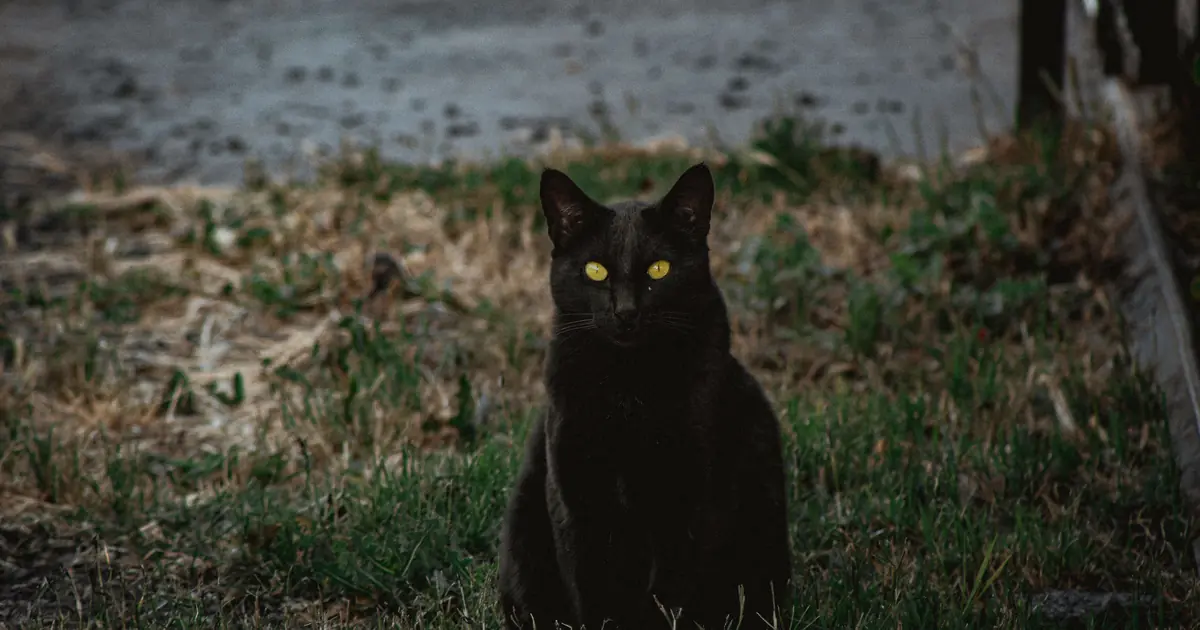
Picture this: it’s 2am, the house is pitch black, and your cat just sailed off the bookshelf without knocking over a thing. Meanwhile you’re stubbing your toe on the same ottoman you’ve owned for three years. It’s tempting to think your cat has a superpower.
So can cats see in the dark, really? Your cat isn’t seeing in a lightless void, but their eyes are built for the shadowy hours most of us fumble through. Understanding how that works also explains the eerie glow you catch in photos, and why your cat treats 4am like prime time.
- Cats need roughly one-sixth to one-eighth the amount of light humans do to see clearly.
- No cat, and no animal, can see in complete, total darkness. Some light source has to be present.
- A cat’s tapetum lucidum, a reflective layer behind the retina, bounces light back through the eye for a second pass and causes the glowing eyeshine you see in photos.
- Cat eyes hold far more rod cells than human eyes, which boosts motion and low-light detection but costs them color range and fine detail.
- Cats are naturally crepuscular, meaning they’re built to hunt at dawn and dusk, not necessarily at midnight in a sealed room.
Can Cats See in Complete Darkness?
No. Cats cannot see in total, pitch-black darkness, because vision of any kind needs at least a trace of light to reach the eye. What cats can do is see remarkably well in dim conditions that would leave you groping for a light switch. A moonlit room or a hallway with a sliver of light under a door is often enough for your cat to move around confidently while you’re stuck squinting.
This is different from true night vision devices, which amplify existing light or detect heat. Your cat just has a far more efficient eye than yours, not a sci-fi gadget.
Why Do Cats See So Well in Low Light?
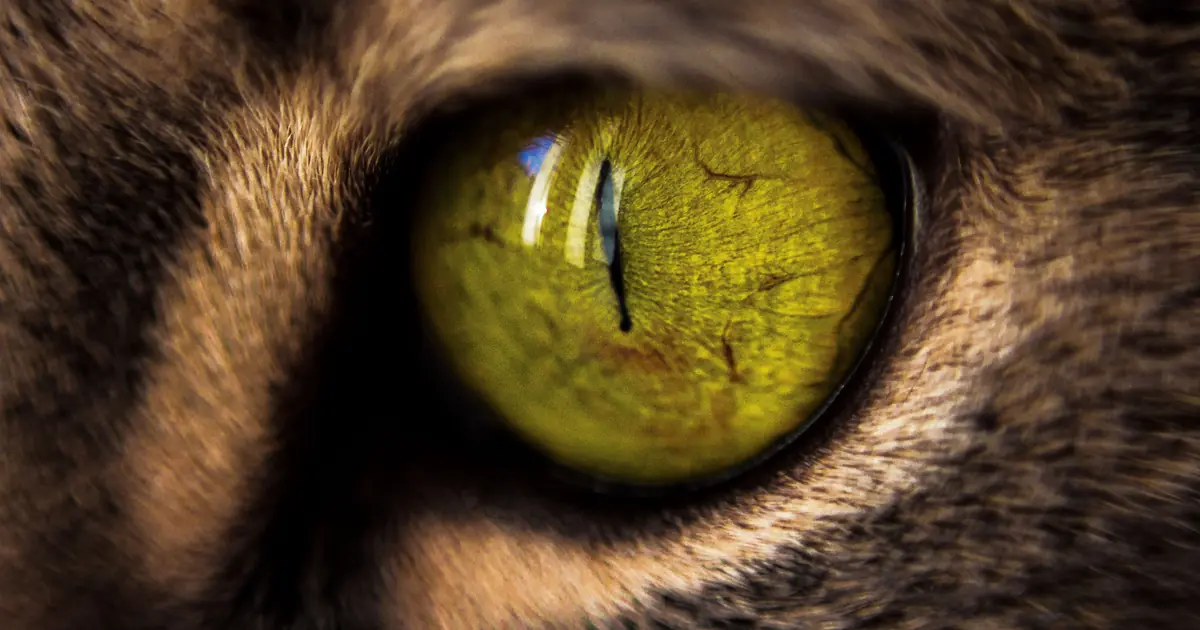
Cats see well in low light because of a handful of physical adaptations working together, not one single trick. Each piece matters, and together they add up to a serious low-light advantage.
Bigger Eyes and Wider Pupils
A cat’s eyes are large relative to their skull, which lets in more light to begin with. Their pupils also open dramatically wide in dim settings, some research puts the dilation range at over 100 times larger than fully constricted, far beyond what a human pupil can do.
A Flood of Rod Cells
The retina, the light-sensing layer at the back of the eye, holds two photoreceptor types: rods for low light and motion, and cones for color and detail. Cats pack in far more rod cells than humans, some studies estimate up to six to eight times the density. That’s great for spotting a mouse skittering through shadows, but it comes at a cost we’ll get to shortly.
The Tapetum Lucidum
Behind a cat’s retina sits the tapetum lucidum, a reflective layer of tissue (Latin for “bright tapestry”). Think of it as a tiny mirror. Light that passes through the retina without being absorbed bounces back for a second chance at detection. That’s also exactly why your cat’s eyes glow green or gold in a flash photo, you’re seeing the tapetum lucidum reflecting light straight back at the camera.
How Much Better Is Cat Night Vision Than Human Vision?
Cats can see clearly in light that’s roughly six to eight times dimmer than what a human eye needs for the same scene. That’s the combined payoff of bigger pupils, extra rod cells, and the tapetum lucidum’s reflective boost. It’s a real edge, but it’s not limitless.
Here’s how cat and human vision stack up:
| Vision Trait | Cats | Humans |
|---|---|---|
| Light needed to see in dim conditions | About 1/6 to 1/8 the light | Baseline (needs more light) |
| Rod cells (low-light, motion) | Up to 6 to 8 times more | Fewer, prioritizes cones |
| Reflective tapetum lucidum | Yes, boosts low-light vision | No |
| Color vision | Limited, mostly blues and yellows | Full range (red, green, blue) |
| Sharp detail and distance focus | Blurrier, slightly nearsighted | Sharper at a distance |
| Peak activity window | Dawn and dusk (crepuscular) | Daytime |
If you’re curious how the colors your cat perceives compare to yours, we go deeper on what colors a cat can see and break down exactly which shades stand out to them and which fade into gray.
What Do Cats Trade Off for Better Night Vision?
Cats trade color range and sharp detail for their low-light edge, since an eye can’t max out every ability at once. It’s a fair trade for a hunter built for the shadows, but it means your cat’s world doesn’t look like a crisp, colorful photograph the way ours does.
- Fewer colors: cats see a muted range, mostly blues and yellow-greens. Reds and pinks likely read as grayish or brownish tones to them.
- Softer detail: with fewer cone cells doing the detail work, a cat’s world looks somewhat blurry up close and at a distance.
- Mild nearsightedness: cats are thought to be slightly nearsighted, estimated around 20/100 to 20/200 vision, meaning distant objects look less sharp to them than to a person with normal eyesight.
Curious what your living room actually looks like through your cat’s eyes? Our guide on what cat vision looks like walks through the blur, the color shift, and the wider field of view side by side.
Why Are Cats More Active at Dawn and Dusk?
Cats are more active at dawn and dusk because they’re crepuscular by nature, a body clock inherited from wild ancestors who hunted small, fast-moving prey during those exact hours. Mice, birds, and insects tend to be busiest at twilight too, so a cat’s low-light vision evolved to match dinner’s schedule, not the other way around.
That’s also the biology behind the infamous “witching hour.” If your cat turns into a sprinting, wall-eyed maniac around sunrise or sunset, their eyes and instincts are telling them it’s go time. Read more in why cats get the zoomies.
Should You Leave a Light On for Your Cat at Night?
You don’t need to leave a light on for a healthy adult cat, since their eyes are already built for dim rooms. A pitch-black bedroom or hallway is well within their comfort zone. A few situations are worth a small exception, though:
- Senior cats or cats with vision problems: cataracts or age-related decline can shrink that low-light advantage, so a dim nightlight near stairs or litter boxes adds a safety margin.
- Multi-level homes with stairs: even a sharp-eyed cat benefits from a faint glow near a steep staircase, especially with any joint stiffness.
- New or nervous cats: a cat still learning a new home’s layout may move with more confidence if a small light softens total darkness for the first few weeks.
Watching your cat’s pupils is a good habit anyway. Our full breakdown of cat body language covers what dilated or narrowed pupils are usually telling you.
A quick vet note: if your cat suddenly bumps into furniture, hesitates at stairs, or has pupils that stay unusually wide in bright light, don’t chalk it up to clumsiness. Sudden vision changes can signal a real medical issue worth a call to your vet. This article is meant to inform, not replace a professional exam. The Cornell Feline Health Center is a solid resource on feline eye health.
Why Do Cats’ Eyes Glow in the Dark?
A cat’s eyes glow in photos and flashlight beams because the tapetum lucidum reflects light straight back out of the eye. Light enters, passes through the retina, and instead of being fully absorbed, some of it bounces off that mirror-like layer and exits again as a green or gold shimmer, depending on the cat’s eye color.
It looks spooky in a dark hallway, sure, but it’s proof your cat’s eyes are doing exactly what they evolved to do: squeeze every bit of use out of whatever light is around. According to International Cat Care, this reflective structure is common across nocturnal and crepuscular animals, not unique to cats, though it’s especially pronounced in them.
Frequently Asked Questions
Q: Can cats see better than humans in the dark?
Yes, cats see far better than humans in low light, needing about one-sixth to one-eighth the light we do. In true total darkness, though, neither cats nor humans can see anything.
Q: Do cats need a light on at night?
Most healthy adult cats don’t need any light at night since their eyes handle dim rooms easily. A small nightlight can still help senior cats or cats with vision issues.
Q: Why do cats’ eyes glow in photos?
Cats’ eyes glow because of the tapetum lucidum, a reflective layer behind the retina that bounces light back through the eye, creating the green or gold glow seen in flash photography.
Q: Are cats nearsighted?
Cats are believed to be mildly nearsighted, with estimates around 20/100 to 20/200 vision, meaning distant objects look less sharp to them than to a person with normal eyesight.
Q: Can cats see color in low light?
Cats have limited color vision at any light level, seeing mostly blues and yellow-greens. In very dim conditions, rod cells take over almost entirely, so color fades even further and motion becomes the priority.
Q: Why is my cat more active at night?
Cats are naturally crepuscular, wired to be most active at dawn and dusk, a holdover from ancestors who hunted when prey animals were also moving. Daytime play and a consistent feeding schedule can shift some of that energy earlier.
Q: What is the tapetum lucidum?
The tapetum lucidum is a reflective layer of tissue behind a cat’s retina that bounces light back through the eye for a second chance at detection. It’s why cats see so well in dim light and why their eyes glow at night.
Q: Should I worry if my older cat seems to see worse at night?
A senior cat bumping into furniture or hesitating in dim rooms is worth a vet visit, since it can point to cataracts or other treatable conditions rather than normal aging alone.

Hello and welcome to The Ideal Cat!
We are some passionate cat owners from different professions. We love our cats and have a lot of experience in how to care for our pets. We are incredibly excited to share our knowledge, experience, and research with you. So you can take good care of your loving cat. We will answer most of the common questions about owning cats, taking care of them, etc. If you have any question contact with us. Thanks for visiting! Enjoy the content.
