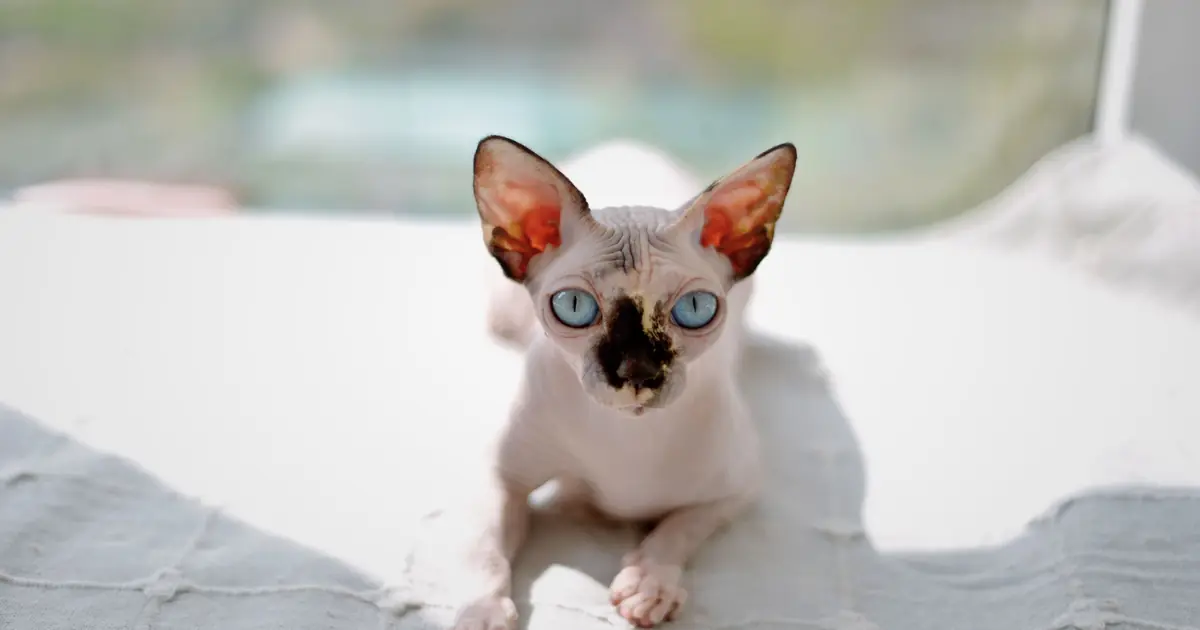
Picture a Sphynx cat perched on the back of the couch, wrinkled face tilted, giving you that unmistakable “why are you not petting me right now” look. Something about that face seems a little different from your average tabby, and it’s not just the missing fur. Look closely and you might notice the whiskers are short, kinked, or barely there at all.
That’s not a grooming accident or a quirky one-off. It’s genetics. The same mutation that strips a Sphynx of its coat also messes with its whiskers, and it happens on purpose, in a manner of speaking, every single time.
- Sphynx cats usually have whiskers, but they’re often short, sparse, curled, or broken off rather than long and straight.
- The Sphynx hairlessness comes from a mutation in the KRT71 gene, and that same gene shapes hair follicles all over the body, whiskers included.
- Some hairless cats, including certain Peterbalds, have no whiskers or eyebrows at all, while others (flock and velour coat types) keep fairly normal ones.
- Whisker follicles hold 100 to 200 nerve endings each, far more than a regular hair follicle, which is why whiskers matter so much for a cat’s sense of space.
- Sphynx cats with reduced whiskers generally adjust fine, though owners sometimes notice slightly clumsier navigation in the dark or around tight gaps.
Do Hairless Cats Have Whiskers?
Yes, most hairless cats have whiskers, but they rarely look like the long, elegant whiskers you’d see on a Maine Coon or a domestic shorthair. On a Sphynx cat, whiskers tend to be short, thin, curly, or snapped off partway, and some cats grow in with almost none at all. A few Sphynx kittens are born with whiskers that look nearly normal at first and then break or fall out within a few weeks.
It’s a spectrum, not an all-or-nothing trait. You’ll meet Sphynx cats with a decent fringe of stubby, corkscrew whiskers, and you’ll meet Sphynx cats that look completely bare-faced. Both are perfectly normal for the breed.
Why Do Hairless Cats Have Fewer or Curlier Whiskers?
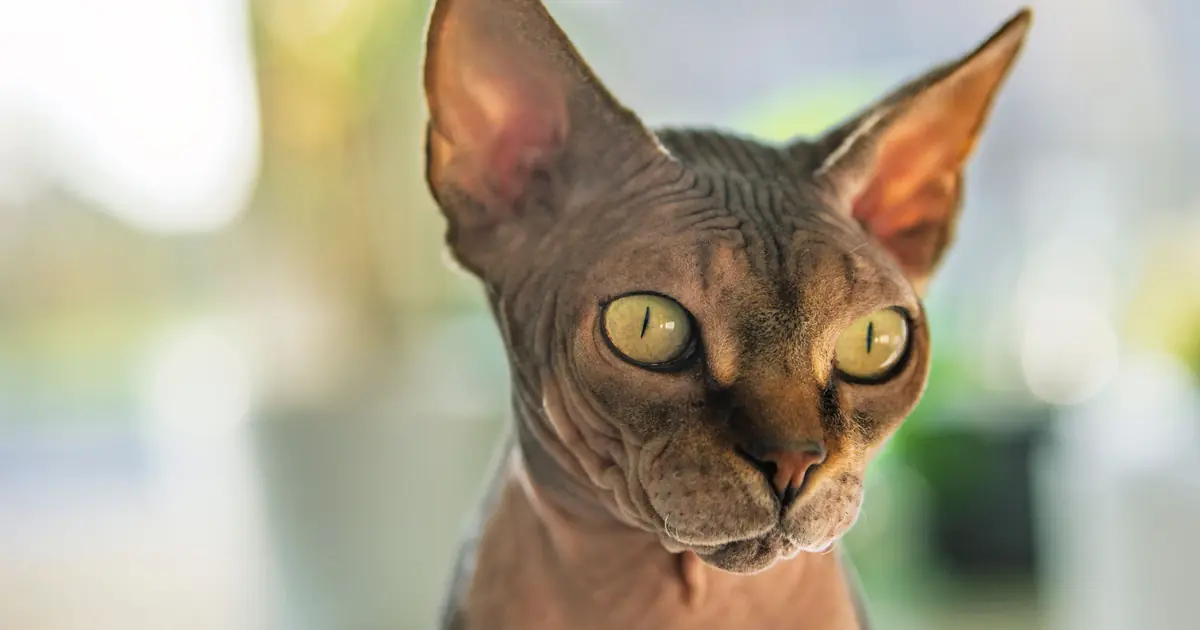
Hairless cats have fewer or curlier whiskers because the mutation responsible for their hairlessness affects keratin, the structural protein that builds both hair and whiskers. In Sphynx cats specifically, researchers have traced the trait to mutations in the KRT71 gene, which codes for keratin 71 and shapes how hair follicles form (study published in PLOS Genetics). That gene doesn’t just switch off body fur. It also weakens and curls whatever comes out of the whisker follicles.
Think of it like a manufacturing defect that hits every product on the same line. Fur, whiskers, and eyebrows all come out of similar follicle machinery, so when the gene that builds that machinery is mutated, all three get affected together. That’s why a hairless cat’s eyebrows are often as sparse as its whiskers.
Which Hairless Cat Breeds Have Reduced Whiskers?
Several hairless cat breeds show this same whisker pattern, though the degree varies by breed and even by individual cat. Here’s how the main ones compare.
- Sphynx: The best-known hairless breed. Whiskers are usually short, sparse, and curled, sometimes absent entirely.
- Peterbald: A Russian breed with several coat types. The fully bald Peterbald often has no whiskers or eyebrows at all, while the “flock” and “velour” coat variations usually keep whiskers and eyebrows that look closer to normal.
- Donskoy (Don Sphynx): Also from Russia, and genetically distinct from the Sphynx despite the similar look. Whiskers are typically short and sparse, similar to the Sphynx pattern.
- Bambino: A Sphynx and Munchkin mix with the same short legs as a Munchkin. Because it carries the Sphynx hairlessness gene, its whiskers follow the same short, curly, sparse pattern.
If you’re weighing a hairless breed against a fluffier one for allergy reasons, it’s worth knowing that hairlessness doesn’t actually mean allergen-free. Check out our guide on which cat breeds run lower on allergens before you decide.
What Do Whiskers Actually Do, and Why Does It Matter If a Cat Has Fewer?
Whiskers work as sensory antennae, letting a cat read the width of a gap, the location of nearby objects, and subtle air currents without needing to see or touch anything directly. Cats use them to judge whether their body will fit through a space, to track prey in low light, and to protect their eyes (a touch to the whisker triggers an automatic blink). According to VCA Animal Hospitals, each whisker follicle is packed with 100 to 200 nerve endings, compared to just 2 or 3 in a regular hair follicle, making whiskers roughly as sensitive as a human fingertip.
So when a Sphynx has noticeably fewer or shorter whiskers, it’s losing a chunk of that built-in radar. Not all of it though. Cats also read a room with their eyes, ears, paw pads, and that ever-twitchy tail, so whiskers are one sensor among several rather than the whole system.
Do Sphynx Cats Struggle Without Full Whiskers?
Most Sphynx cats adapt just fine to reduced whiskers and live completely normal, confident lives. Even so, some owners do notice their Sphynx being a touch more hesitant in unfamiliar dark spaces, or occasionally misjudging a tight squeeze between furniture. It’s a minor adjustment, not a disability.
Cats are wired to compensate. A Sphynx leans a little harder on vision, hearing, and memory of its home layout to make up the difference. If you’ve ever watched one confidently launch off a cat tree in a dim room, you already know reduced whiskers aren’t slowing them down much.
How Should You Care for a Sphynx’s Whiskers and Skin?
The single most important rule is simple: never trim a cat’s whiskers, hairless or not. Whiskers that break off naturally from the breed’s genetics are one thing, but deliberately cutting them removes a working sensory tool and can leave a cat disoriented for weeks while they regrow. If you’re curious how that regrowth timeline works, our article on whether cat whiskers grow back breaks down the specifics.
Whisker care for a Sphynx is honestly the easy part. Skin is where the real attention goes. Without fur to act as a natural barrier, hairless cats are exposed to sun, cold, and skin oil buildup in a way coated cats aren’t.
- Keep sun exposure short and indirect, since bare skin can burn or, over time, raise the risk of skin cancer.
- Bathe a Sphynx every week or two to manage natural oil buildup on the skin (coated cats use fur to spread and absorb those oils; hairless cats can’t).
- Keep your Sphynx warm with sweaters or heated beds in cooler weather, since they lose body heat faster without insulation.
- Check skin folds regularly for buildup or irritation, especially around the ears, paws, and tail base.
This article is educational and not a substitute for veterinary care. If you notice skin redness, sores, scabbing, or your cat seems to be in pain, get them checked out by a licensed veterinarian.
Do Hairless Cats Have the Other Types of Whiskers Too?
Cats have whiskers in four main spots, not just the obvious ones on the muzzle, and hairless breeds are typically thinner in all four locations. Here’s how a Sphynx compares to a fully coated cat, spot by spot.
| Whisker Type | Present in Sphynx? | Notes |
|---|---|---|
| Muzzle (mystacial) | Usually, but reduced | The main whisker rows beside the nose; short, curly, or broken in most Sphynx cats. |
| Eyebrow (superciliary) | Often sparse or absent | These sit above the eyes and help trigger the protective blink reflex; frequently missing on a Sphynx. |
| Cheek (genal) | Sometimes present, sparse | Small scattered whiskers along the cheeks; less studied but generally follows the same reduced pattern. |
| Wrist (carpal) | Usually present, may be finer | Located on the back of the front legs, these help a cat sense prey movement and footing; not fur-dependent so they’re less affected. |
Curious about that last row? Cats have whiskers on their legs too, and it’s a detail most people never notice. We cover it in more detail in our piece on whiskers on a cat’s legs, and if you’re on a roll learning about feline facial features, our guide to whether cats have eyelashes is a fun follow-up read.
Do Hairless Cats Shed Their Whiskers Like Other Cats Do?
Yes, hairless cats shed and regrow whiskers the same natural way any cat does, whether their whiskers are full-length or short and curly. A whisker that falls out on its own is simply making room for a new one, and that’s completely normal. Hairless cats just tend to have visibly fewer whiskers to begin with, so losing even one or two can look more noticeable than it would on a fluffier cat. Our article on whether cats shed their whiskers walks through what’s normal shedding versus what’s worth mentioning to your vet.
Frequently Asked Questions
Q: Do all Sphynx cats have missing whiskers?
No, not all Sphynx cats lack whiskers entirely. Most have some whiskers, but they’re commonly short, curled, or brittle rather than fully absent, and the amount varies quite a bit from cat to cat.
Q: Why do Sphynx cats have curly whiskers instead of straight ones?
Sphynx cats have curly whiskers because the KRT71 gene mutation behind their hairlessness also weakens the keratin structure inside each whisker, causing it to curl, kink, or break rather than grow straight and stiff.
Q: Can a hairless cat function normally without full whiskers?
Yes, most hairless cats function normally day to day. They lean more on eyesight, hearing, and spatial memory to compensate, and while some owners notice slightly clumsier movement in dark or tight spaces, it doesn’t stop them from living an active, confident life.
Q: Is it safe to trim a Sphynx cat’s whiskers?
No, you should never trim a cat’s whiskers, including a Sphynx’s. Whiskers are working sensory organs connected to hundreds of nerve endings, and cutting them can disorient a cat and affect its balance and spatial awareness until they regrow.
Q: Do Peterbald cats have whiskers?
It depends on the coat type. Fully bald Peterbalds often have no whiskers or eyebrows at all, while Peterbalds with a flock or velour coat usually keep whiskers and eyebrows that look close to normal length.
Q: Do hairless cats have eyebrows?
Many hairless cats have sparse or absent eyebrow whiskers, since the same gene mutation that reduces body hair and muzzle whiskers also affects the whiskers above the eyes. Some Sphynx cats have a faint fringe, others have none at all.
Q: Does having fewer whiskers make a Sphynx cat more prone to whisker fatigue?
Not particularly. Whisker fatigue is thought to come from whiskers getting overstimulated, often from crowded food or water bowls, and it isn’t linked to whisker length or count. Any cat, hairless or coated, can be sensitive to it.
Q: Are a hairless cat’s whiskers a sign of poor health?
No, sparse or curly whiskers on a Sphynx or other hairless breed are a normal genetic trait, not a health problem. Sudden new whisker loss on an otherwise coated cat, though, is worth mentioning to your vet since that can occasionally signal a skin or nutritional issue.

Hello and welcome to The Ideal Cat!
We are some passionate cat owners from different professions. We love our cats and have a lot of experience in how to care for our pets. We are incredibly excited to share our knowledge, experience, and research with you. So you can take good care of your loving cat. We will answer most of the common questions about owning cats, taking care of them, etc. If you have any question contact with us. Thanks for visiting! Enjoy the content.
