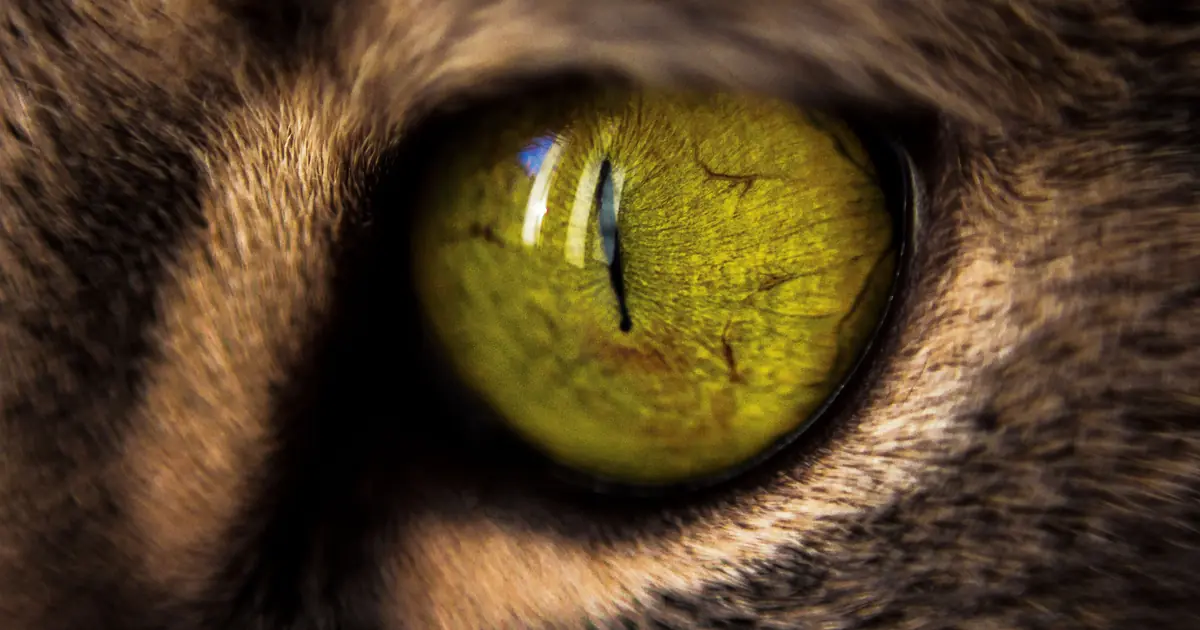
Ever gotten close enough to your cat’s face to really look at their eyes? Maybe you were checking for gunk in the corner, or just having one of those quiet staring contests cats seem to love winning. Either way, you probably noticed something: no lashes. No little fringe framing those big, glassy eyes.
So what’s going on there? Did evolution just skip cats when handing out eyelashes, or is there something else doing the job? Turns out cats have their own system for keeping their eyes safe, and it is honestly pretty clever once you know what to look for.
- Cats do not grow true eyelashes the way humans do; a defined lash row is not a normal part of feline eye anatomy.
- Whiskers above a cat’s eyes, called superciliary whiskers, act as a substitute, sensing objects near the face and triggering a fast blink to protect the eye.
- Cats have a third eyelid, also called a nictitating membrane or “haw,” that sweeps across the eye to clean and protect it.
- Some long-haired breeds, like Persians and Maine Coons, can have longer facial hairs near the eyes that look lash-like but are not true eyelashes.
- Eyelash-related problems such as distichiasis and ectopic cilia are rare in cats but can cause squinting, redness, or discharge and are worth a vet visit.
Do Cats Have Eyelashes?
No, not in any meaningful sense. Cats do not have a true row of eyelashes lining their eyelids the way humans, horses, and even some dogs do. If you have ever tried to spot a cat’s eyelashes and come up empty, you were not missing anything. There is nothing there to find.
What cats have instead is a thin fringe of very fine, short hairs along the eyelid margin in some individuals, but these are not organized into the thick, curved lash line you see in humans. They do not serve the same brushing-away-debris function either. For that job, cats rely on a completely different set of tools built into their face.
What Do Cats Have Instead of Eyelashes?
Cats use specialized whiskers above their eyes, called superciliary whiskers, to do the work human eyelashes do. These stiff, sensitive hairs sit just above each eye and act like an early warning system. The moment something brushes against them, a dust speck, a blade of grass, a curious kitten sibling’s paw, they send a signal straight to the brain that triggers an automatic blink.
This reflex happens before the object ever reaches the actual eyeball. It is fast, it is involuntary, and it is remarkably effective. If you want to see the whole whisker system in action, including the ones on the cheeks, chin, and even the backs of the front legs, whiskers regrow after being trimmed or lost, so a cat that loses a few in a scuffle is not left unprotected for long.
According to VCA Animal Hospitals, whisker follicles are packed with nerve endings and blood vessels, making them roughly as sensitive as a human fingertip. That sensitivity is exactly what makes them such a good stand-in for eyelashes.
What Is a Cat’s Third Eyelid?
A cat’s third eyelid is a thin, pale membrane tucked in the inner corner of the eye, and it sweeps sideways across the eyeball to clean and protect it. Vets also call it the nictitating membrane, or simply the “haw.” Humans do not have a working version of this structure, but it is standard equipment in cats.
The third eyelid spreads tears evenly across the eye, clears away debris, and can partially close over the eye during a scuffle with another animal for extra protection. In a healthy cat, you barely notice it, since it usually stays tucked out of sight. The Cornell Feline Health Center notes that a third eyelid that stays visible or protrudes across the eye can be a sign of illness, pain, or dehydration, which is one reason vets check it during routine exams.
How Do Cats Protect Their Eyes Without Lashes?
Cats protect their eyes with a three-part system: the superciliary whiskers that trigger a blink before contact, the third eyelid that shields and cleans the surface, and frequent grooming that keeps the fur around the eyes free of debris. Together, these do the job a lash line does for us, arguably better.
Grooming plays a bigger role here than people expect. Cats cannot lick their own eyes directly (their tongues are covered in backward-facing spines called papillae, and a cat’s tongue is rough enough to work like a hairbrush, which is great for fur but far too abrasive for delicate eye tissue). Instead, a cat licks a paw and wipes it carefully around the eye area, picking up dust and sleep crust without ever touching the eyeball itself.
Then there is blinking itself. You may have noticed your cat giving you a slow, deliberate blink from across the room. That is not random. A slow blink is one of the ways cats show trust and affection, and it uses the same eyelid muscles that snap shut fast when a whisker senses danger.
Do Some Cats Look Like They Have Eyelashes?
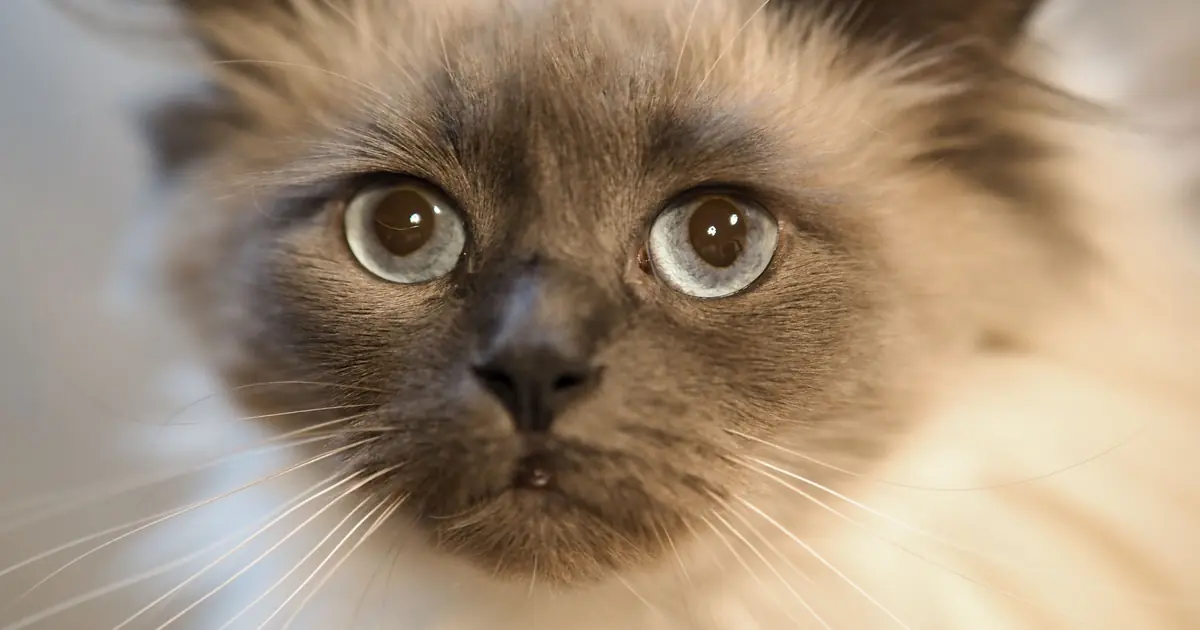
Yes, some long-haired cats can appear to have lash-like hairs, but this is a coat effect, not true eyelashes. Breeds like Persians, Himalayans, and Maine Coons grow longer, denser fur all over the face, including near the eyelid margin, and a few stray hairs there can catch the light and look like a lash line in photos.
Don’t be fooled, though. Run a finger gently near a Persian‘s eye and you will feel scattered facial fur, not a structured row of lashes growing from the lid itself. It is the same reason a fluffy dog breed can look like it has “eyebrows.” The illusion comes from coat length and grooming, not a different eyelid anatomy. Long-haired cats do need extra attention around the eyes, since their facial fur is more likely to trap tears and cause staining, which is a grooming issue rather than a true eyelash issue.
What’s the Difference Between Human Eyelashes and a Cat’s Eye Protection?
Here’s a side-by-side look at how a cat’s eye protection compares to what humans rely on.
| Eye Feature | Present in Cats? | What It Does |
|---|---|---|
| True eyelashes (human-style) | No, not as a defined lash row | Filters dust and debris, provides a light touch sensor near the eye in humans |
| Superciliary whiskers (above the eye) | Yes | Detects objects near the face and triggers a fast protective blink |
| Third eyelid (nictitating membrane) | Yes | Spreads tears, clears debris, shields the eye during rough play or fights |
Can Cats Get Eyelash Problems Like Distichiasis?
Yes, but it is uncommon. Cats can occasionally develop distichiasis (extra hairs sprouting from an abnormal spot on the eyelid) or ectopic cilia (hairs growing through the inside of the eyelid where they should not be). Both conditions let hair rub directly against the cornea or conjunctiva, and both are far more common in dogs than in cats.
When these do show up in cats, the misplaced hairs act like a constant irritant, similar to an eyelash that fell the wrong way and never left. Signs include squinting, excess tearing, redness, or a cat pawing repeatedly at one eye. PetMD explains that treatment can range from lubricating drops to surgical removal of the follicle, depending on how much discomfort the cat is in.
When Should You Worry About Your Cat’s Eyes?
Squinting, discharge, pawing at an eye, or a third eyelid that stays visible instead of tucking away are all signs worth a vet visit, not something to wait out. These symptoms can point to anything from mild irritation to an infection or an eye injury that needs prompt care.
Clear, watery discharge after a sneeze is usually nothing. But thick, colored, or crusty eye boogers can signal an infection that needs treatment. And if your cat suddenly won’t open one eye all the way, do not wait to see if it clears up on its own; a scratched cornea or foreign object can get worse fast without care. This article is educational and not a substitute for a veterinary exam. International Cat Care recommends a quick weekly at-home check of your cat’s eyes for clarity, symmetry, and any change in the color of the iris, which by the way, cat eye color itself can range widely from copper to green to blue depending on breed and genetics.
Frequently Asked Questions
Q: Do cats have eyelashes at all?
Not in any real sense. Cats lack the defined row of eyelashes humans have. A few very fine hairs may sit along the eyelid margin, but they do not form a true lash line and are not standard feline anatomy.
Q: What protects a cat’s eyes if they don’t have eyelashes?
Superciliary whiskers above the eyes and the third eyelid do the job. The whiskers detect anything close to the face and trigger an instant blink, while the third eyelid sweeps across the eye to clean and shield it.
Q: What is a cat’s third eyelid called?
It is called the nictitating membrane, or “haw.” This pale, thin membrane sits in the inner corner of the eye and normally stays tucked out of view in a healthy cat.
Q: Do long-haired cats like Persians or Maine Coons have eyelashes?
They can appear to, but it is a coat illusion. Long-haired breeds grow denser facial fur that can catch the light near the eyelid, mimicking lashes, without actually being a structured row of eyelashes.
Q: What are the whiskers above a cat’s eyes for?
Those are superciliary whiskers, and they sense objects approaching the face before they reach the eye. They trigger a fast, involuntary blink, functioning as the closest thing a cat has to eyelashes.
Q: Can cats get ingrown or misplaced eyelashes?
Rarely, yes. Conditions called distichiasis and ectopic cilia cause hairs to grow from the wrong spot on or inside the eyelid, irritating the cornea. These are much more common in dogs but do occasionally occur in cats.
Q: Why do cats blink less often than humans?
Cats rely more on their whisker-triggered blink reflex for protection than on constant, routine blinking. A slow, deliberate blink aimed at a person is a different behavior entirely, often a sign of trust and calm.
Q: When should I take my cat to the vet for an eye problem?
See a vet if your cat is squinting, pawing at an eye, has colored or crusty discharge, or shows a third eyelid that will not tuck away. These can signal infection, injury, or irritation that needs treatment.

Hello and welcome to The Ideal Cat!
We are some passionate cat owners from different professions. We love our cats and have a lot of experience in how to care for our pets. We are incredibly excited to share our knowledge, experience, and research with you. So you can take good care of your loving cat. We will answer most of the common questions about owning cats, taking care of them, etc. If you have any question contact with us. Thanks for visiting! Enjoy the content.
