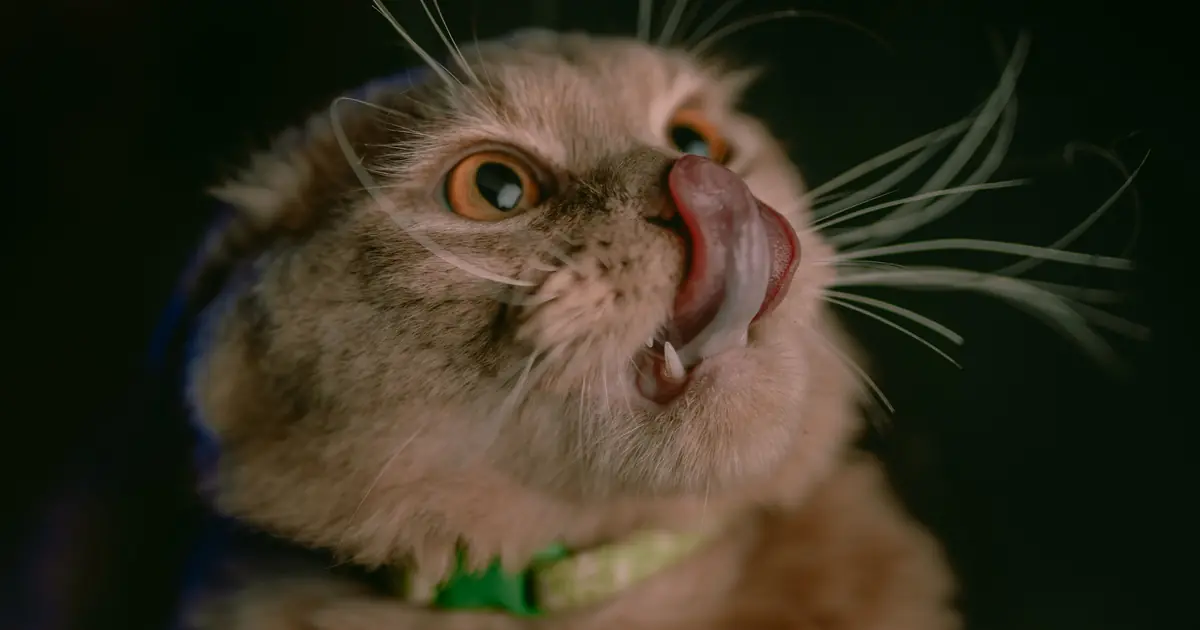
You lean in for a sweet head-boop and your cat licks your hand instead. And it feels like you just ran your knuckles across a strip of Velcro. If you’ve ever yanked your arm back mid-lick wondering what on earth is going on in that mouth, you’re not alone.
Here’s the thing: that scratchy texture isn’t random. It’s a piece of finely tuned biological hardware that your cat uses dozens of times a day, and once you know what’s actually happening on the surface of that tongue, the sandpaper feeling makes a lot more sense.
- A cat’s tongue is rough because of hundreds of hook-shaped spines called filiform papillae, made of keratin, the same protein that forms claws and fingernails.
- A 2018 Georgia Tech study published in PNAS found that each papilla is actually scoop-shaped and hollow, not solid, and wicks saliva down through the fur toward the skin using capillary action.
- Cats spend roughly 30 to 50 percent of their waking hours grooming, according to Cornell Feline Health Center, and the rough tongue is the main tool doing that work.
- Filiform papillae don’t taste anything. Taste happens through a separate, much smaller set of papillae located mostly on the sides and back of the tongue.
- A cat who just forgets to put her tongue away is doing something else entirely, a habit known as the blep. A sudden change in tongue texture, color, or the appearance of sores is a reason to call a vet, not something to wait out.
Why Are Cats’ Tongues So Rough?
A cat’s tongue is rough because its surface is packed with hundreds of tiny, hook-shaped spines that all point backward, toward the throat. Run your finger over one and it feels almost like a strip of hook-side Velcro, because that’s essentially what it is doing to loose fur and stray hairs. Dogs, for comparison, have smooth, mostly flat tongues built for lapping water and panting, not scrubbing a coat clean. Cats got the scrubber version, and it shows every time they groom.
What Are Filiform Papillae?
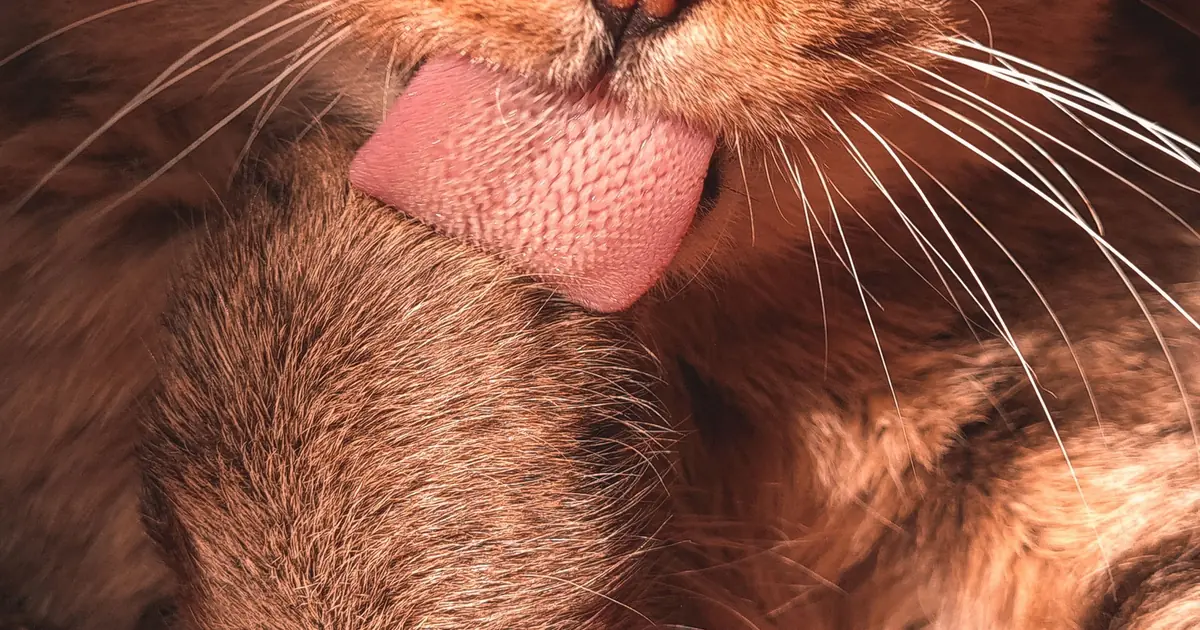
Filiform papillae are the small, cone-shaped structures covering the top and sides of a cat’s tongue that give it that gritty texture. The word “filiform” means thread-like, which fits how they look up close: slender, curved, and packed in tight rows. Unlike the papillae on your own tongue, filiform papillae carry no taste buds at all. They’re purely mechanical, more like a built-in hairbrush than a sensory organ. A cat’s actual taste buds sit on a much smaller set of papillae toward the back and sides of the tongue (and cats can’t taste sweetness at all, thanks to a nonfunctional sweet-taste gene).
What Are Cat Tongue Spines Made Of?
Cat tongue spines are made of keratin, the same tough, fibrous protein that makes up a cat’s claws, a human’s fingernails, and hair itself. Keratin is hard-wearing and slightly flexible, which is exactly what’s needed for a structure that gets dragged across fur, skin, and bone hundreds of times a day without wearing down. It’s also why the spines feel so unmistakably scratchy rather than soft. You’re not imagining the texture: you’re literally feeling keratin hooks brushing against your skin.
What Does a Cat’s Rough Tongue Actually Do?
A cat’s rough tongue does four main jobs: it grooms the coat, helps regulate body temperature, strips meat from bone, and assists with drinking. Each job relies on the same hook-shaped papillae doing something slightly different depending on the task at hand.
For years, scientists assumed those papillae were solid little cones, basically tiny combs. Then, in 2018, researchers Alexis Noel and David Hu at Georgia Tech used CT scans and high-speed video to look closer, and found something nobody expected: each papilla is actually U-shaped and hollow, like a tiny scoop. The study, published in the Proceedings of the National Academy of Sciences, showed these scoops pull saliva out of the mouth and wick it deep into the fur through capillary action, essentially delivering a tiny drop of cleaning fluid with every single lick. That’s a big part of why a cat bath from its own tongue reaches all the way down to the skin, not just the surface of the coat.
| Job | What the Rough Tongue Does |
|---|---|
| Grooming | Papillae hook onto loose fur and dead hair, pulling it free and distributing saliva down to the skin for a deep clean. |
| Cooling | Saliva wicked into the fur evaporates off the coat, helping a cat cool down since cats don’t sweat the way humans do. |
| Eating | The backward-facing hooks act like a rasp, scraping every last bit of meat off bones the way a wild cat would strip a carcass. |
| Drinking | The tongue’s tip curls and flicks water upward faster than gravity can pull it back down, drawing a thin column of liquid into the mouth. |
That grooming function is also why cats swallow so much loose hair. As the papillae rasp through the coat, that stray fur gets carried straight to the back of the throat and down, which is exactly how hairballs get their start. Long-haired cats and heavy shedders are especially prone to this, and if you notice your cat gagging or struggling to bring one up, it’s worth knowing whether a hairball can actually become dangerous.
Why Does a Cat’s Lick Sometimes Actually Hurt?
A cat’s lick can hurt because those keratin hooks are dragging across your skin the same way they’d drag through fur, and human skin doesn’t have a protective coat to buffer the scrape. One or two licks usually just feels rough. A long, enthusiastic grooming session on the same patch of skin, though, can genuinely leave a red mark or a mild scrape, especially on thin skin like the back of your hand or your wrist. It’s not aggression. Most cats who lick people are showing affection, marking you as part of their social group, or just grooming you the way they’d groom a housemate cat. If your cat is licking you a lot more than usual, it’s worth reading up on why cats lick their humans in the first place, since the reasons range from bonding to stress to plain old habit.
Do All Cats, Including Big Cats, Have Rough Tongues?
Yes, every cat species has some version of the rough, spiny tongue, from a housecat to a tiger. The Georgia Tech researchers actually examined tongues across six cat species, from domestic cats up through bobcats, cougars, snow leopards, and lions, and found the same hollow, hook-shaped papillae design in every one, just scaled up with the animal’s size. It’s an ancient feature that’s stuck around across the entire cat family because it works. Kittens are born with the same papillae structure as adult cats, though the tongue (like the rest of the kitten) is smaller and the texture can feel a little less intense at first.
When Do Tongue Changes Signal a Health Problem?
A cat’s tongue should look pink, feel roughly textured across the top, and stay free of sores, swelling, or discoloration. Any change from that baseline is worth paying attention to. A pale or white tongue can point to anemia, blood loss, or shock. A blue or purple tinge (called cyanosis) means the body isn’t getting enough oxygen and needs emergency care right away. A yellowish tongue can signal jaundice and a possible liver problem. Sores or ulcers on the tongue are commonly linked to dental disease, feline calicivirus, or kidney disease, according to PetMD’s overview of feline mouth ulcers, and the Merck Veterinary Manual notes that mouth pain in cats often shows up as drooling, bad breath, or reluctance to eat before an owner ever spots the sore itself.
This article is for general education and isn’t a substitute for a vet visit. If you notice a blue, purple, or unusually pale tongue, treat it as an emergency and get to a vet immediately. Sores, unexplained bleeding, or a cat that suddenly stops grooming and stops eating also deserve a same-day call to your vet.
Grooming trouble isn’t always about the tongue itself, either. If your cat is licking one spot bald or seems to be grooming compulsively, that’s a different pattern worth understanding, and if you’re noticing flaky skin along with the excess licking, a look at what causes cat dandruff can help you figure out whether it’s a skin issue driving the behavior. Mats are another common side effect of grooming problems: a cat that’s grooming too little (often from pain or arthritis) or too much in one area can end up with matted fur that a rough tongue alone can’t fix.
Frequently Asked Questions
Q: Why does my cat’s tongue feel like Velcro?
Your cat’s tongue feels like Velcro because it’s covered in hundreds of small, backward-curving keratin spines called filiform papillae. They hook onto surfaces the same way Velcro hooks catch onto loops, which is exactly what makes the texture so scratchy.
Q: Can a cat’s rough tongue actually hurt me?
Yes, a long or vigorous licking session can leave a mild scrape or red mark on thin skin, since human skin has no fur coat to protect it. A quick lick or two is usually just uncomfortable, not harmful.
Q: Do kittens have rough tongues too?
Yes, kittens are born with the same hook-shaped papillae structure as adult cats. The tongue is simply smaller, so the roughness can feel a little less intense during a kitten’s early weeks.
Q: Do all cat species have rough tongues, even lions and tigers?
Yes, a 2018 Georgia Tech study examined tongues from six cat species, including bobcats, cougars, snow leopards, and lions, and found the same hollow, scoop-shaped papillae in every one, just larger to match the animal’s size.
Q: Why is my cat’s tongue rougher than my dog’s tongue?
A cat’s tongue is rougher than a dog’s because cats evolved as solitary, self-grooming hunters that need a built-in tool to clean fur and strip meat off bone. Dogs rely far less on self-grooming and their tongues are smooth, built mainly for lapping water and panting to cool off.
Q: What color should a healthy cat’s tongue be?
A healthy cat’s tongue is typically pink. A pale or white tongue can signal anemia or shock, a blue or purple tongue is a medical emergency pointing to oxygen deprivation, and a yellow tinge can suggest jaundice, so any of these warrant a prompt vet visit.
Q: Does my cat’s rough tongue mean it can taste better than mine?
No, the rough surface of a cat’s tongue has nothing to do with taste. Filiform papillae carry no taste buds at all; a cat’s actual taste buds sit on a smaller set of papillae elsewhere on the tongue, and cats can’t taste sweetness at all due to a nonfunctional taste gene.
Q: Why does my cat swallow so much hair when grooming?
A cat swallows loose hair during grooming because the backward-facing papillae rasp through the coat and carry dead hair straight to the back of the throat. Cornell Feline Health Center notes cats spend 30 to 50 percent of their waking hours grooming, which adds up to a lot of swallowed fur and is the main cause of hairballs.

Hello and welcome to The Ideal Cat!
We are some passionate cat owners from different professions. We love our cats and have a lot of experience in how to care for our pets. We are incredibly excited to share our knowledge, experience, and research with you. So you can take good care of your loving cat. We will answer most of the common questions about owning cats, taking care of them, etc. If you have any question contact with us. Thanks for visiting! Enjoy the content.
