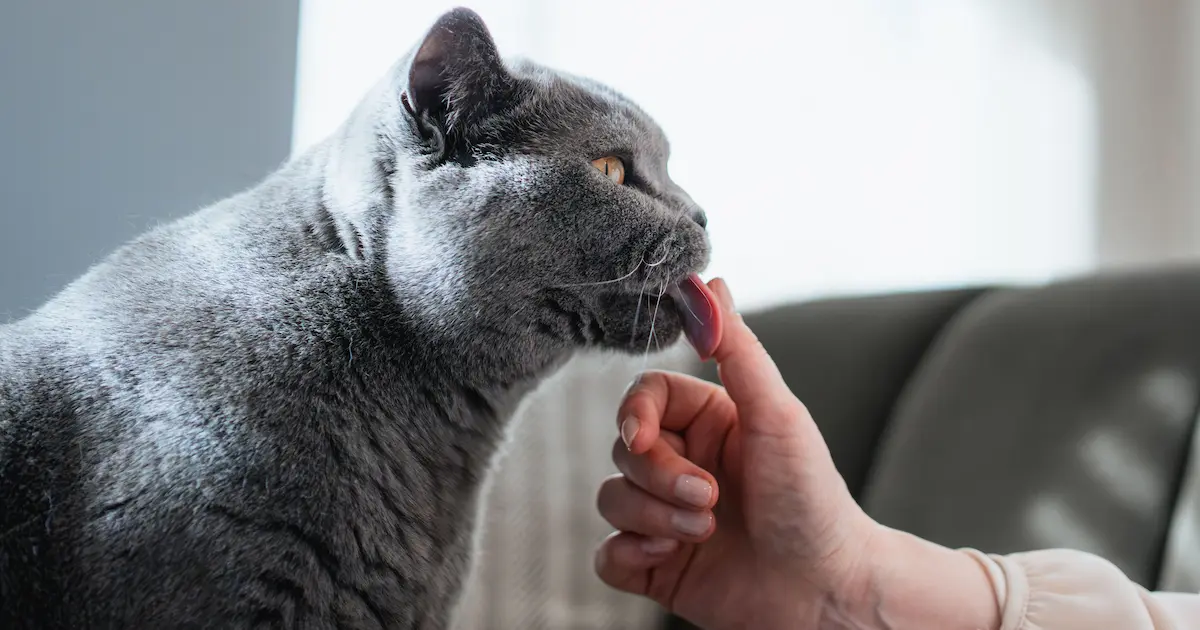
You’re relaxing on the couch, your cat curls up close, and then comes that rough little tongue dragging across your hand. Sweet, slightly weird, and a tiny bit scratchy. If you’ve ever wondered what’s going on in that fuzzy head, you’re in good company.
The good news is that most cat licking is a love language. Here’s exactly what your cat is telling you, when to relax about it, and the few times it’s worth a closer look.
Is it normal for my cat to lick me?
Yes. Licking a person is normal, friendly cat behavior, and for most cats it is the same grooming they would give a cat they trust. Grooming is a big part of a cat’s day: a 2018 Georgia Tech study in PNAS notes that house cats can spend up to 24 percent of their waking time on it. Licking only becomes a worry when it is sudden, frantic, or comes with other changes like hiding, vomiting, or bald patches on your cat’s own coat.
Why does my cat lick me? The 7 most common reasons
Cats lick you for a handful of clear reasons: affection and bonding, scent-marking you as family, the taste of your skin, attention-seeking, comfort and stress relief, leftover kitten grooming instinct, and occasionally a medical issue. Most of these are warm, friendly signals. Here’s the quick version, then the details.
| Reason your cat licks you | What it looks like | What to do |
|---|---|---|
| Affection and bonding (allogrooming) | Slow, rhythmic licks during a calm cuddle, often with purring or slow blinks | Enjoy it. Nothing needs fixing. |
| Scent-marking | Licks mixed with head-bonks and cheek rubs, often when you get home | Nothing to fix. It means you belong. |
| Taste | Focused licking right after you exercise, cook, or put on lotion | Wash off medicated creams first. Some, like pain-relief gels, are toxic to cats. |
| Attention-seeking | Licks when you are busy, often followed by a meow or a stare | Give attention when your cat is calm, not as a reward for licking. |
| Comfort and stress relief | More licking during change: a move, a new pet, visitors | Keep routines steady and add daily play. |
| Maternal grooming instinct | Firm, repeated licks on your hair or hands | Harmless. Redirect if it gets too rough. |
| A medical issue | Sudden, frantic licking plus hiding, vomiting, drooling, or bald patches | Book a vet visit, and call the same day if your cat stops eating. |
1. Affection and bonding (allogrooming)
The number one reason cats lick people is affection. Cats in the same social group groom each other in a behavior called allogrooming, and it’s how they build and keep close bonds. When your cat licks you, they’re treating you like one of their own and saying you’re trusted family.
2. Marking you with their scent
Cats lick you to share scent and claim you as part of their group. Transferring saliva makes you smell familiar, so with one quick sniff your cat can tell you belong to their social circle. It’s a quiet little “you’re mine” that sits alongside the head-bonks and cheek rubs.
3. The taste of your skin
Sometimes a cat licks you simply because you taste good to them. Sweat leaves salt on your skin, and so do lotions, food crumbs, and the oils your body makes naturally. If your cat zeroes in right after you’ve worked out or cooked, taste is the likely draw.
4. Attention-seeking
Cats lick to get a reaction, and you probably trained this without realizing it. The first time your cat licked you, you likely talked to them, petted them, or laughed. Your cat filed that away. Now the lick is a request: notice me, pet me, play with me.
5. Comfort and stress relief
Licking calms cats down because it releases endorphins, the brain’s feel-good chemicals. A cat that licks you while purring and kneading is usually settling in and feeling safe. A cat that licks a lot when something’s off (a new pet, a move, a noisy house) may be self-soothing through stress.
6. Maternal grooming instinct
Your cat may lick you because grooming is wired in from kittenhood. Mother cats lick their kittens to clean and comfort them, and adult cats carry that instinct forward. So when your cat gives you a few firm licks, part of them is treating you like a kitten that needs tidying up. Try not to take it personally.
7. A medical reason
Once in a while, licking is a health signal rather than a love note. Nausea, pain, dental discomfort, skin irritation, or anxiety can all push a cat to lick more than usual, including licking you, objects, or their own fur. If the licking is new, intense, or feels out of character, that’s your cue to call the vet.
What does it mean when your cat licks you?
When your cat licks you, it almost always means trust and affection. Licking exposes your cat to a vulnerable moment, since the tongue is a survival tool, so choosing to use it on you is a real sign of comfort. Pair the licking with slow blinks, purring, or kneading and you’ve got a cat that feels safe and bonded to you. In plain terms: yes, it usually means your cat loves you.
Why is my cat’s tongue so rough?
A cat’s tongue feels like sandpaper because it’s covered in tiny, firm, backward-facing spines called papillae, made of keratin, the same material as your fingernails. A domestic cat has about 290 of them. For years they were described as solid cones, but the 2018 Georgia Tech study found each one has a hollow, scoop-shaped tip that soaks up saliva and releases it down at the roots of the fur. They help your cat comb dirt and loose fur out of their coat and spread cooling saliva over it. On your skin, that same texture is what turns a gentle lick into a scratchy little loofah.
Why does my cat lick me then bite me?
A cat that licks you then bites you is usually either over-groomed into a “love bite” or telling you they’ve had enough petting. Cats nip during mutual grooming with other cats, so a soft bite after a lick can be part of that bonding routine. Other times it’s overstimulation, known as petting-induced aggression, where pleasant petting tips over into “too much.” The MSD Veterinary Manual describes these cats as having a low tolerance for contact or being easily overstimulated by it.
Watch your cat’s body before the bite. These signs mean stop now:
- Tail flicking or thumping
- Skin twitching or rippling along the back
- Ears turning back or flattening
- Pupils growing wide
- A sudden still, tense body
A true love bite is slow, soft, and quiet, often during a calm cuddle. An overstimulation bite is faster and sharper. Either way, gently end the session before the nip rather than scolding your cat, who isn’t being naughty.
Why does my cat lick my face, hair, or hands?
Where your cat licks often hints at why. The spot usually comes down to scent, taste, or closeness. Here’s a quick read on the most common targets.
| Where your cat licks | The likely reason |
|---|---|
| Your face | Deep affection and bonding, copying how mother cats clean kittens’ faces. Keep it off the eyes, nose, and mouth for hygiene. |
| Your hair | Grooming instinct plus the smell of shampoo, oils, or product. Your hair is basically fascinating fur to them. |
| Your hands | Taste and scent: salt, food traces, and your personal smell all collect on your hands. |
| Your feet | Strong, novel scents. Harmless curiosity, though heavy foot focus can mean a bored cat that needs play. |
Is it safe to let your cat lick you?
Letting a healthy cat lick your skin is usually fine, but it isn’t risk-free. A cat’s mouth carries a lot of bacteria, including Pasteurella multocida, which can cause infection if it enters broken skin or an open wound. According to the Cornell Feline Health Center, it lives in the mouths of 70 to 90 percent of cats. Acquiring an actual illness from a lick is rare, but a few simple habits keep it that way.
- Don’t let your cat lick cuts, scrapes, or broken skin.
- Keep licking off your face, especially your eyes, nose, and mouth.
- Wash your hands before eating if your cat has licked them.
- Keep your cat current on vet checks, vaccines, and parasite control.
People with weakened immune systems should be extra cautious and generally avoid letting a cat lick their skin at all, since their bodies fight off infection less easily. For everyone else, a few licks from a healthy, well-cared-for cat are part of the deal.
When is cat licking a problem? Signs to see a vet
Licking becomes a concern when it’s sudden, intense, or aimed obsessively at one spot. Occasional grooming-style licking is normal and healthy. Compulsive licking, on the other hand, can point to stress, allergies, pain, nausea, or a skin condition, and your cat can’t tell you which.
Call your veterinarian if you notice any of these:
- Licking that suddenly increases or seems frantic
- Over-grooming that creates bald patches or irritated skin (this can be a stress condition called psychogenic alopecia)
- Licking paired with hiding, appetite changes, or vomiting
- Constant licking of objects, walls, or surfaces
- Signs of pain when touched, or new grumpiness
Routine visit or same day? Book a normal appointment for slow-building over-grooming or a thinning patch of fur. Call the same day if licking comes with repeated vomiting, heavy drooling, a swollen face, or a cat who hasn’t eaten for 24 hours.
Everything here is general education rather than a diagnosis. Your own vet, who can actually examine your cat, gets the final word.
How to get your cat to stop licking you
If the licking has become too much, you can gently redirect it without hurting the bond. The goal is to interrupt calmly and offer something better to do, never to punish.
- Stand or move away calmly the moment the licking starts so it stops earning a reaction.
- Redirect to a toy or play session to burn off energy, especially with a bored or under-stimulated cat.
- Offer a chew or lick-safe enrichment so your cat has its own outlet.
- Reward the quiet moments with attention, so calm behavior gets the petting, not the licking.
- Add daily play and climbing options to cut the boredom that fuels repetitive licking.
If redirecting doesn’t help and the licking feels compulsive, loop in your vet before assuming it’s only a habit.
More questions about cats licking you
Q: Why does my cat lick me when I’m sleeping?
A cat that licks you while you sleep is often grooming, seeking comfort, or trying to wake you for food or attention. The closeness also helps them feel secure. It’s normal, but redirect with play before bed if it’s disrupting your sleep.
Q: Why does my cat lick me and then purr?
Licking followed by purring usually means your cat is content and bonding with you. Both behaviors release feel-good endorphins, so a licking, purring cat is typically relaxed, affectionate, and enjoying your company.
Q: Why does my cat lick me after I pet them?
Licking after petting is your cat returning the grooming, treating you like a fellow cat. It’s a mutual bonding ritual. Just watch for overstimulation signs like a flicking tail, since the lick can sometimes lead to a nip.
Q: Why does my kitten lick me more than my adult cat?
Kittens lick a lot because they’re still wired from being groomed by their mother, and licking comforts them. As cats mature, grooming you tends to settle into a calmer, occasional affection habit.

Hello and welcome to The Ideal Cat!
We are some passionate cat owners from different professions. We love our cats and have a lot of experience in how to care for our pets. We are incredibly excited to share our knowledge, experience, and research with you. So you can take good care of your loving cat. We will answer most of the common questions about owning cats, taking care of them, etc. If you have any question contact with us. Thanks for visiting! Enjoy the content.
)