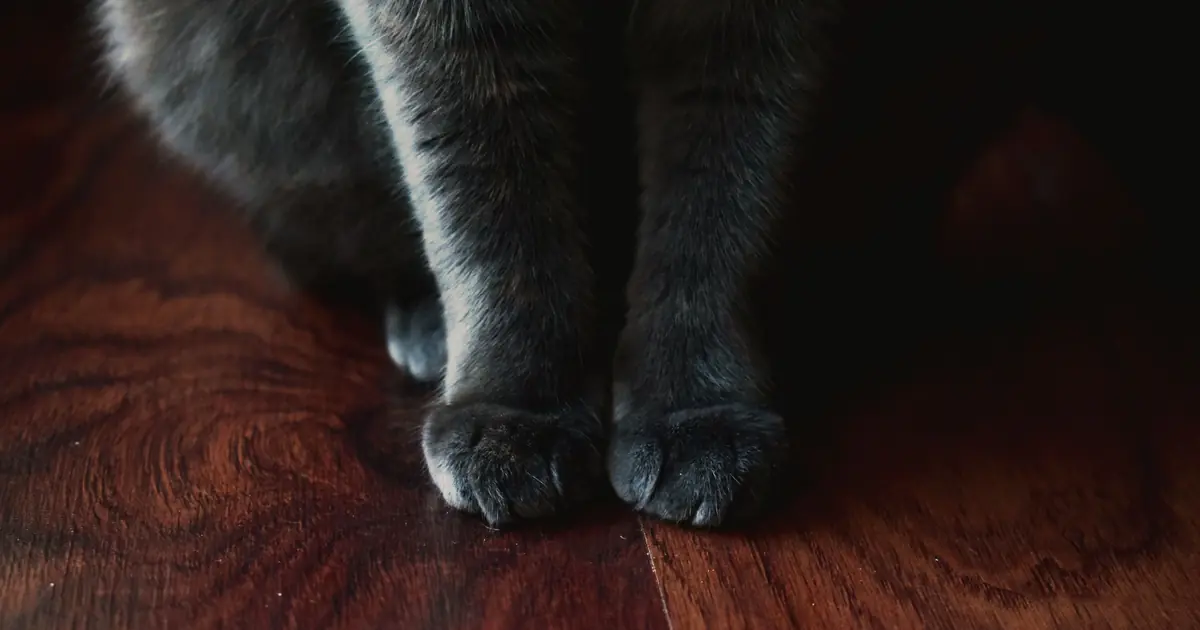
If you’ve ever run your hand down your cat’s front leg and felt a few stiff little hairs poking out near the wrist, you weren’t imagining things. Those aren’t stray hairs that grew in wrong. They’re real, working whiskers, and they’ve been there since your cat was a kitten.
Most cat parents know about the whiskers on the face. Fewer know their cat is carrying a second, smaller set of sensors on the front legs. Here’s what those leg whiskers are, what they do, and why you should never trim them off.
- Cats have whiskers on their front legs called carpal whiskers, located on the back of each leg near the wrist joint (the carpus).
- Carpal whiskers are exclusive to the front legs. Cats do not have whiskers on their back legs.
- These whiskers help a cat feel exactly where prey is positioned in its paws, which matters most in close-up hunting when a cat’s eyes physically can’t focus.
- A cat’s full whisker map includes the muzzle, above the eyes, on the chin and cheeks, and the carpal whiskers on the front legs.
- Whiskers are sensory organs rooted three times deeper than regular fur, so they should never be trimmed or plucked.
Do Cats Really Have Whiskers on Their Legs?
Yes, every cat has a small cluster of whiskers on the back of each front leg. Vets and researchers call these carpal whiskers, named after the carpus, which is the joint that works like a cat’s wrist. If you gently part the fur just behind that joint on a front paw, you’ll find several short, stiff hairs standing apart from the regular coat.
They’re easy to miss because they’re shorter than the whiskers on a cat’s face. But they’re structurally the same kind of hair: thick, deeply rooted, and wired into a dense patch of nerve endings. Your cat has had them since birth, and they’ll stay for life unless something damages the follicle.
Where Exactly Are Carpal Whiskers Located?
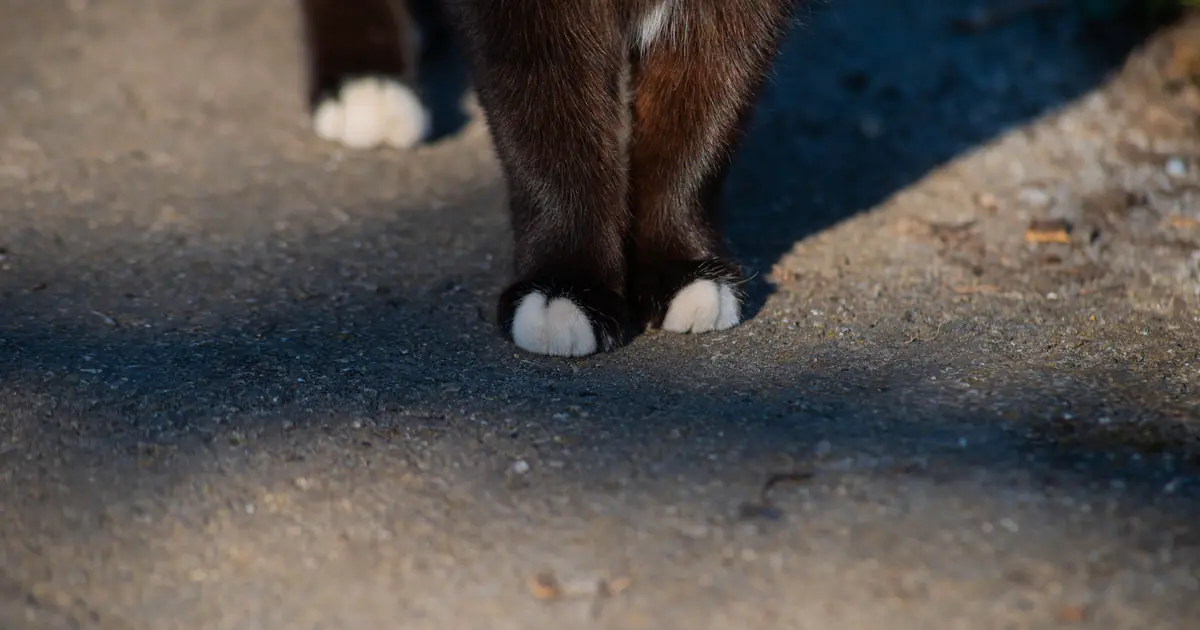
Carpal whiskers sit on the back of the front legs, just above the paw and behind the wrist joint. You won’t find them on the back legs at all. That’s a detail a lot of people get wrong when they picture “leg whiskers”: it’s front legs only, and always in that same wrist-area spot on both sides.
Because they point backward and downward, carpal whiskers are perfectly placed to brush against anything a cat’s paws are holding, gripping, or standing on. Run your fingers along a sleeping cat’s front leg sometime. You’ll feel them before you see them.
What Do Carpal Whiskers Actually Do?
Carpal whiskers give a cat detailed, real-time feedback about anything held in its front paws. When a cat catches a mouse, a toy, or your shoelace, its eyes are often too close to the object to focus properly. Cats are farsighted at short range, so the last few inches of a catch happen almost blind.
That’s where the leg whiskers step in. As prey or an object shifts against a cat’s paws, the carpal whiskers pick up the tiniest movements and relay them straight to the brain. This lets a cat know instantly if what it’s holding is struggling to escape, and adjust its grip without needing to look. It’s a big part of why cats are such efficient close-range hunters, and why the flexibility that lets cats twist and pin prey pairs so well with this kind of paw-level feedback.
Carpal whiskers also help with balance and footing. Cats use them to read subtle changes in surfaces and air currents around their front paws, especially when navigating tight spaces or uneven ground in low light.
What Is the Full Map of a Cat’s Whiskers?
A cat’s whiskers aren’t limited to the face or the legs. They’re spread across several spots on the body, and each cluster does a slightly different job. Most cats have around 12 whiskers on each side of the muzzle, plus smaller sets above the eyes, on the chin, and on the backs of the front legs.
| Whisker Location | What It Does |
|---|---|
| Muzzle (mystacial whiskers) | Measures gaps and openings, senses nearby objects and air currents, guides night navigation |
| Above the eyes (superciliary whiskers) | Triggers a protective blink reflex when something gets too close to the eye |
| Chin (mandibular whiskers) | Adds extra sensory coverage below the face, useful when eating or investigating low objects |
| Front legs (carpal whiskers) | Senses movement and position of prey or objects held in the paws, aids close-range hunting and footing |
Together, this whisker network wraps a cat’s most active body parts (the face and front paws) in a layer of touch sensitivity most other animals simply don’t have.
Why Do Whiskers Matter So Much to a Cat?
Whiskers matter because they’re sensory organs, not decoration. Each one is rooted about three times deeper than an ordinary hair, sitting in a follicle packed with blood vessels and nerve endings, according to VCA Animal Hospitals. When a whisker bends even slightly, it fires signals to the brain the same way a fingertip would after touching something.
This is why you should never cut, trim, or pluck a cat’s whiskers, including the carpal ones on the legs. Whiskers are not like regular fur that grows back overnight and causes no harm if snipped. Cutting them can leave a cat disoriented, hesitant, or clumsy for weeks while it relearns how to judge distance and movement without its normal input, according to International Cat Care. The good news is that whiskers do eventually grow back on their own timeline. If you’re curious how long that takes, we’ve covered it in our guide on whether cat whiskers grow back.
Do All Cats Have Carpal Whiskers?
Yes, carpal whiskers are standard equipment on every cat, regardless of breed, coat length, or age. Kittens are born with them, and they stay in place through adulthood. Even hairless breeds like the Sphynx still grow carpal whiskers, since they’re a different structure from the coat.
The one thing that does vary a little is how noticeable they are. On a longhaired cat, carpal whiskers can hide in the leg fur and take a careful look to spot. On shorthaired cats, they’re usually easy to see at a glance.
What Do Whisker Problems on the Legs Look Like?
A healthy carpal whisker is stiff, straight, and firmly attached at the base. Signs of a problem include a whisker that’s bent, broken close to the skin, missing in a way that leaves a bald or irritated patch, or a leg your cat seems reluctant to let you touch near the wrist. Occasional shedding of a single whisker is normal, since cats do shed and regrow whiskers naturally over time, just like any other hair.
What isn’t normal is redness, swelling, or crusting around the whisker base, or a cat suddenly favoring one front leg. Those can point to an injury, an infection, or in rare cases a skin condition affecting the follicle. This article is educational, not a substitute for veterinary care, so if you notice anything like that, it’s worth a call to your vet rather than waiting it out.
Frequently Asked Questions
Q: Do cats have whiskers on their back legs too?
No. Carpal whiskers only grow on the front legs, on the back of each leg near the wrist joint. Cats don’t have any comparable whiskers on their back legs or paws.
Q: Why are they called carpal whiskers?
They’re named after the carpus, the joint on a cat’s front leg that works like a wrist. Since these whiskers grow right behind that joint, vets and anatomists use “carpal” to describe them.
Q: Can I trim my cat’s carpal whiskers if they look messy?
No, you should never trim any of a cat’s whiskers, including the carpal ones. They’re sensory organs rooted deep in nerve-rich follicles, and cutting them can leave a cat disoriented until they regrow.
Q: How many whiskers does a cat have in total?
Most cats have around 12 whiskers on each side of the muzzle, plus smaller clusters above the eyes, on the chin, and on the backs of the front legs. The exact count varies a bit by individual cat.
Q: Do kittens have carpal whiskers from birth?
Yes, kittens are born with carpal whiskers already in place, just like their facial whiskers. They grow and thicken as the kitten matures but are present from day one.
Q: Do carpal whiskers help cats hunt?
Yes. When a cat holds prey or an object in its front paws, its eyes are often too close to focus clearly. Carpal whiskers sense movement and position in that blind spot, helping the cat adjust its grip in real time.
Q: Is it normal for a carpal whisker to fall out?
Yes, losing an occasional whisker is normal shedding, and a new one will grow back in the same follicle over time. It’s only a concern if you notice redness, swelling, or several whiskers missing from the same spot at once.
Q: Do all cat breeds have carpal whiskers, even hairless ones?
Yes. Even hairless breeds like the Sphynx grow carpal whiskers, since whiskers are a distinct structure from the regular coat and aren’t affected by the gene that limits fur growth.

Hello and welcome to The Ideal Cat!
We are some passionate cat owners from different professions. We love our cats and have a lot of experience in how to care for our pets. We are incredibly excited to share our knowledge, experience, and research with you. So you can take good care of your loving cat. We will answer most of the common questions about owning cats, taking care of them, etc. If you have any question contact with us. Thanks for visiting! Enjoy the content.
