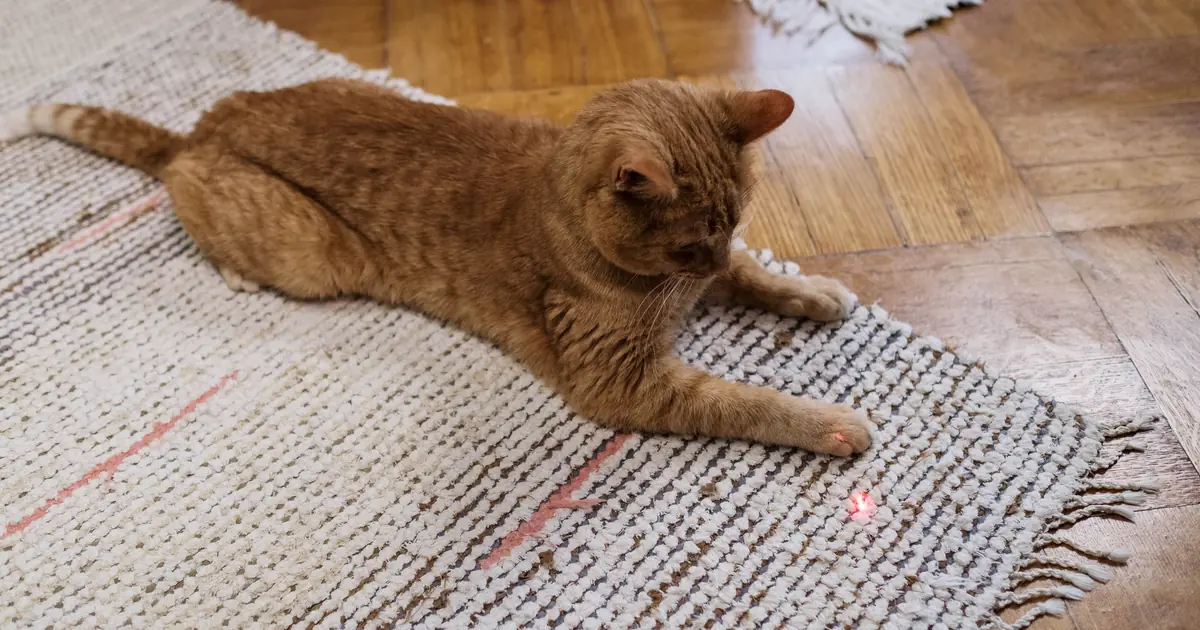
If you’ve ever clicked a laser pointer and watched your cat go from sleepy couch potato to full-on ninja in half a second, you already know the appeal. That little red or green dot zips across the floor and something ancient wakes up in your cat’s brain.
But have you ever wondered what your cat is actually seeing when they chase it? Cat eyes work differently from ours, and color plays a bigger role in that laser obsession than most people realize. Let’s get into how cat vision actually works, and why green dots tend to be the crowd favorite.
- Cats are dichromatic, meaning they see the world through two color channels instead of three, so they see blues and greens best while reds look dull and grayish.
- Green laser light, usually around 520 nanometers, sits right in the part of the spectrum cats see most clearly, making it appear brighter to them than a red laser near 650 nanometers.
- Cats mostly hunt using motion detection, not color, so a laser’s erratic, darting movement is what really triggers the chase.
- Shining any laser directly into a cat’s eyes, or a person’s, can cause permanent eye damage and should never happen.
- Laser play can leave cats frustrated because they can never physically catch the dot, so vets recommend ending every session with a toy they can actually grab.
Can Cats See Green Lasers?
Yes, cats can absolutely see green lasers, and their eyes are actually well suited for it. A standard green laser pointer emits light around 520 to 532 nanometers, which falls close to the peak sensitivity of a cat’s color-detecting cone cells. That means the dot doesn’t just register as “a bit of light” to your cat, it shows up as a genuinely bright, high-contrast spot against most floors, walls, and carpets.
This is a big part of why green laser toys have become so popular for cat play. The color itself lines up with how a cat’s eyes are wired, so the dot is easy for them to lock onto the moment it starts moving.
How Does Cat Color Vision Actually Work?

Cats see color through a dichromatic system, meaning they rely on two types of cone cells instead of the three humans have. Their cones are tuned to blue-violet light and green-yellow light. Human eyes, by contrast, have a third cone tuned to red, which is exactly the piece cats are missing. According to VCA Animal Hospitals, this setup means cats see a color palette dominated by blues, greens, and yellows, while reds and pinks likely appear as dull grays or muted browns.
This is often compared to red-green color blindness in people, and it’s a genuinely useful comparison. It’s not that cats see in black and white (a myth that still floats around), it’s that certain colors simply don’t register with much contrast for them.
Is a Green Laser Really Better for Cats Than a Red One?
Green lasers tend to be more visible to cats than red ones, mainly because green wavelengths fall inside their strongest color range while red wavelengths sit near the edge of what their cones can pick up well. A red laser dot, usually around 650 nanometers, likely reads to a cat as a faint, low-contrast smudge rather than a crisp point of light. A green dot at 520 nanometers reads as noticeably brighter and sharper by comparison.
Here’s the honest caveat though: plenty of cats chase red laser dots with total enthusiasm too. Color is only part of the equation. Brightness, contrast against the surface, and above all, movement, matter just as much, maybe more.
| Laser Color | Wavelength | Visibility to Cats |
|---|---|---|
| Green | ~520 nanometers | High. Falls near peak cone sensitivity, appears bright and sharp against most surfaces. |
| Red | ~650 nanometers | Lower. Sits outside a cat’s strongest color range, likely appears dimmer and lower-contrast. |
Why Do Cats Love Chasing Lasers in the First Place?
Cats chase laser dots because the fast, erratic movement mimics fleeing prey, which flips on their predatory instinct almost instantly. A little dot that darts, pauses, then bolts across the room looks a lot like a mouse or bug trying to escape. Cats are natural-born hunters, and that instinct doesn’t switch off just because they live indoors and get fed on schedule.
This is also why a laser held perfectly still rarely gets much reaction. It’s the unpredictability that does the work. Stop-start motion, sudden direction changes, quick bursts of speed, that’s the exact pattern of a small animal trying to save its own life, at least as far as your cat’s brain is concerned.
Is Color the Main Reason Cats Chase Lasers?
No, color is not the main draw, movement and contrast matter far more to a cat’s hunting response. Cats rely heavily on detecting motion, thanks to a visual system packed with rod cells built for tracking movement in low light. That’s part of why cats are such capable hunters at dawn and dusk, and if you’re curious how far that low-light vision goes, it’s worth reading about whether cats can see in the dark.
So while a green dot’s brightness gives it a small edge, a bright red dot or even a well-lit white light moving erratically can trigger the exact same chase response. Color is the seasoning here, not the main course.
Are Laser Pointers Actually Safe for Cats?
Laser pointers are generally safe for cats when used correctly, but they carry one hard rule: never aim the beam at a cat’s eyes, or anyone’s eyes. Even brief exposure from a handheld laser pointer can cause retinal damage, and the risk goes up with cheaper, higher-powered pointers that aren’t properly regulated. Keep the beam on the floor or a wall, never on your cat’s face.
The bigger, more common welfare concern isn’t eye safety, though, it’s frustration. A cat can chase that dot for ten straight minutes and never once get to sink their teeth or claws into it, because there’s nothing physically there to catch. International Cat Care notes that predatory play works best when cats get a real, satisfying “catch” at the end, something a laser alone simply can’t provide. Over time, laser-only play with no payoff can leave some cats keyed up, restless, or oddly anxious instead of satisfied.
This is educational information, not a substitute for veterinary guidance. If your cat seems unusually obsessive, anxious, or fixated after laser play, or you notice compulsive behaviors like excessive light-chasing even when no laser is present, it’s worth mentioning to your vet.
How Do You Play With a Laser the Right Way?
The right way to use a laser toy is to always let your cat “catch” something real at the end of the session. Here’s a simple routine that keeps laser play fun instead of frustrating:
- Pick a room with enough open space for your cat to run and pounce safely.
- Move the dot in short, erratic bursts, like real prey, rather than smooth circles.
- Keep sessions short, around 5 to 10 minutes, so your cat stays engaged instead of overstimulated.
- Never point the laser at your cat’s face or anyone else’s eyes.
- End every session by tossing a physical toy or a small treat for your cat to actually catch and “kill.”
- Alternate laser sessions with wand toys or other interactive toys so your cat gets real physical contact during play too.
If you’re building out a rotation of toys beyond the laser, it’s worth browsing a list of interactive cat toys that give your cat something tangible to grab, bite, and carry off in victory.
Do Green Lasers Only Matter for Play?
No, understanding how cats see color also explains a lot of everyday cat behavior beyond laser toys. It’s why certain cat toys, beds, and scratchers get more attention than others depending on their color and contrast against the floor. If this topic has you curious about the bigger picture, our guide on what colors cats can see breaks down the full palette, and it pairs well with knowing whether laser pointers are bad for cats if used the wrong way.
And since a cat’s senses work as a team, not in isolation, it’s worth remembering that hearing plays a role in the chase too. Cats can pick up on the faint whir of a laser pointer’s button or your footsteps circling the room, something covered in more detail in our piece on how far a cat can hear.
Frequently Asked Questions
Q: Can cats see red laser pointers at all?
Yes, cats can see red laser dots, just less vividly than green ones. Red light sits near the edge of a cat’s color range, so the dot likely looks dimmer and less contrasted, but the fast movement is usually enough to trigger a chase regardless of color.
Q: What colors do cats see best?
Cats see blues, greens, and yellows the most clearly, thanks to their two types of color-sensing cone cells. Reds and pinks likely appear as muted grays or browns to them, similar to how red-green colorblindness works in people.
Q: Why does my cat ignore the laser sometimes?
Cats often ignore lasers when the movement is too slow, too predictable, or the room is too brightly lit for the dot to stand out. Try dimming the lights slightly and using quick, erratic movements instead of smooth sweeps.
Q: Is it bad to only play with my cat using a laser pointer?
Yes, relying only on a laser can lead to frustration since your cat never gets a physical catch at the end. Vets and cat behaviorists recommend mixing laser play with wand toys or tossable toys so your cat gets a real “win” during every play session.
Q: Can a laser pointer damage a cat’s eyes?
Yes, direct exposure to a laser beam can damage a cat’s retina, just as it can in humans. Never point a laser pointer at your cat’s face or eyes, and keep the beam moving across the floor or a wall instead.
Q: Do cats see laser dots the same way they see real prey?
Not exactly, but the movement pattern triggers a very similar instinct. Cats respond to the darting, unpredictable motion of a laser dot much like they’d respond to a mouse or insect trying to flee, even though the dot itself has no scent, texture, or shape.
Q: What wavelength is a typical green laser pointer?
Most green laser pointers sit around 520 to 532 nanometers, which lands close to the peak sensitivity of both human and feline eyes. That’s part of why green pointers generally look brighter than red ones, which sit closer to 650 nanometers.
Q: Are cats actually colorblind?
Cats aren’t fully colorblind, but they are considered red-green colorblind in a way similar to some humans. They see the world through blue and green tones rather than the full red-green-blue spectrum humans perceive.

Hello and welcome to The Ideal Cat!
We are some passionate cat owners from different professions. We love our cats and have a lot of experience in how to care for our pets. We are incredibly excited to share our knowledge, experience, and research with you. So you can take good care of your loving cat. We will answer most of the common questions about owning cats, taking care of them, etc. If you have any question contact with us. Thanks for visiting! Enjoy the content.
